If you are shipping from China to the UK and the delivery date matters more than the freight bill, air freight is usually the only mode that works. Cargo leaves Shanghai, Shenzhen or Guangzhou on a freighter or in the belly of a passenger aircraft and is available for collection at Heathrow within three to five days — roughly one-sixth of the time a container needs.
What most rate sheets fail to explain is that air freight pricing is not a single number. It moves weekly with fuel, capacity and peak-season demand, it is charged on the higher of actual and volumetric weight, and the invoice at the other end is rarely just freight: UK duty, 20% import VAT, terminal handling and delivery all land on top. This guide sets out what air freight from China to the UK actually costs in October 2026, how the chargeable weight is calculated, what UK customs will ask for, and how to keep the total down without slowing the shipment down.

Air Freight from China to the UK at a Glance
Before the detail, here is the short version. These are the benchmarks our operations team quotes against in the fourth quarter of 2026, and they are refreshed from public market data rather than from a static rate card.
| Metric | Typical range (Oct 2026) |
|---|---|
| Freight rate, general cargo | US$4.50–9.00 per chargeable kg, all-in |
| Rate for 100 kg+ consolidated cargo | US$5.86–6.60 per kg (China–London benchmark) |
| Airport-to-airport transit | 3–5 days (direct), 5–8 days (one-stop) |
| Door-to-door transit | 6–10 days including UK clearance and delivery |
| Main departure airports | PVG (Shanghai), SZX (Shenzhen), CAN (Guangzhou), PEK (Beijing), HKG (Hong Kong) |
| Main arrival airports | LHR (Heathrow), MAN (Manchester), STN (Stansted), EMA (East Midlands), BHX (Birmingham) |
| Chargeable weight divisor | Length × width × height in cm ÷ 6,000 (= 167 kg per CBM) |
| Import VAT | 20% on goods value + freight + insurance + duty |
| Customs platform | CDS (HMRC), importer must hold a GB EORI number |
Two numbers anchor everything else. The Baltic Air Freight Index, calculated by TAC Index from actual transaction prices, stood at 2,775 in the week to 26 October 2026 — up 3.9% week on week and 27.1% year on year, and above the highest points reached in either of the previous two peak seasons. On the China–Europe lane, average spot and contract rates were US$4.80 per kg in September 2026, up from US$4.58 in August and 8.8% higher than a year earlier.
In other words: this is not a cheap moment to fly cargo out of China. The reason is fuel. IATA’s Jet Fuel Price Monitor had kerosene up 113.7% year on year in mid-October 2026, and jet fuel typically accounts for a quarter to a third of an airline’s cargo cost — which puts a hard floor under the rates carriers will accept.
How Much Does Air Freight from China to the UK Cost?
Published “from” rates are almost always the rate for a 1,000 kg consignment on a lane the forwarder has spare capacity on that week. What you will actually be quoted depends on weight break, origin airport, commodity and how the flight is routed. The table below shows the structure most carriers use, benchmarked against current market data.
| Weight break | Indicative all-in rate | Typical use case |
|---|---|---|
| +45 kg | US$7.50–9.00 / kg | Samples, spare parts, first production run |
| +100 kg | US$6.00–7.50 / kg | Small e-commerce replenishment |
| +300 kg | US$5.20–6.60 / kg | Mid-size B2B order, 2–4 pallets |
| +500 kg | US$4.80–6.00 / kg | Palletised cargo, weekly restock |
| +1,000 kg | US$4.50–5.60 / kg | Consolidated air container, full pallet positions |
Those brackets are indicative and should be treated as a planning range, not a quotation: two independent 2026 benchmarks put general cargo from China to the UK at US$4.50–9.00 per chargeable kilogram all-in, and US$5.86–6.60 per kilogram for consignments above 100 kg into London. The gap between the two is exactly why you compare all-in numbers rather than headline rates.
What Is Included in an “All-In” Air Freight Rate?
A properly built quote for air freight from China to the UK should show five separate components. If a rate sheet only shows the per-kilo figure, ask for the rest — the add-ons are where budgets break.
- Base air freight: the airline’s charge per chargeable kilo at your weight break.
- Fuel surcharge (FSC): the component most exposed to the kerosene price. With jet fuel up 113.7% year on year in October 2026, this line moves fastest.
- Security surcharge (SSC): covers screening and regulated-agent handling before uplift.
- Origin charges: export declaration, terminal handling at PVG/SZX/CAN, palletisation, and documentation.
- Destination and clearance charges: UK terminal handling, CDS entry, duty and VAT, plus delivery if you have asked for door-to-door.
A Worked Example: 300 kg of General Cargo to Manchester
Take 300 kg chargeable of consumer electronics accessories from Shenzhen to a Manchester warehouse, goods value £12,000, insurance £60, quoted at £4.80 per kg all-in. Freight is £1,440. UK duty on a 4% commodity line applies to goods + freight + insurance, which is £13,500 × 4% = £540. Import VAT at 20% then applies to £13,500 + £540 = £14,040, giving £2,808. Landed cost at the warehouse door before UK delivery: £16,908. If your commodity is duty-free — laptops and smartphones are both 0% — you keep the £540 and pay £2,700 VAT instead.
This is the arithmetic that makes air freight decisions hard: the freight line is roughly 9% of the landed cost here, while VAT alone is 17%. Importers who negotiate hard on the per-kilo rate but ignore the duty line usually save less than they think.
Chargeable Weight: How Airlines Price Air Cargo
Air cargo is billed on chargeable weight — the greater of actual gross weight and volumetric (dimensional) weight. Volumetric weight is calculated as length × width × height in centimetres divided by 6,000, which is equivalent to 167 kg per cubic metre. Light, bulky cargo therefore pays for space rather than mass, and this single formula explains most invoice surprises.
| Shipment | Actual weight | Volume | Volumetric weight | Billed on |
|---|---|---|---|---|
| 12 cartons, 60×50×40 cm each | 180 kg | 1.44 CBM | 240 kg | 240 kg |
| Machine parts on one pallet, 120×100×120 cm | 420 kg | 1.44 CBM | 240 kg | 420 kg |
| Bedding in 8 cartons, 70×60×50 cm each | 96 kg | 1.68 CBM | 280 kg | 280 kg |
Two practical consequences. First, on the bedding shipment above the importer is paying for 280 kg while shipping 96 kg of goods — that is where vacuum packing and carton re-dimensioning earn their money. Second, when the volumetric weight of a low-value, bulky product exceeds its actual weight by a wide margin, the per-kilo comparison against sea freight becomes meaningless; the honest comparison is per cubic metre.
One more rule worth knowing: airlines round up. Each piece is measured to the nearest centimetre and the whole consignment is rounded up to the next half or full kilo depending on the carrier, so a 300.4 kg shipment is billed as 301 kg and may cross into a lower weight break if you can trim packaging by a few kilos.
Air Freight Transit Times from China to the UK
Transit time quoted by a forwarder almost always means airport-to-airport flight time plus the next available uplift. The clock that matters for your customer is door to door, and that includes pickup, export declaration, screening, flight, UK clearance and final delivery.
| Service | Airport to airport | Door to door | Typical use |
|---|---|---|---|
| Express (integrator, e.g. courier networks) | 1–3 days | 2–4 days | Samples, documents, sub-30 kg parcels |
| Standard direct air freight (PVG–LHR) | 3–5 days | 6–8 days | Commercial cargo with a fixed delivery window |
| Standard with one stop (via HKG, DXB, IST or DOH) | 5–8 days | 8–11 days | Cheaper routing, non-urgent replenishment |
| Consolidated air freight (LCL-style, weekly uplift) | 7–10 days | 10–14 days | Sub-100 kg shipments sharing a master air waybill |
| Sea-air combination (ocean to Gulf, air to UK) | 18–25 days | 21–28 days | Mid-value cargo where pure air is too expensive |
The largest single variable is not flight time but cut-off. A shipment that misses the airline’s cargo cut-off — typically four to six hours before departure for loose cargo, earlier for palletised — waits 24 hours, and on some China–UK lanes only two or three direct frequencies a week exist, so the wait can be three days. If your production schedule is tight, ask for the specific flight number and cut-off time in writing before you book.
Factors That Still Delay Air Cargo in 2026
- Screening and security status: cargo from a non-validated site needs physical screening or comes through a regulated agent, which adds a day. Known Consignor status at origin removes most of this.
- Customs holds on the UK side: an incomplete CDS declaration, a missing 10-digit commodity code or a value that disagrees with the invoice stops the consignment at the border, not in the air.
- Peak-season capacity: October to December is when rates and rollovers both rise. In the week to 19 October 2026 the global air freight index gained 4.7% in seven days and passed the previous two peak seasons’ highs.
- Battery and dangerous goods paperwork: lithium battery consignments with the wrong packing instruction or state of charge are rejected at acceptance, not en route.
Air, Sea or Express: Choosing the Right Mode
Air freight is typically six to eight times more expensive per kilogram than sea freight, and roughly a third of the transit time. That trade-off only makes sense for certain cargo profiles, and getting it wrong is the most expensive mistake in China–UK sourcing.
| Mode | Indicative 2026 cost | Transit | Best for |
|---|---|---|---|
| Sea FCL, 40ft Shanghai/Ningbo–Felixstowe | US$2,800–4,600 per container | 30–40 days port to port | Bulk, low value density, planned stock |
| Sea LCL | Charged per CBM, typically US$80–160/CBM to UK | 32–45 days | 1–10 CBM, non-urgent |
| Air freight | US$4.50–9.00 per chargeable kg | 3–8 days airport to airport | High value density, tight deadlines |
| Express courier | Highest per kg, door to door integrated | 2–4 days | Samples, documents, parcels under 30 kg |
A simple rule we use with importers: divide the goods value by the chargeable weight. Above roughly US$8–10 of value per kilo, air freight is usually justified because the freight cost is a small percentage of the capital tied up in the goods and the cash-flow release pays for it. Below US$3 per kilo, air freight rarely makes sense unless a stock-out would cost you a customer. Between those two figures, the decision depends on how much a week of delay actually costs your business — and on whether the product is a launch, a seasonal line or a steady reorder.
For a deeper comparison of the ocean alternative, including sailing times to each UK port, see our guide to how long sea freight from China to the UK takes.
Major Airports and Routes Between China and the UK
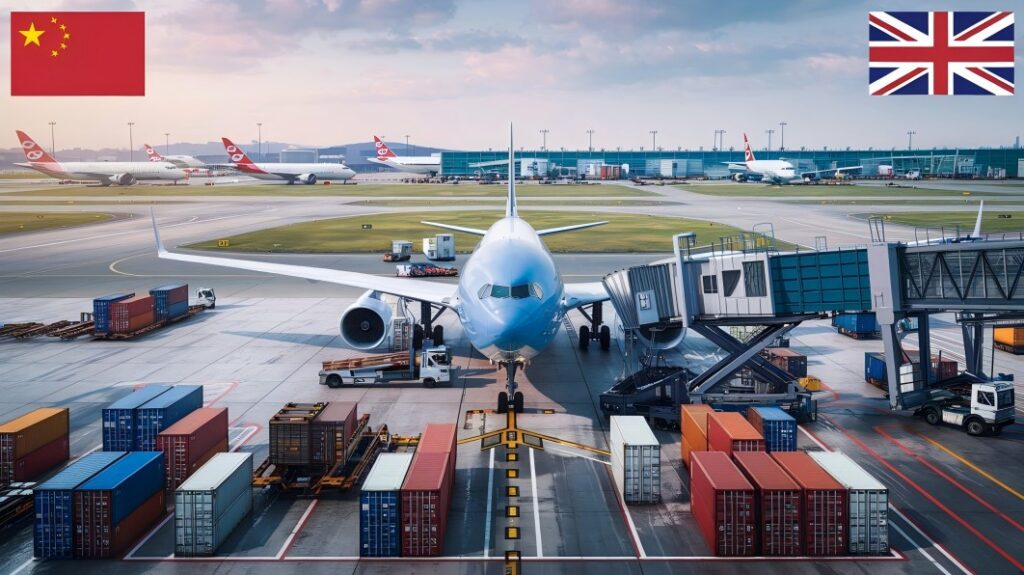
Departure Airports in China
| Airport | Code | Strength for UK cargo |
|---|---|---|
| Shanghai Pudong | PVG | Largest cargo gateway in mainland China; the widest choice of direct UK frequencies and the deepest weight-break pricing |
| Shenzhen Bao’an | SZX | Electronics and consumer tech; short trucking from Dongguan and Huizhou factories |
| Guangzhou Baiyun | CAN | Apparel, furniture, general merchandise from Pearl River Delta suppliers |
| Beijing Capital / Daxing | PEK / PKX | Northern China manufacturing, chemicals, machinery |
| Hong Kong | HKG | World’s largest cargo airport by volume; best frequencies but requires a cross-border truck leg from mainland factories |
| Zhengzhou Xinzheng | CGO | Growing freighter hub for central China, useful for Henan and Hubei suppliers |
Arrival Airports in the UK
| Airport | Code | Why it matters |
|---|---|---|
| London Heathrow | LHR | Primary UK cargo gateway with the deepest direct China frequencies; best for London and the South East |
| London Stansted | STN | Major freighter airport, often cheaper handling than Heathrow, strong for East of England distribution |
| Manchester | MAN | Serves the North of England; direct China services and shorter inland trucking for northern importers |
| East Midlands | EMA | Express and integrator hub, central for Midlands distribution |
| Birmingham | BHX | Midlands cargo gateway, useful when Heathrow slots are tight |
| Glasgow Prestwick | PIK | Niche freighter option for Scottish destinations |
Choosing the arrival airport is a cost decision as much as a convenience one. Flying into Manchester rather than Heathrow can save a day of UK road haulage for a northern consignment, while a Heathrow arrival with a Felixstowe-bound delivery is usually the wrong pairing. Ask your forwarder to price the complete airport-plus-delivery combination, not just the cheapest air leg.
UK Customs Clearance, Duty and VAT on Air Cargo
Air cargo clears quickly only when the paperwork is right before the aircraft lands. Since the Customs Declaration Service (CDS) became the sole UK declaration platform — CHIEF closed for imports on 30 September 2022 and for exports on 4 June 2024 — declarations carry considerably more data elements than the old entry, and an incomplete file means your consignment sits in a bond while the clock runs.
What the Importer Needs Before the Flight Lands
- A GB EORI number — free from HMRC and, in most cases, issued quickly; without it nobody can declare your goods.
- The 10-digit commodity code — legal responsibility sits with the importer, not the forwarder. A six-digit code is not enough for CDS.
- Commercial invoice and packing list — with Incoterm, currency, goods description, quantities, weights and country of origin.
- Air waybill details — master and house AWB numbers, which must match the manifest.
- Licences if applicable — for controlled, dual-use or food and plant products (the latter also need IPAFFS pre-notification).
How Much Duty Will I Pay? 2026 Rates by Common Air Commodity
Under the UK Global Tariff, the third-country duty rate for China-origin goods varies enormously by product. These are the rates published in the UK Trade Tariff as checked in October 2026:
| Product | Commodity code | UK third-country duty |
|---|---|---|
| Laptops and portable computers | 8471 30 00 00 | 0% |
| Smartphones | 8517 13 00 00 | 0% |
| Toys (dolls and similar) | 9503 00 41 00 | 4% |
| Cotton T-shirts | 6109 10 00 10 | 12% |
Duty is charged on the customs value: goods value plus international freight plus insurance. Import VAT at 20% is then charged on that same total plus the duty. That sequencing matters — VAT is charged on the duty you pay, not just on the goods.
The £135 Low-Value Rule — and Why It Is Changing
Consignments of non-excise goods with a total intrinsic value of £135 or less are currently relieved of customs duty in Great Britain, and for business-to-consumer sales the VAT is collected by the seller or marketplace at the point of sale rather than at the border. The threshold is assessed per consignment, not per item, so three £50 items shipped together are a £150 consignment. Gifts from one private individual to another are relieved up to £39.
This relief is on the way out. HMRC confirmed in July 2026 that the low-value import relief will be removed and replaced with a dedicated regime in which duty is payable on consignments of £135 or less, with implementation scheduled between October 2028 and March 2029. Sellers routing small parcels through air freight should model duty into their landed costs now rather than at the point of change.
Postponed VAT Accounting and Duty Deferment
VAT-registered importers do not have to fund 20% at the border. Postponed VAT Accounting (PVA) lets you declare import VAT on your VAT return and reclaim it in the same period, which is cash-flow neutral for fully taxable businesses; the monthly CDS import VAT statement replaces the old C79 certificate. Regular importers should also hold a duty deferment account, which moves duty payment to the 15th of the following month instead of at clearance. Both are set up against your EORI in CDS and take a few working days, so arrange them before your first shipment rather than during a customs query.
Documents Required for an Air Shipment to the UK
| Document | Issued by | Why customs needs it |
|---|---|---|
| Commercial invoice | Exporter | Establishes value, Incoterm, origin and the description used for classification |
| Packing list | Exporter | Piece count, dimensions and gross/net weight — the basis for chargeable weight |
| Air waybill (MAWB/HAWB) | Airline / forwarder | Contract of carriage and the manifest reference customs matches against |
| Certificate of origin (if claiming preference) | Chamber of commerce or supplier declaration | Only relevant where a preferential rate applies; China-origin goods normally pay the full third-country rate |
| Dangerous goods declaration | Shipper, trained and certified | Required for lithium batteries, aerosols, chemicals and other regulated cargo |
| Product compliance evidence | Manufacturer | UKCA or CE marking documentation for regulated categories (electricals, toys, PPE, machinery) |
One documentation point catches importers repeatedly: the description on the invoice must be specific enough to justify the commodity code. “Gifts”, “samples” or “spare parts” on a commercial consignment invites a query, and a query on an air shipment costs more than on sea freight because the goods are sitting on a bonded terminal clock rather than on a ship.
Restricted and Dangerous Goods on China–UK Air Routes
Air cargo acceptance is stricter than ocean freight, and the categories that most often affect China–UK importers are the ones shipped by e-commerce sellers.
Lithium Batteries: the 2026 Rules
Lithium cells and batteries are Class 9 dangerous goods, regulated by the 67th edition (2026) of the IATA Dangerous Goods Regulations. Standalone lithium-ion batteries (UN 3480, Packing Instruction 965) have long required a state of charge not exceeding 30% of rated capacity. From 1 January 2026 that limit also applies to lithium-ion batteries packed with the equipment they power (UN 3481, PI 966) where the battery exceeds 2.7 Wh, and to lithium-ion battery-powered vehicles — a change that has caught out sellers of e-bikes and cordless tools. Every cell and battery must also have passed UN 38.3 testing, and the shipper must hold a signed declaration confirming both facts.
Practically: if your product contains a battery, tell your forwarder at quotation stage, not at the airport. Many passenger aircraft cannot carry standalone lithium-ion batteries at all, so the shipment must be booked as cargo-aircraft-only, and several carriers apply their own operator variations that are stricter than IATA’s baseline. The difference between a correctly declared battery shipment and an undeclared one is the difference between a two-day delay and a refused consignment with a destruction notice.
Other Categories That Need Attention
- Magnets and magnetised material: need a shielding test; strongly magnetised items may be refused entirely.
- Liquids, cosmetics and aerosols: many are flammable or pressurised and fall under dangerous goods rules; alcohol-based perfumes are a frequent rejection.
- Powders and foodstuffs: subject to UK import controls and, for products of animal or plant origin, IPAFFS pre-notification.
- Counterfeit risk categories: branded goods need authorisation evidence, or they are seized at the UK border regardless of paperwork.
Door-to-Door vs Airport-to-Airport Air Freight
Airport-to-airport is cheaper on paper: you buy the air leg, and the UK consignee handles clearance and delivery. In practice most first-time importers and virtually all e-commerce sellers are better served by door-to-door, because the handover between airport and final mile is exactly where costs and delays accumulate.
| Option | What is covered | Best for |
|---|---|---|
| Airport-to-airport | Export declaration, uplift, arrival handling | Importers with their own customs broker and UK haulage |
| Door-to-door (DAP) | Pickup, export, air, clearance arrangement, delivery; duty and VAT on your account | Businesses without a UK customs capability |
| Door-to-door DDP | Everything including duty and VAT, one landed price | E-commerce, marketplace sellers, samples and trade shows |
A DDP shipping service removes the surprise invoice problem entirely: your supplier delivers to our Shenzhen warehouse, we handle export clearance, the flight, UK duty and VAT, and the final delivery to your door or to an Amazon fulfilment centre. For sellers who are not UK VAT registered or who do not want to run a deferment account, that is usually the difference between a predictable cost per unit and a customs query in week one.
Air Freight for Amazon FBA UK Sellers
Amazon FBA shipments by air have three extra requirements that ordinary commercial air freight does not: the goods must arrive compliant with FBA labelling and prep, the delivery must be booked against the correct fulfilment centre reference, and the importer of record must be resolvable for VAT purposes. Missing any of the three turns a five-day air shipment into a two-week resale problem.
- FNSKU labelling and poly-bagging: done at origin, not at the warehouse — UK prep centres charge per unit for work that costs a fraction of that in Shenzhen.
- Carton limits: Amazon caps carton weight and size; exceeding it means the shipment is refused at the dock after you have already paid the air freight.
- Delivery appointment: fulfilment centres work to booked slots. Factoring in two to four days between customs release and the actual dock booking is realistic for a first shipment.
Our Amazon FBA service covers labelling, palletisation, FBA-compliant documentation and delivery booking as part of the door-to-door price, which is what most sellers actually need from an air freight partner.
Read More:
- Shipping From China To Netherlands
- Shipping From China To Spain
- Shipping From China To Germany
- Shipping From China To France
- Shipping From China to Italy
- Shipping From China To Poland
- Shipping From China to United Kingdom
Nine Ways to Reduce Your Air Freight Bill
Rate negotiation gets the attention, but the biggest savings in air freight come from how the cargo is built rather than what the airline charges per kilo.
Reach the next weight break. Moving from 280 kg to 305 kg can lower the per-kilo rate for the entire consignment. Ask what the break points are before you split a shipment.
Cut volumetric weight. Reducing carton dimensions by 3 cm on each side can remove 10% of the billed weight on light cargo. Vacuum packing textiles routinely saves 30–40%.
Ship the dense goods by air, the bulky goods by sea. Splitting a mixed order by value density usually beats shipping everything on one mode.
Use consolidation. Sharing a master air waybill with other consignments on the same flight gets small shippers access to +300 kg or +500 kg pricing. See our air freight consolidation service.
Book off-peak where the calendar allows. Golden Week, Chinese New Year and the October–December peak all tighten capacity; a week either side can be materially cheaper.
Compare arrival airports. Stansted or Manchester handling is sometimes cheaper than Heathrow even after inland haulage.
Get PVA and a deferment account in place. Not a freight saving, but it stops you funding 20% VAT at the border on every shipment.
Classify correctly. A wrong commodity code either overpays duty for years or triggers a retrospective assessment. Laptops at 0% versus apparel at 12% is a twelve-point swing on the goods value.
Insure deliberately. Air cargo loss rates are low, but a total loss without cover is a write-off. Cargo insurance typically costs a small fraction of the consignment value — far less than the rate difference you are negotiating.
What to Expect in the 2026–2027 Peak Season
The market entering this peak is unusually tight. The Baltic Air Freight Index ended the week to 26 October 2026 at 2,775, 3.9% higher week on week and 27.1% higher year on year, and TAC Index noted rates were already above the highest points of the previous two peak seasons before the peak had properly started. Jet fuel at more than double last year’s price is the main driver, with continued disruption in the Middle East and the Russia–Ukraine conflict keeping energy markets volatile.
The China–Europe lane has lagged the transatlantic in this rally, partly because e-commerce volumes into Europe fell after the EU ended its de minimis exemption for small parcels in mid-2026. That is a buying opportunity for UK importers: capacity that used to serve European parcel flows is available on China–UK routes, and forwarders with direct airline contracts can lock space at better levels than spot. It will not last through December.
Practical planning advice for the next ten weeks: book space two to three weeks ahead rather than days; accept that a 48-hour rollover is possible on any given lane; keep a sea freight fallback for anything that can wait five weeks; and confirm rates in writing with a validity window, because weekly movement of 3–5% is normal in this market.
How to Choose a China–UK Air Freight Forwarder
Anyone can quote a per-kilo rate. The differences that matter appear when something goes wrong at 2 a.m. in a different time zone, or when a customs officer asks a question your supplier cannot answer.
- Licensed and accredited: a Chinese Class-A freight forwarder licence, NVOCC registration, FMC and Jctrans membership — the paperwork that means the company can book space directly rather than resell someone else’s.
- Direct carrier contracts: contracted space with airlines is what keeps rates stable when the spot market spikes, and what gets your cargo on the aircraft when the flight is overbooked.
- Both ends covered: origin operations in Shenzhen plus a UK clearance capability, not a hand-off to a third party who has never seen your file.
- Visibility: daily status updates with photographs of the cargo at pickup, at the terminal and on delivery. This is the single most requested feature from importers who have been burned by silence.
- Response time: a named contact who answers outside office hours, because air freight problems are always urgent.
Dantful International Logistics has handled China-origin freight since 2008 from our base in Shenzhen, with Class-A forwarder status, NVOCC, FMC and Jctrans accreditation and a network of agents in 200 countries. Our air freight desk books directly with carriers, which is why we can hold a rate when the index moves, and our operations and customer service teams total around 100 people working around the clock. If you would rather compare options than negotiate blind, our shipping from China to the UK page sets out the full service range, and our shipping agent China to UK guide explains how an agent relationship works in practice.
Frequently Asked Questions About Air Freight from China to the UK
How much does air freight from China to the UK cost per kg?
For general cargo in October 2026, expect US$4.50–9.00 per chargeable kilogram all-in, with the lower end applying to 1,000 kg+ consolidated shipments and the upper end to 45 kg consignments. A China–London benchmark for cargo above 100 kg sits at US$5.86–6.60 per kilogram. Rates are quoted per chargeable kilo, which is the greater of actual and volumetric weight.
How long does air freight take from China to the UK?
Three to five days airport to airport on a direct service from Shanghai or Shenzhen to Heathrow, and five to eight days with one stop. Door to door, allow six to ten days including UK customs clearance and delivery, and a day or two more for an Amazon FBA booking.
Is air freight from China to the UK worth it?
It is worth it when the goods value divided by chargeable weight is above roughly US$8–10 per kilo, or when a stock-out costs more than the freight premium. For low-value bulky goods, sea freight at a sixth to an eighth of the per-kilo cost is almost always the better answer.
What duty and VAT will I pay on air cargo?
Duty at the UK Global Tariff rate for your 10-digit commodity code, charged on goods value plus freight and insurance; then import VAT at 20% on that total plus duty. Common rates: laptops and smartphones 0%, toys 4%, cotton T-shirts 12%. Consignments of £135 or less currently enjoy duty relief, though HMRC has confirmed this is being removed by 2028–2029.
Can I ship batteries and electronics by air?
Yes, with the right declaration. Lithium-ion batteries must be at 30% state of charge or less — a rule extended from 1 January 2026 to batteries packed with equipment above 2.7 Wh — and must have passed UN 38.3 testing. Standalone lithium-ion batteries are forbidden on many passenger aircraft and travel as cargo-aircraft-only, so book early and declare the battery at quotation stage.
Do I need an EORI number to clear air cargo in the UK?
Yes. A GB EORI number is required for any commercial import declaration on CDS. It is free from HMRC and normally issued quickly, but nothing can be declared — and the aircraft will not release the cargo — until you have it.
What is the cheapest way to send a small air shipment?
For 20–100 kg, consolidated air freight on a shared master air waybill is usually 20–35% cheaper than an express courier account rate, at the cost of two to four extra days. Below 20 kg the courier networks’ integrated clearance and delivery normally wins.
Can I ship from China to the UK door to door?
Yes — that is the standard service for most importers. A door-to-door or DDP arrangement covers supplier pickup in China, export declaration, the flight, UK clearance, duty and VAT, and delivery to your address or a fulfilment centre, with one all-in price per shipment.
Which airports do China–UK air freight flights use?
Departures are mainly Shanghai Pudong (PVG), Shenzhen (SZX), Guangzhou (CAN), Beijing (PEK), Zhengzhou (CGO) and Hong Kong (HKG). Arrivals are mainly Heathrow (LHR), Stansted (STN), Manchester (MAN), East Midlands (EMA), Birmingham (BHX) and, for some freighters, Glasgow Prestwick (PIK).
How early should I book air freight in peak season?
Two to three weeks before the cargo is ready between October and December, and a week to ten days in the quieter months. With the air freight index up 27% year on year in late October 2026 and jet fuel more than double last year’s price, space rather than price is the binding constraint this peak.
You may be interested in the following related articles:
- Air Freight from China to Europe
- Air Freight from China to the USA
- How Long Is Sea Freight from China to the UK
- How Much Is Shipping from China to the United Kingdom
- Shipping Agent China to UK

Young Chiu is a seasoned logistics expert with over 15 years of experience in international freight forwarding and supply chain management. As CEO of Dantful International Logistics, Young is dedicated to providing valuable insights and practical advice to businesses navigating the complexities of global shipping.