
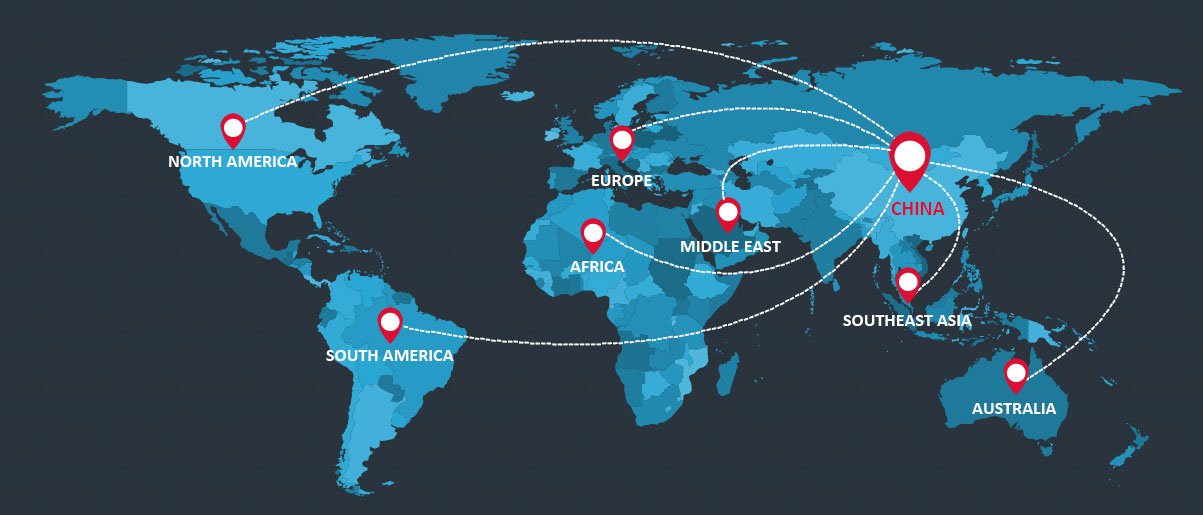
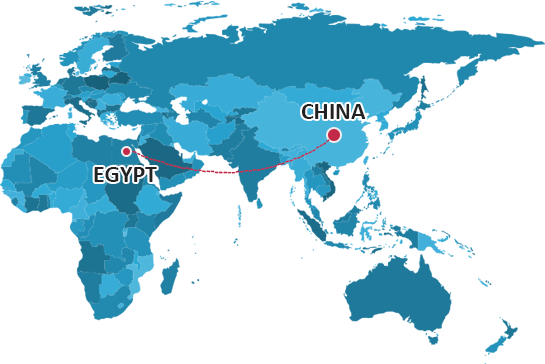
Egypt has become one of the fastest-growing import markets in the Middle East and North Africa, with China remaining its largest trading partner. From machinery and building materials to consumer electronics and e-commerce products, thousands of containers move between China and Egypt every week.
However, successful shipping to Egypt is about more than choosing the lowest freight rate. Importers must also consider ACID registration, customs documentation, port selection, transit times, and destination charges. Even small documentation errors can lead to customs delays and additional storage costs after arrival.
Whether you are importing a full container, several pallets, or urgent cargo by air, selecting the right shipping solution before your cargo leaves China can significantly reduce both cost and risk.
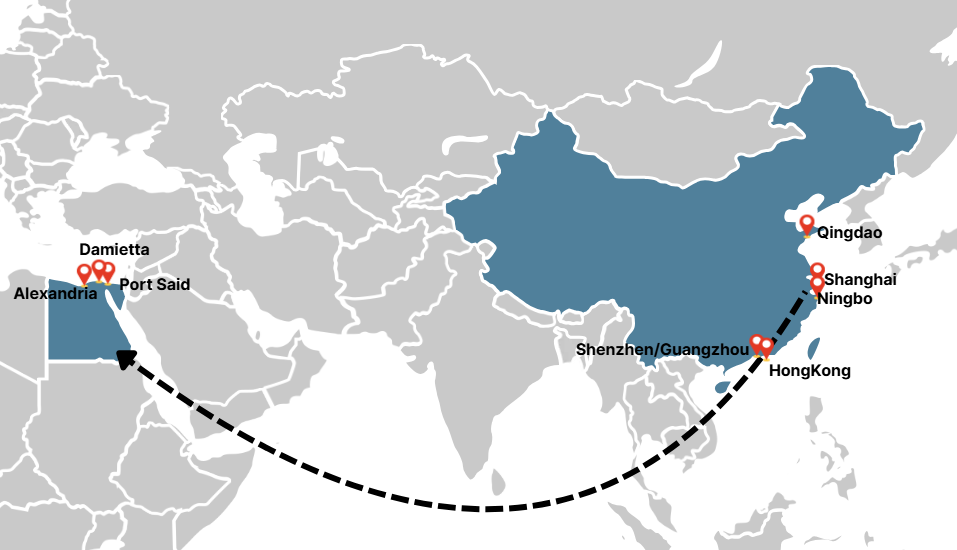
At Dantful International Logistics, we help businesses ship from major Chinese ports—including Shanghai, Ningbo, Shenzhen, Qingdao, Xiamen, and Guangzhou—to Egypt‘s main gateways such as Alexandria, Ain Sokhna, Port Said, and Damietta. Our team supports the entire shipping process, from export documentation and customs clearance in China to freight booking, cargo tracking, and destination delivery.
This guide explains the most practical shipping options, estimated transit times, freight costs, customs requirements, and common challenges importers should understand before shipping from China to Egypt.
Shipping Routes from China to Egypt
Choosing the right port pairing isn’t just about finding the shortest transit time on a map. Every China–Egypt corridor has its own rhythm — the dominant cargo types, carrier concentration, transshipment patterns, seasonal pressure points, and the quirks of Egyptian customs at each entry point. Below is what we’ve learned from moving thousands of containers across these lanes.
Shanghai to Alexandria: The Workhorse Corridor
This is the highest-volume China–Egypt route, and for good reason. Shanghai’s Yangtze River Delta manufacturing base — automotive parts, industrial machinery, precision instruments, and high-end textiles — aligns naturally with Alexandria’s role as Egypt’s primary container gateway.
What you should know:
- Carrier density is unmatched. COSCO, MSC, CMA CGM, Maersk, and Hapag-Lloyd all run regular strings on this lane. Competition keeps rates sharp, but it also means space evaporates fast when demand spikes — if you’re booking during Q3 (Egypt’s pre-Ramadan inventory build) or the pre-Chinese New Year rush, secure space at least 3–4 weeks ahead.
- Most sailings are direct. Shanghai–Alexandria direct services take 22–27 days. Transshipment options via Singapore or Port Klang add 5–8 days but may offer lower rates during peak season when direct slots are full.
- Alexandria port congestion is real. The port handles over 60% of Egypt’s containerized imports. During peak periods, vessels can wait 2–4 days for a berth. Factor this into your delivery timeline — a 25-day sailing can easily become 30 days door-to-port when Alexandria is backed up.
- Inland tip: If your cargo is ultimately destined for the Nile Delta region (Tanta, Mansoura, Zagazig), Alexandria cuts inland trucking costs by 40–60% compared to routing through Ain Sokhna. For Upper Egypt destinations south of Cairo, the advantage narrows.
Ningbo to Port Said: The Free-Zone Advantage
Ningbo is the quiet giant of China’s export machine — dominant in small commodities, hardware, home appliances, electrical fittings, and light industrial products. Port Said, sitting at the northern mouth of the Suez Canal, operates as a free-zone transshipment and distribution hub.
What you should know:
- This is the “duty-deferral route.” Because Port Said is a free zone, goods can be stored, processed, or re-exported to neighboring markets (Libya, Sudan, Jordan, Syria, Lebanon) without triggering Egyptian import duties. If your business model involves regional distribution from Egypt, this pairing is worth the price premium.
- Ningbo has fewer peak-season roll-overs than Shanghai. In our experience, Ningbo’s container availability holds up better during the August–October crunch, partly because it draws from a more diversified base of mid-sized exporters rather than mega-factories booking blocks of 50+ containers at once.
- Transshipment is the norm, not the exception. Few carriers offer direct Ningbo–Port Said sailings. Most cargo transships via Singapore, Port Klang, or Jeddah. Budget 23–31 days port-to-port, and build in a 3–5 day buffer for missed feeder connections at the transshipment hub.
- Documentation vigilance pays off here. Port Said customs are particularly strict about HS code consistency between the commercial invoice and the ACID filing — more so than Alexandria in our experience. A mismatch that might get a warning in Alexandria can result in a 48-hour hold in Port Said.
Shenzhen to Ain Sokhna: The Electronics Express Lane
Shenzhen and the Pearl River Delta produce the majority of China’s consumer electronics, mobile accessories, IoT devices, and fast-fashion goods bound for Egyptian retail. Ain Sokhna, just 120 km east of Cairo within the Suez Canal Economic Zone, is the natural landing point for this cargo.
What you should know:
- The fastest sea route from southern China to Egypt. At 25–34 days port-to-port (and sometimes as fast as 22–26 days on premium loops), Shenzhen–Ain Sokhna saves 3–7 days versus Shenzhen–Alexandria routings that require Suez Canal transit. The Red Sea approach via the Bab el-Mandeb is simply shorter for southern Chinese departures.
- Ain Sokhna is purpose-built for the new Cairo. If your consignee is in New Cairo, the New Administrative Capital, 10th of Ramadan City, or the industrial zones east of Cairo, Ain Sokhna delivery can save 3–5 hours of inland trucking and EGP 2,000–5,000 in transport costs versus Alexandria discharge.
- Electronics inspections are more frequent at Ain Sokhna. Egyptian customs at Ain Sokhna have developed particular scrutiny for electronic goods, driven by valuation concerns and NTRA (National Telecom Regulatory Authority) compliance checks. Ensure your commercial invoice has detailed product descriptions — “electronics” alone is an invitation for a physical inspection.
- For air freight backup: Shenzhen Bao’an (SZX) and Hong Kong (HKG) offer 2–4 day air service to Cairo. For electronics importers who need to bridge a stock-out while ocean cargo is in transit, this is the most practical air bridge.
Guangzhou to Alexandria: The Furniture & Building Materials Pipeline
Guangzhou’s Nansha terminal and the surrounding Pearl River hinterland (Foshan, Dongguan, Zhongshan) dominate China’s furniture, home decoration, lighting, ceramics, and building materials exports — categories that align directly with Egypt’s ongoing construction boom and new city development.
What you should know:
- Volume-driven consolidation economics. Because Nansha handles enormous volumes of bulky but relatively low-value-per-CBM cargo (furniture, tiles, sanitary ware), LCL consolidation rates on this route are often 5-15/CBM cheaper than Shenzhen departures. If you’re shipping 8–14 CBM of furniture from a Foshan factory, routing through Nansha rather than Shekou can save you 100 – 200 on a single shipment.
- Watch for fumigation requirements. Wooden furniture, pallets, and packing materials from Guangdong are flagged more frequently by Egyptian plant quarantine authorities than cargo from other Chinese regions. Ensure all wood packaging has IPPC-compliant heat treatment stamps before container loading — fumigation certificates issued after departure won’t help at Alexandria inspection.
- Many vessels consolidate Nansha + Shekou cargo. It’s common for a single vessel to call at both Nansha and Shekou before heading to the Suez. This means Guangzhou bookings can sometimes get rolled if Shekou overbooks the same vessel. Confirm with your forwarder which port is the “load port” versus “feeder port” on your booking.
Qingdao to Damietta: The Heavy Machinery Corridor
Qingdao, together with Tianjin, anchors northern China’s heavy industrial export base — construction machinery, agricultural equipment, tires, steel products, transformers, and project cargo. Damietta, with its lower congestion and faster average clearance times, is the preferred Egyptian entry point for this cargo profile.
What you should know:
- The longest transit, but with a payoff. At 26–34 days, this is the slowest of the main China–Egypt lanes. Qingdao-origin cargo almost always transships — typically via Shanghai, Busan, or Singapore — and each handoff adds variability. However, Damietta’s efficiency on the back end often compensates: clearance times averaging 2–4 days versus Alexandria’s 4–7 days on heavy-lift and breakbulk cargo.
- Damietta is the right port for construction cargo. If you’re importing machinery for infrastructure projects in the Nile Delta or along the Mediterranean coast (Damietta, Port Said, Mansoura areas), Damietta discharge saves 150–200 km of inland trucking versus Alexandria. For a low-bed trailer hauling a 30-ton excavator, that’s a meaningful cost difference.
- Flat-rack and open-top availability is better out of Qingdao. The port’s experience with heavy industrial exports means there’s a deeper pool of specialized equipment (flat racks, open tops, platforms) available without the 2–3 week lead time sometimes needed at southern ports for the same gear.
- Winter weather risk is real. Qingdao port operations can be disrupted by fog and ice in January–February, adding 2–5 days of uncertainty to departure schedules. If your project timeline is tight, shipping from Qingdao before mid-December or after early March avoids the worst of the winter window.
Hong Kong to Alexandria or Port Said: The High-Value & Consolidated Lane
Hong Kong remains a premium departure point for consolidated, high-value, and regulation-sensitive cargo destined for Egypt.
What you should know:
- Battery and electronics advantage. Hong Kong applies fewer export restrictions on battery-containing products (lithium batteries, power banks, e-cigarettes) compared to mainland Chinese ports. If your shipment includes DG Class 9 cargo, Hong Kong departure can mean the difference between a straightforward booking and weeks of back-and-forth with mainland port safety departments.
- Fastest transit in the market. Hong Kong–Alexandria sailings can clock 19–26 days on premium loops, and Hong Kong–Cairo air freight runs 2–3 days door-to-airport. For high-value or time-critical shipments where days genuinely equal money, Hong Kong consistently delivers the shortest total transit.
- Consolidation central. Hong Kong is the preferred consolidation hub for cargo originating from multiple southern China factories (Shenzhen, Dongguan, Guangzhou, Foshan, Xiamen). Goods are trucked across the border, consolidated in Hong Kong warehouses, and loaded as a single FCL or LCL consignment. This is particularly efficient for buyers sourcing from 5+ suppliers spread across different Guangdong cities.
- The cost premium is narrowing. Historically, Hong Kong commanded a 150-300 premium over Shenzhen for FCL bookings. In the current market, the gap has compressed to 50 – 200 on many carrier contracts — and for consolidated or DG cargo, Hong Kong can actually be cheaper once you factor in the lower risk of delays and fewer documentation hurdles.
Route Selection: A Practical Framework
Rather than defaulting to “the biggest port” or “the cheapest freight quote,” work through these three questions when choosing your China–Egypt corridor:
- Where does your cargo originate in China? The closer your factory is to the departure port, the less you spend on China-side inland trucking. A factory in Qingdao shipping through Shenzhen adds 3–5 days and 400 – 800 in domestic transport.
- Where in Egypt does your cargo need to go? Alexandria for the Delta and nationwide distribution. Ain Sokhna for Greater Cairo and the new eastern industrial cities. Damietta for northern Delta efficiency. Port Said for free-zone and re-export operations.
- What’s your cargo profile? Electronics from Shenzhen → Ain Sokhna is a natural fit. Machinery from Qingdao → Damietta plays to both ports’ strengths. Bulky furniture from Guangzhou → Alexandria leverages consolidation economics. Don’t fight the lane’s natural gravity — work with it.
Operational reality: The “best” route on paper isn’t always the best route on any given week. Vessel schedules shift, seasonal demand re-routes cargo flows, and a port that was efficient last month can be congested this month. A forwarder with active boots-on-the-ground relationships at both the Chinese departure port and the Egyptian arrival port can route your shipment dynamically — not by a fixed playbook, but by what’s actually working right now.
Ocean Freight From China to Egypt
Ocean freight remains the most cost-effective method for bulk imports to Egypt. Based on our daily bookings, over 80% of China-Egypt trade moves via sea, utilizing major Chinese hubs to access Alexandria, Port Said, Damietta, and Ain Sokhna. For a comprehensive breakdown of all sea freight options, see our ultimate guide to sea freight from China to Egypt.
Key Advantages of Ocean Freight
Cost-Effective for Bulk: Lowest cost per CBM/KG for machinery, construction materials, and consumer goods.
Flexible Capacity: Scalable solutions via FCL (Full Container) or LCL (Shared Container).
Predictable Supply Chain: Weekly fixed schedules from top Chinese ports minimize disruption.
Dantful Insight: Our integrated network ensures smooth inland trucking and seamless handover at Egyptian ports, mitigating demurrage risks.
Major Origin Ports in China
Shanghai: The primary hub offering the highest frequency of direct sailings to the Mediterranean.
Ningbo: Ideal for East China manufacturers, offering competitive rates and fewer peak-season roll-overs.
Shenzhen/Guangzhou: The go-to exit points for electronics and textiles from the Pearl River Delta. For port schedules and service details, see our guide on shipping from Shenzhen to Egypt.
Qingdao: Strategically positioned for heavy machinery and industrial exports from Northern China.
Hong Kong: A critical transshipment hub for consolidated and high-value cargo.
Main Ports of Entry in Egypt
Alexandria: Egypt’s primary maritime gateway, handling over 60% of the country’s foreign trade. Equipped with modern container terminals and direct road/rail connections to Cairo and the Nile Delta industrial zones.
Ain Sokhna: The closest deep-water port to Cairo (approximately 120 km east), strategically located within the Suez Canal Economic Zone (SCZone). Increasingly preferred for Red Sea routing and serving the new industrial cities east of Cairo.
Port Said: A critical Suez Canal transshipment hub located at the northern entrance of the Canal, ideal for free-zone distribution and re-export operations to regional markets.
Damietta: Known for faster average clearance times and lower congestion levels compared to Alexandria. An efficient alternative for cargo destined to the northern Nile Delta and Port Said free zones.
Types of Ocean Freight Services
Dantful tailors ocean freight services to your specific cargo profile:
Full Container Load (FCL)
FCL provides a dedicated 20ft or 40ft container. Expert Tip: FCL is usually more economical than LCL once your cargo exceeds 15 CBM. For current market rates by container type, see our breakdown of container shipping costs from China to Egypt and 20ft container shipping costs.
Less than Container Load (LCL)
LCL consolidates your goods with others. Ideal for smaller shipments (2-15 CBM) without paying for empty space.
Special Containers
Refrigerated (Reefer) for perishables, and Open-Top/Flat-Rack containers for out-of-gauge (OOG) cargo.
Roll-on/Roll-off Ship (RoRo Ship)
RoRo is the standard for wheeled cargo (vehicles, excavators), allowing direct driving onto the vessel. For detailed vehicle shipping procedures, see our guide on shipping a car from China to Egypt.
Break Bulk Shipping
For massive infrastructure components that exceed standard container dimensions, handled individually.
Oversized Equipment Shipping
Requires specialized lashing and port handling. Dantful secures proper permits for heavy-lift inland transport in Egypt. For industrial-scale heavy cargo such as shipping a transformer from China to Egypt, our project cargo team manages the end-to-end logistics from factory loading to jobsite delivery.
Consolidated Shipping
Consolidation merges multiple supplier orders in China before export, significantly reducing destination clearance fees.
Factors Affecting Ocean Freight Rates
Supply vs. Demand: Rates spike pre-Chinese New Year and during Q3 holiday stocking.
Bunker Adjustment Factor (BAF): Global fuel price fluctuations directly impact base rates.
Container Imbalances: Equipment shortages at specific origin ports can trigger premium surcharges.
Suez Canal Dynamics: Transit fees and regional geopolitical factors can influence carrier routing and pricing.
Ocean Freight Forwarder From China to Egypt
Choosing an ocean freight forwarder is about more than just finding the lowest container rate—it’s about avoiding costly destination delays. We know that Egyptian importers lose sleep over demurrage charges and ACI (Advance Cargo Information) rejections. Dantful International Logistics has a dedicated Egypt desk that double-checks every Nafeza/ACID filing before the vessel departs China. If there’s a discrepancy in the HS codes or commercial invoices, we catch it early, ensuring your container clears Alexandria or Sokhna port without racking up thousands in storage penalties.
Air Freight From China to Egypt
For time-critical or high-value shipments, air freight cuts transit times from weeks to days. It is the preferred choice for electronics, medical supplies, and urgent manufacturing components.
Main Benefits of Air Freight
Speed: 2–5 days door-to-door delivery, drastically reducing inventory holding cycles.
Security: Strict airport controls minimize theft and handling damage.
Lower Insurance Premiums: Shorter transit times typically result in lower cargo insurance costs.
Dantful Advantage: We secure block-space agreements (BSA) with major airlines to guarantee capacity even during peak seasons.
Key Departure Airports in China
Shanghai Pudong (PVG): Top choice for direct freighters to Cairo.
Shenzhen Bao’an (SZX) & Guangzhou Baiyun (CAN): Dominant hubs for South China’s tech and apparel exports.
Hong Kong (HKG): Offers the most flexible routing and fewer export restrictions for battery-powered goods.
Ningbo (NGB) & Qingdao (TAO): Excellent feeder airports connecting to major international flights.
Key Egypt Airports and Routes
Cairo International Airport (CAI): The absolute center for air cargo in Egypt, handling 90%+ of inbound air freight from China.
Borg El Arab Airport (HBE): Serves the Alexandria region, useful for industrial parts.
Hurghada (HRG) & Luxor (LXR): Primarily handle specialized or regional project cargo.
Types of Air Freight Services
Standard Air Freight
Balances cost and speed (3-5 days). Cargo is routed on scheduled passenger or freighter flights.
Expedited Air Freight
Priority boarding on direct flights (1-3 days). Essential for line-down manufacturing emergencies.
Consolidated Air Freight
We group your cargo with others to secure lower per-kg rates on major routes like PVG-CAI.
Factors Affecting Air Freight Rates
Chargeable Weight: Airlines charge based on actual weight or volumetric weight (1 CBM = 167 KG), whichever is greater.
Cargo Classification: Hazardous materials (e.g., lithium batteries) incur high handling surcharges. If your shipment includes battery-powered products, refer to our dedicated guide on how to import and ship lithium batteries from China to Egypt — proper UN38.3 testing certification and DG documentation are mandatory before air freight booking.
Fuel Surcharges (FSC): Highly volatile and updated weekly by airlines.
Market Seasonality: Rates typically surge in November/December due to consumer electronics launches.
Air Freight Forwarder From China to Egypt
When you pay premium rates for air freight, reliability is non-negotiable. Dantful International Logistics understands that time-sensitive cargo requires meticulous pre-flight planning. We work closely with your suppliers to ensure packing and labeling meet strict airline standards at your cargo’s designated departure airport across China—especially for regulated items like battery-powered electronics. By managing the export customs documentation proactively, we help your cargo clear Chinese customs smoothly and board the scheduled flight, setting the stage for efficient handling once it arrives at Cairo International.
Shipping Costs from China to Egypt
Optimizing your logistics budget requires understanding the total landed cost, not just the base freight rate. For a focused overview, see our dedicated pages on how much is shipping from China to Egypt and current shipping rates from China to Egypt.
Factors Influencing Shipping Costs
Transport Mode: Ocean FCL is cheapest for volume; Air is premium for speed.
Incoterms: EXW requires you to pay China local charges; FOB means the supplier covers origin costs.
Cargo Density: Light, bulky goods pay higher volumetric rates in both air and sea freight.
Destination Charges (DTHC): Port handling fees in Egypt are significant and vary by terminal.
Customs Duties (Tariffs): Egypt applies varying VAT and import duties based on the HS code.
Shipping Costs Table: China to Egypt (2026)
Analyst Note: These are estimated 2026 post-Chinese New Year stabilization rates. Contact Dantful for real-time spot rates.
| Major Route | Air Freight (USD/KG, 100kg+) | Sea Freight (USD/Container & LCL) | Notes |
|---|---|---|---|
| How much does shipping from Shanghai to Alexandria cost | $4.9 – $7.3 | FCL: 20’GP: $1,430–$1,970 40’GP: $2,240–$3,000 LCL: $44–$79/cbm | Regular direct sailings; optimal for bulk cargo |
| How much does shipping from Ningbo to Port Said cost | $5.0 – $7.5 | FCL: 20’GP: $1,470–$2,030 40’GP: $2,310–$3,150 LCL: $45–$80/cbm | Strong route for East China manufacturing |
| How much does shipping from Shenzhen to Alexandria cost | $5.1 – $7.7 | FCL: 20’GP: $1,490–$2,100 40’GP: $2,350–$3,200 LCL: $47–$82/cbm | High frequency via Shekou/Yantian |
| How much does shipping from Guangzhou to Alexandria cost | $4.9 – $7.6 | FCL: 20’GP: $1,455–$2,000 40’GP: $2,250–$2,950 LCL: $44–$77/cbm | Pearl River Delta rapid export hub |
| How much does shipping from Qingdao to Damietta cost | $5.4 – $8.1 | FCL: 20’GP: $1,600–$2,170 40’GP: $2,390–$3,300 LCL: $49–$91/cbm | Damietta offers efficient North Delta access |
| How much does shipping from Hong Kong to Alexandria cost | $4.5 – $7.1 | FCL: 20’GP: $1,340–$1,840 40’GP: $2,200–$2,730 LCL: $41–$70/cbm | Highly efficient for battery/electronics LCL |
When to Choose Air Freight or Ocean Freight
Choose Air Freight: For shipments under 2 CBM / 500 KG, high-margin goods, or strict deadlines.
Choose Ocean Freight: For shipments over 2 CBM, heavy machinery, and routine inventory restocking.
Additional Costs to Consider
Nafeza / ACID Fees: Mandatory registration fees for Egypt’s advance cargo system.
Insurance: Typically 0.1% – 0.3% of the commercial value. Dantful offers comprehensive insurance services.
Customs Clearance Fees: Brokerage fees for navigating Egyptian customs.
Storage/Demurrage: Penalties for late container pickup at Alexandria/Port Said.
Shipping Time from China to Egypt
Accurate lead times prevent stockouts. Sea freight requires robust planning, while air freight offers agility. For a focused transit-time analysis, see how long is freight from China to Egypt.
Factors Influencing Shipping Time
Direct vs. Transshipment: Direct ocean sailings take ~22 days; transshipment via Singapore or Jeddah adds 7-10 days.
Customs Efficiency: Missing an ACID number will halt clearance in Egypt indefinitely.
Origin Congestion: Pre-holiday vessel roll-overs can delay departures by a week.
Average Shipping Times: Ocean Freight vs. Air Freight
| Major Route | Air Freight Transit Time | Sea Freight Transit Time | Notes |
|---|---|---|---|
| How long does it take to ship from Shanghai to Alexandria | 2 – 4 days | 22 – 27 days | Direct sea freight available |
| How long does it take to ship from Ningbo to Port Said | 3 – 5 days | 23 – 31 days | Potential transshipment in SE Asia |
| How long does it take to ship from Shenzhen to Alexandria | 2 – 4 days | 25 – 34 days | Fast air links via HKG/SZX |
| How long does it take to ship from Guangzhou to Alexandria | 2 – 4 days | 24 – 29 days | Shekou/Nansha main sea hubs |
| How long does it take to ship from Qingdao to Damietta | 3 – 5 days | 26 – 34 days | Extended sea time due to port calls |
| How long does it take to ship from Hong Kong to Alexandria | 2 – 3 days | 19 – 26 days | Unmatched air transit speed |
Key Insights
Air freight reliably delivers to CAI within 2-5 days.
Sea freight requires a 30-40 day buffer from factory floor to your Egyptian warehouse.
Expert Advice: Always factor in 3-5 days for origin export clearance and destination ACI processing.
Egypt Customs Clearance
Customs clearance is one of the most critical stages in shipping from China to Egypt. The majority of delays and unexpected costs originate from three root causes: missing or inconsistent documentation, incorrect HS code classification, and ACID registration errors. Understanding Egypt’s customs framework before your cargo departs China is essential.
Egypt’s Nafeza System & ACID Registration
Egypt operates the Nafeza (National Electronic Window for Foreign Trade) system, managed by Misr Technology Services (MTS) under the Ministry of Finance. All import shipments must be registered with an ACID (Advance Cargo Information Declaration) number before the cargo departs from the origin port. This is not optional — it is a mandatory, strictly enforced requirement.
Key requirements:
An ACID number must be obtained for each individual shipment and is valid for a single use only.
The ACID number must appear on the Commercial Invoice, Packing List, and Bill of Lading (or Air Waybill). Shipments arriving with a missing or incorrect ACID reference are prohibited from discharge.
Nafeza registration must be completed at least 48 hours before vessel departure; however, a 5–7 working day buffer is strongly recommended to accommodate data corrections, as revisions become increasingly difficult once the vessel is en route.
The importer (or their authorized customs broker) is responsible for initiating the ACID registration through the Nafeza portal. The exporter or forwarder cannot create an ACID number independently.
Required Documents for Egypt Customs Clearance
Commercial Invoice — Must include HS codes per line item, unit values, total commercial value, and the ACID number. All details must match the Nafeza registration exactly.
Packing List — Should provide carton-level detail: dimensions, gross/net weight per carton, and a description of contents per carton. Generic or incomplete packing lists increase the likelihood of an inspection hold.
Bill of Lading (B/L) or Air Waybill (AWB) — The ACID number must appear in the cargo description or reference field. Egyptian customs will reject B/Ls without this information.
Certificate of Origin — While China does not have a free trade agreement with Egypt, a Certificate of Origin is commonly requested by Egyptian customs for valuation verification and to confirm the country of manufacture. This is typically issued by CCPIT (China Council for the Promotion of International Trade).
Import License — Required for all commercial importers. Foreign entities without an Egyptian subsidiary must operate through a licensed Egyptian importer of record or customs broker.
Regulated & Restricted Product Categories
Certain product categories require additional regulatory approvals before shipment from China. Obtaining these approvals after the cargo arrives in Egypt will result in storage fees and clearance delays of weeks to months.
| Product Category | Regulatory Body | Additional Requirement |
|---|---|---|
| Electronics & telecom equipment | NTRA (National Telecom Regulatory Authority) | Type approval or equipment import permit |
| Lithium batteries, power banks, e-cigarettes | Egyptian Civil Aviation Authority / Customs | UN38.3 test report, MSDS, Dangerous Goods declaration |
| Cosmetics & personal care products | EDA (Egyptian Drug Authority) | Product registration & certificate of conformity |
| Medical devices & pharmaceuticals | EDA | Pre-market registration & import authorization |
| Food products & agricultural goods | Ministry of Health / Ministry of Agriculture | Health certificate, radiological certificate, lab analysis report |
| Chemicals & industrial raw materials | Environmental Affairs Agency (EEAA) | Safety data sheets, environmental import permit |
| Used machinery & equipment | GOEIC (General Organization for Export & Import Control) | Mandatory pre-shipment inspection (PSI) certificate |
| Textile & leather products | GOEIC | Certificate of conformity (quality and labeling standards) |
Importers should verify all regulatory requirements with their forwarder or customs broker before confirming supplier orders, as some approvals (particularly EDA and NTRA) can take 4–8 weeks to secure.
Egypt Import Duty & Tax Structure
Egypt applies a tiered customs duty system based on the Harmonized System (HS) code classification. Duty rates for commonly imported product categories from China are:
5% – 10%: Raw materials, industrial components, certain machinery and spare parts
10% – 20%: Semi-finished goods, plastic products, some electrical items and accessories
20% – 30%: Most consumer electronics, household appliances, and finished industrial products
30% – 40%: Textiles, garments, footwear, and furniture
40% – 60%: Certain luxury or finished consumer goods
VAT is applied at a standard rate of 14% on the CIF value plus customs duty (the “VAT base”). Certain essential items — such as basic foodstuffs, pharmaceutical raw materials, and educational materials — may qualify for VAT exemption, but approval must be confirmed before import. Importers should also expect a customs service fee (typically 0.5% – 2% of the duty amount) collected by Egyptian customs as a processing charge.
Customs Clearance Ports in Egypt
Major clearance ports include Alexandria (handling the largest volume of containerized imports), Ain Sokhna (closest to Cairo, serving the SCZone and new industrial development east of the capital), Port Said (particularly efficient for free-zone and re-export operations), and Damietta (often less congested than Alexandria, well-suited for North Delta destinations).
Seasonal & Operational Considerations for Egypt Imports
Ramadan: Customs offices operate on reduced hours during Ramadan (a full lunar month, shifting approximately 10–11 days earlier each Gregorian year). Clearance processing times can increase by 50%–100%. Port congestion also intensifies as importers rush to clear goods before the holiday. Plan shipments to arrive at least 2–3 weeks before Ramadan begins.
Eid Holidays & Public Closures: Major holidays such as Eid al-Fitr (3–4 days), Eid al-Adha (4–5 days), Sinai Liberation Day (April 25), and Revolution Day (July 23) can result in multi-day port and customs closures. Factor these into your shipping timeline when planning dispatch dates.
Currency & Payment Considerations: Egypt has experienced periodic foreign currency (USD) availability constraints that can affect importers’ ability to open Letters of Credit (LC) and transfer funds to suppliers in China. Since the 2024 exchange rate liberalization, the situation has stabilized, but importers should monitor Central Bank of Egypt (CBE) circulars and confirm their bank’s LC processing timelines well ahead of placing large orders.
Tips to Avoid Egypt Customs Delays
Initiate ACID registration 5–7 working days before vessel departure — do not wait until the last 48 hours.
Match all documents to Nafeza data exactly — the shipper name, consignee name, cargo description, declared value, and ACID number must be identical across all shipping documents. Even minor discrepancies (a typo in the consignee’s address, a different unit of measurement on the packing list) can trigger a rejection.
Verify HS codes with a customs specialist — Egypt applies duty rates strictly. A one-digit HS code error can mean a 10%+ duty difference or a clearance hold while the correction is processed (which can take days).
Confirm regulatory approvals before shipment — for regulated products (electronics, cosmetics, medical goods, food), secure all permits before the container is loaded. Egyptian customs does not allow “approval pending” shipments.
Work with a forwarder that has active Egypt operations — the Nafeza system, customs circulars, and trade regulations evolve regularly. A forwarder with a dedicated Egypt desk is aware of the latest procedural changes and can preempt issues before they become expensive delays.
Door-to-Door Service Shipping From China to Egypt
Door-to-Door Service (DDP) is the most comprehensive logistics solution for importers who want a single point of accountability from the Chinese supplier’s factory to their warehouse or facility in Egypt. Under DDP (Delivered Duty Paid) Incoterms 2020, the freight forwarder assumes full responsibility for the entire logistics chain — including factory pickup, China export customs clearance, international freight, Egypt import customs clearance, duty and VAT payment, and final-mile delivery to your specified address.
For a focused overview of this service, visit our dedicated page on door-to-door shipping from China to Egypt.
What DDP Covers (And What It Doesn’t)
A properly structured DDP quotation for Egypt should include every component of the landed cost. The table below clarifies which costs fall under the forwarder’s DDP responsibility and which remain the importer’s obligation:
| Included in DDP (Forwarder’s Responsibility) | NOT Included (Importer’s Responsibility) |
|---|---|
| Factory pickup & China export customs clearance | Product purchase cost (supplier invoice) |
| Ocean freight or air freight to Egypt | Egyptian importer registration (one-time setup with Nafeza) |
| Egypt destination port charges (DTHC, port handling) | Storage/demurrage penalties caused by importer’s documentation delays |
| Egypt import customs clearance & brokerage fees | Regulatory approvals from NTRA, EDA, or other bodies (importer must obtain) |
| Import duties, VAT, and customs service fees | Internal company compliance costs (e.g., obtaining an import card) |
| Last-mile trucking to your facility or warehouse | Unpacking, shelving, or installation at destination |
Egypt-Specific DDP Considerations
DDP to Egypt involves unique complexities that generic freight forwarders — particularly those without dedicated Egypt operations — commonly underestimate:
1. Nafeza / ACID Registration Timing
The ACID number must be obtained and all shipment data registered in the Nafeza system before the vessel departs China. Any discrepancy between the ACID-registered data and the actual shipping documents can trigger a clearance hold at destination. Under DDP, the forwarder coordinates the ACID registration on the importer’s behalf, but the importer must provide the necessary registration credentials. We recommend initiating this process at least 5–7 working days before the planned departure date to allow time for data verification and any required corrections.
2. Egypt Import Duties & VAT Under DDP
Egypt applies varying duty rates (5%–60%) depending on HS code classification, plus a standard 14% VAT on the CIF value plus duty. Under DDP, the forwarder pays these charges upfront and includes them in the all-inclusive quotation. This means the forwarder must classify HS codes correctly — a one-digit error can change the duty rate by 10% or more, and under a fixed DDP quotation, that difference either erodes the forwarder’s margin or becomes a surprise surcharge for the importer. An experienced Egypt desk verifies HS codes against Egyptian customs tariff schedules before quoting.
3. Importer of Record (IOR) Requirements
Egypt requires a locally registered entity or an authorized agent to act as the Importer of Record for customs clearance purposes. Foreign companies without an Egyptian subsidiary must work with a freight forwarder that has an established IOR capability through licensed Egyptian customs brokers. Dantful’s Egypt desk maintains direct partnerships with licensed clearance brokers at Alexandria, Ain Sokhna, Port Said, and Damietta customs offices, ensuring compliant and efficient DDP clearance regardless of the port of entry.
DDP Shipping Process: Factory Floor to Your Door in Egypt
Under a DDP arrangement with Dantful, the shipment flows through five integrated stages:
Supplier Coordination & Cargo Readiness — We liaise with your Chinese supplier(s) to confirm cargo dimensions, weight, and readiness date. For multi-supplier shipments, we arrange collection from each factory and consolidation at our warehouse before export.
ACID Registration & Export Documentation — Before cargo moves to the port, we ensure the ACID number is secured through the Nafeza portal and all export documents (Commercial Invoice, Packing List, Certificate of Origin) align exactly with the Nafeza filing data. Discrepancies caught at this stage prevent multi-thousand-dollar clearance delays in Egypt.
International Transport — Cargo is shipped via ocean freight (FCL or LCL) or air freight based on your timeline and budget requirements. Real-time tracking updates are provided throughout transit, from Chinese port departure to Egyptian port arrival.
Egypt Customs Clearance & Duty/VAT Payment — Upon arrival, our licensed Egyptian customs partners process the shipment through Nafeza, pay all applicable duties, VAT, and customs service fees on your behalf, and manage any physical inspection requirements from customs or regulatory authorities.
Last-Mile Delivery — After customs release, cargo is trucked from the port to your final destination — whether that’s a warehouse in 6th of October City, a retail outlet in Alexandria, a distribution center in the Port Said free zone, or a construction site near the New Administrative Capital.
DDP vs. Other Incoterms for Egypt Imports
| Feature | DDP (Delivered Duty Paid) | CIF (Cost, Insurance & Freight) | FOB (Free On Board) |
|---|---|---|---|
| China export customs | ✅ Forwarder manages | ✅ Supplier manages | ❌ Importer arranges through forwarder |
| International freight to Egypt | ✅ Forwarder manages | ✅ Supplier arranges (included in price) | ❌ Importer arranges through forwarder |
| Egypt import customs clearance | ✅ Forwarder manages through local broker | ❌ Importer must handle independently | ❌ Importer must handle independently |
| Import duties & VAT | ✅ Forwarder pays upfront | ❌ Importer pays directly to customs | ❌ Importer pays directly to customs |
| Last-mile delivery in Egypt | ✅ Forwarder arranges | ❌ Importer must arrange separately | ❌ Importer must arrange separately |
| Best for | Importers wanting one invoice, minimal coordination | Importers with existing Egypt clearance relationships | Experienced traders who want maximum freight rate control |
Key Benefits of DDP Door-to-Door Service
One Invoice, Fully Predictable Cost — A single all-inclusive quotation covers the entire logistics chain. No surprise terminal handling charges, no unexpected customs inspection fees, no separate trucking invoices. This is particularly valuable for importers operating on fixed product margins who cannot absorb logistics cost overruns.
Regulatory Compliance Managed End-to-End — With Egypt’s strict ACI/Nafeza enforcement, a single forwarder responsible for end-to-end documentation eliminates the risk of data mismatches between export filings (done in China) and import filings (done in Egypt). When separate parties handle different legs, discrepancies are almost inevitable — and in Egypt, they always result in clearance delays.
Faster Total Transit Time — Integrated handovers between the trucking company, port terminal, shipping line, and customs broker eliminate the 3–7 day handover gaps that typically occur when the importer coordinates different service providers for each segment. The forwarder manages the schedule as a single, continuous process rather than a series of disconnected bookings.
Multi-Supplier Consolidation — For importers sourcing from 3, 5, or 10 different factories across China (a common scenario for Alibaba and 1688 buyers), DDP consolidates all supplier collections, export procedures, and Egypt delivery under a single service agreement. Instead of managing separate shipments from each supplier, you receive one consolidated delivery to your door.
How Dantful International Logistics Manages Your Egypt DDP Shipment
Managing multiple communications with Chinese suppliers, trucking companies, shipping lines, and Egyptian customs brokers can be overwhelming — and in our experience, it is the number one source of logistics stress for importers new to the China-Egypt trade lane. Dantful International Logistics serves as your single point of contact for the entire journey: from arranging factory pickups across multiple Chinese cities, to verifying cargo and export documents before departure, to managing Nafeza/ACID filings, to coordinating with our licensed Egyptian customs partners for efficient clearance and final delivery to your specified address in Cairo, Alexandria, or any other Egyptian destination. If a customs inquiry arises at any port of entry, our established local broker network provides prompt resolution without requiring you to navigate the Egyptian customs system yourself.
Freight Forwarder from China to Egypt
Choosing the right freight forwarder for the China-Egypt trade lane means selecting a partner who understands both sides of the equation — the export environment in China and the import regulatory framework in Egypt. Effective freight forwarding on this route requires more than competitive container rates; it demands practical expertise in managing Egypt’s ACI/Nafeza requirements, accurate HS code classification for Egyptian customs, and reliable coordination with licensed clearance brokers at Alexandria, Ain Sokhna, Port Said, and Damietta.
If you are evaluating forwarder options, see our guide on why choose a professional freight forwarder for shipping from China to Egypt and learn about shipping agent services from China to Egypt.
Freight Forwarding for Alibaba & 1688 Buyers
A growing number of Egyptian importers source products through Chinese B2B platforms — particularly Alibaba, 1688.com, and Made-in-China.com. These platforms simplify supplier discovery and product sourcing, but they introduce specific logistics challenges that a dedicated China-based freight forwarder is uniquely positioned to solve:
Multi-Supplier Consolidation
When purchasing from 5, 10, or more different suppliers across Yiwu, Guangzhou, Shenzhen, and other Chinese manufacturing cities, each supplier would otherwise ship independently — resulting in multiple separate freight charges and duplicated destination fees. A freight forwarder collects goods from each factory, consolidates them at a central warehouse, and ships everything as a single consolidated FCL or LCL shipment. This can reduce per-unit freight costs by 40%–60% compared to shipping each supplier’s order separately.
Quality & Packaging Inspection Before Export
Alibaba’s Trade Assurance inspection has value, but it typically occurs at the supplier’s facility weeks before the actual shipping date — and the goods may be repackaged or partially changed before final dispatch. A forwarder with an on-the-ground team in China can perform a final inspection at the consolidation warehouse immediately before container loading: verifying carton quality, checking labels and markings against Egyptian customs requirements, photographing the cargo, and flagging substandard packaging that would not survive a 25–30 day ocean voyage. For Egypt-bound cargo — where labeling discrepancies are a common trigger for customs inspection — this final check is disproportionately valuable.
1688.com: Domestic-Only Platform, International-Ready Forwarder
1688.com (Alibaba Group’s domestic Chinese wholesale marketplace) offers significantly lower product prices than Alibaba’s international platform — often 15%–30% less for identical products. However, 1688 is designed exclusively for the domestic Chinese market: most 1688 suppliers only ship to addresses within China, do not provide English-language communication, and cannot produce export documentation (Commercial Invoices, Packing Lists, Certificates of Origin). A China-based freight forwarder solves this by acting as the buyer’s domestic receiving agent — accepting 1688 deliveries at their warehouse, generating the required export documentation from the supplier’s domestic invoices, handling Chinese export customs declaration, and managing the international freight leg to Egypt. Without a forwarder fulfilling this role, goods purchased on 1688 simply cannot leave China.
Platform Logistics vs. Independent Freight Forwarding
Alibaba Trade Assurance Logistics and similar platform-integrated shipping options offer convenience, but they typically come with higher per-kilogram rates, limited carrier routing choices, and a logistics support team that is separated from the physical handling of your cargo by multiple intermediary layers. By managing freight independently through a specialized forwarder, importers gain access to competitive direct-carrier rates, flexible departure scheduling, and — most importantly — a single, named operations contact who is accountable for the shipment from factory to destination. When a container is held at Alexandria customs for a document query, direct access to the person who prepared those documents matters more than a platform dispute resolution system.
How Dantful International Logistics Supports Your China-Egypt Supply Chain
Dantful International Logistics provides comprehensive freight forwarding services tailored to the Egypt trade lane:
Ocean Freight (FCL/LCL) — Direct access to competitive rates from all major Chinese ports (Shanghai, Ningbo, Shenzhen, Guangzhou, Qingdao, Hong Kong) to Alexandria, Ain Sokhna, Port Said, and Damietta. Volume-based pricing agreements with COSCO, MSC, CMA CGM, and other carriers active on the Asia-Mediterranean and Asia-Red Sea routes.
Air Freight — Priority capacity on direct and connecting flights from PVG, SZX, CAN, and HKG to Cairo International Airport (CAI). Block-space agreements (BSA) with major airlines provide capacity guarantees and rate stability during Q3/Q4 peak seasons.
Customs Clearance — Full ACI/Nafeza compliance management: ACID registration, document preparation and verification, HS code review against Egyptian tariff schedules, and direct coordination with licensed Egyptian customs brokers at all four major container ports.
Consolidation Warehousing — Receiving and consolidation facilities in Shenzhen, Guangzhou, Yiwu, Shanghai, and Ningbo. Purpose-built for multi-supplier Alibaba/1688 orders requiring pre-shipment consolidation, quality inspection, repacking, and export documentation preparation.
Cargo Insurance — All-risk coverage at competitive premiums (typically 0.1%–0.3% of declared commercial value), protecting your shipment from warehouse departure in China through to final delivery in Egypt.
Door-to-Door (DDP) — End-to-end logistics covering China factory pickup, export customs clearance, international freight, Egypt import customs clearance, duty and VAT payment, and last-mile trucking delivery to any destination in Egypt.
FAQs
1. How much does shipping from China to Egypt cost?
20ft FCL container: $1,430–$2,170 USD
40ft FCL container: $2,240–$3,300 USD
LCL (Less than Container Load): $44–$91 USD per CBM
Air freight (100kg+): $4.9–$8.1 USD per kg
Express courier (DHL/FedEx, small parcels): $8–$18 USD per kg
Actual rates vary by route, season, cargo type, and shipping volume. For real-time quotes, consult a freight forwarder with direct carrier agreements on the China-Egypt trade lane.
2. What is the cheapest way to ship from China to Egypt?
Sea freight (LCL or FCL) is definitively the most cost-effective option for commercial volumes. FCL (Full Container Load) delivers the lowest cost per unit for shipments exceeding 15 CBM. LCL (Less than Container Load) is ideal for smaller volumes (2–15 CBM), where you only pay for the space used. For shipments under 2 CBM, air freight or consolidated shipping may be more practical despite higher per-kg rates.
3. How to get the cheapest shipping from China to Egypt?
Compare Incoterms: FOB often yields better freight rate control than CIF, where the supplier’s included freight may carry a markup.
Consolidate shipments: Use a forwarder to merge multiple supplier orders (including Alibaba and 1688 purchases) into one consolidated FCL or LCL shipment — this can reduce per-unit freight costs by 40%–60%.
Plan ahead: Book 3–4 weeks in advance to avoid peak-season premium surcharges (pre-Chinese New Year, Q3/Q4 holiday stocking).
Choose the right port: Hong Kong and Shanghai often offer the most competitive rates due to high sailing frequency and container availability.
4. How long does shipping from China to Egypt take?
Transit times depend on the shipping method and specific route:
Sea freight (port-to-port): 19–34 days, depending on the origin port in China and whether the sailing is direct or involves transshipment
Air freight (door-to-door): 2–5 days, with the fastest transit from Hong Kong (HKG) to Cairo (CAI)
Express courier (DHL/FedEx/UPS): 2–5 days door-to-door for small parcels
Add 3–5 days for China export customs clearance and 2–7 days for Egypt import customs clearance (depending on ACID readiness and document accuracy) when calculating total door-to-door timelines.
5. What documents are required for Egypt customs clearance?
Egypt requires the following documents for all import shipments:
Commercial Invoice — with HS codes per line item and ACID number
Packing List — with carton-level detail (dimensions, weights, contents)
Bill of Lading (ocean) or Air Waybill (air) — with ACID number referenced
ACID Number — obtained through Egypt’s Nafeza system before cargo departure
Certificate of Origin — issued by CCPIT, commonly requested by Egyptian customs
Import License — required for all commercial importers
Additional permits or certificates may be required for regulated products: electronics (NTRA approval), lithium batteries (UN38.3, MSDS), cosmetics and medical devices (EDA registration), food products (health certificates), and chemicals (safety data sheets, environmental permits).
6. Can I ship from Alibaba or 1688 to Egypt — how does it work?
Yes. For Alibaba purchases, you can either use Alibaba’s Trade Assurance Logistics (convenient but typically higher rates with limited routing) or engage an independent freight forwarder who will collect goods from your Alibaba suppliers, consolidate them, and manage the freight to Egypt at competitive direct-carrier rates.
For 1688.com purchases, a freight forwarder is essential. 1688 is Alibaba’s domestic Chinese wholesale platform — most 1688 suppliers only ship to addresses within China and cannot provide export documentation. Your forwarder acts as a domestic receiving agent: accepting 1688 deliveries at their China warehouse, generating export documents from the supplier’s domestic invoices, handling Chinese export customs declaration, and managing international freight to Egypt.
In both cases, multi-supplier consolidation through a forwarder significantly reduces total freight cost compared to shipping each supplier’s order separately.
7. What products are restricted or require special permits to import into Egypt?
Several product categories require regulatory approvals before shipment:
Electronics & telecom equipment — NTRA type approval required
Lithium batteries & power banks — UN38.3 test report, MSDS, DG declaration required
Cosmetics, medical devices & pharmaceuticals — EDA registration required
Food products — health certificates and lab analysis reports required
Used machinery — mandatory pre-shipment inspection (PSI) certificate from GOEIC
Chemicals — safety data sheets and environmental import permits required
Importers should verify all regulatory requirements before placing supplier orders, as some approvals (EDA, NTRA) can take 4–8 weeks to obtain. Working with a forwarder experienced in Egypt import compliance helps identify which permits apply to your specific cargo.
8. Do I need an import license to bring goods into Egypt?
Yes. All commercial imports into Egypt require the importer to hold a valid import card (import license) issued by the Egyptian Ministry of Trade and Industry. Foreign companies without an Egyptian legal entity cannot obtain an import card directly — they must work through a licensed Egyptian importer of record (which can be arranged through a freight forwarder with local broker partnerships) or register an Egyptian subsidiary.
Additionally, Egypt requires importers to be registered in the Nafeza system. The ACID number for each shipment must be linked to a registered importer account. One-time or occasional importers should confirm these registration requirements with their forwarder before initiating a shipment.
9. How does Egypt’s foreign currency situation affect shipping?
Egypt has historically faced periodic foreign currency (USD) availability constraints that can affect importers in two key ways: (1) banks may take longer to process Letters of Credit (LC) or international transfers to Chinese suppliers, and (2) importers may face delays in accessing USD at official exchange rates for customs duty and VAT payments. Since the 2024 exchange rate liberalization and the establishment of a more flexible exchange rate regime, the situation has stabilized significantly, but importers should still:
Confirm their bank’s current LC processing timeline before committing to supplier payment deadlines
Monitor Central Bank of Egypt (CBE) circulars for any changes to import financing rules
Discuss payment logistics with their freight forwarder during the quotation stage
10. Why should I use a freight forwarder instead of arranging shipping directly with a carrier?
Freight forwarders provide value beyond what shipping lines and airlines offer directly:
Multi-vendor consolidation — Forwarders combine cargo from multiple suppliers and manage the entire shipment as a single consignment, which individual carriers do not handle.
Customs brokerage — Shipping lines and airlines do not manage customs clearance. A forwarder coordinates both China export and Egypt import clearance, including ACI/Nafeza compliance.
Flexible routing and pricing — Forwarders have agreements with multiple carriers and can select the best combination of rate, transit time, and reliability for your specific cargo profile rather than being locked into a single carrier’s schedule and pricing structure.
Problem resolution — When a shipment encounters a customs hold, a documentation issue, or a port delay, a forwarder with an active Egypt desk resolves it directly rather than referring you to a third party.