
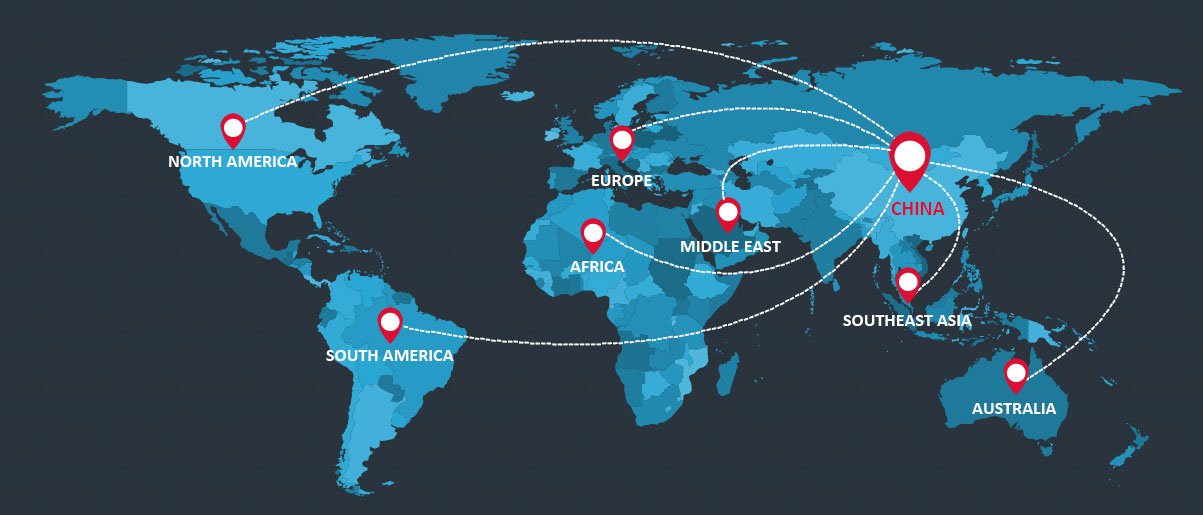
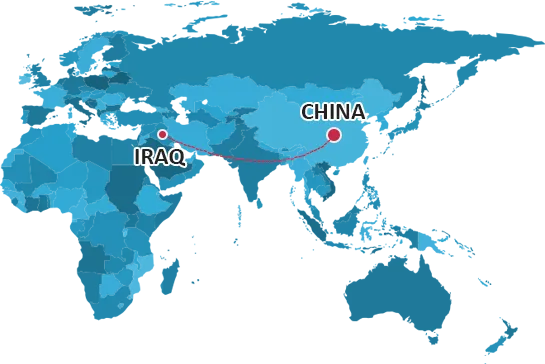
Shipping goods from China to Iraq is crucial for businesses aiming to tap into the thriving trade relationship between the two countries. As Iraq’s largest import partner, China supplies a diverse range of products — from electronics, machinery, and textiles to construction materials and consumer goods. This robust trade corridor demands a reliable logistics partner who understands both the Chinese export landscape and Iraq’s unique import requirements. That’s where Dantful International Logistics comes in.
As a premier international logistics service provider, Dantful International Logistics offers a comprehensive suite of services tailored to your shipping needs. From air freight and ocean freight to meticulous customs clearance, secure warehouse services, and comprehensive insurance services, we handle every aspect of your logistics with professionalism and precision. Choose Dantful International Logistics for a seamless and reliable shipping experience from China to Iraq.
Ocean Freight From China to Iraq
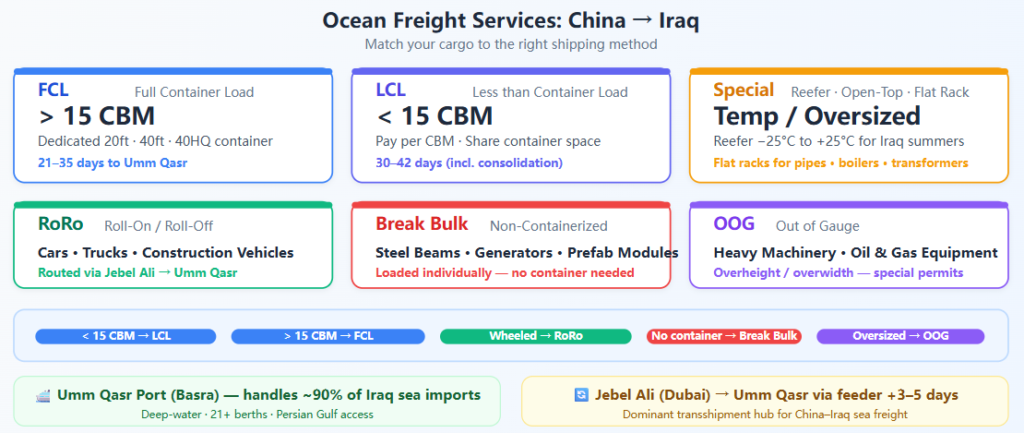
Ocean freight is the backbone of China–Iraq trade, handling the vast majority of cargo volume between the two countries. It is the optimal choice for businesses shipping large volumes or heavy goods in a cost-effective manner. Key advantages include:
Lowest cost per unit — significantly cheaper than air freight, especially for shipments exceeding 2–3 CBM
Massive capacity — 20ft containers (~28 CBM), 40ft containers (~58 CBM), and 40ft High Cube (~68 CBM) accommodate everything from consumer goods to industrial equipment
Versatile cargo acceptance — virtually all product categories are accepted, including electronics, machinery, furniture, textiles, and construction materials
Predictable schedules — major carriers operate regular sailings from Chinese ports to the Middle East Gulf
Key Iraq Ports and Shipping Routes
Understanding Iraq’s port infrastructure and actual shipping routes is fundamental to logistics planning.
Primary Iraqi Sea Ports:
| Port | Location | Role |
|---|---|---|
| Umm Qasr (North Port & South Port) | Basra Governorate, Persian Gulf coast | Iraq’s primary deep-water port, handling ~90% of all sea imports; 21+ berths |
| Khor Al-Zubair | Near Umm Qasr | Secondary commercial port, handles bulk cargo and project shipments |
| Al Maqal | Basra city center | Smaller port, primarily for regional barge traffic |
Actual Shipping Routes from China to Iraq:
The standard ocean freight route from China to Iraq traverses: South China Sea → Strait of Malacca → Indian Ocean → Arabian Sea → Strait of Hormuz → Persian Gulf → Umm Qasr. Typical transit from Chinese main ports is 21–35 days depending on departure port, carrier schedule, and whether direct or transshipment service is used.
⚠️ Important: Unlike China-to-Europe routes, the China-to-Iraq sea route does not pass through the Suez Canal. The critical chokepoint is the Strait of Hormuz, which all vessels must transit to enter the Persian Gulf.
Transshipment Hubs:
Most China–Iraq ocean services transship through one of these regional hubs:
| Hub | Location | Notes |
|---|---|---|
| Jebel Ali | Dubai, UAE | The dominant transshipment hub; most carriers relay from here to Umm Qasr with feeder vessels adding 3–5 days |
| Singapore | Southeast Asia | Used by some carriers as an alternative relay point |
| Bandar Abbas | Iran | Occasionally used for cargo destined to Kurdish region via overland transfer |
Types of Ocean Freight Services
Full Container Load (FCL)
FCL (Full Container Load) is the most secure and cost-efficient option when your cargo volume justifies a dedicated container. You rent the entire container — your goods are the only ones inside, sealed at origin and unsealed at destination.
Iraq applicability: FCL is the go-to choice for Iraqi importers of construction materials, machinery, furniture, and bulk consumer goods. If your shipment exceeds approximately 15 CBM, FCL typically becomes more economical than LCL on a per-unit basis.
Less than Container Load (LCL)
LCL (Less than Container Load) allows you to share container space with other shippers, paying only for the cubic meters (CBM) your cargo occupies.
Iraq applicability: Ideal for small-to-medium Iraqi importers testing new suppliers, shipping samples, or moving smaller batches of consumer electronics, spare parts, or textiles. Note that LCL shipments to Iraq may face additional consolidation/deconsolidation time at the transshipment hub (typically Jebel Ali), adding 5–10 days to overall transit.
Special Containers
Reefer Containers (Refrigerated): Temperature-controlled containers for perishable goods, pharmaceuticals, and temperature-sensitive chemicals. Iraq’s hot climate (summer temperatures regularly exceed 50°C / 122°F) makes reefers critical for food and pharma imports.
Open-Top Containers: For cargo too tall for standard containers (machinery, generators, steel structures). Loading is done from above via crane.
Flat Rack Containers: For heavy, wide, or awkwardly shaped cargo — construction equipment, pipes, industrial boilers, transformers. Iraq’s reconstruction sector uses flat racks extensively.
Roll-On/Roll-Off (RoRo)
RoRo vessels transport wheeled cargo — cars, trucks, buses, construction vehicles, and agricultural machinery — by driving them on and off the vessel.
Iraq applicability: Significant volumes of used vehicles are imported to Iraq via RoRo. Many shipments are routed through Jebel Ali (Dubai), where vehicles are consolidated from multiple origins before being shipped to Umm Qasr. This is the most efficient method for vehicle imports.
Break Bulk & OOG Freight
Break bulk handles goods that cannot fit standard containers — large industrial equipment, steel beams, wind turbine components, prefabricated structures. Each item is loaded, secured, and unloaded individually.
OOG (Out of Gauge) Freight covers cargo exceeding standard container dimensions — overheight, overwidth, or overweight items such as heavy construction machinery, oil & gas equipment, and oversized factory components.
Iraq applicability: Iraq’s ongoing infrastructure and oil & gas sector development generates consistent demand for break bulk and OOG shipping. Items like drilling equipment, pipeline sections, power generators, and prefabricated building modules are common break bulk shipments to Iraq.
Iraq Inland Transportation Network
Once cargo arrives at Umm Qasr, overland trucking delivers it to inland destinations. Understanding these distances and transit times is essential for total supply chain planning.
| Origin | Destination | Distance | Truck Transit | Notes |
|---|---|---|---|---|
| Umm Qasr | Basra City | ~50 km | 1–2 hours | Short haul, minimal cost |
| Umm Qasr | Baghdad | ~550 km | 6–10 hours | Main highway; occasional security checkpoints |
| Umm Qasr | Erbil | ~900 km | 12–18 hours | Multiple governorate crossings; coordination with KRG checkpoints |
| Umm Qasr | Sulaymaniyah | ~800 km | 12–16 hours | Mountainous final leg |
| Umm Qasr | Kirkuk | ~700 km | 10–14 hours | Route via Baghdad or direct |
| Umm Qasr | Najaf | ~380 km | 5–7 hours | Relatively straightforward route |
| Umm Qasr | Mosul | ~950 km | 14–20 hours | Longest northern route; security considerations apply |
Alternative Overland Routes to Kurdish Region (Erbil/Sulaymaniyah):
For shipments destined to the Kurdistan Region of Iraq (KRG), a popular alternative avoids Umm Qasr entirely: ocean freight to Mersin Port (Turkey) → overland truck across the Turkey–Iraq border (Ibrahim Khalil / Habur crossing) → Erbil. This route can save days compared to Umm Qasr + long overland trucking through southern and central Iraq. Transit via Mersin is typically 25–35 days total (sea + truck).
Ocean Freight Forwarder From China to Iraq
Choosing a reliable ocean freight forwarder is essential for a smooth shipping experience. Dantful International Logistics stands out as a highly professional and cost-effective one-stop logistics service provider. Our ocean freight services cover everything from FCL and LCL to specialized containers, break bulk, and OOG cargo — always with customs clearance, warehouse services, and insurance integrated into a single, transparent package.
Air Freight From China to Iraq
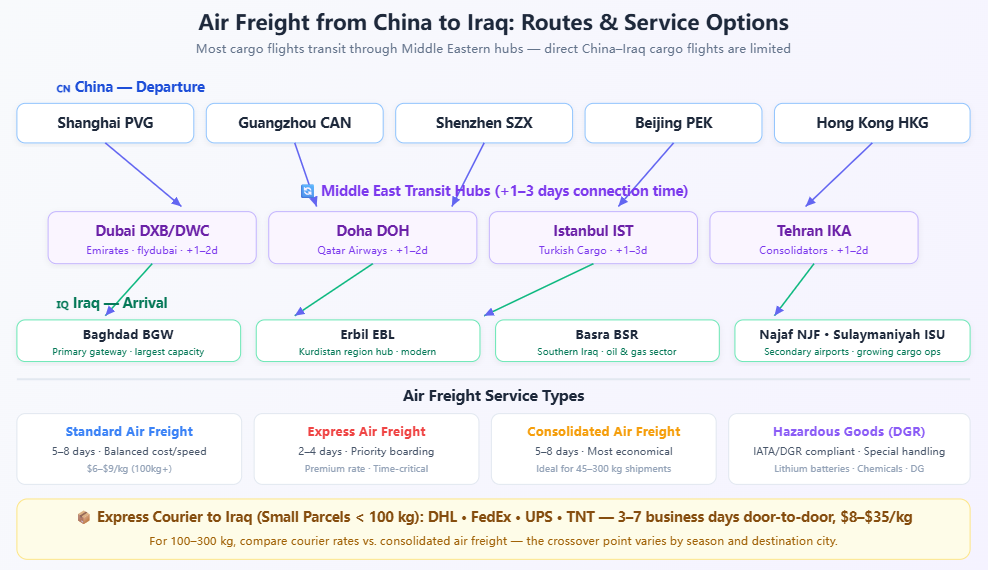
Air freight is the go-to solution when speed, security, and reliability are non-negotiable. For Iraq-bound shipments, air freight is particularly valuable given:
Speed: 3–7 days vs. 25–40 days by sea — critical for time-sensitive inventory, urgent spare parts, and seasonal demand spikes
Security: Reduced handling touchpoints and airport-level security minimize theft, damage, or loss risk
Perishables & Pharma: Temperature-sensitive goods requiring minimal transit time; Iraq’s pharmaceutical and medical device imports rely heavily on air freight
Lower inventory carrying cost: Faster transit means less capital tied up in goods-in-transit
Key Iraq Airports and Routes
Iraq has five international airports capable of receiving cargo:
| Airport | Code | Region | Cargo Capability |
|---|---|---|---|
| Baghdad International | BGW | Central Iraq | Primary air cargo gateway; largest cargo handling capacity |
| Erbil International | EBL | Kurdistan Region (KRG) | Modern facilities; key hub for KRG-bound cargo |
| Basra International | BSR | Southern Iraq | Strategic for oil & gas sector logistics |
| Najaf International | NJF | Central-South Iraq | Growing cargo operations; serves central provinces |
| Sulaymaniyah International | ISU | Kurdistan Region (KRG) | Secondary Kurdish airport; limited cargo capacity |
Air routes from China to Iraq are typically indirect, transiting through regional hubs:
| Hub | Typical Transit | Carriers |
|---|---|---|
| Dubai (DXB/DWC) | +1–2 days connection | Emirates SkyCargo, flydubai Cargo |
| Doha (DOH) | +1–2 days connection | Qatar Airways Cargo |
| Istanbul (IST) | +1–3 days connection | Turkish Cargo |
| Tehran (IKA) | +1–2 days connection | Used by some consolidators |
Direct cargo flights from China to Iraq are limited — most freight moves via these Middle Eastern hubs, which offer excellent connectivity to Baghdad, Erbil, and Basra.
Types of Air Freight Services
Standard Air Freight
Ideal for regular shipments that don’t require same-week delivery. It offers a strong balance of cost and speed, with transit times of 5–8 days door-to-airport for consolidated cargo.
Express Air Freight
For true urgency — priority boarding, minimal ground time, fastest possible routing. Express air freight delivers door-to-airport in 2–4 days and is the right choice for critical spare parts, emergency medical supplies, and time-critical electronics.
Consolidated Air Freight
Multiple shippers’ cargo is consolidated into a single air waybill (MAWB), with each shipper receiving a house air waybill (HAWB). This spreads the cost across multiple parties and is the most economical air freight option — ideal for shipments in the 45–300 kg range.
Hazardous Goods Transportation
Transporting hazardous materials (lithium batteries, chemicals, compressed gases, flammable liquids) requires specialized handling, IATA/DGR-compliant packaging, and carrier approval. Dantful International Logistics provides full-service dangerous goods air freight to Iraq, ensuring full regulatory compliance at both origin and destination.
Express Courier Shipping to Iraq (Small Parcels & Samples)
For shipments under 100 kg — product samples, documents, small e-commerce orders, or spare parts — express courier services offer the fastest and simplest shipping option:
| Courier | Transit (Door-to-Door) | Weight Range | Best For |
|---|---|---|---|
| DHL Express | 3–5 business days | 0.5–300 kg | Most extensive Iraq coverage; reliable to all major cities |
| FedEx | 3–6 business days | 0.5–68 kg | Good Baghdad & Erbil coverage |
| UPS | 3–7 business days | 0.5–70 kg | Reliable express option; competitive for heavier small packages |
| TNT | 4–7 business days | 0.5–500 kg | Good for mid-weight express shipments |
Rough express pricing to Iraq: $14–$35/kg for shipments under 30 kg, dropping to $8–$18/kg for 30–100 kg brackets. Express couriers include basic customs clearance, making them the simplest option for first-time shippers or small-volume importers.
💡 Tip: For shipments between 100–300 kg, compare express courier rates against consolidated air freight — the price crossover point varies by season and destination city within Iraq.
Air Freight Forwarder From China to Iraq
Selecting a reliable air freight forwarder is crucial for a smooth and efficient shipping process. Dantful International Logistics provides professional, cost-effective air freight services — standard, express, consolidated, and dangerous goods — all backed by our customs clearance expertise, secure warehouse services, and comprehensive insurance coverage.
Door-to-Door DDP Shipping From China to Iraq
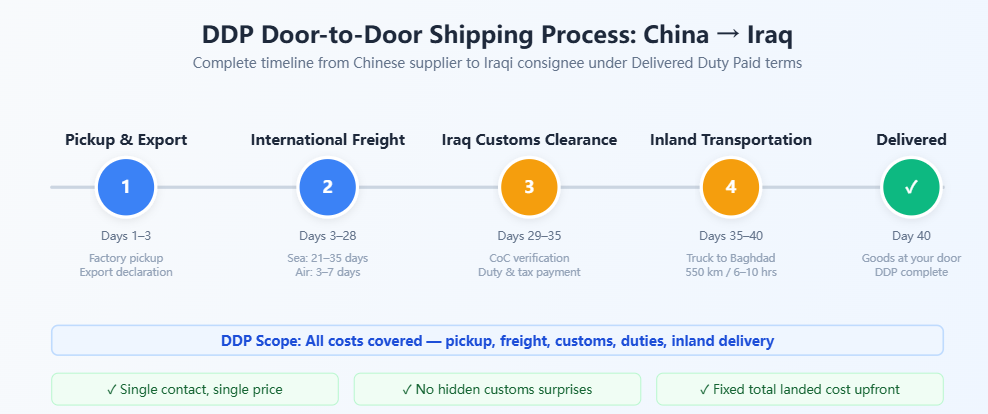
DDP (Delivered Duty Paid) is the ultimate hassle-free shipping solution. Under DDP terms (Incoterms 2020), the seller assumes all responsibility and costs: factory pickup in China → export customs clearance → international freight (sea or air) → Iraq import customs clearance → payment of all import duties and taxes → final delivery to your specified address in Iraq. You receive your goods at your door — nothing more to pay, no customs paperwork to handle.
Why DDP is particularly popular for Iraq shipments:
Iraq’s customs procedures are complex and differ by region (KRG vs. Federal Iraq)
Iraqi import documentation requirements can be unfamiliar to first-time importers
Local customs brokers in Iraq charge variable fees; DDP fixes your total cost upfront
Many Iraqi SMEs lack an established in-country customs clearance capability
DDP eliminates the risk of unexpected customs penalties or demurrage charges
DDP vs. Other Incoterms: Which Is Right for You?
Understanding where costs and responsibilities shift from seller to buyer is essential for choosing the right shipping terms:
| Incoterm | Seller Responsibility | Buyer Responsibility | Best For |
|---|---|---|---|
| EXW (Ex Works) | Goods made available at factory | Everything else — pickup, export customs, freight, import customs, duties, delivery | Buyers with their own logistics team in China |
| FOB (Free On Board) | Export customs + delivery to origin port + loading on vessel | Ocean freight, insurance, import customs, duties, inland delivery in Iraq | Buyers with an established freight forwarder relationship |
| CIF (Cost, Insurance, Freight) | Export customs + ocean freight + minimum insurance to Umm Qasr | Import customs, duties, inland delivery in Iraq | Buyers who want freight arranged but handle their own Iraq-side clearance |
| DAP (Delivered at Place) | Everything up to named destination in Iraq, except import duties & taxes | Import customs clearance, duties, and taxes | Buyers with their own Iraqi customs broker but who want delivery logistics handled |
| DDP (Delivered Duty Paid) | Everything — door to door, including all Iraqi customs duties and taxes | Receive goods at your address | First-time importers, SMEs without Iraq customs capability, hassle-free priority |
📊 Visual Guide: See the timeline below for a step-by-step walkthrough of the DDP process from Chinese factory to Iraqi delivery address.
DDP Shipping Cost Structure
DDP pricing to Iraq is typically quoted as an all-inclusive per-CBM or per-kg rate. This rate bundles:
Origin costs: Factory/warehouse pickup anywhere in China, export documentation, export customs declaration
International freight: Sea (LCL or FCL) or Air freight
Destination costs: Iraq import customs clearance, customs brokerage fees, import duties & taxes payment, port/airport handling charges
Last-mile delivery: Trucking from port/airport to your final address in Baghdad, Erbil, Basra, or other Iraqi cities
Estimated DDP door-to-door rates (China → Iraq, 2026 reference):
| DDP Mode | Typical Rate | Transit (Door-to-Door) | Suitable Cargo |
|---|---|---|---|
| Sea DDP (LCL) | $350–$550 / CBM | 35–50 days | General cargo, 1–15 CBM |
| Sea DDP (FCL, 20ft) | Custom quote (based on goods type + destination city) | 30–45 days | Single-consignee full container loads |
| Air DDP | $9–$14 / kg | 7–15 days | Urgent, high-value, or low-weight shipments |
Note: DDP rates vary based on the HS code of your goods (different products attract different Iraqi customs duty rates), the destination city within Iraq (inland cities like Erbil involve longer trucking), and shipment volume. Contact Dantful for a precise all-inclusive quote tailored to your specific cargo.
Benefits of Door-to-Door Service
Total Convenience: The entire logistics chain is managed by a single provider — one point of contact, one contract, one invoice
Cost Certainty: The all-inclusive DDP quotation means no surprises — duties, taxes, clearance fees, and delivery are all included
Time Efficiency: While the service provider handles every logistics detail, you focus on your core business operations
Reduced Risk: Professional handling at every stage — from Chinese export compliance to Iraqi import customs — minimizes delays and damage
End-to-End Visibility: Real-time tracking from pickup in China through to final delivery in Iraq
How Dantful International Logistics Can Help
Dantful International Logistics provides comprehensive DDP door-to-door services for shipments from China to Iraq. We manage the entire process — supplier pickup, export clearance, sea or air freight, Iraqi import customs (both KRG and Federal Iraq), duty/tax payment, and final delivery. One partner, one price, zero hassle.
Shipping Costs from China to Iraq
Shipping from China to Iraq involves multi-modal logistics and variable cost components. The table below provides the most common routing options and their estimated costs:
| Major Route | Air Freight (USD/KG, 100kg+) | Sea Freight (USD/Container & LCL) | Notes |
|---|---|---|---|
| Shanghai to Baghdad | $6.2 – $8.0 | FCL (via Umm Qasr + Truck): 20’GP: $2,100–$2,800 / 40’GP: $3,300–$4,200 LCL: $72–$115/CBM Trucking to Baghdad: $950–$1,300 | No direct sea access; sea+land or direct air. Good flight frequency. |
| Ningbo to Basra (Umm Qasr) | $6.0 – $7.8 | FCL: 20’GP: $1,900–$2,600 / 40’GP: $3,050–$3,900 LCL: $65–$105/CBM | Umm Qasr is Iraq’s busiest port. Typical sea transit 24–27 days. |
| Shenzhen to Erbil | $7.0 – $8.7 | FCL (Sea via Mersin+Truck): 20’GP: $2,250–$3,100 / 40’GP: $3,500–$4,700 LCL: $80–$130/CBM Overland Truck to Erbil: $1,250–$1,600 | Via Mersin port (Turkey) + truck; direct air service available. |
| Guangzhou to Baghdad | $6.3 – $8.1 | FCL (Umm Qasr + truck): 20’GP: $2,100–$2,750 / 40’GP: $3,400–$4,200 LCL: $74–$117/CBM Trucking: $950–$1,350 | Similar to Shanghai routing; efficient air and consolidated LCL options. |
| Qingdao to Basra (Umm Qasr) | $6.4 – $8.3 | FCL: 20’GP: $1,950–$2,650 / 40’GP: $3,100–$3,950 LCL: $68–$112/CBM | Often requires transshipment; sea lead time 28–31 days. |
| Hong Kong to Baghdad | $6.1 – $7.9 | FCL (via Umm Qasr + Truck): 20’GP: $2,050–$2,750 / 40’GP: $3,350–$4,100 LCL: $73–$119/CBM Trucking: $950–$1,350 | Fastest air routes; sea best for bulk; precise documentation required. |
Key notes:
Air Freight is best for urgent shipments, electronics, or high-value goods
Sea Freight (FCL/LCL) is cost-effective for bulk, but requires multi-modal planning since Baghdad and Erbil have no direct sea access — sea+land is required
Overland trucking is a crucial cost leg, especially from Umm Qasr to interior Iraqi cities
All rates are for general cargo. Dangerous goods, oversized, or special commodities incur surcharges
Rates fluctuate based on fuel prices (BAF), seasonal demand, and Middle East Gulf carrier capacity
Factors Influencing Shipping Costs
Mode of Transport: Air freight is 5–10× more expensive than ocean freight per kg but delivers in days rather than weeks
Weight and Volume: Carriers charge based on actual weight or volumetric weight, whichever is higher. Volumetric formula: (L×W×H in cm) ÷ 6,000 for air, ÷ 1,000 for sea LCL
Distance and Route: Direct sailings are cheaper than multi-leg transshipment; remote Iraqi destinations add trucking costs
Fuel Surcharges (BAF): Fluctuate monthly based on global bunker fuel prices; can swing rates by 10–20%
Seasonal Demand: Peak seasons (pre-Ramadan restocking, pre-Chinese New Year rush, Q4 holiday season) push rates higher
Customs Duties and Taxes: Iraqi import duties (typically 5–30% of CIF value) and the reconstruction levy significantly impact total landed cost
Special Handling: Hazardous goods, perishables, high-value cargo, and oversized items each attract surcharges
Additional Costs to Consider
Port and Airport Fees: Terminal Handling Charges (THC), documentation fees, container sealing fees
Customs Clearance Fees: Brokerage fees, inspection charges, Certificate of Conformity (CoC) issuance ($300–$1,500)
Insurance: Cargo insurance (typically 0.3–0.8% of declared value); strongly recommended for Iraq destinations
Storage and Warehousing: Demurrage (container exceeding free days at port) and detention (container held beyond free days outside port) are costly if not managed
Inland Iraq Delivery: Last-mile trucking from Umm Qasr to final destination — often as expensive as the ocean freight itself for northern cities
Packaging and Handling: Export-grade packaging — especially important for Iraq’s hot climate and potential rough handling
How to Calculate Your Total Landed Cost
Many importers focus only on the freight quote and are surprised by the final cost. The Total Landed Cost formula captures everything:
Total Landed Cost = Product Cost (FOB) + Ocean/Air Freight + Cargo Insurance + Iraq Customs Duty (% of CIF Value) + Reconstruction Levy (if applicable) + Certificate of Conformity (CoC) Fee + Customs Brokerage Fee + Port/ Terminal Handling Charges + Inland Trucking to Final Destination
Simplified walkthrough example — 20ft container of general consumer goods, Shenzhen → Baghdad (DDP):
| Cost Component | Estimated Amount |
|---|---|
| Ocean Freight (Shenzhen → Umm Qasr, 20ft) | $2,400 |
| Cargo Insurance (0.5% of $50,000 declared value) | $250 |
| Terminal Charges (Umm Qasr) | $350 |
| Iraq Customs Duty (~15% on CIF value of ~$53,000) | ~$7,950 |
| CoC Certificate | $500 |
| Customs Brokerage | $400 |
| Trucking (Umm Qasr → Baghdad, ~550 km) | $1,100 |
| Total Estimated Landed Cost (excl. product cost) | ~$12,950 |
This example illustrates why looking at the ocean freight quote in isolation is misleading. The freight itself is only ~18% of the total logistics cost — duties, inland trucking, and clearance fees make up the majority. Dantful provides all-inclusive DDP quotations that capture every line item above, so you know your true landed cost before you ship.
How to Reduce Shipping Costs to Iraq
Ship FCL once you exceed ~15 CBM: Below this threshold, LCL is usually cheaper per CBM. Above it, a dedicated 20ft container almost always delivers lower cost per unit.
Plan around peak seasons: Avoid shipping during the 4 weeks before Chinese New Year (January/February) and during Ramadan (dates shift annually) when demand surges and rates spike 20–40%.
Choose the right Chinese departure port: For southern Iraq (Basra/Umm Qasr), southern Chinese ports (Shenzhen, Guangzhou) offer shorter transit and often lower rates than northern ports. For Kurdish region via Turkey, Ningbo/Shanghai may offer competitive services.
Use consolidated services: Consolidating multiple smaller shipments into one FCL, or using consolidated air freight, spreads fixed costs across more cargo.
Optimize packaging: Reducing cargo volume by even 10–15% through compact packaging directly lowers LCL/air freight charges calculated on volumetric weight.
Work with a dedicated freight forwarder: A forwarder with direct carrier contracts and Iraq-specific expertise can secure better rates, avoid costly documentation errors, and minimize customs delays that lead to demurrage charges.
Shipping Time from China to Iraq
Transit time varies significantly by destination city, transport mode, and whether multi-modal links are needed (especially for inland destinations):
| Major Route | Air Freight Transit | Sea Freight Transit | Notes |
|---|---|---|---|
| Shanghai to Baghdad | 3–5 days | 28–35 days (Umm Qasr by sea + 2–4 days truck) | No direct sea; via Umm Qasr port then inland trucking |
| Ningbo to Basra (Umm Qasr) | 3–5 days | 24–31 days | Basra (Umm Qasr) is Iraq’s principal seaport |
| Shenzhen to Erbil | 3–6 days | 28–40 days (Sea to Mersin + 3–5 days inland truck) | Erbil is inland; uses Turkish port (Mersin) for sea+land |
| Guangzhou to Baghdad | 3–5 days | 29–36 days (Umm Qasr by sea + 2–5 days truck) | Similar to Shanghai–Baghdad, with efficient air options |
| Qingdao to Basra (Umm Qasr) | 4–7 days | 26–33 days | Often includes transshipment; longer sea lead time |
| Hong Kong to Baghdad | 3–5 days | 27–34 days (Umm Qasr by sea + 2–4 days truck) | Fast air connection; sea via principal port + trucking |
Key Notes:
Direct Air Freight: Available to Baghdad and Erbil — even during high-demand periods
Sea Freight: Primary entry port is Umm Qasr (Basra); shipping to Baghdad/Erbil involves extra inland transport (trucking) after sea arrival
Multimodal Route to Erbil: Often uses Turkish port Mersin for the sea leg, followed by overland trucking — this bypasses southern Iraq entirely
Customs, Security & Documentation: Can impact clearance and delivery times, particularly during regional holidays or periods of instability
Factors Influencing Shipping Time
Mode of Transport: Air freight to Iraq is 5–8× faster than ocean freight
Distance and Route: The specific Chinese origin port and Iraqi destination dramatically affect total transit — Shenzhen → Umm Qasr is ~21 days vs. Shanghai → Erbil (via Turkey) at 28–40 days
Customs Clearance: Iraq’s dual customs system and documentation requirements can add 2–7 days if not managed proactively
Port Congestion: Umm Qasr experiences periodic congestion, especially during peak import periods
Weather Conditions: Persian Gulf shipping can be affected by seasonal shamal winds and summer heat extremes; winter fog can delay Umm Qasr berthing
Transshipment Dwell Time: Cargo transshipping through Jebel Ali typically sits 2–5 days awaiting the feeder vessel to Umm Qasr
Inland Iraq Factors: Checkpoints, road conditions, and security situations can add variability to trucking transit times from Umm Qasr to final destination
Seasonal Planning: When to Ship
Timing your shipments strategically can save money and avoid delays:
| Period | Impact | Planning Advice |
|---|---|---|
| Chinese New Year (late Jan – mid Feb) | Factory closures (2–4 weeks), port labor shortages, rate spikes 20–40% | Book space 3–4 weeks in advance; ship before January 15 or after February 20 |
| Ramadan (dates shift ~11 days earlier each year) | Reduced working hours at Iraqi ports and customs; clearance slows significantly | Ship at least 4 weeks before Ramadan begins to ensure pre-holiday delivery |
| Eid al-Fitr & Eid al-Adha | 3–5 day public holidays in Iraq; customs and logistics operations pause | Account for ~1 week of added transit time around these holidays |
| Summer (Jun–Aug) | Extreme heat in Iraq (50°C+) — reefer containers work harder, some goods require climate-controlled storage; port productivity drops during midday hours | Reefer shipments: ensure backup power contingency; general cargo: heat-resistant packaging |
| Q4 Peak (Oct–Dec) | Global shipping peak season; Middle East Gulf capacity tightens; rates rise 15–25% | Book early; consider air freight for time-critical Q4 shipments |
| Arbaeen Pilgrimage (varies) | Massive population movement in southern Iraq; road congestion between Basra and Najaf/Karbala | Check dates; avoid scheduling critical trucking during the pilgrimage period if routing through central Iraq |
Iraq Customs Clearance & Import Compliance
Iraq’s Dual Customs System
One of the most important — and least understood — aspects of importing to Iraq is the country’s dual customs system:
| Customs Zone | Authority | Territory |
|---|---|---|
| Federal Iraq Customs | Iraqi General Commission of Customs (IGCC) | Central and southern Iraq, including Baghdad, Basra, Umm Qasr, Najaf, Karbala, and Nineveh provinces |
| KRG Customs (Kurdistan Region) | KRG Ministry of Finance — Customs Directorate | Erbil, Sulaymaniyah, and Duhok provinces |
Critical note for importers: Cargo cleared through KRG customs (e.g., at Erbil airport or the Ibrahim Khalil border crossing from Turkey) is not automatically cleared for Federal Iraq. If your goods need to move from the Kurdish region into Federal Iraq, a second customs clearance is typically required, adding 1–3 days and additional fees. Conversely, goods cleared at Umm Qasr can generally move north into the Kurdish region, but documentation verification at internal checkpoints remains a possibility.
Always specify your final delivery address precisely before shipping — this determines which customs authority handles clearance and whether dual-clearance procedures apply.
Certificate of Conformity (CoC) — Mandatory for Iraq
Iraq requires a Certificate of Conformity (CoC) for most regulated imported products. This certifies that your goods meet Iraqi standards and technical regulations.
Issuing bodies: Authorized inspection companies — Bureau Veritas, SGS, Intertek, TÜV
Process: Pre-shipment inspection (PSI) at origin (China) → lab testing if required → issuance of CoC
Cost: Typically $300–$1,500 depending on product type, complexity, and whether lab testing is needed
Timeline: Allow 7–15 days for the CoC process; factor this into your shipping timeline
Without a valid CoC: Goods may be rejected at the Iraqi port of entry, incurring storage costs, re-export expenses, or confiscation
Dantful’s tip: Start the CoC application as soon as your supplier confirms the shipment is ready. Waiting until the container is already on the water is the #1 cause of CoC-related clearance delays for Iraq imports.
Required Documentation Checklist
Use this consolidated checklist when preparing any shipment from China to Iraq:
| # | Document | Required For | Notes |
|---|---|---|---|
| 1 | Commercial Invoice | All shipments | Must accurately declare goods description, quantity, unit value, total value, currency, Incoterm, and country of origin |
| 2 | Packing List | All shipments | Detailed item-by-item breakdown: dimensions, weights, package count, marks & numbers |
| 3 | Bill of Lading (B/L) | Sea freight | Issued by the carrier; confirms goods loaded on vessel. “To Order” or “To Order of Shipper” is standard for Iraq |
| 4 | Air Waybill (AWB) | Air freight | Issued by the airline or freight forwarder; non-negotiable document |
| 5 | Certificate of Origin | All shipments | Must be certified/stamped by the China Council for the Promotion of International Trade (CCPIT) — uncertified certificates are frequently rejected by Iraqi customs |
| 6 | Certificate of Conformity (CoC) | Regulated products | See section above; mandatory pre-shipment certification |
| 7 | Import License | Restricted goods | Required for specific product categories (pharmaceuticals, chemicals, telecom equipment, food products) |
| 8 | Insurance Certificate | Recommended for all | Proof of cargo insurance coverage |
Import License Requirements
Certain product categories require an import license from the relevant Iraqi ministry before goods can clear customs:
Pharmaceuticals & medical devices: Iraqi Ministry of Health approval required
Food products: Ministry of Health and Iraqi Standards and Quality Control Authority approvals
Telecommunications equipment: Ministry of Communications license
Chemicals & hazardous materials: Ministry of Environment and Ministry of Interior approvals
Weapons & security equipment: Ministry of Interior / Ministry of Defense authorization
If your goods fall into a regulated category, initiate the import license application before your supplier ships from China. Dantful can coordinate this process with our network of Iraqi customs brokers.
Import Duties & Taxes in Iraq
Iraqi Customs Duty Structure
Iraq applies customs duties on imports based on the CIF value (Cost + Insurance + Freight) of goods, classified under the Harmonized System (HS Code). While rates vary by HS code, here is a general framework:
| Product Category | Typical Duty Rate | Notes |
|---|---|---|
| Raw materials & industrial inputs | 0–5% | Lower rates to encourage domestic manufacturing |
| General consumer goods | 10–20% | Electronics, textiles, household items |
| Food products & agricultural goods | 5–15% | Varies significantly by product type and season |
| Automobiles & vehicles | 15–30% | Depends on engine size, age, and type |
| Luxury goods | 20–30% | Higher rates for premium products |
| Machinery & industrial equipment | 5–10% | Often eligible for reconstruction-related reduced rates |
| Building materials | 10–20% | Rate depends on type; some categories have temporary reduced rates |
Reconstruction Levy: Iraq imposes an additional reconstruction levy on certain imports. The application and rate vary. Consult with your freight forwarder or customs broker for the latest applicable levies on your specific HS code.
Customs duty calculation formula:
Customs Duty = CIF Value × Applicable Duty Rate (%)
where CIF Value = Product Cost + Ocean/Air Freight + Insurance
Worked example — $30,000 worth of consumer electronics, shipped LCL from Shenzhen to Baghdad:
| Step | Calculation | Amount |
|---|---|---|
| FOB Product Value | — | $30,000 |
| Ocean Freight (LCL, 5 CBM at $80/CBM) | — | $400 |
| Insurance (0.5% of $30,400) | — | $152 |
| CIF Value at Umm Qasr | Product + Freight + Insurance | $30,552 |
| Customs Duty (15% of CIF) | $30,552 × 0.15 | $4,583 |
| Landed Cost Before Trucking | CIF + Duty | $35,135 |
| + Trucking to Baghdad | — | $1,100 |
| Total Landed Cost at Baghdad | — | $36,235 |
This example demonstrates why duty alone can add 15% or more to your total cost. Accurately classifying your product under the correct HS code is critical — misclassification can result in overpayment or customs penalties.
Prohibited & Restricted Items When Shipping to Iraq
Iraqi customs law strictly regulates what can and cannot be imported. Shipping prohibited items can result in seizure, fines, and legal action.
Prohibited Items (Cannot Be Imported)
| Category | Examples |
|---|---|
| Narcotics & drugs | All illegal substances, drug paraphernalia |
| Weapons & ammunition | Firearms, explosives, military equipment (without special government authorization) |
| Counterfeit goods | Fake branded products, pirated media, forged documents or currency |
| Toxic & hazardous materials | Radioactive substances, unapproved chemicals, biological hazards |
| Endangered wildlife | Products derived from CITES-listed species (ivory, certain animal skins, etc.) |
| Culturally sensitive materials | Artifacts or items that violate Iraqi cultural protection laws |
| Gambling equipment | Slot machines, gambling-specific devices |
| Israeli-origin goods | Products manufactured in Israel or with Israeli certificates of origin |
Restricted Items (Require Special Permits/Licenses)
| Category | Requirements |
|---|---|
| Pharmaceuticals | Ministry of Health import license; product registration in Iraq |
| Medical devices | Ministry of Health approval; conformity to Iraqi medical device standards |
| Chemicals | Ministry of Environment approval; safety data sheets required |
| Live animals | Veterinary health certificates; CITES permits where applicable |
| Plants & agricultural products | Phytosanitary certificates; Ministry of Agriculture inspection |
| Telecommunications equipment | Ministry of Communications type approval |
| Food products | Health certificates; shelf-life requirements (typically minimum 6 months remaining); Arabic labeling |
| Cosmetics & personal care | Iraqi Standards and Quality Control Authority registration |
| Antiques & art | Ministry of Culture export/import permits |
If you’re unsure whether your product is restricted, always verify before shipping. Dantful’s customs team can review your product details against current Iraqi import regulations and advise on required permits.
Cargo-Specific Shipping Guidance
Different product categories demand different shipping strategies. Below is guidance for the three largest Chinese export categories to Iraq:
Electronics & Consumer Goods
China is Iraq’s dominant supplier of smartphones, home appliances, computer equipment, and consumer electronics.
Key considerations:
Packaging: Anti-static wrapping, moisture-proof barriers, and shock-absorbing padding are mandatory. Iraq’s summer humidity in Basra can damage unprotected circuit boards
Container choice: Standard dry containers are suitable, but consider reefer containers (set to 20–25°C, not refrigerated) for high-value electronics during summer months to prevent heat damage
Insurance: All Risks coverage is essential; electronics are high-theft targets at Umm Qasr
HS Code accuracy: Electronics span dozens of HS codes with different duty rates — precise classification is critical to avoid overpaying duties
Express courier tip: For samples and small batches (under 50 units), DHL/FedEx to Iraq is faster and simpler than LCL sea freight
Machinery & Industrial Equipment
Iraq’s reconstruction and oil & gas sectors import heavy machinery, generators, construction equipment, and manufacturing lines from China.
Key considerations:
OOG & break bulk assessment: Determine whether your machinery fits standard containers or requires flat rack / open-top / break bulk handling — this is the single biggest cost variable
Export packaging: Heavy machinery must be professionally crated, weatherproofed, and secured with lashing points for ocean transit. Inadequate packaging is the #1 cause of transit damage to machinery
Port of entry: Umm Qasr is equipped for heavy lifts; verify maximum crane capacity at the terminal assigned to your vessel
Inland transport: Ensure Iraqi-side trucking company has low-bed trailers and experience with heavy/oversized loads on Iraq’s main highways
Duty classification: Machinery often qualifies for reduced duty rates (5–10%) under Iraq’s industrial development policies — verify HS code classification with a customs broker before shipping
Building & Construction Materials
Steel, cement, tiles, sanitary ware, aluminum profiles, and prefabricated structures are among Iraq’s highest-volume imports from China.
Key considerations:
FCL vs break bulk: Steel coils, rebar, and pipes can ship FCL (if dimensions allow) or as break bulk. For bagged cement and tiles, FCL is strongly preferred to minimize handling damage
Weight: Building materials are dense — a 20ft container of tiles can reach the 28-ton weight limit well before filling the 28 CBM volume. Always calculate weight vs. volume before choosing container type
Moisture protection: Desiccant packs and moisture-barrier wrapping protect steel and cement products from Persian Gulf humidity during the 25–35 day sea transit
Iraqi standards compliance: Many building materials require specific Iraqi standards certification — verify requirements through your CoC provider during the pre-shipment inspection
Port storage: Umm Qasr has open storage areas suitable for construction materials; inquire about yard storage options if your project site is not ready to receive
Step-by-Step Guide to Shipping from China to Iraq with Dantful
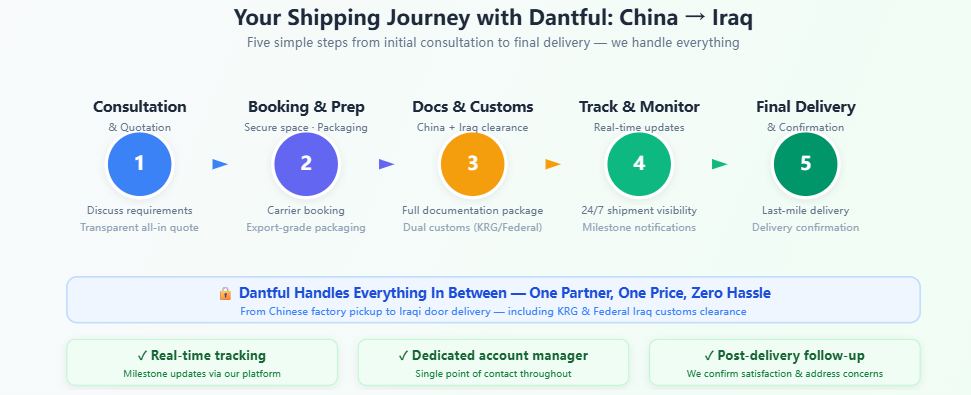
1. Initial Consultation and Quotation
The shipping process begins with an initial consultation where our expert team at Dantful International Logistics works closely with you to understand your specific shipping requirements. During this consultation, we discuss the nature of the goods, preferred shipping methods (air freight or ocean freight), delivery timelines, and any special handling needs. Based on this information, we provide a detailed and transparent quotation that outlines all potential costs, including freight charges, customs duties, insurance, and any additional services you may require, such as door-to-door service or DDP (Delivered Duty Paid) arrangements.
2. Booking and Preparing the Shipment
Once you approve the quotation, the next step is booking the shipment. We coordinate with carriers to secure space on the most suitable vessel or aircraft, ensuring alignment with your schedule and budget. Dantful International Logistics handles all aspects of preparing the shipment, including packaging, labeling, and ensuring compliance with international shipping standards. For LCL (Less than Container Load) and FCL (Full Container Load) shipments, we optimize container space to maximize cost-efficiency. If you opt for air freight, we ensure your cargo meets all airline requirements.
3. Documentation and Customs Clearance
Proper documentation is crucial for a smooth shipping process. Dantful International Logistics assists you in preparing all necessary documents, including the bill of lading, commercial invoice, packing list, Certificate of Origin (CCPIT-certified), and CoC where required. Our experienced team manages the customs clearance process in both China and Iraq — including navigating Iraq’s dual customs system (KRG vs. Federal Iraq) — ensuring that your shipment complies with all regulatory requirements. We handle any potential issues that may arise during customs inspections, minimizing delays and additional costs. Whether you choose DDU (Delivered Duty Unpaid) or DDP (Delivered Duty Paid), we ensure that all duties, taxes, and fees are accurately calculated and managed.
4. Tracking and Monitoring the Shipment
To provide peace of mind and ensure transparency, Dantful International Logistics offers comprehensive tracking and monitoring services. From the moment your shipment leaves the point of origin, you can monitor its progress in real-time through our advanced tracking system. We provide regular updates on the status of your shipment, including key milestones such as departure, arrival at transshipment hubs, and customs clearance. Our dedicated customer support team is available to answer any queries and provide timely information, ensuring you are always informed about the whereabouts of your cargo.
5. Final Delivery and Confirmation
The final step in the shipping process is the delivery of your goods to the designated destination in Iraq. Dantful International Logistics ensures that the last mile delivery is handled with the same level of professionalism and care as the rest of the shipping journey. For door-to-door service, we coordinate with local logistics partners to ensure prompt and secure delivery to your specified address. Upon delivery, we obtain confirmation and feedback to ensure that the shipment has arrived in perfect condition and meets your expectations. Our commitment to customer satisfaction means we follow up to address any concerns and ensure a positive shipping experience.
Partnering with Dantful International Logistics guarantees a seamless, efficient, and reliable shipping process from China to Iraq. Our comprehensive and customer-centric approach ensures that your logistics needs are met with the highest standards of service, allowing you to focus on your core business activities.
Freight Forwarder From China to Iraq
Choosing a freight forwarder from China to Iraq is a crucial decision for businesses looking to ensure efficient and reliable logistics. Dantful International Logistics stands out as a premier provider, offering a comprehensive suite of services tailored to the unique needs of each client. Our expertise spans across various shipping methods, including air freight for time-sensitive deliveries and ocean freight for cost-effective bulk shipments. We handle every aspect of the shipping process, from initial consultation and quotation to customs clearance, documentation, and final delivery. Our commitment to excellence ensures that your goods are transported securely and arrive on time, every time.
With Dantful International Logistics, you gain a trusted partner dedicated to simplifying your supply chain and optimizing your shipping operations. Our advanced tracking systems provide real-time updates, giving you full visibility over your shipments. Additionally, our professional team is always on hand to provide support and address any concerns you may have. Whether you need DDU (Delivered Duty Unpaid) or DDP (Delivered Duty Paid) services, our tailored solutions are designed to meet your specific needs. Choose Dantful International Logistics for a seamless and stress-free shipping experience from China to Iraq.
FAQs
1. How many days does shipping from China to Iraq take?
Sea freight (FCL/LCL): Typically 25–35 days to Umm Qasr, plus 2–5 days for inland trucking to Baghdad or 3–5 days to Erbil (via Turkey)
Air freight: 3–7 days door-to-airport
Express courier (DHL/FedEx/UPS): 3–7 business days door-to-door
DDP door-to-door (sea): 35–50 days total
2. How much does shipping cost from China to Iraq?
Sea freight (FCL, 20ft): $1,900–$3,100 depending on origin port and destination
Sea freight (LCL): $65–$130 per CBM
Air freight: $6.0–$8.7 per kg (100kg+ general cargo)
Express courier: $8–$35 per kg (weight-dependent)
DDP door-to-door (sea LCL): $350–$550 per CBM all-inclusive
3. What are the main ports of entry in Iraq for Chinese goods?
The primary sea port is Umm Qasr (Basra Governorate), which handles approximately 90% of Iraq’s maritime imports. For air freight, the main cargo airports are Baghdad International (BGW) and Erbil International (EBL).
4. What documents are required for shipping to Iraq?
The essential documents are: Commercial Invoice, Packing List, Bill of Lading (sea) or Air Waybill (air), Certificate of Origin (must be CCPIT-certified), Certificate of Conformity (CoC) for regulated products, and Import License for restricted goods. See the full checklist in the Customs Clearance section above.
5. How can I reduce my shipping costs to Iraq?
Ship FCL instead of LCL once your cargo exceeds approximately 15 CBM
Avoid peak seasons (pre-Chinese New Year, Ramadan, Q4 holiday season)
Choose the Chinese departure port closest to your supplier
Consolidate multiple small shipments into one larger shipment
Optimize packaging to reduce volumetric weight for air freight and LCL charges
Work with a dedicated freight forwarder who has direct carrier contracts and Iraq-specific expertise
6. What’s the best shipping method for small shipments and samples to Iraq?
For shipments under 100 kg — samples, documents, small e-commerce orders — express courier services (DHL, FedEx, UPS) offer the fastest and simplest option with 3–7 business days door-to-door delivery. For 100–300 kg shipments, compare express courier rates against consolidated air freight to determine the most cost-effective option.