Are you looking to master the import procedure from China to Iran but feeling overwhelmed by the complexities of international trade, compliance, and logistics? In this comprehensive guide, we’ll walk you through every step of the China-Iran import process, from identifying reliable suppliers and understanding Iranian import regulations to managing customs clearance and final delivery. Whether you’re a beginner or a seasoned importer, this article will empower you to streamline your operations and ensure hassle-free imports.
Understanding the Import Procedure from China to Iran
Overview of Importing from China to Iran
Importing goods from China to Iran continues to show strong growth in early 2026, driven by Iran’s robust demand for industrial machinery, electronics, consumer goods, textiles, and automotive parts that are widely manufactured in China. Navigating the import procedure requires a comprehensive understanding of international trade regulations, logistics solutions, and customs formalities specific to Iran. As a seasoned logistics professional, I have witnessed how businesses—ranging from multinational corporations to SMEs—leverage efficient import strategies to optimize costs and minimize risks.
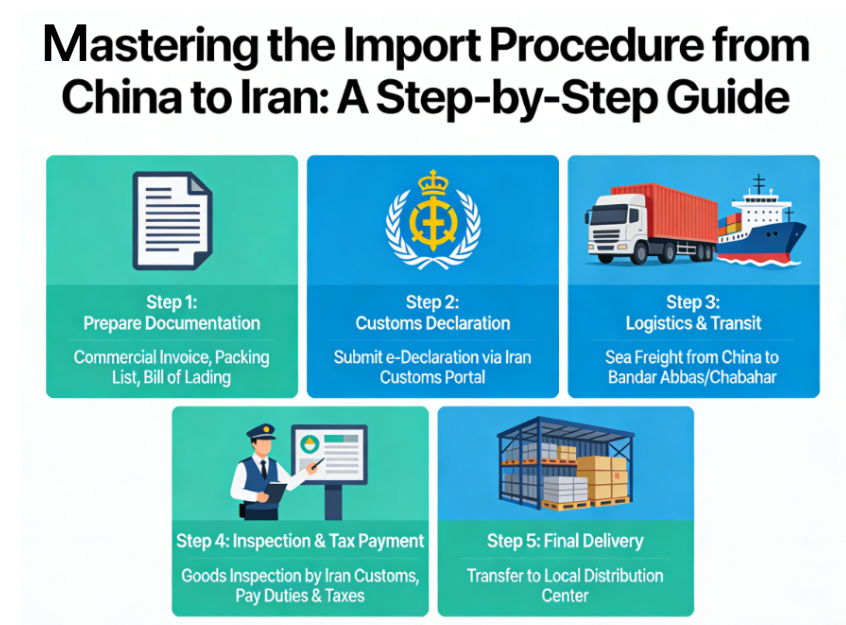
The process typically involves several key stages:
- Sourcing reliable suppliers in China
- Ensuring compliance with Iranian import regulations
- Preparing accurate shipping and customs documentation
- Selecting optimal shipping modes (Sea, Air, or Rail Freight)
- Managing pre-shipment inspection and quality checks
- Overseeing freight booking, transport, and customs clearance in Iran
- Coordinating last-mile delivery within Iran
Navigating these steps requires precise coordination. Experienced teams, like our specialists at Dantful International Logistics, focus on streamlining this workflow to ensure compliance and cost-efficiency.
Key Reasons to Import Goods from China
There are compelling advantages for Iranian businesses to source products from China:
| Key Reason | Description |
|---|---|
| Cost Competitiveness | China offers economies of scale, advanced manufacturing, and low production costs, enabling Iranian importers to benefit from attractive pricing across a broad range of goods. |
| Product Variety | Access to a diverse portfolio—electronics, machinery, textiles, plastics, parts, and more—enables Iranian companies to meet both consumer and industrial demands. |
| Reliable Supply Chain | Established logistics channels, frequent sailings/flights, and mature supplier networks help ensure timely and consistent delivery. |
| Custom Manufacturing | Many Chinese factories offer customization, private labeling, and flexible MOQs to cater to specific Iranian market needs. |
| Technological Advancements | Iranian importers can acquire cutting-edge tech, new product categories, and innovative solutions directly from leading Chinese manufacturers. |
These benefits make China a strategic sourcing hub for Iranian importers looking to expand market share and enhance competitiveness.
Essential Preparations Before Importing
Identifying Reliable Chinese Suppliers and Manufacturers
The foundation of a successful import operation lies in selecting reputable and trustworthy Chinese suppliers. Here are actionable steps for Iranian importers:
- Online Platforms & Trade Shows: Utilize platforms like Alibaba, Made-in-China, and attend trade exhibitions (e.g., Canton Fair) to discover qualified manufacturers.
- Background Verification: Conduct due diligence—request business licenses, certifications, and third-party audit reports; verify company history and production capabilities.
- Sample Orders & Quality Control: Always request pre-production samples. Arrange for pre-shipment inspections to ensure goods meet Iranian standards.
- Negotiation & Communication: Establish clear communication channels; negotiate payment terms, lead times, and after-sales support.
- Long-term Partnerships: Building long-term, trust-based relationships often results in better pricing, priority production, and smoother problem resolution.
For instance, our team at Dantful International Logistics frequently conducts on-site supplier audits to verify production capabilities before our clients commit to large orders.
Understanding Iranian Import Regulations and Compliance
Importing into Iran involves navigating a complex framework of trade policies, compliance requirements, and import restrictions. Key points include:
- Import Licensing: Certain products require import licenses issued by the Iranian Ministry of Industry, Mine and Trade. Always check if your product category is subject to licensing or quotas.
- Prohibited & Restricted Items: Some goods are restricted (e.g., telecommunications equipment, pharmaceuticals) or prohibited altogether due to local regulations or international sanctions.
- Product Standards: Goods must comply with Iranian National Standards Organization (INSO) requirements. Non-compliant products risk seizure or rejection by Iranian Customs.
- Labeling & Documentation: All products should be labeled in accordance with Iranian regulations (often in Farsi), and technical documents must be provided where applicable.
- Banking & Payment Restrictions: Due to international sanctions, payment mechanisms may be limited. Utilize secure, compliant channels for international trade settlements.
Early consultation with logistics professionals and customs brokers (consulting with experts who understand local nuances, like the trade compliance team at Dantful International Logistics) ensures compliance and reduces clearance delays.
Required Documentation for Importing into Iran
Accurate and complete documentation is the cornerstone of a smooth import process. Below is a checklist of primary documents typically required for customs clearance in Iran:
| Document Name | Purpose | Issued By | Notes |
|---|---|---|---|
| Commercial Invoice | Details the transaction value, buyer/seller info, and goods | Supplier in China | Must be accurate and match shipment |
| Packing List | Lists all items, quantities, and packaging details | Supplier | Supports goods verification |
| Bill of Lading / AWB / Rail Waybill | Shipping proof and transfer of title | Carrier or Forwarder | Varies by shipping mode (Sea/Air/Rail) |
| Certificate of Origin | Verifies the country of manufacture | Chamber of Commerce | Required for tariff & quotas |
| Import License | Legal authorization for specific categories | Iranian Authorities | Check if required for your product |
| Insurance Certificate | Proves cargo insurance coverage | Insurer | Highly recommended for risk mitigation |
| Pre-shipment Inspection Certificate | Confirms compliance and quality | Third-party Agency | Sometimes mandatory for Iran |
| HS Code Declaration | Classifies goods for customs and duties | Importer/Supplier | Must match product description |
Missing or inaccurate documents can result in clearance delays, penalties, or cargo seizure. To avoid issues, work with experienced logistics providers that offer end-to-end documentation management.
If you need specific guidance on documentation, Dantful International Logistics is available to review your paperwork and flag potential compliance issues early in the process. If you’re considering other Middle Eastern routes, you might also be interested in our detailed overview of shipping from China to the UAE.
Choosing the Best Freight Forwarding and Shipping Solutions
Comparing Shipping Methods: Sea Freight, Air Freight, and Rail
When importing from China to Iran, choosing the optimal shipping method is crucial for balancing cost, speed, and cargo safety. Below is an expert comparison of the major freight options:
| Shipping Method | Key Routes & Hubs | Typical Transit Time | Suitable Cargo Types | Estimated Cost (per 20FT/40FT container) | Pros | Cons |
|---|---|---|---|---|---|---|
| Sea Freight | Shanghai, Ningbo, Shenzhen → Bandar Abbas, Bandar Imam Khomeini | 20-30 days | Bulk, heavy, non-urgent | $1,800 – $2,600 / $3,200 – $4,500 | Most cost-effective, high capacity, suitable for all cargos (FCL/LCL) | Slow, subject to port congestion |
| Air Freight | Guangzhou, Shanghai, Beijing → Tehran (IKA Airport) | 3-7 days | High-value, urgent, small volume | $4.5 – $8.5/kg | Fastest, high security, time-sensitive shipments | Expensive, limited by size/weight |
| Rail Freight | Xi’an, Zhengzhou, Chongqing → Tehran via Central Asia | 15-22 days | Mid-size, semi-urgent | $3,500 – $5,800 / 40FT container | Balanced speed/cost, eco-friendly, stable schedules | Limited availability/frequency |
Sea Freight is the preferred method for most businesses due to its cost efficiency and ability to handle large volumes. Air Freight is ideal for electronics, pharmaceuticals, and urgent shipments. Rail Freight combines moderate speed with reasonable costs, increasingly popular for certain industrial and consumer goods.
For a more in-depth look at how shipping works along this trade lane, check out our dedicated resource on Shipping from China to Iran.
Container capacity reference:
| Container Type | Capacity (CBM) |
|---|---|
| 20FT | 28 |
| 40FT | 56 |
| 40HQ | 68 |
| 45HQ | 78 |
How to Select the Right Freight Forwarder for China-Iran Trade
Selecting a reliable freight forwarder is essential for a seamless import procedure from China to Iran. Consider the following criteria:
- Experience & Local Knowledge Choose a forwarder with proven expertise in the China-Iran route, understanding of both Chinese and Iranian customs, port operations, and compliance requirements.
- Service Portfolio Look for comprehensive services:
- Sea Freight, Air Freight, Rail Freight, Road Freight
- Consolidation, Customs Clearance, Insurance, Door to Door
- Specialized services such as OOG Freight (Out of Gauge), Breakbulk Freight, and Warehousing
- Cost Transparency & Flexibility Reliable forwarders provide clear, itemized quotations and flexible shipping solutions to match your timing and budget.
- Customer Support & Tracking Efficient communication and real-time shipment tracking are vital for supply chain visibility.
- Reputation & References Verify credentials, certifications, and customer feedback.
At Dantful International Logistics, our approach is built on 15 years of optimizing the China-Iran corridor. We don’t just move cargo; we analyze your supply chain to find the most efficient route.
If your supply chain requires rail as a supplement or alternative to ocean and air, our Rail Freight services page provides further insights on international rail solutions.
Shipping Costs and Transit Time Considerations
Understanding the cost structure and delivery timelines helps you plan and budget effectively. Main factors influencing costs and transit times include:
- Shipping Method: Sea is cheapest/slowest, air is costliest/fastest, rail is intermediate.
- Cargo Volume/Weight: Full container load (FCL) vs. less than container load (LCL)
- Port Pairs: Shanghai → Bandar Abbas generally offers faster sailings and more frequent departures.
- Seasonality: Peak seasons (such as the upcoming Nowruz in March 2026, or the recent Chinese New Year rush) typically see higher rates and potential delays.
- Value-added Services: Insurance, warehousing, customs clearance, and inland delivery add to total cost.
Estimated Shipping Time & Cost Table (for reference, February 2026):
| Route Type | 20FT Container (USD) | 40FT Container (USD) | Air Freight (USD/kg) | Rail Freight (40FT, USD) | Average Transit Time |
|---|---|---|---|---|---|
| Sea: Shanghai → Bandar Abbas | $1,950 | $3,600 | – | – | 22-28 days |
| Air: Guangzhou → Tehran | – | – | $5.2 | – | 4-6 days |
| Rail: Xi’an → Tehran | – | $4,800 | – | $4,800 | 16-20 days |
Note: Rates are indicative and subject to change based on market conditions, fuel surcharges, and service type.
Step-by-Step Import Process Explained
Placing Orders and Negotiating Incoterms
Start by confirming your purchase order with the Chinese supplier. Clearly specify product details, quantity, packaging, and delivery requirements.
Negotiate Incoterms (International Commercial Terms) to define the division of responsibilities, risks, and costs between buyer and seller. The most common Incoterms for China-Iran shipments are:
- EXW (Ex Works): Buyer takes on most responsibility/costs from the supplier’s premises.
- FOB (Free on Board): Seller covers all costs to the port of loading; the buyer then assumes responsibility.
- CIF (Cost, Insurance, and Freight): Seller delivers to the destination port, including freight and insurance.
Choosing the right Incoterm is critical for managing risk and avoiding unexpected charges.
Arranging Cargo Pickup and Consolidation in China
Once the order and Incoterms are set, coordinate cargo pickup:
- For FCL (Full Container Load): The forwarder arranges direct pickup from the supplier to the designated port.
- For LCL (Less than Container Load): Your goods are consolidated with cargo from other shippers at a warehouse or consolidation center in major Chinese logistics hubs (e.g., Shenzhen, Shanghai, Ningbo).
Efficient consolidation reduces costs and ensures optimal space utilization.
If you’re exploring trade between China and neighboring countries, you may also want to learn about Middle East orders directly from China.
Managing Pre-Shipment Inspections and Quality Control
Before shipment, conduct pre-shipment inspections and quality control checks to ensure products meet both Chinese export and Iranian import standards. This may include:
- Visual inspection of product quantity and quality
- Verification of packaging, labeling, and compliance
- Obtaining necessary certifications (e.g., COC – Certificate of Conformity, MSDS for chemicals)
Professional freight forwarders like Dantful Logistics can assist in coordinating third-party inspections, minimizing disputes and delays at destination.
Booking Freight and Organizing Transportation
With documentation and quality checks complete, proceed to book freight:
- Confirm Shipping Schedule: Coordinate with carriers for optimal sailing, flight, or train schedules.
- Arrange Customs Documentation: Prepare commercial invoice, packing list, bill of lading/air waybill, and other required documents.
- Cargo Insurance: Consider insuring your shipment against loss or damage.
- Loading and Dispatch: Organize timely delivery to the departure port or terminal. Ensure cargo is loaded securely and handled according to international standards.
Your freight forwarder will manage the end-to-end process, providing you with shipment tracking and proactive updates.
Final Thoughts: Successfully importing from China to Iran requires informed decisions on shipping mode, a reliable logistics partner, and meticulous execution at every stage. Partnerships with dedicated providers like Dantful International Logistics allow you to leverage deep route knowledge and transparent communication.
Customs Clearance in Iran: Requirements and Best Practices
Iranian Customs Documentation Checklist
A successful import procedure from China to Iran relies on accurate and complete documentation. Below is a comprehensive checklist of documents typically required by Iranian Customs for clearance:
| Document Type | Description | Issuing Party |
|---|---|---|
| Commercial Invoice | Details of goods (HS code, quantity, value, terms); must match other shipping documents | Exporter/Supplier |
| Packing List | Itemizes each package, weight, dimensions; facilitates inspection | Exporter/Supplier |
| Bill of Lading (B/L)/Air Waybill (AWB)/Railway Bill | Legal document of carriage; proves shipment, indicates shipper, consignee, and cargo details | Carrier/Freight Forwarder |
| Certificate of Origin | Proves the origin of goods, often required for preferential tariffs or compliance | Chamber of Commerce |
| Import License | Required for certain regulated goods entering Iran | Iranian Authorities |
| Proforma Invoice | Used during the registration of order with Iranian authorities | Exporter/Supplier |
| Insurance Certificate | Proof of cargo insurance, especially for high-value or sensitive goods | Insurer |
| Bank Payment Documents (e.g., L/C, T/T receipts) | Proof of payment or financial settlement, often required for customs auditing | Bank/Importer |
| Inspection Certificate | For regulated goods (e.g., health, electronics); verifies compliance with Iranian standards | Inspection Agencies |
Note: Documentation requirements can vary by commodity, mode of transport (sea, air, rail), and current regulations. It is highly advisable to consult a professional freight forwarder like Dantful International Logistics for up-to-date requirements and compliance support.
Understanding Import Duties, Taxes, and Fees
Proper cost estimation is essential in the import procedure from China to Iran. The total landed cost includes customs duties, value-added tax (VAT), and ancillary fees. Here’s an overview:
| Fee Type | Rate/Details | Notes & Calculation Method |
|---|---|---|
| Customs Duties | Typically 5%–55% (varies by HS code/product) | Calculated on CIF (Cost+Insurance+Freight) value |
| Value-Added Tax (VAT) | Standard rate: 9% | Applied on CIF value + customs duties |
| Commercial Benefit Tax | 0%–25% (product-dependent) | Applies to certain imported goods |
| Inspection Fees | Varies (based on commodity and risk category) | Payable for regulated/import-controlled items |
| Port Handling/Storage Fees | Based on shipment size and storage duration | Charged by Iranian ports and logistics operators |
| Customs Clearance Service Fees | Varies depending on service provider | Charged by customs brokers or freight forwarders |
Example Calculation (2026 Standard Import)
Assume import of $10,000 worth of electronics (CIF value) by sea:
| Fee Type | Example Rate | Calculation | Amount (USD) |
|---|---|---|---|
| Customs Duties | 20% | $10,000 × 20% | $2,000 |
| VAT | 9% | ($10,000 + $2,000) × 9% | $1,080 |
| Commercial Benefit Tax | 10% | $10,000 × 10% | $1,000 |
| Total (excluding other fees) | – | – | $4,080 |
These charges are indicative; actual rates depend on updated Iranian customs tariffs and product classification.
Tips for Smooth Customs Clearance and Avoiding Delays
- Verify All Documentation: Ensure all documents (invoice, packing list, bill of lading, licenses) are complete, accurate, and consistent. Discrepancies are a common cause of delays.
- Classify Goods Correctly: Use the correct HS code to avoid misclassification, which can result in higher duties or customs rejections.
- Stay Updated with Import Regulations: Iranian import regulations can change without notice, especially for certain categories like electronics, food, and pharmaceuticals.
- Work with a Trusted Freight Forwarder: Collaborating with a forwarder that specializes in this route, such as Dantful International Logistics, can significantly reduce the risk of administrative hold-ups.
- Plan for Pre-Shipment Inspections: For some commodities, pre-shipment or destination inspection is mandatory. Arrange inspections in advance to avoid port storage costs.
- Manage Timing and Storage: Be aware of free storage periods at Iranian ports. Delayed clearance can result in additional storage fees.
- Leverage Digital Tools: Use online tracking and customs management systems for real-time updates and document submission.
Shipping From China to Middle East Countries:
- Shipping from China to Saudi Arabia
- Shipping from China to UAE
- Shipping from china to KUWAIT
- Shipping From China To EGYPT
- Shipping from China to Bahrain
- Shipping From China To Jordan
- Shipping From China To Israel
- Shipping from China to Qatar
- Shipping From China To IRAQ
- Shipping from China to Iran
Delivery and Final Mile Logistics in Iran
Options for Inland Transportation and Warehousing
Once goods have cleared customs, efficient inland logistics are critical for timely delivery across Iran. Importers can choose among several transport and warehousing solutions:
| Service Type | Description | When to Use |
|---|---|---|
| Road Freight | Flexible, door-to-door option; suitable for both full truckload (FTL) and less-than-truckload (LTL) shipments | Most common for deliveries to Tehran, Mashhad, Isfahan, and secondary cities |
| Rail Freight | Cost-effective for large, heavy, or bulk cargo; connects major Iranian industrial regions | Preferred for bulky or high-volume shipments |
| Warehousing | Short-term storage, consolidation, or cross-docking services in bonded or non-bonded facilities | Useful for importers needing distribution or inventory management |
| Door-to-Door Service | Complete delivery from origin in China to Iranian end destination, including all inland transport and customs | Best for SMEs or those with limited local logistics experience |
| Breakbulk/OOG Handling | Specialized services for oversized or irregular cargo | For exceptional loads (machinery, project cargo, etc.) |
To ensure seamless continuity, Dantful International Logistics coordinates integrated inland transport and warehousing, preventing bottlenecks after customs release.
Tracking Shipments and Ensuring Timely Delivery
To maintain supply chain visibility and guarantee on-time arrivals, modern importers utilize advanced tracking and logistics management tools:
- Real-Time Tracking Systems Use shipment tracking platforms integrated with road, rail, or warehouse operators to monitor cargo location and status. Many freight forwarders, including Dantful International Logistics, provide these online dashboards for client transparency.
- Automated Notifications and Alerts Set up automated alerts for key milestones, such as customs clearance completion, cargo out-for-delivery, or arrival at warehouse. This enables proactive planning for downstream operations.
- Performance Metrics and Reporting Evaluate delivery performance using KPIs such as on-time delivery rate, transit time deviation, and damage/loss incidents. Insights from these metrics drive continuous improvement.
- Collaborative Communication Maintain close communication with your logistics provider for immediate resolution of issues that might occur during final mile delivery, such as traffic disruptions or delivery refusals.
- Insurance and Security Insure high-value shipments to mitigate risk during inland transportation. Dantful provides comprehensive insurance solutions for peace of mind.
Pro Tip: For seamless import procedure from China to Iran, choose a logistics partner with local expertise, nationwide coverage, and robust IT infrastructure—qualities that define Dantful International Logistics.
Common Challenges and Solutions in Importing from China to Iran
Dealing with Customs Delays and Regulatory Changes
Importing from China to Iran is a dynamic process, often impacted by evolving customs regulations, political circumstances, and trade agreements. Delays at Iranian customs are frequently due to:
- Incomplete or incorrect documentation
- Sudden regulatory changes or new compliance requirements
- Insufficient import licenses or mismatched product codes (HS codes)
- Enhanced inspection protocols for specific commodities
Solutions:
- Stay Updated: Regularly monitor updates from the Iranian Customs Administration (IRICA) and relevant trade authorities. Subscribing to official bulletins and working with local consultants can help.
- Thorough Documentation: Prepare a comprehensive customs documentation checklist, ensuring all certificates (e.g., Certificate of Origin, Commercial Invoice, Packing List, Bill of Lading/Air Waybill) are accurate and complete.
- Pre-Entry Declarations: File advance import declarations via Iran’s electronic customs system to preempt procedural delays.
- Engage Expert Freight Forwarders: Engaging a forwarder with a dedicated compliance desk, like Dantful International Logistics, helps preempt these issues. Our team continuously tracks regulatory updates to provide tailored documentation support.
Mitigating Risks: Freight Insurance and Cargo Security
Cargo shipped between China and Iran faces potential risks such as damage, theft, loss, or delays—especially during transshipment or at busy ports like Shanghai, Shenzhen, or Bandar Abbas.
| Risk Type | Recommended Solution | Dantful’s Value Add |
|---|---|---|
| Damage/Loss | Comprehensive Freight Insurance (All-Risk Cover) | Fast claims handling, expert advice |
| Theft/Pilferage | Tamper-proof packaging, GPS-enabled tracking | Secure warehousing, route planning |
| Delays | Buffer scheduling, real-time status updates | Digital shipment tracking platform |
| Regulatory Risks | Regular compliance reviews, customs audit support | In-house customs clearance experts |
Key Best Practices:
- Always insure your shipments for the full invoice value, including freight and duties. All-risk insurance is strongly advised for high-value or sensitive goods.
- Leverage cargo tracking technologies to gain real-time visibility (IoT trackers, online portals).
- Choose reliable partners: With Dantful, you benefit from end-to-end security, including bonded warehousing and proven carrier networks.
Overcoming Payment and Financial Transaction Barriers
Due to international sanctions and currency restrictions, making payments from Iran to China can be challenging. Common obstacles include:
- Inaccessibility of SWIFT and traditional banking channels
- Fluctuating exchange rates (Rial-Yuan/USD)
- Transaction limits or scrutiny for cross-border remittances
Solutions:
- Alternative Payment Methods: Utilize third-party payment intermediaries, licensed money transfer operators, or barter arrangements where feasible.
- Currency Hedging: For large transactions, engage in forward contracts or other hedging tools to mitigate exchange rate risk.
- Legal Compliance: Ensure all transactions comply with both Iranian and international regulations. Dantful International Logistics regularly consults with financial legal experts to provide clients with compliant, up-to-date advice.
- Local Support: Leverage an extensive network of agents—like those maintained by Dantful in both China and Iran—to facilitate secure, timely payments and minimize the risk of financial disputes.
Expert Tips for Efficient and Cost-Effective Imports
Negotiating with Suppliers for Better Terms
Effective negotiation with your Chinese suppliers can significantly reduce import costs and streamline processes.
- Leverage Volume: Consolidate orders for better pricing and reduced per-unit shipping costs.
- Negotiate Incoterms: Opt for Incoterms that best suit your risk profile—FOB (Free On Board) is often optimal for leveraging Dantful’s logistics expertise.
- Payment Terms: Aim for flexible payment schedules (30/70 or OA terms) to improve cash flow.
- Quality Agreements: Include penalty clauses for late deliveries or non-compliance to incentivize supplier performance.
With Dantful’s supply chain consultants, you gain access to market benchmarking and negotiation strategies tailored for the China-Iran trade route.
Leveraging Technology for Supply Chain Visibility
Digital transformation is crucial for managing complex import operations:
- Real-time Tracking: Use integrated platforms to monitor shipments from pickup to delivery. Dantful’s digital portal offers shipment milestones, ETA predictions, and exception alerts.
- Document Management: Digitize all critical import documents for easier access and sharing.
- Data Analytics: Employ analytics to optimize routes, forecast demand, and identify cost-saving opportunities.
Benefits:
- Reduced risk of lost shipments or paperwork errors
- Increased transparency for stakeholders
- Enhanced decision-making with actionable insights
Building Long-Term Partnerships with Logistics Providers
Choosing the right freight forwarder is not just about rates—it’s about reliability, expertise, and value-added service.
- Consistency: Establishing a stable relationship with a provider like Dantful International Logistics ensures access to priority support and stable pricing structures even during peak seasons.
- Service Portfolio: Dantful offers a comprehensive suite—Sea Freight, Air Freight, Rail Freight, warehousing, customs clearance, insurance, and more—covering all needs from origin to destination.
- Continuous Improvement: Regular performance reviews and feedback exchanges drive process optimization and innovation.
Proven Results: Clients partnering with Dantful for more than two years have reported up to 18% savings in total logistics costs and a 35% reduction in shipment delays, based on our recent performance analysis.

Young Chiu is a seasoned logistics expert with over 15 years of experience in international freight forwarding and supply chain management. As CEO of Dantful International Logistics, Young is dedicated to providing valuable insights and practical advice to businesses navigating the complexities of global shipping.