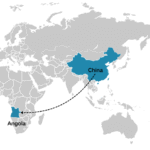
Shipping from China to Angola by sea costs roughly $1,150–$1,750 for a 20ft container and $2,100–$2,700 for a 40ft container (port-to-port, August 2026 market range), with ocean transit of 32–45 days and air freight of 4–8 days. The fastest and least risky way to move cargo is to work with a licensed forwarder who manages the CNCA loading certificate before the vessel sails — the single most common cause of fines and delays at the Port of Luanda. This guide walks you through what a freight forwarder does on the China–Angola lane, what a 2026 quote should contain, and exactly how to vet, evaluate, and contract the right partner — grounded in our daily operations as a Shenzhen-based forwarder moving thousands of containers to Angola every year. As a specialist in Shipping From China To Angola, Dantful handles everything from FCL and LCL to customs clearance and door-to-door delivery.
What Does a Freight Forwarder from China to Angola Do?
A freight forwarder is a licensed logistics intermediary that plans, books, and manages the movement of cargo between China and Angola — without necessarily owning the ships or planes. On this lane, a forwarder’s job covers six practical areas:
- Carrier booking and routing: securing space on shipping lines (Maersk, MSC, CMA CGM, COSCO) or airlines, and choosing direct or transshipment routings around the Cape of Good Hope.
- Origin handling in China: factory pickup, export customs declaration, container loading, and consolidation of goods from multiple suppliers.
- Angola compliance: obtaining the mandatory CNCA/ARCCLA loading certificate, preparing import documentation, and coordinating with licensed clearing agents in Luanda.
- Documentation: commercial invoice, packing list, bill of lading, certificate of origin, and insurance certificates.
- Cost control: negotiating freight rates and itemizing every charge so you know your landed cost before the vessel departs.
- Visibility: tracking your shipment from pickup to final delivery, with proactive alerts when schedules change.
One distinction matters when you start comparing providers: a freight forwarder is not the same as a shipping agent or a customs broker, and the three terms are often used interchangeably on this lane.
| Role | Core Responsibility | Can It Issue a Bill of Lading? | Best Fit For |
|---|---|---|---|
| Freight Forwarder | End-to-end shipment management: booking, routing, documentation, compliance, consolidation | Yes, if licensed as an NVOCC (Non-Vessel Operating Common Carrier) | Importers who want one accountable partner for the whole move |
| Shipping Agent | Representation and operational coordination for specific legs or shipments, often on behalf of a forwarder or shipper | Usually no | Buyers who already manage most of the process themselves |
| Customs Broker | Customs declaration, duty payment, and clearance at a specific port (e.g., Luanda or Lobito) | No | Importers who need clearance expertise only |
The practical takeaway: when your cargo is worth thousands of dollars and the transit is 30–45 days, you want a licensed forwarder with NVOCC status — because an NVOCC issues its own bill of lading and carries real contractual responsibility for the move. You can compare NVOCC-licensed options and read more about the licensed-agent route in our guide on the shipping agent from china to Angola.
Why You Need a Freight Forwarder for Shipping from China to Angola (2026)
Generic logistics experience is not enough on this lane. Three Angola-specific realities make a specialized forwarder the difference between a smooth shipment and a costly delay:
1. The CNCA certificate is mandatory — and it must be done before the vessel sails. Every sea freight shipment to Angola requires a CNCA (Conselho Nacional de Carregadores de Angola) loading certificate, now issued under the ARCCLA system. It must be obtained and validated at origin before the ship departs; cargo arriving in Luanda without it faces fines and holds at customs. This is the #1 compliance failure we see on the China–Angola lane, and it is invisible to forwarders who only sell “China to anywhere” capacity.
2. Luanda is a demanding port to clear. The Port of Luanda handles roughly 70–80% of Angola’s imports, and its free time is tight — typically 5–7 days before demurrage and detention charges start accruing, often at $1,000+ per day once they do. A forwarder who knows the port pre-files documentation while the vessel is at sea, negotiates extended free days with the carrier (we routinely secure 14–21 days), and can clear cargo in days rather than weeks saves you real money, not just time.
3. Angola’s tax and tariff structure needs local knowledge. Angola applies IVA (Imposto sobre o Valor Acrescentado) at 14% on most imported goods (with special rules for the Cabinda exclave), import duties vary widely by HS code, and SADC tariff provisions can reduce costs on qualifying goods. Correct HS classification and invoice valuation at origin prevent both overpayment and clearance holds.
A professional forwarder turns these three realities from risk into process — which is exactly why the rest of this guide focuses on what to look for and what to pay.
Shipping Costs from China to Angola in 2026
The market settled into a predictable range after the post-Chinese New Year stabilization. Below is the August 2026 consensus across the major China–Angola services. The first column is the port-to-port sea or airport-to-airport air rate; the second is what a door-to-door all-in service typically lands at once every charge is included.
| Service | Port-to-Port Rate (USD) | Door-to-Door All-in Range (USD) | Transit Time |
|---|---|---|---|
| 20ft FCL | $1,150–$1,750 | $4,200–$5,800 | 32–45 days |
| 40ft FCL | $2,100–$2,700 | $6,500–$8,500 | 32–45 days |
| 40HQ FCL | $2,300–$2,900 | $7,900–$9,800 | 32–45 days |
| LCL (per CBM) | $140–$200 | — | 39–55 days |
| Air freight (100kg+, per kg) | $5.8–$8.5 | — | 4–8 days |
Rates reflect August 2026 market conditions and vary weekly with carrier capacity, fuel (BAF), and peak-season pressure. The gap between the two columns is not padding — it is the destination cost chain explained in the table below. Contact us for a live, itemized quote for your specific cargo.
What Every Quote Should Break Down: Destination Charges, Explained
None of these charges are hidden — they are standard parts of the cost chain, and a professional forwarder lists them in the quote up front. This is what each line means and how to plan for it:
| Charge | What It Is & How to Plan |
|---|---|
| Ocean freight | The sea leg itself (port-to-port). Plan: compare 2–3 forwarders on the same routing and container size. |
| BAF / fuel surcharge | Bunker adjustment passed through by carriers. Plan: ask whether the quote is all-in or plus BAF at booking. |
| Origin charges (China) | Pickup, export customs declaration, container loading, and documentation at the Chinese port. Plan: confirm these are itemized — EXW buyers often underestimate them. |
| CNCA/ARCCLA certificate fee | The mandatory Angola loading certificate, issued at origin before sailing. Plan: confirm it is included in the quote; a quote without CNCA is incomplete for Angola. |
| Destination THC and port charges (Luanda/Lobito) | Terminal handling and port release fees at the destination port. Plan: ask for the current range — Luanda terminal handling is materially higher than most African ports. |
| Customs clearance fee | The licensed clearing agent’s fee in Angola, including your import declaration and duty payment handling. Plan: confirm whether IVA (14%) and duty are billed at cost with receipts. |
| Demurrage & detention (D&D) | Charged when a container stays at the terminal or in the carrier’s yard beyond free time (5–7 days at Luanda, negotiable to 14–21). Plan: confirm your forwarder’s average clearance time and free-day negotiation practice. |
| Cargo insurance | Typically 0.2–0.5% of cargo value for all-risk cover on a 30–45-day ocean transit. Plan: always insure — ocean transits to West Africa see more claims than any other region we serve. |
For a deeper breakdown of the sea leg itself, see our Sea Freight From China to Angola rate guide.
Which Incoterms Should You Buy? EXW vs FOB vs CIF vs DDP
Your choice of Incoterms decides who pays for what — and on the China–Angola lane it is usually the biggest cost mistake importers make. This table maps the responsibility split:
| Incoterm | Freight & Insurance | Export Clearance (China) | Import Clearance + IVA (Angola) | Destination Delivery | Your Total Spend |
|---|---|---|---|---|---|
| EXW | You | Supplier / you | You | You | Lowest headline price, highest workload and risk |
| FOB | You | Forwarder | You | You | Recommended: you control origin and sea-leg costs |
| CIF | Seller arranges | Seller | You | You | Convenient, but the seller controls the freight cost |
| DDP | Forwarder | Forwarder | Forwarder | Forwarder | Highest price, fully hands-off — a single locked-in invoice |
If you want a single accountable partner from factory gate to your door in Luanda, Benguela, or Huambo, DDP Shipping Services give you one all-in price with no surprises at destination. For smaller volumes, weekly consolidated freight shipping (LCL) to Luanda is a cost-effective alternative to a full container.
READ MORE:
- Shipping From China To Algeria
- Shipping From China To Angola
- Shipping From China To Morocco
- Shipping From China To Nigeria
- Shipping From China To Kenya
- Shipping From China To Tanzania
- Shipping From China To South Africa
How Long Does Shipping from China to Angola Take?
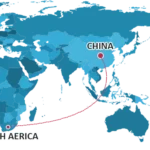
Ocean transit to Angola runs via the Cape of Good Hope (Suez routings are largely redirected), and schedules vary by port pair. Here are the working estimates we quote in August 2026:
| Origin Port (China) | Destination | FCL Transit (Days) | Routing |
|---|---|---|---|
| Shenzhen | Luanda | 32–40 | Often direct |
| Shanghai | Luanda | 35–42 | Often transshipment |
| Ningbo | Luanda | 36–45 | Often transshipment |
| Qingdao | Luanda | 42–46 | Transshipment |
| Guangzhou | Luanda | 35–40 | Often direct |
| Any above | Lobito | +4–7 days vs Luanda | Feeder or transshipment |
Plan around these buffers:
- LCL shipments add 7–10 days for consolidation at origin and deconsolidation at Luanda.
- Air freight takes 4–8 days door-to-door from major Chinese airports (PVG, CAN, SZX) to Luanda (LAD), including clearance.
- Clearance time at Luanda averages 3–5 working days with pre-filed documentation; our own average is 3.5 days, comfortably inside the standard 5–7-day free period.
- Book space 2–3 weeks ahead during Q4 peak and the weeks around Chinese New Year, when capacity tightens and rates climb.
Key Ports in Angola: Luanda, Lobito & Namibe
Knowing your destination port changes both your rate and your transit time. Three ports handle the overwhelming majority of China-bound containerized imports:
- Port of Luanda — Angola’s capital and busiest port, handling an estimated 70–80% of imports. It serves Luanda, Benguela, and the central provinces via road. Expect the tightest congestion and the highest terminal handling charges — which is why free-day negotiation and fast clearance matter most here.
- Port of Lobito — Angola’s second-largest container port, on the Atlantic coast near Benguela. It is the smarter choice for cargo destined for Huambo, the mining provinces, and the east, saving several days of inland trucking versus clearing in Luanda.
- Port of Namibe — the third-largest port by cargo volume, a natural harbor serving southern Angola (including the border trade toward Namibia). Choose Namibe for destinations in Huíla and Cunene provinces.
- Cabinda — a separate exclave province with its own port and a distinct tax regime; shipments to Cabinda need special handling and are best routed via its local port rather than trucked from Luanda.
Port-selection logic: if your final destination is Luanda or Benguela, clear at Luanda. If it is Huambo, Huíla, or the eastern provinces, compare Lobito — the extra sea days are usually offset by shorter inland trucking. A forwarder with agents at all three ports will advise this at quotation time rather than defaulting to Luanda.
Angola Customs: CNCA Certificate, IVA & Import Documents
The CNCA/ARCCLA Certificate: Non-Negotiable for Sea Cargo
The CNCA loading certificate (now processed through ARCCLA, the Angola Cargo and Logistics Regulatory Authority) is required for every sea freight shipment to Angola. Three things to know:
- It is obtained at origin, before the vessel sails — your forwarder files it in China, not in Luanda. Cargo that arrives without it is held and fined.
- It applies to FCL and LCL alike, and to most commercial cargo. There is no “small shipment” exemption for containerized goods.
- It is priced per shipment (roughly $150–$300 depending on volume) — confirm it appears in your quote, and confirm who is responsible if it is missed. A contract that does not assign CNCA responsibility is a contract with a gap.
Import Duties, IVA, and the Documents You Need
Angola’s import tax structure is simpler than many West African neighbors, but the details matter:
| Tax / Requirement | Rate / Rule |
|---|---|
| IVA (value-added tax) | 14% standard rate on most imports, calculated on CIF value plus duty; reduced or special rules apply in Cabinda |
| Import duty | Varies by HS code — typically 0–30%, with construction materials, machinery, and agricultural inputs often at the lower end |
| SADC provisions | Qualifying goods may benefit from reduced tariff treatment under SADC agreements — worth checking at classification time |
| Import license | Required for certain categories; your clearing agent verifies whether your HS code needs one |
The standard document set for an Angola shipment: commercial invoice, packing list, bill of lading (or airway bill), certificate of origin, CNCA certificate (sea), and import license where applicable. Documentation should be in Portuguese or English with full product descriptions and correct HS codes — discrepancies between invoice and cargo are the second most common cause of Luanda clearance delays after CNCA issues.
How to Choose a Reliable Freight Forwarder from China to Angola?
Vetting a forwarder on this lane is really about one question: can this company manage the three jobs inside a single China–Angola quote — the ocean leg, the CNCA and Angola customs compliance, and the Luanda/Lobito destination handling? Four checks answer it:
- Verify the license class. A forwarder that can issue its own bill of lading holds NVOCC registration; top-tier providers also hold Class-A licenses and memberships like FIATA or WCA. Anyone who cannot show these credentials cannot assume the contractual responsibility your cargo needs.
- Ask how many CNCA certificates they file per month — and who files them. If the answer is “our partner handles it” without a name or process, keep looking. This certificate is the #1 clearance risk on this lane, and it must be done in China before sailing.
- Ask for their Luanda clearance time and free-day negotiation record. A forwarder that pre-files documentation at sea and has negotiated 14–21 free days from carriers is worth more than one that saves you $200 on the sea leg and costs you $1,000/day in demurrage.
- Check they have physical agents at the destination ports. Clearing at Luanda, Lobito, or Namibe requires a licensed local partner, not a forwarding chain of subcontractors. Confirm the agent’s name and license before booking.
At Dantful International Logistics — a Class-A licensed forwarder and NVOCC based in Shenzhen since 2008, with FMC and Jctrans certifications — we file hundreds of CNCA certificates annually, hold direct contracts with major carriers, and clear cargo in Luanda in an average of 3.5 days. Our 50-operator operations team and 50+ multilingual customer-service staff provide 24/7 tracking from factory pickup to final delivery.
How to Evaluate a Freight Forwarder’s Angola Experience
Once you have shortlisted two or three forwarders, evaluate them on evidence rather than marketing:
- Request an itemized quote — and read it twice. The quote must break out ocean freight, origin charges, CNCA, destination THC, clearance, and insurance. A single-line “all-in” price with no breakdown is a red flag on this lane, because destination charges at Luanda vary widely between providers.
- Ask for lane-specific proof, not general testimonials. Request a case study or reference for cargo similar to yours (construction machinery, electronics, consumer goods) cleared through Luanda or Lobito within the last six months.
- Test their documentation competence. Ask how they handle CNCA, HS classification, and IVA payment. The quality of the answer tells you more than any brochure.
- Check response time. If a forwarder takes three days to answer a quote request, imagine the response when your container is sitting in demurrage. A dedicated account manager with same-day response is the minimum standard on this lane.
For project cargo and unusual shipments — oilfield equipment, mining machinery, or oversized units — confirm the forwarder has real experience with out of gauge cargo and Breakbulk Freight Shipping, which are common on the Angola energy corridor.
Negotiating Your Freight Forwarding Contract: Scope, Free Days & Payment Terms
A good contract protects both sides and prevents the classic disputes on this lane. Negotiate these four points before signing:
- Scope of services, in writing. The contract must list every leg: pickup, export clearance, ocean freight, CNCA, import clearance, and destination delivery (if door-to-door). Anything not listed is not included — and on Angola shipments, “not included” usually means the destination charges.
- Free days at destination. Negotiate the number of free days the carrier grants (5–7 days is standard at Luanda; 14–21 is achievable with carriers like MSC or Maersk when the forwarder has volume). Put the target in the contract, and define who is responsible if clearance overruns.
- CNCA responsibility. State explicitly that the forwarder obtains the CNCA certificate before sailing, and what the liability is if it is missed. This single line prevents the most expensive failure on this lane.
- Payment terms and quote validity. Agree on payment milestones (typically deposit at booking, balance before delivery), the validity period of the quoted rates (usually 7–14 days), and what happens if fuel or peak-season surcharges move the market mid-shipment.
Long-term partnerships pay off on this lane: repeat shippers get priority space during Q4 peak, better free-day terms, and rates that reflect history rather than spot market. A forwarder that treats you as a recurring account — rather than a one-off booking — is the partner worth keeping.
FAQs
1. How much does it cost to ship a container from China to Angola in 2026?
Port-to-port, a 20ft container runs $1,150–$1,750 and a 40ft container $2,100–$2,700 (August 2026 market range). Door-to-door all-in, budget $4,200–$5,800 for a 20ft and $7,900–$9,800 for a 40HQ once CNCA, destination THC, clearance, and inland delivery are included.
2. How long does shipping from China to Angola take?
Ocean freight takes 32–45 days port-to-port depending on origin port (Shenzhen 32–40, Shanghai 35–42, Ningbo 36–45, Qingdao 42–46). LCL adds 7–10 days. Air freight delivers in 4–8 days.
3. How much is the IVA on imports to Angola?
Angola applies IVA at 14% on most imported goods, calculated on the CIF value plus duty. Reduced or special rules apply in the Cabinda exclave, and SADC provisions can lower duty on qualifying goods.
4. What documents do I need to import into Angola?
Commercial invoice, packing list, bill of lading (or airway bill), certificate of origin, the CNCA certificate for sea cargo, and an import license where the HS code requires one. Documentation should be in Portuguese or English with correct HS codes.
Ready to ship? Choosing the best freight forwarder from China to Angola comes down to three things: a verifiable license, real CNCA and Luanda experience, and an itemized quote you understand before you commit. That is exactly the standard we hold at Dantful — Class-A licensed, NVOCC-certified, and operating the China–Angola lane daily since 2008. Send us your cargo details for a same-day itemized quote, and we will show you the full cost chain before you decide.

Young Chiu is a seasoned logistics expert with over 15 years of experience in international freight forwarding and supply chain management. As CEO of Dantful International Logistics, Young is dedicated to providing valuable insights and practical advice to businesses navigating the complexities of global shipping.
The other language versions of this article
- العثور على أفضل شركة شحن من الصين إلى أنجولا – دانتفول
- De beste expediteur vinden van China naar Angola
- Trouver le meilleur transitaire de Chine vers l’Angola
- Den besten Spediteur von China nach Angola finden
- Trovare il miglior spedizioniere dalla Cina all’Angola
- Cómo encontrar el mejor transportista de China a Angola
- Encontrando o melhor despachante de carga da China para Angola
- Поиск лучшего экспедитора из Китая в Анголу
- Çin’den Angola’ya En İyi Nakliye Komisyoncusunu Bulmak