Are you navigating the complexities of LCL shipping rates from China to the USA for your business? For small to medium-sized importers, Less than Container Load (LCL) shipping is a game-changer, allowing you to transport goods efficiently without the cost of a full container.
In this comprehensive guide, we analyze current February 2026 LCL shipping rates, explain how to calculate your chargeable weight, and compare LCL vs. FCL costs. Whether you are sourcing electronics from Shenzhen or textiles from Ningbo, this guide will help you optimize your supply chain and reduce landed costs.
Understanding LCL Shipping
What is LCL Shipping?
LCL (Less than Container Load) is a method of ocean freight where goods from multiple shippers are consolidated into a single standard container (20ft or 40ft).
- Best For: Shipments between 1 CBM and 15 CBM.
- How It Works: Your goods are collected at a Container Freight Station (CFS), loaded with other cargo, and deconsolidated at the destination port.
- Key Benefit: You only pay for the space your cargo occupies, making it the most cost-effective option for smaller volumes.
Advantages for Importers
Security: Professional consolidation reduces damage risk compared to loose break-bulk shipping. (Don’t forget to ask about cargo insurance)
Cost Efficiency: No need to pay for unused air in a full container.
Inventory Control: Ship smaller batches more frequently to improve cash flow.
Flexibility: Ideal for testing new products or managing seasonal fluctuations.
Current LCL Shipping Rates from China to the USA (February 2026)
Estimated Port-to-Port Rates
Shipping rates fluctuate based on fuel surcharges, congestion, and season. Below are estimated ranges for February 2026, based on Dantful’s internal data and Shanghai Shipping Exchange trends:
Market Alert: February 2026 rates are fluctuating. Lock in your rate today to avoid the March GRI (General Rate Increase).
| Origin Port (China) | Destination Port (USA) | Est. Rate (per CBM) | Transit Time (Days) |
|---|---|---|---|
| Shanghai | Los Angeles (LAX/LGB) | $45 – $75 | 18 – 22 |
| Shenzhen | New York (NYC/NJ) | $65 – $95 | 28 – 35 |
| Ningbo | Chicago (IPI) | $55 – $85 | 24 – 30 |
| Guangzhou | Miami | $65 – $100 | 30 – 38 |
| Xiamen | Houston | $60 – $90 | 26 – 32 |
Note: These are base ocean freight rates. Total landed cost will include local charges, customs, and delivery. For a precise quote tailored to your cargo, contact Dantful International Logistics.
Key Factors Influencing Your Costs
Destination Charges (The “CIF Trap”): DDC (Destination Delivery Charges) and deconsolidation fees at US ports are significant.
Warning: Many freight forwarders quote $0 ocean freight at the origin port to win the order, only for you to be charged $500+ at the destination. This is common with CIF terms.
Dantful’s Promise: We promise transparent pricing. Our quotes include destination estimates so you are never surprised by hidden fees. We refuse to engage in hidden cost tactics.
Volume & Weight: Rates are based on “Revenue Tons” (W/M).
Fuel (BAF): Fuel Adjustment Factors can add 10-20% to the base rate.
Seasonality:
Peak Season (Aug-Oct): Expect higher rates and congestion due to holiday stocking.
Pre-CNY (Jan): Rush before Chinese New Year spikes demand.
General Rate Increases (GRI): Carriers may apply surcharges monthly based on demand.rcharges monthly based on demand.
READ MORE:
- Shipping From China to the United States
- Shipping From China TO Canada
- Shipping From China TO Mexico
- Shipping From China to Panama
- Shipping From China to Costa Rica
- Shipping From China to Brazil
- Shipping From China TO Colombia
- Shipping From China to Jamaica
- Shipping From China to Venezuela
How to Calculate LCL Shipping Costs: CBM vs. Weight
One of the most confusing aspects for new importers is the “Chargeable Weight”. LCL is charged based on W/M (Weight or Measure), whichever is higher.
The Rule: 1 CBM = 1,000 KG
- Volume: Cubic Meters (Length x Width x Height in meters).
- Weight: Gross Weight in Kilograms.
Scenario A: Light & Bulky (Charged by Volume)
- Cargo: 2 Pallets
- Volume: 3 CBM
- Weight: 500 KG
- Comparison: 3 CBM > 0.5 Tons (500 KG)
- Billable Unit: 3 CBM
Scenario B: Heavy & Dense (Charged by Weight)
- Cargo: Steel Parts
- Volume: 1 CBM
- Weight: 1,500 KG
- Comparison: 1 CBM < 1.5 Tons (1,500 KG)
- Billable Unit: 1.5 CBM (Revenue Tons)
Tip: Always optimize your packaging to reduce dead space and lower your CBM.er your CBM.eeds.
LCL vs. FCL: Which Should You Choose?
Cost Comparison Table
Is it cheaper to ship LCL or upgrade to a Full Container (FCL)?
| Feature | LCL (Less than Container Load) | FCL (Full Container Load) |
|---|---|---|
| Volume Sweet Spot | 1 – 13 CBM | 14+ CBM (20ft Container) |
| Cost Basis | Per CBM / Ton | Per Container (Fixed) |
| Speed | Slower (requires consolidation) | Faster (direct loading) |
| Handling Risk | Moderate (multiple handling) | Low (sealed at origin) |
| Customs | Shared entry (sometimes complex) | Individual entry |
When to Switch to FCL?
If your shipment exceeds 13-15 CBM, FCL might be cheaper even if the container isn’t full, due to the flat rate and lower destination handling fees.
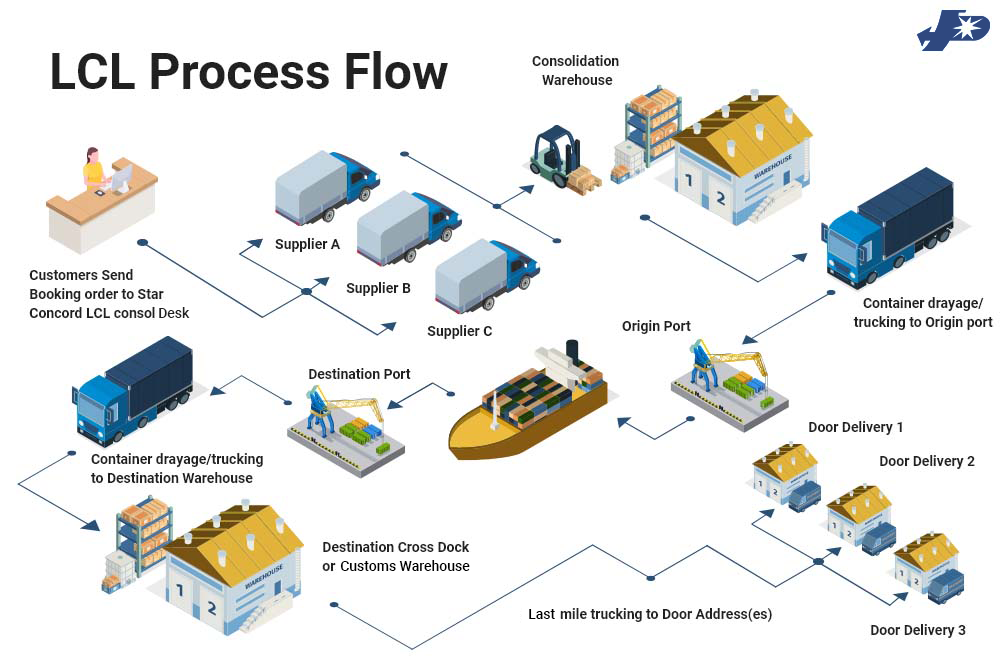
The LCL Shipping Process: Step-by-Step
- Booking & Pickup: Your freight forwarder arranges pickup from the supplier’s factory (EXW) or the supplier delivers to the warehouse (FOB).
- Consolidation (CFS): Goods are measured, weighed, and loaded into a container with other shipments.
- Export Customs: The container is cleared for export from China.
- Ocean Transit: The vessel sails to the USA (e.g., Long Beach, NY).
- Deconsolidation: At the destination warehouse, the container is unpacked, and shipments are separated.
- Import Customs: Duties and taxes are paid.
- Final Delivery: Goods are trucked to your door (DDP/DDU).
Essential Documents for LCL Imports
To avoid customs delays, ensure these documents are accurate:
- Commercial Invoice: Must list true value and HS Codes.
- Packing List: Details package count, weight, and dimensions.
- Bill of Lading (B/L): For LCL, this is usually a House Bill of Lading (HBL).
- Arrival Notice: Issued by the destination agent upon arrival.
- ISF (10+2) Filing: Must be filed 24 hours before loading at the Chinese port.
Tips for Reducing LCL Shipping Costs
- Consolidate Suppliers: If buying from multiple factories, ask Dantful to combine them into one LCL shipment to save on docs and clearance fees.
- Buy FOB Terms: Buying FOB (Free on Board) gives you control over the freight forwarder and rates, avoiding hidden “CIF” destination fees.
- Plan Ahead: Ship during off-peak seasons (March-June) to get better rates.
- Packaging: Stackable pallets reduce damage risk and optimize volume.
Why Choose Dantful International Logistics?
For businesses shipping from China to the USA, Dantful International Logistics stands out as a highly professional, cost-effective choice.
- Transparent Pricing: No hidden destination fees.
- US-Centric Expertise: Deep knowledge of US Customs, ISF filing, and door-to-door delivery.
- One-Stop Solution: We handle pickup, consolidation, customs, and final delivery.
- Real-Time Updates: Keep track of your cargo every step of the way.
Ready to ship? Get a Free LCL Shipping Quote & Volume Optimization Plan Today and let us handle the logistics while you focus on growing your business.gistics while you focus on growing your business.
FAQs
1. How much is LCL shipping from China to the USA per kg?
LCL is typically priced per CBM, not kg. However, if converted, rates roughly range from $0.15 to $0.40 per kg depending on density, plus destination charges. For precise weight-based quotes, air freight might be a comparison point.
2. How long does LCL shipping take?
LCL takes slightly longer than FCL due to consolidation.
- West Coast: 18-25 days (Port to Port)
- East Coast: 28-40 days (Port to Port)
- Add 5-7 days for consolidation and deconsolidation.
3. Is LCL cheaper than Air Freight?
Yes, LCL is significantly cheaper—often 80-90% less than air freight. Air freight is recommended only for urgent shipments under 300kg or high-value goods.
4. What are the “hidden” costs in LCL?
Common extra costs include CFS charges (Container Freight Station fees), DDC, and ISF filing fees. Buying on CIF terms often leads to inflated destination fees. We recommend shipping FOB or EXW with a US-focused forwarder like Dantful to control these costs.
5. How to calculate LCL freight charges?
LCL charges are based on the greater of the cargo’s volume (in CBM) or weight (in metric tons), following the rule that 1 CBM = 1,000 KG; whichever is greater is used as the chargeable unit.
6. What is the minimum weight for LCL shipment?
The minimum chargeable volume for LCL shipments is usually 1 CBM. Even if your shipment is smaller (e.g., 0.5 CBM), carriers typically charge based on the 1 CBM minimum.

Young Chiu is a seasoned logistics expert with over 15 years of experience in international freight forwarding and supply chain management. As CEO of Dantful International Logistics, Young is dedicated to providing valuable insights and practical advice to businesses navigating the complexities of global shipping.