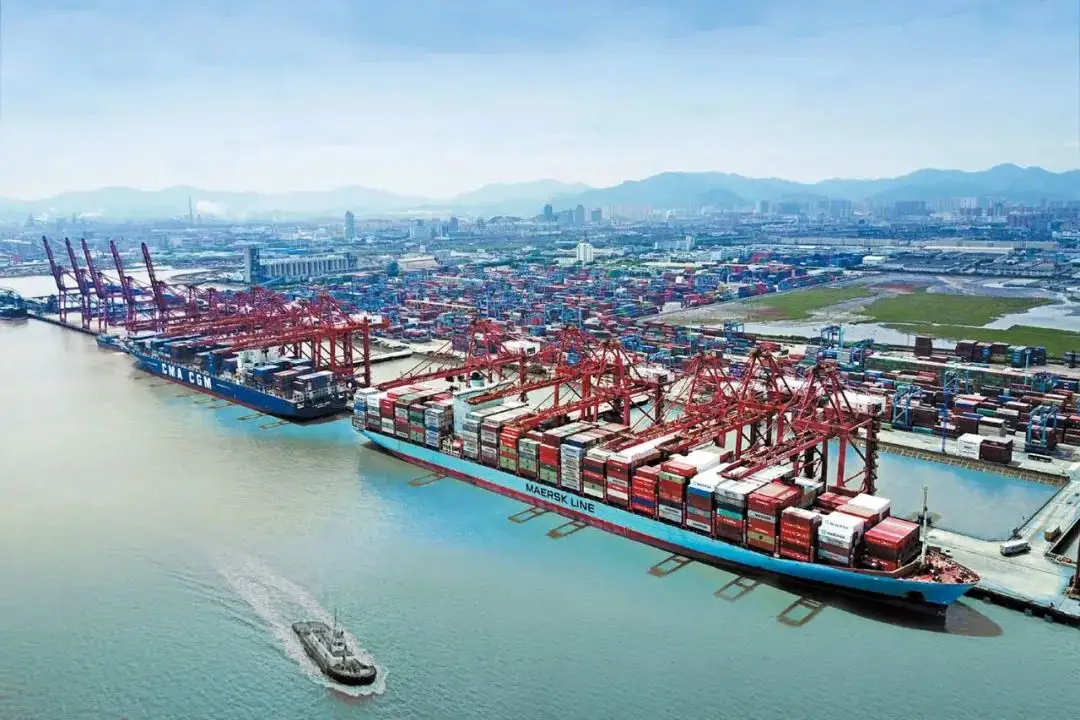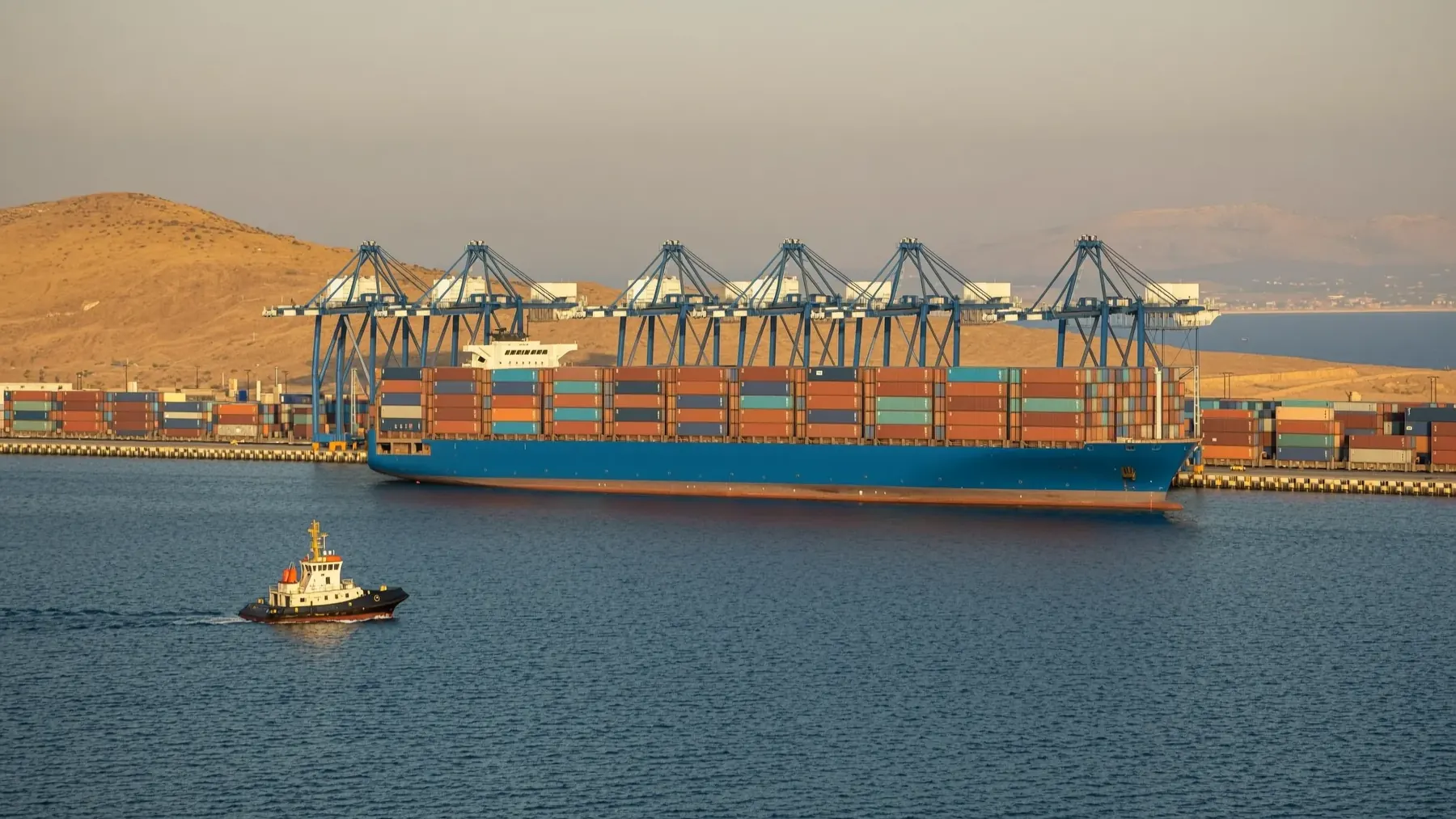
If you source products from China and need to ship them to the Middle East, knowing which port to route your cargo through isn’t just trivia — it’s a decision that directly impacts your transit time, import duties, and overall supply chain reliability. The top 10 port in Middle East rankings have shifted significantly over the past two years, driven by Saudi Arabia’s aggressive Vision 2030 infrastructure investments, Oman’s emergence as a Hormuz-proof logistics corridor, and Jebel Ali’s continued dominance as the region’s undisputed transshipment king. In 2024 alone, Jebel Ali handled 15.5 million TEUs — its highest figure since 2015 — while Dammam posted a staggering 37% year-over-year growth in the first half of the year.
In this guide, you’ll get more than a list. We break down every major Middle Eastern port by what actually matters to an importer: real-world transit times from Chinese departure ports, which cargo types each port handles best, how to navigate local customs requirements, which free zones offer genuine cost advantages, and — critically — how to keep your shipments moving when geopolitical tensions disrupt the Strait of Hormuz or Red Sea routes. Whether you’re shipping FCL containers of consumer electronics, LCL consolidated pallets, or breakbulk project cargo, this guide will help you pick the right destination port with confidence.
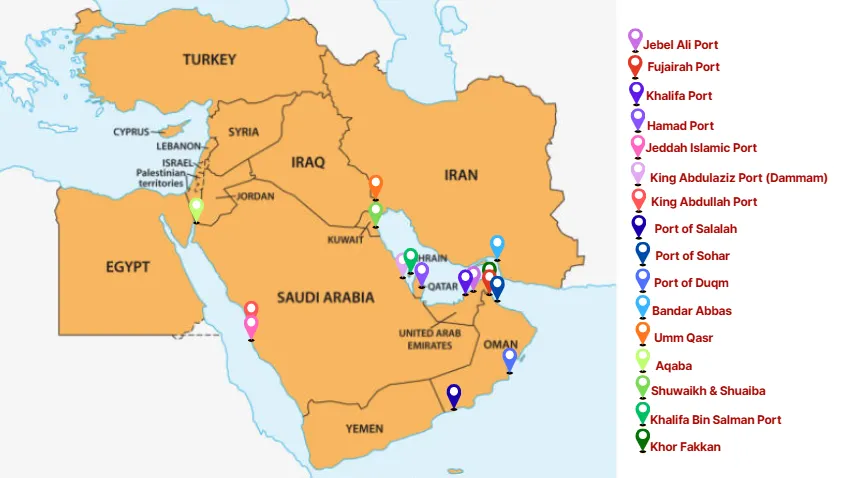
UAE & Qatar — Persian Gulf Giants
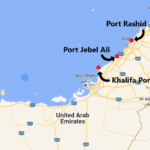
The Persian Gulf is home to the Middle East’s three largest container ports by throughput, and the UAE alone hosts four of the region’s most strategically significant maritime facilities. If you’re shipping from China to the UAE, there’s a high probability your cargo will touch at least one of these ports.
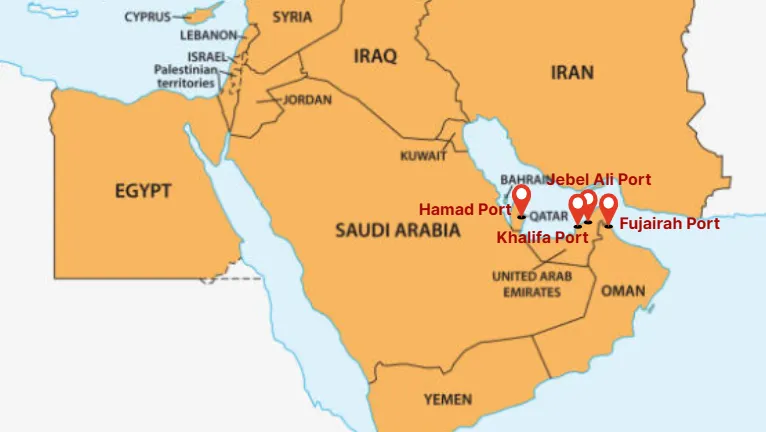
Jebel Ali Port (Dubai, UAE) — The Undisputed King of Middle East Ports
Jebel Ali isn’t just the busiest port in the Middle East — it’s the ninth-busiest container port on the planet. Operated by DP World, it handled 15.5 million TEUs in 2024 with an annual capacity of 19.4 million TEUs across four terminals and 77 berths. To put that in perspective: Jebel Ali alone accounts for roughly 18% of DP World’s entire global throughput.
What makes Jebel Ali genuinely unique isn’t just its size — it’s the Jebel Ali Free Zone (JAFZA) adjacent to the port. This is the single most important logistics feature in the Middle East for importers. Goods entering JAFZA pay 0% customs duty and 0% VAT, and can be stored, processed, repackaged, or re-exported without ever technically entering the UAE mainland. For importers serving multiple GCC markets, East Africa, or Central Asia, this is a game-changer: you consolidate shipments in JAFZA and distribute on demand, avoiding redundant customs procedures at every destination.
From China to Jebel Ali:
| Origin Port (China) | Transit Time (Days) | Recommended Carrier Options |
|---|---|---|
| Shenzhen (Yantian/Shekou) | 18–22 | COSCO, CMA CGM, Maersk, OOCL |
| Shanghai | 20–25 | COSCO, MSC, Evergreen |
| Ningbo | 19–23 | COSCO, Maersk, ONE |
| Qingdao | 22–27 | COSCO, CMA CGM, Hapag-Lloyd |
| Guangzhou (Nansha) | 18–22 | COSCO, OOCL, MSC |
| Xiamen (direct call) | 12–15 | COSCO, Evergreen |
Xiamen’s direct Jebel Ali service is notably fast — roughly 12–15 days — because it bypasses intermediate transshipment hubs. If speed matters and you can truck cargo to Xiamen, this is worth considering.
Best cargo types: Consumer electronics, textiles, furniture, building materials, automotive parts, and anything destined for re-export to GCC, Africa, or CIS markets.
Importer’s checklist for Jebel Ali:
- Incoterms: FOB or CIF Jebel Ali are standard. If you want a truly hands-off experience, DDP to Jebel Ali is available through experienced freight forwarders.
- Customs tip: UAE requires Chamber of Commerce certification on all commercial documents. Product labels should be bilingual (Arabic + English). Missing this detail is one of the most common reasons for container holds.
- Free zone vs. mainland: If re-exporting ≥50% of your cargo, use JAFZA. If selling primarily within the UAE, mainland clearance (~5% duty + 5% VAT) may be simpler despite the higher cost.
- Multimodal hack: Jebel Ali Port is 15 minutes from Al Maktoum International Airport (DWC). For time-sensitive cargo, the sea-air combination — ocean freight to Jebel Ali, then air freight onward — cuts 40–60% off pure air freight costs while saving 10–15 days versus pure ocean.
Khalifa Port (Abu Dhabi, UAE) — The Tech-Driven Future Hub
While Jebel Ali dominates the conversation, Khalifa Port in Abu Dhabi has quietly positioned itself as the smartest port in the Gulf. With approximately 4.9 million TEUs handled in 2023 and a target capacity of 15 million TEUs by 2030, it’s on an aggressive growth trajectory that importers should pay attention to.
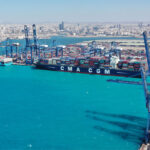
Khalifa Port’s standout feature is its deep integration with COSCO Shipping. The CSP Abu Dhabi Terminal — a COSCO-built and operated facility within the port — gives Chinese exporters a direct, first-party logistics chain from origin to destination. If you ship with COSCO, your containers call at a terminal that COSCO itself manages, which means smoother coordination, fewer handoffs, and better visibility.
The port features semi-automated container terminals, autonomous port trucks, AI-powered tracking, and automated gate systems — all of which translate to faster turnaround times and fewer delays compared to manually operated facilities. It’s also connected to Etihad Rail, the UAE’s national railway network, enabling seamless inland distribution.
From China to Khalifa Port:
| Route | Transit Time | Notes |
|---|---|---|
| Shanghai/Ningbo → Khalifa | 20–24 days | COSCO direct service available |
| Shenzhen → Khalifa | 19–23 days | Multiple weekly sailings |
| Qingdao → Khalifa | 23–28 days | Transshipment via Singapore or Jebel Ali |
Best cargo types: Industrial equipment, steel, chemicals, project cargo, and raw materials destined for KIZAD-based manufacturing facilities.
Importer’s checklist for Khalifa Port:
- Jebel Ali vs. Khalifa: Khalifa is better suited for industrial/B2B cargo and companies setting up manufacturing in KIZAD (Khalifa Industrial Zone). Jebel Ali remains superior for consumer goods and re-export.
- KIZAD advantage: Companies that establish operations within KIZAD benefit from 0% corporate tax, 0% import duties on raw materials, and full foreign ownership — a package that makes local manufacturing economically viable.
- Rail connectivity: If your final destination is anywhere along the Etihad Rail network, Khalifa Port offers lower inland transportation costs than trucking from Jebel Ali.
Hamad Port (Qatar) — The GCC Efficiency Champion
Qatar’s Hamad Port is the newest major port in the Gulf, inaugurated in 2017 with fully modern infrastructure. It handles approximately 1.46 million TEUs annually and ranks 1st in the GCC and 11th globally on the World Bank’s Container Port Performance Index (CPPI) 2024 — a metric that measures vessel turnaround time and operational efficiency.
With an 18-meter draft, Hamad Port can accommodate the world’s largest container vessels. Transshipment volumes now approach 50% of total throughput, with growing feeder networks connecting to South Asia and East Africa.
From China to Hamad Port:
Most shipments from China to Qatar arrive via transshipment through Jebel Ali or Salalah. Direct services from major Chinese ports are less frequent — typical transit times range from 22 to 30 days depending on the transshipment connection.
Best cargo types: Construction materials, hotel supplies, consumer goods, and food products. Post-World Cup 2022, Qatar’s infrastructure spending continues with major projects in transport and tourism.
Importer’s checklist for Hamad Port:
- Qatar enforces import standards comparable to Saudi Arabia’s SASO system. Products must comply with Qatar General Organization for Standards and Metrology (QS) regulations.
- For lower-volume shipments, consolidating via Jebel Ali and trucking across the Saudi-UAE-Qatar land border is often more economical than a direct LCL service.
Fujairah (UAE) — The Critical Contingency Port
Fujairah is the world’s second-largest ship bunkering hub, serving over 12,000 vessels annually with refueling services. But for importers, its real strategic value lies in its location: Fujairah sits on the UAE’s Indian Ocean coast, outside the Strait of Hormuz. When tensions escalate in the Gulf — as they periodically do — Fujairah becomes a vital fallback option for container and breakbulk cargo that would otherwise need to transit the Strait.
The port handles a diverse mix of cargo: oil storage and transfer, dry bulk, containers, and cruise vessels. Its multi-purpose flexibility makes it a useful alternative when primary Gulf ports face congestion or security-driven delays.
From China to Fujairah:
Most Chinese shipments reach Fujairah via feeder connections from Jebel Ali or Salalah. Transit times are approximately 20–28 days depending on routing. In contingency scenarios where Hormuz is disrupted, carriers may offer direct calls to Fujairah as an alternative.
Best cargo types: Oil and gas equipment, pipes, bulk commodities, and containerized cargo during Gulf security contingencies.
Importer’s checklist for Fujairah:
- This is primarily a contingency option, not a default destination. Have it in your logistics contingency plan, but don’t route regular container shipments here unless there’s a specific strategic reason.
- The port’s container handling infrastructure, while functional, is not comparable to Jebel Ali or Khalifa. Factor in additional handling time for containerized cargo.
Saudi Arabia — Red Sea & Gulf Powerhouses
Saudi Arabia’s port sector is undergoing the most dramatic transformation in the Middle East. Under Vision 2030, the Kingdom is investing billions of dollars to expand port capacity, privatize terminal operations, and position itself as a global logistics hub connecting three continents. Three Saudi ports now rank among the world’s top 100 by container throughput — and all are actively expanding.
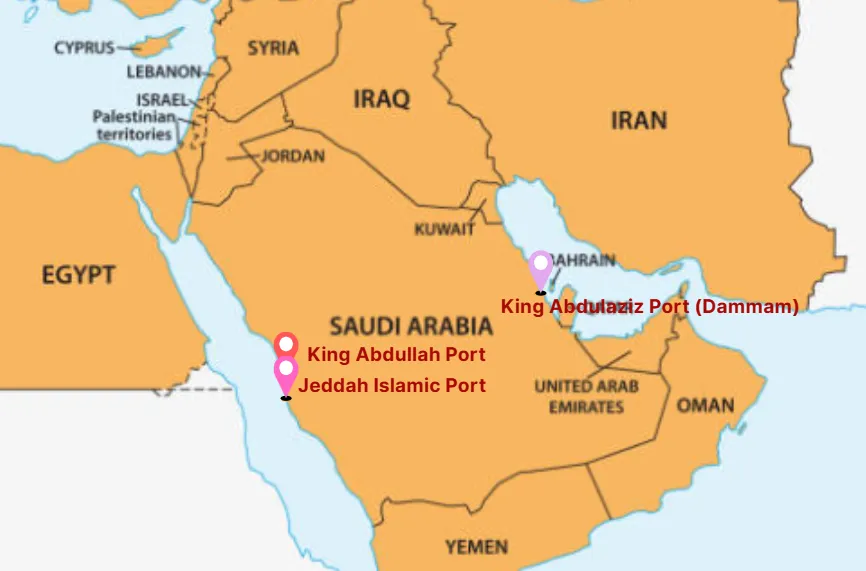
Jeddah Islamic Port — The Red Sea Gateway
Jeddah Islamic Port is Saudi Arabia’s busiest maritime entry point, handling approximately 5.6 million TEUs in 2024 — a 12.6% increase that propelled it from 41st to 32nd on Lloyd’s List global rankings. The port receives 3,805 vessels annually and processes roughly 70% of Saudi Arabia’s total imports by value.
A $240 million infrastructure overhaul is currently underway for the South Container Terminal, targeting 5 million TEU capacity. The Red Sea Gateway Terminal is also expanding, and the port’s Port Community System now offers over 250 electronic services — from vessel scheduling to customs clearance — reducing paperwork delays significantly.
From China to Jeddah:
| Origin Port (China) | Transit Time (Days) | Route |
|---|---|---|
| Shenzhen (Yantian) | 22–26 | Red Sea via Suez |
| Shanghai | 23–28 | Red Sea via Suez |
| Ningbo | 22–27 | Red Sea via Suez |
| Qingdao | 25–30 | Red Sea via Suez |
Red Sea disruption note: As of 2024–2025, Houthi attacks on commercial shipping in the Red Sea have forced some carriers to reroute via the Cape of Good Hope, adding approximately 16 days to transit times. Always confirm your carrier’s current routing before booking.
Best cargo types: Consumer goods, electronics, building materials, vehicles, and food products destined for western and central Saudi Arabia.
Importer’s checklist for Jeddah:
- SASO Certificate of Conformity is mandatory for all regulated products imported into Saudi Arabia. Without it, your container will not clear customs — full stop.
- Saudi Customs requires precise product descriptions on all documentation. A vague description like “household items” will trigger inspection delays. List specific items with HS codes.
- Ramadan timing is critical: In the 20 days before Ramadan, Jeddah experiences severe congestion as importers rush to stock inventory. Ship early or expect delays. During Ramadan itself, port operating hours are reduced.
King Abdulaziz Port (Dammam) — The Arabian Gulf Powerhouse
Dammam’s King Abdulaziz Port is the largest port on the Persian Gulf and Saudi Arabia’s most important eastern gateway. It handled approximately 2.3 million TEUs in 2024 — a 13.1% year-over-year increase — and set a regional record by processing 20,645 TEUs from a single vessel. In the first half of 2024 alone, it moved 1.53 million TEUs, representing 37% year-over-year growth.
Operated by Saudi Global Ports (a joint venture between Saudi Arabia’s Public Investment Fund and Singapore’s PSA International), Dammam is undergoing a 120% capacity expansion to keep pace with demand. It already commands a 51.1% share of Saudi Arabia’s standard container market and handles 35% of the Kingdom’s total inbound cargo by tonnage.
Dammam’s killer feature is the Middle East’s longest railway connection: a direct freight rail line linking the port to Riyadh, Saudi Arabia’s capital and largest city, located 400 km inland. For importers serving the Riyadh market, this rail connection is significantly cheaper and more reliable than trucking from Jeddah (which would require a ~900 km cross-country haul).
From China to Dammam:
| Origin Port (China) | Transit Time (Days) | Notes |
|---|---|---|
| Shenzhen | 22–28 | Persian Gulf route, via Strait of Hormuz |
| Shanghai | 23–28 | Persian Gulf route |
| Ningbo | 22–27 | Persian Gulf route |
| Qingdao | 24–30 | Persian Gulf route |
Best cargo types: Construction materials, machinery, steel products, pipes, vehicles, and heavy equipment destined for eastern and central Saudi Arabia.
Importer’s checklist for Dammam:
- Dammam → Riyadh railway: The most cost-effective inland transport option. Book rail capacity in advance — demand outstrips supply during peak construction seasons.
- Summer heat is no joke: Persian Gulf temperatures reach 50°C (122°F) from May through September. Heat-sensitive cargo — tires, bitumen, certain chemicals, electronics — requires climate-controlled containers or specialized storage. Vessel air conditioning systems must run continuously during port calls.
- Demurrage & detention: Saudi Arabia enforces strict free-time limits. Factor in an extra 5–7 days for customs clearance in your planning; exceeding free time can add hundreds of dollars per container in charges.
King Abdullah Port — The Private-Sector Pioneer
Located within King Abdullah Economic City (KAEC) on the Red Sea coast, King Abdullah Port is Saudi Arabia’s first fully privately owned and operated port. With approximately 2.93 million TEUs handled in 2023, it ranks 70th globally — but its efficiency credentials are outstanding: it topped the World Bank CPPI global rankings in 2021, making it the highest-rated container port in the world that year.
King Abdullah Port offers duty-free zones and business-friendly policies within the KAEC framework, making it an attractive entry point for companies investing in Saudi manufacturing or logistics operations. Crucially, it’s on the Red Sea — no Strait of Hormuz transit required.
From China to King Abdullah Port:
Transit times are comparable to Jeddah (22–28 days), as both ports share the same Red Sea approach. The port’s newer infrastructure means faster berthing and turnaround times compared to older regional facilities.
Best cargo types: Project cargo for KAEC developments, consumer goods, building materials, and manufacturing inputs for companies setting up within the economic city.
Oman — Arabian Sea Strategic Hubs
Oman’s ports have become disproportionately important in the last two years — not because of their raw throughput numbers, but because of their geography. All three of Oman’s major ports sit on the Arabian Sea, outside the Strait of Hormuz. When tensions close the Strait or Houthi attacks disrupt the Red Sea, Omani ports become the region’s most valuable logistics insurance policy.
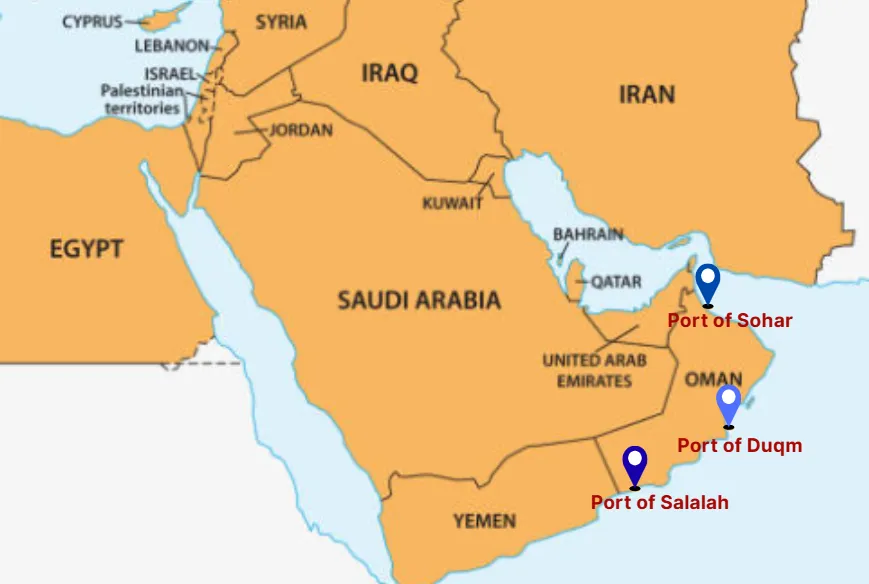
Port of Salalah — The Efficiency Benchmark
Salalah is the most interesting port in the Middle East that most importers haven’t heard of. It handles 3.8–4.5 million TEUs annually and was ranked the second most efficient container port on the planet by the World Bank’s CPPI in 2023 — behind only Yangshan in China. It’s also one of the world’s largest exporters of gypsum.
Salalah’s strategic advantage is straightforward: it sits on the Arabian Sea coast of southern Oman, roughly 1,200 kilometers from the Strait of Hormuz. Ships calling at Salalah don’t need to enter the Persian Gulf at all. For importers, this means Salalah can serve as a “safe harbor” discharge point when Gulf routes are disrupted, with cargo trucked overland to the UAE or Saudi Arabia.
From China to Salalah:
| Route | Transit Time | Notes |
|---|---|---|
| Shenzhen → Salalah | 15–20 days | Indian Ocean direct routing |
| Shanghai → Salalah | 16–21 days | Indian Ocean direct routing |
The transit time from southern China to Salalah is often shorter than to Jebel Ali because ships don’t need to navigate through the Strait of Hormuz.
Importer’s checklist for Salalah:
- Salalah → Dubai land bridge: Approximately 12–14 hours by truck on well-maintained highways. This is a viable alternative to direct Jebel Ali calls when the Gulf is disrupted.
- Customs clearance at Salalah is efficient and less congested than Persian Gulf alternatives.
- Best suited for transshipment cargo and imports where final delivery flexibility is valuable.
Port of Sohar — The Industrial & Breakbulk Hub
Sohar is Oman’s largest breakbulk and industrial port, and it sits adjacent to the China-Oman Industrial Park — a flagship Belt and Road Initiative project. This makes Sohar uniquely relevant for Chinese manufacturers establishing a Middle Eastern production presence.
Sohar is also outside the Strait of Hormuz, making it a strategic alternative entry point. The trucking distance from Sohar to Dubai is just 4–5 hours — comparable to driving from Shanghai to Nanjing.
Best cargo types: OOG freight (out-of-gauge cargo), heavy machinery, steel products, pipes, and breakbulk project cargo. If your shipment doesn’t fit in a standard container, Sohar should be on your shortlist.
Port of Duqm — The Rising Star
Duqm is a new deep-water port with a dry dock facility, built as part of a strategic China-Oman cooperation framework. It’s designed specifically for ultra-heavy and oversized project cargo — the kind that requires specialized handling equipment and cannot be processed at conventional container terminals.
Duqm’s dry dock is one of the few facilities in the region capable of handling equipment like wind turbine components, oil rig modules, and heavy industrial machinery. The surrounding industrial zone offers vast undeveloped land for future manufacturing and logistics operations.
Best cargo types: Oil and gas equipment, wind energy components, large-scale engineering project cargo, and industrial machinery.
Iran & Iraq — Emerging Gateways
These two ports represent some of the most underserved — yet commercially significant — destinations for Chinese exports. They’re rarely covered in English-language port rankings, which makes them valuable differentiators for importers willing to navigate the complexity.
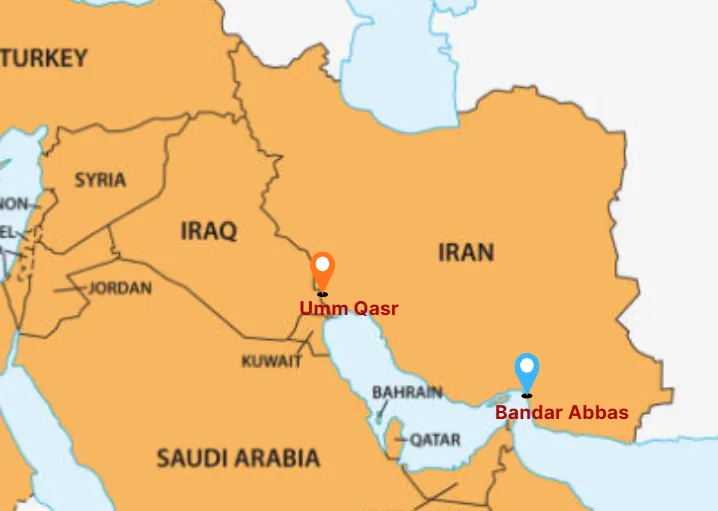
Bandar Abbas (Iran) — Iran’s Maritime Gateway
Bandar Abbas is Iran’s largest port, handling over 90% of the country’s seaborne trade. It sits on the northern shore of the Strait of Hormuz, directly facing the narrowest point of this critical waterway. The Shahid Rajaee Container Terminal — the port’s primary container facility — continues to expand capacity to meet growing import demand.
Iran is one of China’s largest trading partners in the Middle East, importing vast quantities of steel, machinery, chemicals, electronics, and automotive components. Bandar Abbas is the entry point for virtually all of it.
From China to Bandar Abbas:
| Origin Port (China) | Transit Time (Days) |
|---|---|
| Shanghai | 18–22 |
| Ningbo | 18–22 |
| Shenzhen | 19–23 |
| Qingdao | 21–26 |
Importer’s checklist for Bandar Abbas:
- ⚠️ Sanctions compliance is non-negotiable: Shipments to Iran must be screened against OFAC, UN, and EU sanctions lists. Certain goods, dual-use technologies, and financial transactions are restricted. Always engage a freight forwarder with sanctions compliance expertise — Dantful’s team regularly handles compliant shipments to Iran and ensures all documentation meets international regulatory standards.
- Iranian customs procedures are complex and document-intensive. DDP (Delivered Duty Paid) is strongly recommended — it transfers the customs risk to the seller or forwarder who has local expertise.
- Payment terms are typically Letter of Credit (L/C) or advance payment. Working with a freight forwarder that has established relationships with Iranian banks and local agents simplifies the process considerably.
Umm Qasr (Iraq) — Iraq’s Only Deepwater Port
Umm Qasr is Iraq’s sole deepwater seaport, handling over 90% of the country’s imports. Post-conflict reconstruction has driven sustained demand for building materials, power generation equipment, vehicles, consumer goods, and infrastructure supplies — much of it sourced from China.
The port faces significant operational challenges: the approach channel limits vessel draft to approximately 11 meters, meaning large container ships must offload onto barges or feeder vessels at anchorage before docking. Port congestion is common, particularly during peak import periods.
From China to Umm Qasr:
Transit times range from 20–28 days depending on routing and transshipment connections. Most services connect via Jebel Ali or other Gulf hubs.
Importer’s checklist for Umm Qasr:
- Barge transfers are the norm: Large vessels can’t dock directly due to draft restrictions. Budget an additional 5–10 days for barge operations and factor in higher handling costs.
- Cargo insurance is essential: Given the port’s infrastructure limitations and regional security considerations, comprehensive cargo insurance — covering war risk and theft — is not optional. Dantful offers tailored cargo insurance policies specifically designed for high-risk routes.
- Iraqi customs clearance is among the most complex in the region. Using a freight forwarder with established local agency relationships in Iraq — rather than attempting to coordinate with an unfamiliar local broker — can mean the difference between a 3-day clearance and a 3-week hold.
Jordan, Kuwait & Bahrain — Other Key Regional Ports
These ports handle smaller volumes than the Gulf giants but serve specific trade corridors where they’re often the only viable option.
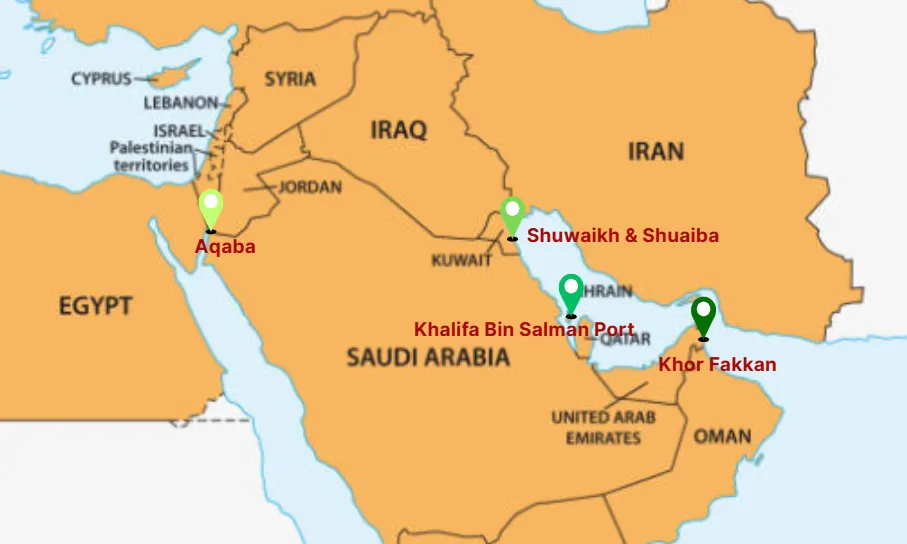
Aqaba (Jordan) — The Levant Gateway
Jordan’s only seaport, Aqaba sits at the northern tip of the Red Sea and serves as the primary maritime gateway for Jordan, Syria, Lebanon, and western Iraq. Operated by APM Terminals, it handles containerized and general cargo with regular Red Sea liner services. For humanitarian supplies, pharmaceutical imports, and reconstruction materials destined for the Levant region, Aqaba is irreplaceable.
Shuwaikh & Shuaiba (Kuwait)
Kuwait’s two primary commercial ports handle steel, prefabricated buildings, oilfield equipment (Shuwaikh) and petrochemical products and bulk commodities (Shuaiba). The market is small but stable, with consistent demand driven by Kuwait’s oil-sector procurement and infrastructure maintenance.
Khalifa Bin Salman Port (Bahrain)
Bahrain’s main commercial port, also operated by APM Terminals, benefits from the island’s free trade zone policies. It’s increasingly used as a transshipment point for cargo destined for Saudi Arabia’s Eastern Province, accessible via the King Fahd Causeway. Importers serving the Dammam–Dhahran–Al Khobar corridor from a duty-free base should consider Bahrain as a strategic alternative.
Khor Fakkan (UAE, Sharjah)
Sharjah’s deep-water container port on the Indian Ocean coast — outside the Strait of Hormuz — is operated by Gulftainer. With the capacity to handle the largest container vessels, Khor Fakkan serves as a critical bypass option when Gulf shipping lanes face disruption. It’s connected to Sharjah’s inland free zones, offering duty-free storage and distribution capabilities similar to JAFZA but with a lower profile.
Port Comparison — Side-by-Side Rankings & Key Metrics
The chart and table below provide a direct comparison of every major Middle Eastern port covered in this guide. Use them as quick-reference decision tools when evaluating destination options.
| Port | Country | TEU Throughput (Latest) | Global Rank (Lloyd’s) | World Bank CPPI | Transit from Shenzhen (Days) | Free Zone | Best For |
|---|---|---|---|---|---|---|---|
| Jebel Ali | UAE | 15.5M (2024) | Top 10 | #26 (2024) | 18–22 | ✅ JAFZA | Re-export, consumer goods, transshipment |
| Jeddah Islamic | Saudi Arabia | 5.6M (2024) | #32 | — | 22–26 | ❌ | Saudi western/central market |
| Khalifa | UAE | 4.9M (2023) | #40 | — | 19–23 | ✅ KIZAD | Industrial cargo, manufacturing inputs |
| Salalah | Oman | 3.8–4.5M | #52 | #2 (2023) | 15–20 | ❌ | Transshipment, Hormuz bypass |
| King Abdullah | Saudi Arabia | 2.93M (2023) | #70 | #1 (2021) | 22–28 | ✅ KAEC | Private-sector projects, KAEC investors |
| Dammam | Saudi Arabia | 2.3M (2024) | #82 | — | 22–28 | ❌ | Riyadh market (rail), construction materials |
| Hamad | Qatar | 1.46M | — | #11 (2024) | 22–30 | ❌ | Qatar domestic, GCC efficiency |
| Bandar Abbas | Iran | N/A | — | — | 19–23 | ❌ | Iran market, steel, machinery |
| Fujairah | UAE | N/A | — | — | 20–28 | ❌ | Contingency routing, energy cargo |
| Umm Qasr | Iraq | N/A | — | — | 20–28 | ❌ | Iraq reconstruction, project cargo |
| Aqaba | Jordan | N/A | — | — | 20–26 | ❌ | Levant gateway, humanitarian supplies |
| Sohar | Oman | N/A | — | — | 16–21 | ❌ | Breakbulk/OOG, China-Oman Park |
How to Read These Rankings
A higher TEU number doesn’t always mean a better choice. Three scenarios illustrate why:
- Speed-first: You need cargo in the Middle East fast. Salalah offers 15–20 days from Shenzhen with no Strait of Hormuz delay risk — the fastest route in the region for southern Chinese exporters.
- Cost-first: Jebel Ali via JAFZA gives you 0% duty on re-exports. If your business model involves regional distribution, the duty savings alone can offset the marginally higher ocean freight.
- Risk-first: If your shipment timeline overlaps with regional tensions, the Oman land-bridge via Salalah or Sohar provides an insurance policy that a direct Gulf routing cannot match.
How to Choose — Matching the Right Port to Your Shipping Needs
After 15 years of managing freight from Shenzhen to every major Middle Eastern port, here’s the decision framework our team at Dantful uses with clients:
| Your Scenario | Recommended Port | Why |
|---|---|---|
| Re-exporting to GCC, Africa, or Central Asia | Jebel Ali + JAFZA | Duty-free storage and redistribution; best global connectivity |
| Selling directly to Saudi consumers or retailers | Jeddah (western) or Dammam (eastern/central) | Closest port to end market; lowest inland transport cost |
| Amazon FBA (UAE or Saudi marketplace) | Jebel Ali or Khalifa | Amazon fulfillment centers are concentrated near these hubs |
| Large-scale industrial or construction project | Duqm, Sohar, or Khalifa | Dry dock, breakbulk handling, heavy-lift capability |
| Iran or Iraq market (complex compliance) | Bandar Abbas / Umm Qasr | Only viable deepwater entry points; DDP strongly recommended |
| Hormuz or Red Sea disruption contingency | Salalah or Sohar → truck to UAE/Saudi | Avoids both chokepoints entirely |
As a Class-A licensed freight forwarder with NVOCC, FMC, and Jctrans certifications, and a team of over 50 operations specialists managing China-to-Middle East routes daily, Dantful International Logistics provides end-to-end shipping solutions tailored to your destination port. Whether you need FCL or LCL ocean freight, door-to-door DDP delivery, Amazon FBA prep and forwarding, or customs brokerage in any Middle Eastern country, we handle the entire chain — from factory pickup in China to final delivery at your warehouse. Contact our team for a customized shipping plan and a transparent, all-inclusive rate quote.
Shipping Risks & Alternatives
Smart port selection isn’t just about transit times and tariffs. The Middle East has unique operational risks that can derail even the best-planned supply chain. Here’s what to watch for and how to prepare.
Strait of Hormuz — The Single Point of Failure
Roughly 21 million barrels of oil transit the Strait of Hormuz daily — and so do most container ships bound for Gulf ports. The Strait is only 33 kilometers wide at its narrowest point, and periodic military tensions between Iran and Western powers create genuine disruption risk. While commercial shipping has continued through past escalations, the margin for error is thin.
Your contingency plan: Pre-identify Omani discharge ports (Salalah or Sohar) as alternatives. Establish relationships with trucking providers who can move containers from Oman to UAE or Saudi Arabia. The land-bridge adds approximately $800–$1,500 per container in trucking costs but keeps your supply chain moving when others are stuck.
Red Sea Security — The Houthi Factor
Since late 2023, Houthi attacks on commercial vessels in the southern Red Sea and Bab el-Mandeb have forced major carriers — including Maersk, MSC, and CMA CGM — to reroute vessels around the Cape of Good Hope. This adds approximately 16 days and significantly higher fuel costs to any voyage bound for Jeddah, King Abdullah Port, or Aqaba.
Your contingency plan: Always confirm your carrier’s current routing at the time of booking. Red Sea routings can change with 24–48 hours’ notice. If your supply chain can’t absorb a 16-day delay, consider routing through a Gulf port (Jebel Ali or Dammam) and trucking cross-country to your Saudi destination — counterintuitive, but sometimes faster than a Cape-routed Red Sea call.
Sanctions Compliance — Get It Right the First Time
Iran, Syria, and certain entities in Iraq and Lebanon are subject to OFAC, UN, and EU sanctions. The compliance burden falls squarely on the shipper and importer. A single misdeclared shipment can result in frozen funds, seized cargo, and regulatory action.
Your protection: Work exclusively with freight forwarders who have dedicated compliance teams. At Dantful, every Iran-bound shipment undergoes a multi-layer sanctions screening before booking — we check the product HS code against restricted lists, verify the consignee against sanctions databases, and ensure the transaction structure complies with international regulations.
Ramadan & Summer Heat — Predictable Disruptions
Ramadan shifts approximately 10–11 days earlier each year in the Gregorian calendar. In the 2–3 weeks before Ramadan, Middle Eastern ports experience a predictable surge in import volumes as businesses stock inventory for the month of reduced operating hours. During Ramadan itself, port working hours are shortened, and customs processing slows.
In summer (May–September), Persian Gulf ports routinely hit 45–50°C (113–122°F). Heat-sensitive cargo requires active temperature management, and container ventilation must be continuously monitored.
Your approach: For Ramadan, ship 20–30 days earlier than your normal schedule. For summer, use ventilated containers (or reefers for sensitive goods) and confirm that your forwarder’s container yard offers shaded storage.
The Sea-Air Shortcut
For time-sensitive but cost-conscious shipments, the sea-air combination — ocean freight to Dubai (typically Jebel Ali), then air freight to the final destination — offers a sweet spot. Compared to pure air freight, sea-air saves 40–60% on cost. Compared to pure ocean freight, it saves 10–15 days. This works especially well for destinations in East Africa, Central Asia, and the Indian subcontinent where direct air freight from China is expensive and ocean transit times are long.
FAQs
Q: What is the busiest port in the Middle East?
Jebel Ali Port in Dubai, UAE, is the busiest port in the Middle East by a wide margin. It handled 15.5 million TEUs in 2024 and ranks among the global top 10 busiest container ports (Lloyd’s List 2025). The next largest — Jeddah Islamic Port — handles roughly one-third of Jebel Ali’s volume.
Q: Which Middle East port is best for shipping from China?
There’s no single answer — it depends entirely on your final destination and business model. For re-export to multiple countries, Jebel Ali with JAFZA is unmatched. For the Saudi market, choose Jeddah (western Saudi Arabia) or Dammam (eastern/central — connected to Riyadh by rail). For Amazon FBA sellers, Jebel Ali and Khalifa Port serve the UAE and Saudi fulfillment networks. If avoiding the Strait of Hormuz is a priority, Salalah in Oman is the fastest and most efficient option.
Q: How long does sea freight take from China to Middle East ports?
Transit times vary by origin and destination port. From Shenzhen: 18–22 days to Jebel Ali, 22–26 days to Jeddah, 22–28 days to Dammam, and 15–20 days to Salalah. From Shanghai or Ningbo, add 2–4 days. Xiamen offers an unusually fast direct service to Jebel Ali at 12–15 days. Red Sea disruptions may add up to 16 days to Jeddah and King Abdullah Port routings.
Q: Which Middle East ports have free trade zones?
The major free zones connected to Middle Eastern ports are JAFZA (Jebel Ali, Dubai — 0% duty, 0% VAT), KIZAD (Khalifa Port, Abu Dhabi), KAEC (King Abdullah Port, Saudi Arabia), and Khalifa Bin Salman Port (Bahrain). Free zones eliminate or significantly reduce import duties and allow full foreign ownership of companies — major advantages for importers serving regional markets.
Q: What documents are required for shipping to Saudi Arabia ports?
Saudi Arabia requires a SASO Certificate of Conformity (or Saber platform registration) for regulated products, Chamber of Commerce-certified commercial documents, and bilingual (Arabic + English) product labels. Product descriptions on the commercial invoice and packing list must be precise — vague descriptions routinely trigger inspection holds and demurrage charges.

Young Chiu is a seasoned logistics expert with over 15 years of experience in international freight forwarding and supply chain management. As CEO of Dantful International Logistics, Young is dedicated to providing valuable insights and practical advice to businesses navigating the complexities of global shipping.