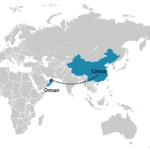
Shipping from China to Jebel Ali should be straightforward — but between FCL vs. LCL trade-offs, opaque destination charges, UAE customs requirements, and JAFZA free zone rules, what looks simple on paper can quickly turn into a supply chain headache.
This guide cuts through the noise. Built on 15+ years of hands-on freight forwarding from China to the Middle East, you’ll get real 2026 pricing by port and container type, a step-by-step DDP process breakdown, a UAE customs compliance checklist, and practical JAFZA strategies to reduce your total landed cost. Whether you’re moving 10 containers a month or testing the market with your first LCL shipment, this guide covers everything you need.
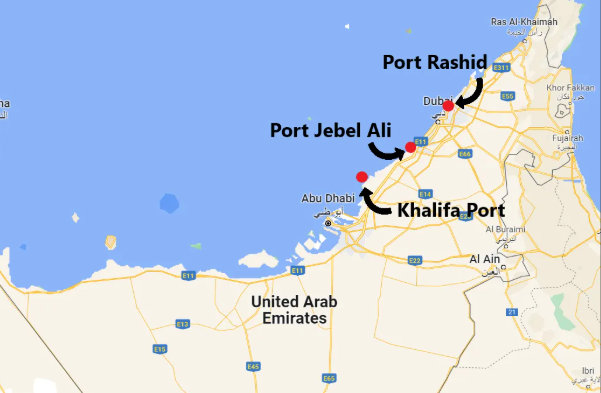
Why Jebel Ali Port Is Your Gateway to Middle East Trade
Before we get into rates and transit times, let’s look at what makes Jebel Ali fundamentally different from other Middle Eastern ports — and why it should be your default entry point for cargo from China.
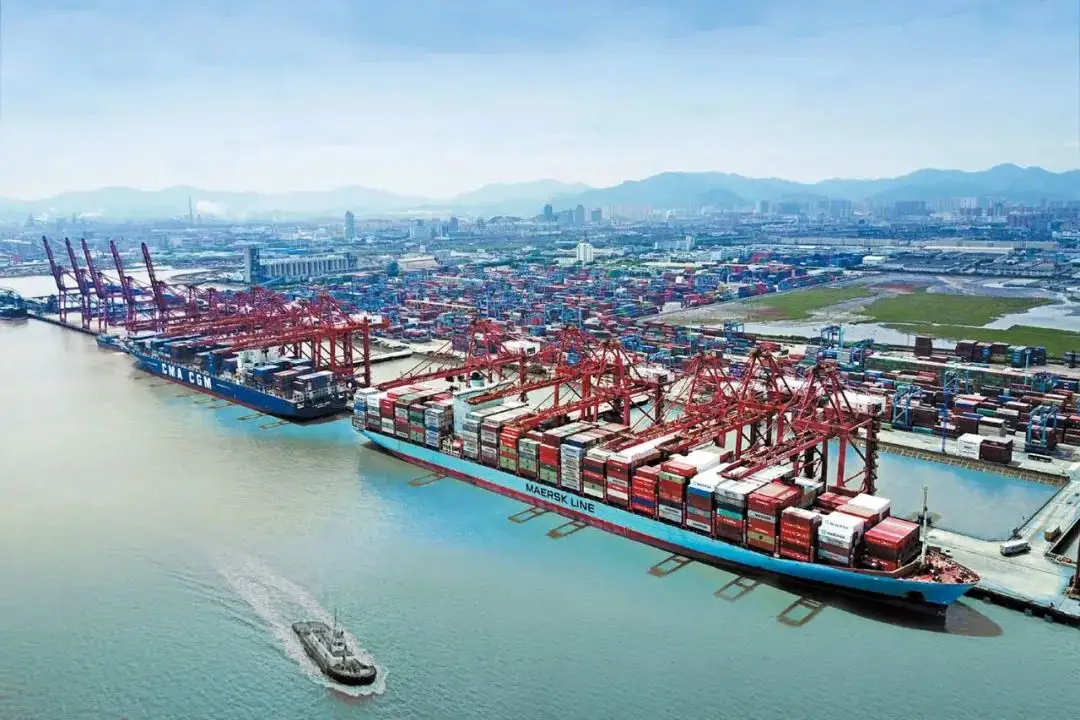
Jebel Ali is the largest container port between Rotterdam and Singapore. Operated by DP World, it runs four container terminals with over 180 international line connections, and its annual throughput consistently ranks in the global top 10. Ongoing expansion projects are adding new berths and automation as of 2026, cementing Jebel Ali’s role as the region’s dominant transshipment hub.
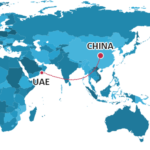
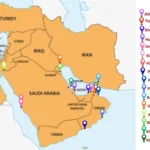
Jebel Ali’s location in the Arabian Gulf means direct sea freight from China to Jebel Ali port takes just 15–20 days of sailing time — far quicker than shipping to Europe or North America. But the real payoff comes after your cargo arrives. As the Middle East’s premier transshipment hub, Jebel Ali feeds into Saudi Arabia (Dammam, Jeddah), Iraq (Umm Qasr), Kuwait, Bahrain, Qatar, and East Africa. For importers serving the broader Middle East logistics corridor, routing through Jebel Ali often shaves 5–10 days off total transit compared to direct calls at smaller regional ports.
Here’s a quick comparison of Jebel Ali against other UAE ports to help you decide which entry point fits your cargo:
| Port | Operator | Best For | Container Capacity | Notes |
|---|---|---|---|---|
| Jebel Ali (Dubai) | DP World | General cargo, transshipment, FCL/LCL | 19M+ TEU/yr | Best connectivity; adjacent to JAFZA free zone |
| Khalifa Port (Abu Dhabi) | AD Ports Group | Heavy industry, project cargo, RORO | 5M+ TEU/yr | Growing capacity; closer to Abu Dhabi industrial zones |
| Port Khalid (Sharjah) | Sharjah Ports Authority | Regional distribution, small vessels | < 1M TEU/yr | Limited China direct calls; mostly feeder services |
For the vast majority of importers shipping from China to UAE, Jebel Ali is the clear winner. It offers the most frequent sailings, the broadest carrier choice, and the unique advantage of Jebel Ali Free Zone (JAFZA) integration (more on that later).
Shipping Methods from China to Jebel Ali: Sea, Air & Express Compared
Choosing the right shipping method comes down to three variables: how fast you need the goods, how much you’re willing to pay, and what type of cargo you’re moving. Here’s a quick-reference comparison:
| Shipping Method | Transit Time | Cost Range | Best For |
|---|---|---|---|
| 🚢 Sea Freight (FCL) | 18–28 days (door-to-door) | $1,200–$2,800 per 20ft | Bulk cargo over 15 CBM; heavy goods |
| 🚢 Sea Freight (LCL) | 25–35 days (door-to-door) | $60–$175 per CBM | Smaller shipments (1–15 CBM); flexible volume |
| ✈️ Air Freight | 3–7 days | $4.50–$8.00 per kg | Urgent orders; high-value electronics; perishables |
| 📦 Express Courier | 2–5 days | $6–$15 per kg | Samples; documents; e-commerce parcels under 50 kg |
The Cargo Decision Matrix
We typically evaluate shipments across three dimensions:
- Heavy & high-volume (>15 CBM, machinery, construction materials, furniture): Sea FCL is the obvious choice. You’re paying per container, not per kilogram, so the heavier the cargo, the lower your per-unit shipping cost.
- Medium-volume (3–15 CBM, consumer goods, auto parts, textiles): Sea LCL or consolidated shipments from China to Jebel Ali strike the right balance. You only pay for the space you use while benefiting from ocean freight economics.
- Light & urgent (<3 CBM, electronics, spare parts, seasonal inventory): Air freight or express courier is worth the premium. The cost difference shrinks considerably for shipments under 100 kg, and the 3–7 day transit keeps your supply chain responsive.
- Hybrid need (medium urgency, cost-sensitive): Consider sea-air via Dubai. Your cargo sails from China to Jebel Ali (15–20 days), then flies to the final Middle Eastern or African destination (1–2 days). This hybrid solution costs roughly 40% less than pure air freight and cuts 10–15 days off pure sea freight to inland destinations.
Common cargo types and our recommended shipping methods:
- Consumer electronics → Air freight or Sea FCL (with cargo insurance, always)
- Industrial machinery → Sea FCL or Breakbulk freight for oversized units
- Textiles & apparel → Sea LCL for initial orders; FCL once volumes scale
- Furniture & home goods → Sea FCL 40HQ (maximizes cubic capacity)
- Auto parts → Sea LCL or FCL, depending on order frequency
Sea Freight to Jebel Ali: FCL, LCL, Costs & Transit Times Deep Dive
Over 85% of China–Jebel Ali cargo moves by sea freight. This section covers everything you need to know about FCL shipping from China to Jebel Ali and LCL shipping from China to Jebel Ali, with 2026 pricing broken down by origin port.
FCL (Full Container Load): When You Need the Whole Box
If your shipment exceeds roughly 15 CBM, booking a full container almost always beats LCL on a per-unit cost basis. FCL also means your cargo never touches anyone else’s goods — lower damage risk, faster clearance, and a single Bill of Lading (B/L) for the entire shipment.
Container types at a glance:
| Container Type | Internal Capacity | Max Payload | Ideal For |
|---|---|---|---|
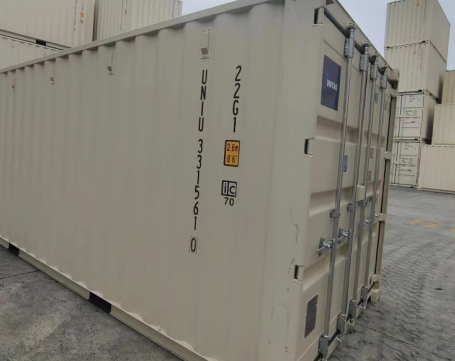
| 20GP (20ft General Purpose) | 33 CBM | 28 metric tons | Heavy, dense goods: machinery, stone, metal products |
| 40GP (40ft General Purpose) | 67 CBM | 26 metric tons | Medium-weight bulk: furniture, plastics, packaged consumer goods |
| 40HQ (40ft High Cube) | 76 CBM | 26 metric tons | Light, voluminous cargo: bedding, toys, insulation — 13% more space than 40GP |
2026 FCL Port-to-Port Reference Rates (USD):
| Port of Origin | 20GP | 40GP / 40HQ | Sea Transit (Port-to-Port) |
|---|---|---|---|
| Shenzhen (Yantian / Shekou) | $1,200 – $1,700 | $1,800 – $2,600 | 15–20 days |
| Guangzhou (Nansha) | $1,300 – $1,800 | $1,900 – $2,800 | 16–22 days |
| Shanghai | $1,400 – $1,900 | $2,100 – $3,000 | 18–24 days |
| Ningbo | $1,300 – $1,800 | $2,000 – $2,900 | 18–22 days |
| Qingdao / Tianjin | $1,500 – $2,100 | $2,200 – $3,200 | 20–28 days |
Rates are port-to-port (base ocean freight + surcharges) as of Q2 2026. Actual rates fluctuate weekly based on carrier capacity, fuel surcharges (BAF), and seasonal demand. These do not include origin trucking, export customs, destination handling, UAE duties, or last-mile delivery.
LCL (Less than Container Load): Pay Only for Space You Use
For shipments between 1–15 CBM, LCL shipping from China to Jebel Ali lets you share container space with other importers and pay only for your cubic volume. Current 2026 LCL rates range from $60 to $175 per CBM, depending on your origin port and total shipment volume. Larger LCL consignments (8+ CBM) often qualify for volume discounts.
One critical watch-out with LCL: always insist on an all-in quote. The base “per CBM” rate sometimes excludes destination-side charges like CFS (Container Freight Station) deconsolidation fees, documentation handling, and customs brokerage at Jebel Ali — which can add $150–$350 to your final bill. A reputable freight forwarder will provide a transparent, line-by-line breakdown upfront.
The FCL vs. LCL Cost Break-Even Point
Here’s a practical example. Let’s say you’re shipping consumer goods from Shenzhen to Jebel Ali with a DDP door-to-door arrangement:
| Shipment Size | LCL DDP Cost (@ $130/CBM) | FCL 20GP DDP Cost | Winner |
|---|---|---|---|
| 5 CBM | $650 | ~$3,000 (wasted space) | LCL saves $2,350 |
| 10 CBM | $1,300 | ~$3,000 | LCL saves $1,700 |
| 15 CBM | $1,950 | ~$3,000 | Roughly equal — consider urgency |
| 20 CBM | $2,600 (but likely 20GP needed) | ~$3,000 | FCL slightly more but faster & safer |
The break-even sweet spot sits around 12–15 CBM. Below that, LCL is more economical. Above it, FCL wins on both cost and convenience — and you get the bonus of faster transit (no consolidation/deconsolidation delays).
Factors That Move Your Sea Freight Rate
Beyond your choice of port and container type, four major variables influence your final shipping cost from China to Jebel Ali:
- Seasonal demand spikes: Ocean freight rates predictably rise by 15–25% in the 4–6 weeks before Chinese New Year (January/February), by 10–20% in the lead-up to Ramadan (dates shift annually by ~11 days), and by 20–30% during the peak season window from September through November. Booking 4–6 weeks ahead is the simplest way to lock in pre-surge rates.
- Bunker Adjustment Factor (BAF): Fuel surcharges tied to global oil prices and IMO 2020 low-sulfur fuel regulations. This is a pass-through cost from the shipping line — all importers pay it, but it fluctuates quarterly.
- Geopolitical risk premiums: Tensions affecting the Strait of Hormuz or Red Sea routing can trigger emergency surcharges ranging from $150–$400 per container. Direct China–Jebel Ali services are relatively insulated from Red Sea disruptions, but the broader market dynamic still influences pricing.
- Carrier selection: Major lines serving the China–Middle East route include CMA CGM, Maersk, MSC, COSCO, and Hapag-Lloyd. Direct contracts with carriers — which established freight forwarders maintain — translate into more stable rates and guaranteed space during tight markets.
Door-to-Door DDP Shipping from China to Jebel Ali: The Complete Process
For many importers — especially SMEs without a UAE trade license or dedicated logistics team — DDP shipping from China to Jebel Ali is the most practical option.
Under Incoterms 2020, DDP means your freight forwarder takes full responsibility for the entire journey, including UAE import duties and taxes.
Why DDP Makes Sense for Jebel Ali Shipments
Here’s a quick comparison of how responsibility shifts across common Incoterms:
| Incoterm | Supplier Handles | You Handle | Best For |
|---|---|---|---|
| EXW (Ex Works) | Factory loading only | Everything else: trucking, export, freight, import, duties, delivery | Large importers with in-house logistics teams |
| FOB (Free on Board) | Trucking + export clearance in China | Ocean freight, insurance, destination charges, import clearance, duties, delivery | Importers with strong freight forwarder relationships |
| CIF (Cost, Insurance, Freight) | All China-side + ocean freight + minimum insurance | Destination handling, import clearance, duties, delivery | Importers who want some coverage but prefer to handle the destination side |
| DDP (Delivered Duty Paid) | Everything: door-to-door including duties & taxes | Nothing — just receive the goods | SMEs, e-commerce sellers, first-time importers |
Three reasons DDP is particularly well-suited to the Jebel Ali route:
- UAE import regulations require the importer to hold a local trade license. Under DDP, your freight forwarder acts as the Importer of Record, eliminating this requirement for foreign buyers.
- Destination charges at Jebel Ali can be opaque. Terminal handling, customs inspection fees, and port storage (demurrage after the free 5-day window) add up fast. DDP bundles everything into one transparent price.
- MOFAIC document attestation — a UAE-specific requirement for commercial invoices exceeding AED 10,000 — is handled entirely by your forwarder under a DDP arrangement.
The DDP Process: Step by Step
Here’s exactly what happens when you ship DDP from China to Jebel Ali, with realistic timelines at each stage:
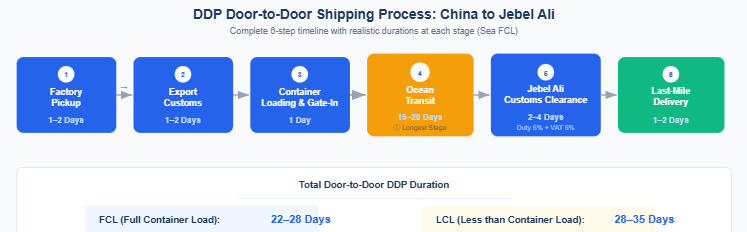
| Step | What Happens | Time Required | What Your Forwarder Handles |
|---|---|---|---|
| 1. Factory Pickup | Truck collects cargo from your supplier’s warehouse | 1–2 days | Vehicle dispatch, loading supervision, cargo receipt documentation |
| 2. Export Declaration | Chinese customs clearance for export | 1–2 days | Full export documentation package, customs declaration filing |
| 3. Container Loading & Gate-In | Cargo stuffed into container; delivered to port terminal | 1 day | Container booking, stuffing coordination, port gate-in |
| 4. Ocean Transit | Vessel sails from China to Jebel Ali | 15–20 days | Space booking, Bill of Lading (B/L) issuance, transit monitoring |
| 5. Jebel Ali Arrival & Import Clearance | Customs inspection, duty/VAT payment, cargo release | 2–4 days | UAE customs clearance, 5% duty + 5% VAT payment, MOFAIC attestation, HS Code classification |
| 6. Last-Mile Delivery | Truck delivers goods to your specified address | 1–2 days | Local trucking dispatch, final delivery confirmation |
⏱️ Total door-to-door DDP timeline: FCL → 22–28 days | LCL → 28–35 days (LCL adds 3–7 days for consolidation/deconsolidation at both ends)
2026 DDP All-Inclusive Rates by Region
The table below shows fully loaded DDP rates — these include base ocean freight, port charges at both ends, Chinese export customs clearance, UAE 5% customs duty, 5% VAT, MOFAIC attestation, and last-mile trucking within Dubai city limits. For a broader look at market pricing across all modes, see our latest shipping rates from China to United Arab Emirates.
| Origin Region | LCL DDP (per CBM) | 20GP DDP | 40HQ DDP |
|---|---|---|---|
| South China (Shenzhen / Guangzhou) | $110 – $145 | $2,800 – $3,400 | $3,800 – $4,500 |
| East China (Shanghai / Ningbo) | $125 – $160 | $3,000 – $3,600 | $4,100 – $4,800 |
| North China (Qingdao / Tianjin) | $140 – $175 | $3,200 – $3,800 | $4,300 – $5,100 |
Rates are reference ranges as of Q2 2026. Final pricing depends on your exact HS Code classification, cargo value (for duty calculation), and delivery address distance from Jebel Ali. Always request a shipment-specific quote.
UAE Customs Clearance & Import Compliance
Clearing customs at Jebel Ali doesn’t have to be stressful — but it does require precision. Here’s what every importer needs to understand about UAE customs clearance before their first shipment arrives.
UAE Import Duties & VAT at a Glance
| Category | Rate | Applies To |
|---|---|---|
| Standard customs duty | 5% of CIF value | Most goods: electronics, machinery, textiles, furniture, consumer products |
| VAT on imports | 5% of (CIF + duty) | All imports — calculated after duty is applied |
| Elevated duty goods | 50% – 100% | Alcohol (50%), tobacco (100%), carbonated/energy drinks (50%) |
| Duty-exempt goods | 0% | Select pharmaceuticals, agricultural products, certain industrial raw materials |
The effective tax burden on a standard shipment is roughly 10.25% of CIF value (5% duty + 5% VAT on the duty-inclusive amount). For a shipment with a CIF value of $10,000, expect to pay approximately $500 in duty + $525 in VAT = $1,025 in total import taxes.
Essential Documentation Checklist
Missing or incorrect paperwork is the #1 cause of customs delays at Jebel Ali. Before your container sails, verify that every document below is accurate and complete:
| Document | Required? | Key Requirement |
|---|---|---|
| Commercial Invoice | ✅ Always | Must be in English (or bilingual); include HS Code, unit values, total CIF value, Incoterm used |
| Packing List | ✅ Always | Itemized per carton/pallet with weight, dimensions, and piece count for each package |
| Bill of Lading (B/L) | ✅ Always | Original or Telex Release — confirm with your forwarder which applies |
| Certificate of Origin | ✅ Always | Issued by CCPIT (China Council for the Promotion of International Trade); required for GCC tariff treatment |
| MOFAIC Attestation | ✅ If invoice > AED 10,000 | UAE Ministry of Foreign Affairs stamp on the commercial invoice — your forwarder handles this under DDP |
| ESMA Certificate of Conformity | ⚠️ Regulated products only | Required for electronics, toys, cosmetics, and other regulated consumer goods |
Top 5 Customs Clearance Delays — and How to Avoid Them
- HS Code misclassification. The UAE uses a 12-digit HS Code system, while China’s export system uses 10 digits. The extra two digits determine your exact duty rate and regulatory requirements. Fix: Have your freight forwarder pre-classify your products before the shipment departs China.
- Missing MOFAIC attestation. This UAE-specific requirement trips up first-time importers regularly. Any commercial invoice exceeding AED 10,000 (~$2,725) must be stamped by the UAE Ministry of Foreign Affairs. Fix: Under DDP, your forwarder manages this end-to-end. Under FOB/CIF, you’ll need a local agent to handle it — and an unattested invoice will hold your cargo at the port.
- Undervaluation (under-invoicing). UAE Customs actively flags shipments where the declared value appears suspiciously low compared to market benchmarks. Penalties can reach 50% of the undervalued amount plus back duties. Fix: Declare the actual transaction value. DDP includes duties in the quote — there’s zero incentive to under-report.
- Counterfeit or unlicensed branded goods. UAE authorities enforce intellectual property rights strictly at Jebel Ali. Branded goods without proper authorization are subject to seizure and destruction. Fix: Ensure your Chinese supplier provides brand authorization documentation before shipping.
- Ramadan and public holiday backlogs. During Ramadan, customs offices operate reduced hours, and clearance processing slows by 30–50%. Combined with pre-Ramadan import surges, delays of 5–10 additional days are common. Fix: Plan shipments to arrive at least 4 weeks before Ramadan begins, or pad your timeline by 7–10 days if shipping during the holy month.
Product Compliance Quick Reference
| Product Category | Compliance Requirement |
|---|---|
| Electronics & electrical appliances | ESMA Certificate + Energy Efficiency Label (EESL) |
| Food & cosmetics | Dubai Municipality registration + Halal certification |
| Construction materials | ESMA Certificate of Conformity (CoC) |
| Toys & children’s products | GSO (GCC Standardization Organization) Toy Directive compliance |
| Machinery & industrial equipment | Safety compliance documentation; CE or equivalent standards accepted |
JAFZA & Free Zone Shipping Advantages: How to Save on Duties
If you’re shipping commercial volumes from China to the UAE, understanding JAFZA isn’t optional — it’s a competitive advantage. The Jebel Ali Free Zone (JAFZA), established in 1985, is one of the world’s most successful free trade zones, hosting over 8,000 registered companies including 150+ Fortune 500 firms. From a logistics perspective, JAFZA and Jebel Ali Port function as a single integrated ecosystem — cargo moves from vessel to free zone warehouse in as little as 15 minutes.
JAFZA’s 5 Core Logistics Benefits
| Benefit | What It Means | Why It Matters for Importers |
|---|---|---|
| 0% import duty | Goods entering JAFZA are exempt from the standard 5% UAE customs duty | Store, re-package, or process goods duty-free — pay duty only when/if goods exit to UAE mainland |
| 100% foreign ownership | No requirement for a UAE national sponsor (unlike mainland companies) | Full control over your trading or warehousing entity |
| 0% corporate tax | Free zone companies pay no corporate income tax | Lower operating costs vs. mainland operations |
| Port-zone integration | JAFZA warehouses are adjacent to Jebel Ali terminals; 15-minute truck transfer | Lowest possible inland transportation cost and fastest cargo availability |
| Flexible facility options | From 50 m² offices to 10,000+ m² warehousing, with multi-temperature options | Scale your physical footprint as your business grows |
Three Supply Chain Strategies Using JAFZA
1. The Transshipment Model: Ship from China to Jebel Ali → deconsolidate and re-pack in JAFZA → forward to Saudi Arabia, Iraq, Kuwait, Bahrain, or East Africa. Because goods never officially enter the UAE mainland, the 5% duty is never triggered. For businesses focused on individual Gulf markets, we also provide dedicated shipping from China to Saudi Arabia and shipping from China to Iraq services that leverage Jebel Ali’s unmatched connectivity.
2. The Distribution Hub Model: Establish a JAFZA-based regional distribution center. Receive bulk FCL shipments from China (lower per-unit ocean freight), warehouse inventory in JAFZA, and fulfill orders to Middle Eastern and African buyers on demand. You benefit from lower bulk rates, duty-free storage, and faster regional delivery compared to fulfilling each order directly from China.
3. The Value-Added Processing Model: Import semi-finished goods from China → complete final assembly, labeling, or packaging in JAFZA → re-export to GCC countries with “Made in UAE” origin. Under the GCC Free Trade Agreement framework, goods with sufficient UAE value-add qualify for preferential (often 0%) duty rates when entering other GCC member states. This is increasingly popular for electronics, furniture, and food products.
Important JAFZA Caveats
- Accessing the UAE mainland market from JAFZA requires a customs declaration and payment of the standard 5% duty + 5% VAT on the goods’ value at the time of entry — not on the original import value if value has been added.
- Certain regulated goods (alcohol, tobacco, pharmaceuticals) have special licensing and storage requirements within JAFZA.
- As of 2026, the UAE’s updated VAT compliance framework has introduced more rigorous record-keeping requirements for free zone entities. Work with a logistics partner who stays current on these regulatory changes.
How to Choose the Best Freight Forwarder from China to Jebel Ali
Not all freight forwarders from China to Jebel Ali are created equal — and the wrong choice costs far more than money. For a broader evaluation framework that works across any trade lane, start with our guide on how to choose the right freight forwarder, then apply the Jebel Ali-specific criteria below.
Delayed shipments, surprise destination charges, customs holds, and radio silence from your forwarder are all symptoms of a bad fit. Here’s how to evaluate your options systematically.
The 7-Point Freight Forwarder Evaluation Framework
1. Credentials & Certifications. Does the forwarder hold Class-A freight forwarding license (issued by China’s Ministry of Commerce), NVOCC accreditation (for issuing their own bills of lading), and FMC registration (essential if you ever expand to US-bound shipments)? Membership in industry bodies like FIATA or IATA adds an extra layer of credibility.
2. Middle East route specialization. A forwarder with a dedicated Middle East desk will navigate Jebel Ali’s customs procedures, HS Code requirements, and carrier relationships far more effectively than a generalist. Ask: “How many TEUs do you move to Jebel Ali monthly? Do you have a local agent or office in Dubai?”
3. DDP capability. A true DDP forwarder handles everything: duty and VAT payment on your behalf, MOFAIC attestation, and last-mile delivery. Confirm this explicitly — some forwarders market “DDP” but exclude destination customs brokerage or local charges.
4. Direct carrier contracts. Forwarders with direct contracts (not just spot-market buying) with carriers like CMA CGM, Maersk, and COSCO offer two distinct advantages: more competitive rates and — critically — guaranteed space allocation during peak season when spot rates spike and capacity tightens.
5. Pricing transparency. Ask for a sample line-by-line quotation. A transparent quote breaks out ocean freight, BAF, origin charges, destination terminal handling, customs brokerage, duty/VAT estimates, and delivery fees. If a forwarder gives you a single number with no breakdown, assume there are hidden shipping costs waiting at destination.
6. Cargo tracking. In 2026, real-time visibility is table stakes. Your forwarder should offer an online tracking platform with milestone updates (vessel departure, transshipment, arrival, customs status, out-for-delivery) — not just periodic email updates when you chase them.
7. Customer support. How responsive is the forwarder during your quotation stage? That’s a reliable indicator of what support will look like when your container is sitting at Jebel Ali awaiting clearance. A dedicated account manager — not a rotating call center queue — makes the difference when issues arise.
Peak Season Planning for the Middle East Route
| Peak Period | Typical Rate Impact | Booking Lead Time | Additional Notes |
|---|---|---|---|
| Pre-Chinese New Year (Jan – Feb) | +15% – 25% | 6+ weeks ahead | Factory closures follow CNY; last shipments before shutdown are extremely competitive for space |
| Pre-Ramadan (dates shift ~11 days/year) | +10% – 20% | 6–8 weeks ahead | UAE import volumes surge as retailers stock up; customs clearance slows 30–50% during Ramadan itself |
| Q4 Peak (Sep – Nov) | +20% – 30% | 4–6 weeks ahead | Global peak season overlaps with Middle East pre-holiday stocking |
Why Importers Choose Dantful for Jebel Ali Shipments
At Dantful International Logistics, we’ve been moving cargo from China to the Middle East since 2008. With a Class-A freight forwarding license, NVOCC accreditation, and membership in FMC and Jctrans, our 50 operations specialists and 50+ customer service professionals manage the entire China–Jebel Ali corridor with the attention to detail that only a dedicated team can provide.
What that means for your shipment: direct carrier contracts that keep your rates competitive even during peak season, fully transparent DDP door-to-door quotations with no hidden destination fees, 24/7 online cargo tracking with milestone updates and on-site photos, and a single dedicated account manager who knows your cargo profile and preferences.
Get your free Jebel Ali shipping quote today — response within 24 hours, no obligation.
FAQs
How long does shipping from China to Jebel Ali take?
FCL sea freight takes 15–20 days port-to-port (sailing time) or 22–28 days door-to-door (including pickup, customs, and delivery). LCL sea freight takes 25–35 days door-to-door due to consolidation and deconsolidation. Air freight from China to Jebel Ali Dubai takes 3–7 days, and express courier (DHL, FedEx, UPS) delivers in 2–5 days. Transit times vary by origin port — Shenzhen is fastest (15 days sailing), while Tianjin/Qingdao take longest (20–28 days).
What is the cheapest way to ship from China to Jebel Ali?
Sea freight is the most cost-effective method for most shipments. LCL is cheapest for cargo under 12–15 CBM ($60–$175/CBM), while FCL becomes more economical above that volume ($1,200–$2,800 per 20ft). For maximum cost control, choose a DDP door-to-door service that bundles all charges into one transparent price — this eliminates the risk of surprise destination fees that can derail your budget.
Can I ship personal effects from China to Jebel Ali?
Yes. Personal effects shipping from China to Jebel Ali is possible through LCL sea freight or international courier services. You’ll need to provide a copy of your passport, a detailed packing list, and a personal effects declaration form. DDP door-to-door service is recommended — it handles customs clearance and delivery so you don’t need to navigate UAE import procedures yourself.
What documents are required for customs clearance at Jebel Ali?
Six core documents: Commercial Invoice (with HS Code and Incoterm), Packing List (itemized weights and dimensions), Bill of Lading (B/L) or Airway Bill, Certificate of Origin (issued by CCPIT in China), MOFAIC-attested invoice (if value exceeds AED 10,000), and ESMA Certificate of Conformity (for regulated consumer goods). Your freight forwarder should provide a complete checklist tailored to your specific cargo type.
How do I ship electronics or machinery from China to Jebel Ali?
For shipping electronics from China to Jebel Ali, air freight or FCL sea freight with full Clause A cargo insurance is the standard recommendation. Ensure your supplier provides ESMA certification and energy efficiency labeling (EESL) before shipping — without these, your goods will be held at Jebel Ali customs. For shipping machinery from China to Jebel Ali, FCL or Breakbulk freight (for oversized equipment) is standard; confirm that your machinery does not contain controlled dual-use technology requiring export licenses.

Young Chiu is a seasoned logistics expert with over 15 years of experience in international freight forwarding and supply chain management. As CEO of Dantful International Logistics, Young is dedicated to providing valuable insights and practical advice to businesses navigating the complexities of global shipping.