Are you struggling to manage your LCL shipping rates from China to USA as the 2026 peak season approaches? For small to medium-sized importers, Less than Container Load (LCL) is the most strategic way to move goods without the prohibitive expense of renting a full container. However, navigating the fluctuating market rates, complex “revenue ton” calculations, and the infamous “CIF trap” requires professional insight.
In this comprehensive guide, we provide a deep dive into the August 2026 market pulse, a transparent breakdown of landed costs, and a strategic shipping calendar to help you optimize your supply chain. Whether you are an Amazon seller sourcing from Shenzhen or a wholesaler importing from Ningbo, this guide will ensure you never overpay for your logistics again. If you are looking for the most reliable Shipping From China to USA, understanding the nuances of consolidated freight shipping is essential for cost control.
August 2026 Market Pulse: Current LCL Shipping Trends
As of August 2026, the Trans-Pacific shipping lane is entering its most volatile phase of the year. With retailers stocking up for Black Friday and Cyber Monday, carrier capacity is tightening. While Full Container Load (FCL) rates have seen a significant month-over-month increase, LCL shipping rates from China to USA have remained relatively stable, hovering around $130 per CBM for base ocean freight, though surcharges are beginning to creep up.
Our Industry Insights: The Peak Season Strategy In our experience managing thousands of LCL shipments, the biggest mistake importers make in August is waiting for a rate drop. According to the World Shipping Council (WSC), seasonal demand spikes are predictable but often catch small businesses off guard. Historically, rates only increase as we approach September. We strongly advise our clients to lock in their space at least 14 days before the cargo ready date (CRD) to avoid the mid-month General Rate Increases (GRI).
The current market is also facing equipment imbalances at major Chinese ports like Shanghai and Ningbo. This means that while the ship might have space, there aren’t enough empty containers to consolidate LCL cargo. Working with a Class-A forwarder like Dantful ensures you get priority access to available equipment through our direct carrier contracts.
Estimated LCL Sea Freight Rates: China to US West Coast vs. East Coast
Shipping to the US West Coast (USWC) is generally faster and cheaper than the East Coast (USEC). Below are the estimated port-to-port LCL shipping rates from China to USA for August 2026, based on major origin hubs.
| Origin Port (China) | Destination (USA) | Est. Rate (per CBM) | Transit Time (Port-to-Port) |
|---|---|---|---|
| Shanghai / Ningbo | Los Angeles / Long Beach | $45 – $75 | 16 – 22 Days |
| Shenzhen / Guangzhou | New York / New Jersey | $65 – $95 | 28 – 35 Days |
| Qingdao / Tianjin | Chicago (IPI) | $75 – $110 | 25 – 32 Days |
| Xiamen | Houston | $60 – $90 | 26 – 32 Days |
| Shenzhen | Savannah / Charleston | $70 – $100 | 30 – 38 Days |
Note: These are base ocean freight rates. Total landed costs will include local charges, customs clearance, and final mile delivery. For a precise, all-in quote, contact Dantful International Logistics.
READ MORE:
- Shipping From China to the United States
- Shipping From China TO Canada
- Shipping From China TO Mexico
- Shipping From China to Panama
- Shipping From China to Costa Rica
- Shipping From China to Brazil
- Shipping From China TO Colombia
- Shipping From China to Jamaica
- Shipping From China to Venezuela
How to Calculate LCL Shipping Charges from China: The W/M Rule Explained
One of the most frequent questions we receive is, “How do I calculate my LCL shipping rates from China to USA?” The industry standard is the W/M (Weight or Measure) rule, which means you are charged based on whichever is greater: the volume in Cubic Meters (CBM) or the weight in Metric Tons.
The Golden Rule: 1 CBM = 1,000 KG
Real-Life Scenario: The Bulky Pallet vs. The Dense Crate Imagine you are shipping two different types of goods. Scenario A (Light & Bulky): You have 2 pallets of pillows. Volume is 4 CBM, but weight is only 400 kg. Since 4 CBM > 0.4 Tons, you are billed for 4 CBM. Scenario B (Heavy & Dense): You have a crate of steel valves. Volume is 1 CBM, but weight is 1,500 kg. Since 1.5 Tons > 1 CBM, you are billed for 1.5 CBM (Revenue Tons).
To lower your costs, always focus on Packaging Optimization. Reducing the “dead space” inside your cartons can significantly lower your CBM and, consequently, your total freight bill.
Landed Cost Breakdown: Hidden Costs in LCL Shipping from China
A common trap for new importers is the “Zero Freight” or “Low Freight” offer. If a forwarder quotes you $0 or $10 per CBM for ocean freight, be very cautious. This is almost always a CIF Trap, where the costs are shifted to the destination port, often resulting in bills exceeding $500 for a single CBM.
A transparent Landed Cost Breakdown should include:
- Origin Charges: Export customs, warehouse handling, and documentation fees.
- Ocean Freight: The base rate per CBM.
- Destination Charges: The most expensive part, including DDC (Destination Delivery Charges), CFS (Container Freight Station) deconsolidation fees, and port security.
- Customs & ISF: ISF (10+2) filing and US Customs Clearance.
- Final Delivery: Trucking from the warehouse to your door.
- Cargo Insurance: Highly recommended to protect against damage during multiple handling stages.
Our Industry Insights: The Sample Bill For a typical 1 CBM shipment from Shenzhen to a residence in Los Angeles under FOB terms, your total landed cost (excluding Duties and Taxes) might look like this:
- Ocean Freight: $55
- Destination CFS & DDC: $180
- Customs Clearance: $125
- ISF Filing: $35
- Local Delivery: $150
- Total: $545 If you were on CIF terms, that “Destination” portion could easily double or triple due to agent markups.
LCL vs FCL Cost Comparison: China to USA Decision Framework
Is it time to upgrade to a Full Container Load (FCL)? While LCL is great for small batches, there is a “sweet spot” where FCL becomes more economical. For a detailed breakdown of these two modes, read our guide on LCL vs FCL Shipping: How to Choose the Right Option for Small Cargo.
| Feature | LCL (Less than Container Load) | FCL (Full Container Load) |
|---|---|---|
| Volume Sweet Spot | 1 – 13 CBM | 14+ CBM (in a 20ft container) |
| Cost Basis | Per CBM / Revenue Ton | Flat rate per container |
| Speed | Slower (due to consolidation) | Faster (direct port-to-port) |
| Handling Risk | Higher (multiple touches) | Lower (sealed at origin) |
| Customs | Shared container (one delay affects all) | Individual entry |
The Tipping Point: If your shipment is between 13 CBM and 15 CBM, we recommend getting quotes for both LCL and a 20ft FCL container. Often, the FCL rate is comparable, and you benefit from faster transit and less handling.
Amazon FBA LCL Shipping Rates from China: Specialized E-commerce Logistics
For Amazon FBA sellers, LCL shipping rates from China to USA are just one part of the equation. You also need to consider Amazon’s strict requirements for palletization and labeling, often referred to as Amazon FBA Forwarding.
- Direct to FBA: Your cargo is deconsolidated and trucked directly to an Amazon warehouse (e.g., ONT8, FTW1). This requires a Carrier Central appointment.
- FBA via Prep Center: Your goods go to a third-party warehouse first for inspection and labeling before being sent to Amazon. For many e-commerce sellers, using DDP Shipping Services is the most efficient way to manage both customs and final delivery without extra hassle. DDP (Delivered Duty Paid) ensures the forwarder handles all taxes, while DDU (Delivered Duty Unpaid) leaves the duty payment to you.
Real-Life Scenario: Avoiding the “Floor-Loaded” Delay We recently helped a client who shipped 10 CBM of floor-loaded (loose) cartons to Amazon. Amazon rejected the shipment because it wasn’t palletized. The client had to pay for emergency palletization at a US warehouse, costing them an extra $800. Always ensure your LCL forwarder understands FBA Palletization Standards (40×48 inch pallets, max 72 inches high).
2026-2027 Shipping Calendar: Strategic Planning for Peak Season
Timing is everything in logistics. To avoid the highest LCL shipping rates from China to USA and ensure your goods arrive before the holidays, follow this strategic calendar:
| Target Holiday | Recommended CRD (Cargo Ready Date) | Shipping Deadline |
|---|---|---|
| Labor Day (Sept 7, 2026) | July 15 – 20 | August 1, 2026 |
| Black Friday (Nov 27, 2026) | Sept 20 – 25 | October 5, 2026 |
| Christmas (Dec 25, 2026) | Oct 15 – 20 | October 30, 2026 |
| Chinese New Year (Feb 2027) | Dec 15 – 20 | January 5, 2027 |
Note: Add 14 days to these deadlines if shipping to the US East Coast.
Door to Door LCL Shipping from China to USA: The Complete Process
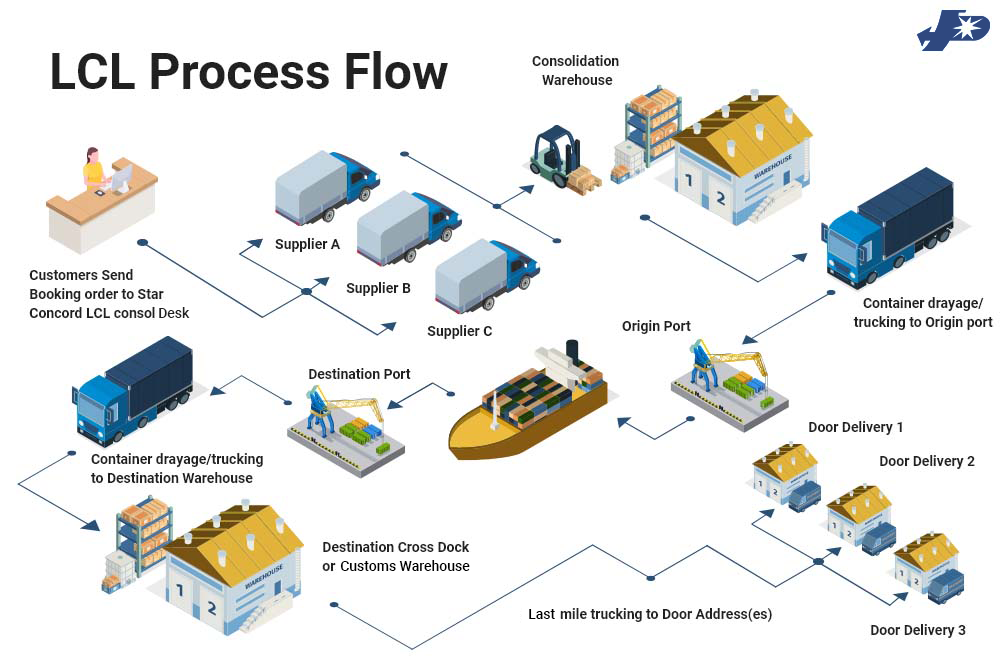
How does your cargo actually move? Here is the step-by-step journey of a Door-to-Door Service for LCL:
- Pickup & Booking: We collect goods from your factory in China (EXW) or they deliver to our warehouse (FOB).
- Consolidation (CFS): Your cargo is measured, weighed, and loaded into a container with other shipments.
- Export Customs: We handle the paperwork to clear the goods out of China.
- Ocean Transit: The container travels across the Pacific.
- Deconsolidation: At a US port warehouse, the container is “stripped,” and individual shipments are sorted.
- Import Customs: ISF (10+2) must be filed 24 hours before loading in China; we handle the final entry, HS Codes verification, and duty payment. According to US Customs and Border Protection (CBP), accuracy in documentation is the number one way to avoid port delays.
- Final Delivery: A local truck delivers the pallets to your Warehousing & Distribution center or Amazon FBA.
Case Study: Why FOB is Better than CIF for Controlling LCL Costs
Most Chinese suppliers prefer to quote CIF (Cost, Insurance, and Freight) because it is easier for them. However, for the buyer, this is a major financial risk under Incoterms 2020.
Case Study: The $900 Difference An importer in Texas bought 3 CBM of furniture on CIF terms. The supplier charged $150 for the freight. When the cargo arrived in Houston, the destination agent sent a bill for $1,200 in “deconsolidation and handling” fees. The next month, the same importer switched to FOB terms with Dantful. We quoted $240 for the freight and $450 for the destination charges. Total CIF Cost: $1,350 Total FOB Cost: $690 Result: The importer saved $660 and had full visibility of their cargo’s location.
FAQs
What is the minimum chargeable volume for LCL?
Most carriers and forwarders have a 1 CBM minimum. If your shipment is 0.5 CBM, you will still be billed for 1 CBM.
Is LCL cargo safe from damage?
Yes, if packed correctly. We recommend Palletization and Shrink-wrapping for all LCL cargo. Unlike FCL, your goods will be handled by forklifts during consolidation and deconsolidation.
What is ISF (10+2) and why is it mandatory?
ISF (Importer Security Filing) is a US Customs requirement. It must be filed at least 24 hours before the ship leaves the Chinese port. Failure to do so results in a $5,000 fine.
Conclusion
Mastering LCL shipping rates from China to USA is the key to scaling your import business in 2026. By understanding the W/M rule, avoiding the CIF trap, and planning around the peak season calendar, you can significantly reduce your landed costs and improve your margins.
At Dantful International Logistics, we pride ourselves on being a Class-A, NVOCC, and FMC-certified partner. With 15+ years of experience and a dedicated team in both Shenzhen and the USA, we offer the transparency and reliability you need to thrive in the global market.
Ready to optimize your supply chain? [Get a Free LCL Shipping Quote & Volume Optimization Plan Today] and let our experts handle the complexities of your cargo while you focus on growing your brand.

Young Chiu is a seasoned logistics expert with over 15 years of experience in international freight forwarding and supply chain management. As CEO of Dantful International Logistics, Young is dedicated to providing valuable insights and practical advice to businesses navigating the complexities of global shipping.