Are you trying to pin down the real cost to ship a car to Jamaica in 2026? Here is the problem with almost every price you will find online: it covers the ocean freight only. By the time your vehicle rolls out of Kingston, the final bill is frequently 60%–100% higher than the number you were first quoted, because you are actually paying three separate bills — the freight, the Jamaican government charges, and the port and delivery costs.
In this guide we break all three down, lane by lane, using the same numbers we give importers every week. You will see what RoRo and container shipping really cost from the US, the UK, Japan and China, how Jamaica Customs compounds duty and GCT on your CIF value, which import rules must be satisfied before the vessel sails, and where first-time importers quietly lose money at the wharf. Every rate and rule on this page was re-checked in October 2026, with the source named next to it.
Table of Contents
Quick Answer: Total Landed Cost at a Glance
| Cost Component | Typical 2026 Amount |
|---|---|
| Ocean freight (RoRo, US East Coast → Kingston) | $1,200 – $2,000 per car |
| Ocean freight (shared 40ft container) | $1,200 – $1,900 per car |
| Trade Board import permit | J$6,325 plus print/amendment fees |
| Pre-shipment inspection (used vehicles) | $150 – $350 |
| Jamaican duties, SCT and GCT | 40% – 130% of CIF value |
| Port, broker and inland delivery charges | $400 – $1,200 |
| Approximate all-in landed cost | 1.8x – 2.5x your FOB purchase price |
If you only remember one thing: the Jamaican tax bill usually costs more than the shipping itself. Anyone who quotes you freight without walking you through the duty calculation is not giving you the cost to ship a car to Jamaica — they are giving you one-third of it.
What Actually Drives the Cost to Ship a Car to Jamaica
1. The Ocean Leg: Origin Port and Route
Rates move with distance, vessel capacity and how many carriers compete on the lane. Kingston is the island’s main vehicle gateway and is served by the major car carriers, which keeps competition healthy on the short US East Coast run. Long-haul lanes behave very differently — sea freight from China or Japan to Kingston takes far longer and carries a wider rate spread, which is why importers sourcing from Asia should compare quotes carefully. For a deeper look at how carriers build these prices, see our breakdown of International Container Shipping Prices.
2. RoRo vs Container Shipping
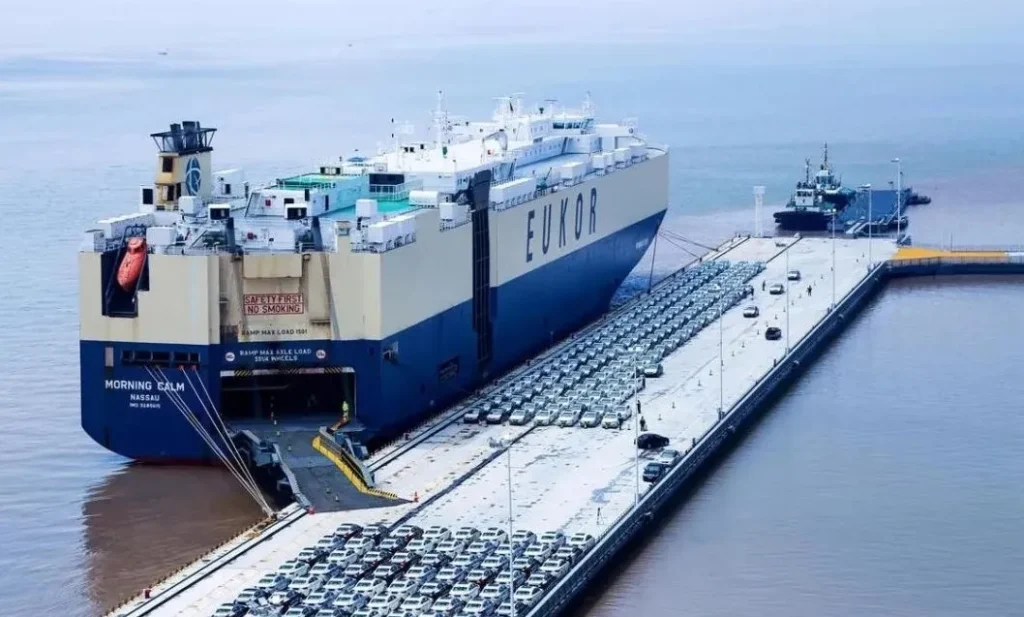
This is the single biggest controllable cost decision. Roll-on/Roll-off (RoRo) is the cheapest option for a running, stock-height vehicle — it is driven onto a specialist car carrier and driven off at Kingston. Containers cost more but protect the vehicle, allow non-runners, and let you ship spare parts or personal effects in the same box. Our explainer on how long does RoRo shipping take covers sailing frequency and port dwell in detail, while what is LCL and FCL in shipping explains the shared-versus-sole container trade-off.
3. Vehicle Size, Weight and Drivability
A Corolla and a Land Cruiser do not cost the same. RoRo is priced by cubic metre and weight, so SUVs, pickups and vans pay a premium — often $150–$400 more than a sedan. Non-running or low-clearance vehicles cannot use RoRo at all and must go into a container, which pushes the cost up immediately.
4. Seasonality and Kingston Port Congestion
Demand spikes between January and March (new model-year arrivals) and again from October to December. Peak-season space is tighter, rates are higher, and dwell time at Kingston Wharves stretches — which matters a lot, because every extra day at the terminal can trigger storage charges. Booking three to four weeks ahead is usually the difference between a mid-market rate and a peak-season one.
5. Permit, Inspection and Documentation Fees
Jamaica’s paperwork is a real cost line, not a formality. The Trade Board import permit, the pre-shipment inspection certificate, the customs broker’s fee and the port’s administrative charges all sit on top of freight. We cover each one below.
RoRo vs Container Shipping to Jamaica
| Shipping Method | How It Works | Best For | Cost Implication |
|---|---|---|---|
| Roll-on/Roll-off (RoRo) | Vehicle is driven onto a car carrier and secured for the voyage | Running, standard-height cars and SUVs | Lowest ocean cost; no personal effects allowed |
| Shared 40ft container | Your car shares a box with other cargo, strapped and chocked | Non-runners, classics, motorcycles, budget shipments | Higher than RoRo, but splits the container cost |
| Sole-use 20ft container | One sealed container for one vehicle plus spares | High-value or modified vehicles, one car with parts | Higher fixed cost, full control and protection |
| Sole-use 40ft container | Two cars, or one large 4×4 with bikes and boxed parts | Dealers and returning residents moving several units | Best per-unit rate if you can fill the box |
| Flat rack / open top | Oversized units that exceed container internal dimensions | Wide or tall vehicles, project equipment | Specialist handling and surcharges apply |
For most private importers landing a single sedan or SUV at Kingston, RoRo wins on price. Choose a container when the vehicle does not run, when its value justifies the extra protection, or when you want to consolidate household goods with the car — in that case Door to Door Shipping is usually the simplest structure.
Average Cost to Ship a Car to Jamaica in 2026
These are indicative street rates for a standard sedan. SUVs and 4x4s typically add $200–$400; larger units add more.
| Origin | Method | Ocean Freight | Sea Transit |
|---|---|---|---|
| US East Coast — Miami / Port Everglades | RoRo | $1,200 – $2,000 | 4 – 7 days, weekly |
| US East Coast — Savannah | RoRo | $1,200 – $2,000 | 6 – 10 days, weekly |
| US East Coast — New York / New Jersey | RoRo | $1,200 – $2,000 | 7 – 11 days, weekly |
| US Gulf — Houston | RoRo | $1,200 – $2,000 | 7 – 12 days, fortnightly |
| US East Coast | Shared 40ft high-cube | $1,200 – $1,900 | 7 – 18 days |
| US East Coast | Dedicated 20ft container | $2,200 – $3,200 | 7 – 18 days |
| US East Coast | Dedicated 40ft high-cube | $3,000 – $4,300 | 7 – 18 days |
| UK (Liverpool / Tilbury / Felixstowe) | RoRo | from £1,416 | 2 – 5 weeks |
| UK | 20ft container | from £2,191 | 2 – 5 weeks |
| UK | 40ft container | from £3,144 | 2 – 5 weeks |
| Japan | RoRo | $1,500 – $2,800 | 30 – 45 days |
| China (Shanghai / Shenzhen / Ningbo) | RoRo or container | $1,800 – $3,500 | 30 – 45 days |
Two important caveats. First, the ocean rate is only the ocean rate — it excludes the destination charges listed further down. Second, Asia-to-Jamaica lanes fluctuate most, so a live quote matters far more on those routes. Our regularly updated pages on shipping rates from China to Jamaica and how long is freight from China to Jamaica are useful benchmarks before you commit.
US East Coast and container figures above are indicative per-unit rates from US forwarders reviewed in October 2026; the UK figures come from a UK forwarder’s published October 2026 sailing rates. Japan and China are our own booking ranges — those lanes move most, so treat them as a benchmark and confirm against a live quote.
How Much Does It Cost to Ship a Car from the USA to Jamaica?
The United States is the shortest and busiest vehicle lane into Kingston, and it is the one where quotes vary least. Port-to-port RoRo from Miami, Port Everglades, Savannah or New York/New Jersey runs $1,200–$2,000 for a standard sedan. A shared 40ft high-cube container is $1,200–$1,900, a dedicated 20ft box $2,200–$3,200, and a dedicated 40ft high-cube — which carries three or four cars — $3,000–$4,300.
Transit is quick: Miami sails weekly with 4–7 days at sea, Savannah 6–10 days, New York/New Jersey 7–11 days, and Houston 7–12 days on a fortnightly service. What actually slows a US import down is not the ocean leg but the left-hand-drive question: Jamaica drives on the left, so a US-spec car is assessed on whether the Trade Board will license it at all. Confirm that before you bid at auction, not after the car is sitting at a Florida terminal.
One more number keeps US buyers honest. On a US$9,000 CIF sedan, $1,500 of ocean freight is the small line — the Jamaican duty, SCT, levy and GCT stack on the same vehicle is roughly $6,000. The freight is the part you negotiate; the tax is the part you plan for. If you are booking the ocean leg on its own, our ocean freight team quotes RoRo and container side by side so you can see the real spread.
The Biggest Line Item: Jamaican Customs Duties and Taxes
How Jamaica Calculates Vehicle Duty
Jamaica Customs assesses everything on the CIF value — Cost of the vehicle, plus Insurance, plus Freight to Kingston. Taxes are then applied in a fixed order, and because each layer builds on the one before it, the total is much larger than the headline percentages suggest:
- Import Duty — assessed on the CIF value; passenger cars commonly fall around 20%, with other categories ranging up to 40%.
- Special Consumption Tax (SCT) — an excise tax applied on the duty-inclusive value. This is the layer that punishes big engines: SCT is banded by engine displacement and fuel type, and it rises steeply above 2,000cc.
- Environmental Levy — approximately 0.5% of the CIF value.
- General Consumption Tax (GCT) — 15% applied to the running total of CIF + duty + SCT + levy.
- Statutory fees — small percentage charges such as the standards compliance fee and additional stamp duty, plus a fixed Customs Administrative Fee per entry.
The Duty and SCT Bands, Side by Side
There is no single duty rate for a car. Jamaica Customs assigns the band from the engine displacement and fuel type printed on the export certificate, then compounds the charges. These are the bands that decide most of the bill:
| Vehicle band | Import duty | SCT | GCT | Total charge on CIF |
|---|---|---|---|---|
| Petrol, 1,000cc and below | 20% | 0% | 15% | ≈ 39% |
| Petrol, 1,001 – 2,000cc | 20% | 20% | 15% | ≈ 66% |
| Petrol, over 2,000cc | 20% | 30% | 15% | ≈ 80% |
| Hybrid | 20% | 0% | 15% | ≈ 39% |
| Electric, made 3 years ago or less | 10% | 0% | exempt (ANC V14) | ≈ 10.5% |
| Electric, older than 3 years | 30% | 0% | exempt (ANC V14) | ≈ 30.5% |
Totals include the 0.5% environmental levy and the compounding of GCT on the running total, but exclude the flat customs administrative fee. Rate sheets in circulation do differ — a 2020 dealer sheet still in use carries 10% SCT and 20% GCT on the 1,001–2,000cc band and lands near 59% instead of 66%. On a J$10 million CIF that seven-point spread is J$700,000, so get the assessment run on your VIN before you commit to a purchase, not after the vessel sails.
One legitimate exception is worth knowing if you are buying European or British stock. Under the EU–CARIFORUM Economic Partnership Agreement, Chapter 87 vehicles of EU or UK origin that meet the origin rules and travel on a valid EUR.1 movement certificate can be entered at 0% import duty instead of the 20% band rate. SCT and GCT still apply, and the certificate has to be presented with the declaration — a UK-sourced car bought without one pays the full rate.
Because SCT and GCT are compounded, a vehicle with a large engine can end up with a duty stack that is well over 100% of what you paid for it. On a small-engine car, the same stack can land near 60%. That gap is the single most important number in your budget.
Illustrative Landed-Cost Example
A 2020 Toyota Corolla Fielder, 1,500cc, running, purchased with a CIF value of $9,000:
| Charge | Rate Used | Amount (USD) |
|---|---|---|
| CIF value (cost + insurance + freight) | — | $9,000 |
| Import duty | ~20% of CIF | $1,800 |
| Special Consumption Tax | ~20% of CIF + duty | $2,160 |
| Environmental levy | 0.5% of CIF | $45 |
| GCT | 15% on the subtotal above | $1,951 |
| Customs administrative fee | Fixed per entry | ~$30 |
| Total duties and taxes | ~$5,986 (≈66% of CIF) |
Add the freight and the local port and delivery charges and this vehicle lands in Jamaica at roughly $16,000–$17,000. Swap the 1,500cc engine for a 3,000cc unit and the tax line alone can climb past $9,000.
Rates change with each tariff update and depend on HS code, fuel type and engine size. Always confirm the current figures for your specific VIN with your broker before you pay a supplier.
Electric and Hybrid Vehicles Pay Less
Jamaica actively encourages cleaner vehicles, and for once the saving is unambiguous. An electric vehicle manufactured three years ago or less pays 10% import duty instead of 30%, is not charged SCT, and is exempt from GCT — Jamaica Customs clears electric vehicles under Additional National Code V14. That takes the total government charge on a young EV to roughly 10.5% of CIF, against about 66% for a 1.5-litre petrol car. On a US$20,000 CIF that is roughly US$11,000 of difference, which is why Chinese EVs have become one of the fastest-growing categories arriving at Kingston.
Watch the clock rather than the model year. The 10% band is counted in months since manufacture — thirty-six of them — assessed on the date the entry is lodged, not the date you paid the exporter. A car that is 34 months old when it sails can be 38 months old when it clears, and the duty rate then triples. If your unit is close to the line, book the earliest sailing rather than the cheapest one. Hybrids get a smaller but still useful break: no SCT, so roughly 39% instead of 66%.
Jamaica Vehicle Import Rules You Must Clear Before Shipping
This is where experience pays off, because a vehicle that fails these tests cannot be licensed and cannot be economically returned.
1. Get Your Trade Board Import Licence First
Every imported motor vehicle needs an import licence issued by the Trade Board Limited — and it must be in hand before the vessel arrives. Applications are submitted electronically through the Jamaica Single Window for Trade (JSWIFT) and require the supplier invoice or bill of sale, the title or export certificate (showing VIN, year, model, colour, seating capacity and unladen weight), valid ID, your TRN, and, for used vehicles, the pre-shipment inspection certificate. Processing is normally measured in working days, not weeks, but a missing document resets the clock — and a vehicle sitting at the port while you wait is a vehicle accruing storage. The permit itself costs J$6,325 including GCT; an amendment after issue costs J$2,875.50 and a permit printout J$1,150, per the Trade Board’s published fee schedule.
2. Age Limits
Jamaica enforces hard age ceilings by vehicle class, counted from the year of manufacture:
| Vehicle Category | Maximum Age at Import |
|---|---|
| Motorcycles and ATVs | 5 years |
| Motor cars — sedans, station wagons, SUVs (up to 8 seats) | 6 years |
| Light commercial — pickups up to 1,500 kg, small buses | 6 years |
| Light commercial — pickups 1,501–3,000 kg, panel and window vans, buses 9–14 seats | 10 years |
| Special purpose vehicles (ambulances, hearses, accessible vehicles) | 10 years |
| Returning residents (all categories) | 10 years |
| Commercial vehicles and heavy-duty equipment | 12 – 30 years |
In practical terms, a passenger car imported in 2026 must generally be a 2020 model year or newer. The Trade Board publishes a model-year notice that is updated periodically, and the cutoff must be checked against the notice in force on your import date — not against what a dealer told you last year.
3. Pre-Shipment Inspection
Used vehicles arriving from the United States, United Kingdom, Japan, Singapore and the United Arab Emirates must pass a pre-shipment inspection, arranged through Autoterminal Japan Limited (ATJ). The certificate is part of your permit application, so arrange it before you book the sailing, not after.
4. Steering and Road Rules
Jamaica drives on the left, so right-hand-drive vehicles are the natural fit and dominate the market — which is why Japanese and UK stock clears so smoothly. Left-hand-drive vehicles face additional scrutiny and are not always acceptable, so confirm eligibility for the specific unit before you buy. Note also that damaged or salvage vehicles are broadly prohibited, so auction “salvage grade” listings are usually a dead end.
5. Who Can Import, and How Often
A private individual may import a combination of two motor vehicles every three years, but not two motor cars, and must be a Jamaican resident, a Jamaican by parentage, the spouse of a Jamaican, a returning resident, a contract officer or a work permit holder. Companies that are not certified dealers are capped at three vehicles every three years; certified motor vehicle dealers may import any category and quantity for resale.
Extra Destination Costs Importers Always Forget
The freight and the duty are the numbers people plan for. These are the ones that surprise them.
Port Storage and Demurrage at Kingston
Kingston Wharves allows a limited free period for a cleared vehicle. Miss it and daily storage starts accumulating — and in peak season, when the yard is full, that clock runs faster than you expect. The way to avoid it is sequencing: permit approved before sailing, documents with your broker before arrival, funds ready on the day of assessment.
Customs Broker and Port Charges
Jamaican customs clearance for a vehicle is not a self-service process for most importers. Your licensed broker prepares the entry, handles valuation, and coordinates release. Budget for the broker’s fee plus statutory port charges such as wharfage and terminal handling.
Inland Delivery Across the Island
Kingston is where the car lands; it is rarely where it needs to be. Trucking from the port to Spanish Town, Portmore, Mandeville, Ocho Rios or Montego Bay is a separate charge, and it rises sharply for non-runners that need a flatbed. This is exactly the stage that door to door shipping from China to Jamaica is designed to absorb — you get one quote covering the port, the broker and the final delivery, instead of three separate invoices.
Fitness, Registration and Licensing
After clearance, the vehicle must be inspected and registered through the Island Traffic Authority (ITA) with the Tax Administration Jamaica (TAJ). You will need the customs receipt, a fitness certificate, proof of insurance and your TRN. Plates are issued within a few working days. Do not treat this as an afterthought — without registration the car is not legal to drive.
Marine and Local Insurance
Two different policies matter here. Marine cargo insurance covers the vehicle from handover to the port. Once it is on Jamaican roads you need local motor insurance and, in many cases, third-party coverage before the ITA will release plates. For the transit leg, review the options on our Insurance Services page — a properly insured shipment is what makes the difference between a claim and a total loss.
Shipping Other Belongings in the Same Container
Many importers move a car and a household at once. If you are filling the rest of a container, our guides on the cost to ship furniture to Jamaica and door to door barrel shipping to Jamaica cost will help you budget the rest of the load so nothing arrives as a surprise line item.
Shipping a Car from China to Jamaica
Chinese vehicles — particularly EVs and hybrids — have become a genuine growth category on the Kingston lane, and the freight logic is different from the short US run. Vessels on the Asia-to-Caribbean route call at Kingston via transshipment hubs, so transit is longer, sailings are less frequent, and booking windows matter more. The upside is that vehicle cost plus a favorable Jamaican duty treatment on electric models can produce a very competitive landed price.
Dantful handles this lane end to end, from factory or dealer collection in China through export customs, ocean freight, Kingston clearance and island delivery. Full lane details, transit windows and service options are on our Shipping From China to Jamaica page. If you would rather not manage the Trade Board permit, the broker and the trucking yourself, our team can coordinate the entire chain through a single point of contact.
Step-by-Step: Shipping Your Car to Jamaica
- Confirm eligibility before you buy. Check the model year against the current age limit and confirm the unit is not a salvage or damaged vehicle.
- Apply for the Trade Board import licence through JSWIFT, including the pre-shipment inspection certificate for used vehicles.
- Book the sailing once the permit is approved — RoRo for a runner, container for a non-runner or a multi-item load.
- Prepare the vehicle using the checklist below and photograph everything.
- Clear customs at Kingston through your licensed broker, paying duty, SCT, GCT and the environmental levy.
- Take inland delivery to your address on the island.
- Register the vehicle with the ITA and TAJ, arrange fitness inspection and local insurance, then collect plates.
How to Lower the Cost to Ship a Car to Jamaica
- Buy a smaller engine. SCT is banded by displacement and compounds into GCT, so 1,500cc versus 2,500cc can change your landed cost by thousands.
- Consider a hybrid or EV. Preferential duty treatment is the fastest legitimate saving available.
- Check the model year twice. A car one year outside the age limit is not a bargain at any price.
- Use RoRo for a running car. Containers are worth the premium only when you genuinely need them.
- Book early and avoid peak season. Space booked three to four weeks out is almost always cheaper.
- Clear quickly. Free time at the terminal is generous until it is not — storage fees erase savings fast.
- Consolidate. If you are also shipping furniture or barrels, one container is cheaper than two shipments.
Preparing Your Car and Documents Before Shipping
Essential Steps Before the Vessel Sails
- Clean the vehicle and inspect for existing damage.
- Remove personal items — RoRo carriers do not insure them, and they will be confiscated or cause delays.
- Check all fluid levels to prevent leaks in transit.
- Disable alarm systems and immobilizers so the loading crew has access.
- Photograph the vehicle from every angle, including the odometer, before handover.
- Verify tire pressure and battery charge — a flat battery turns a RoRo booking into a container problem.
Documentation Required
| Document | Purpose |
|---|---|
| Trade Board Import Licence | Mandatory before the vehicle arrives |
| Bill of Lading | Contract between shipper and carrier; names the consignee |
| Vehicle Title or Export Certificate | Proof of ownership with VIN, year and specification |
| Commercial Invoice / Bill of Sale | Establishes the customs value |
| Pre-Shipment Inspection Certificate | Required for used vehicles from the US, UK, Japan, Singapore and UAE |
| Tax Compliance Certificate and TRN | Required for clearance and registration |
| Photo ID | Government-issued identification for the importer |
| Broker Authorization | If an agent clears the vehicle on your behalf |
If you have imported a vehicle into other markets before, the document logic will look familiar — our guide on how to import a car to the United States follows the same bill of lading, title and valuation framework.
Choosing the Right Freight Forwarder
Vehicle shipping goes wrong in the gaps between parties: the seller who ships before the permit is issued, the broker who discovers a valuation query on arrival, the trucker nobody booked. A forwarder with genuine experience on the Kingston lane closes those gaps.
Useful checks before you sign:
- Ask how they handle the Trade Board permit — coordinated or left to you?
- Ask for a landed-cost estimate, not a freight rate. If the reply stops at the ocean leg, keep looking.
- Confirm RoRo and container experience on the Kingston lane specifically.
- Get the destination charges in writing: port, broker, storage thresholds and inland trucking.
- Verify insurance covers the full CIF value.
Our own checklist for this decision is here: how to choose the right freight forwarder.
Why Importers Work With Dantful
Dantful is a Class-A licensed freight forwarder, NVOCC and FMC-registered forwarder based in Shenzhen, operating since 2008 with agents in over 200 countries. For Jamaica-bound vehicles we provide:
- A single chain of responsibility — collection, export customs, ocean freight, Kingston clearance and inland delivery under one booking.
- Transparent landed-cost quoting — freight, permit, duty and destination charges flagged up front, so there are no surprise invoices at the wharf.
- Experienced documentation handling — bills of lading, titles and inspection certificates prepared to match, which is what keeps a vehicle out of the storage yard.
- Licensed customs support — our team works directly with brokers at Kingston and can coordinate customs clearance and, where suitable, an all-in DDP arrangement with duty paid on your behalf.
- Real-time tracking — scheduled updates and photographs at each milestone from pickup to delivery.
- Cargo insurance — coverage arranged against the declared CIF value for the full voyage.
FAQs
What is the average transit time for shipping a car to Jamaica?
From the US East Coast to Kingston, expect roughly 4 to 14 days at sea for RoRo, and 7 to 18 days for container. From the UK, allow 18 to 28 days. From Japan or China, plan on 30 to 45 days. Add one to two weeks on each end for permit approval, loading and destination clearance.
How much does it cost to clear a car through Jamaican customs?
Duty, SCT, GCT and the environmental levy usually total 60%–130% of the CIF value, depending on engine size and fuel type. On a car with a CIF value of $9,000, that is roughly $6,000 in government charges. Small-engine and hybrid or electric vehicles land at the bottom of that range.
Do I need a permit before shipping my car to Jamaica?
Yes. The Trade Board import licence must be issued before the vehicle arrives in Jamaica. Apply through JSWIFT with the invoice, title or export certificate, ID and TRN, plus the pre-shipment inspection certificate for used vehicles.
How old can a used car be to import into Jamaica?
Passenger cars must be no more than 6 years old from the year of manufacture, so a 2026 import generally needs to be a 2020 model year or newer. Light commercial vehicles run from 6 to 10 years depending on size, and returning residents may import vehicles up to 10 years old.
How can I track my vehicle during transit?
Most reputable forwarders provide milestone updates. When you book with Dantful International Logistics, you receive scheduled status updates and photographs from collection through to delivery.
What should I do if my vehicle is damaged during shipping?
Document the damage with detailed photographs before leaving the terminal, notify your forwarder the same day, and file a claim with the carrier and your marine insurer. This is why surveying the vehicle at the port — not at home — matters.
Can I put personal belongings inside my car?
Not in RoRo. Carriers prohibit personal effects in vehicles on RoRo vessels and items are removed or cause delays. If you want to ship spares, tools or household goods with the vehicle, book a container instead.
Is it cheaper to ship a car to Jamaica in a container or by RoRo?
For a single running sedan or SUV, RoRo is almost always cheaper. Containers become the better value when the vehicle does not run, when you are shipping spare parts or household goods alongside it, or when you can split a 40ft container with another importer.
How much does it cost to ship a car from the USA to Jamaica?
Port-to-port RoRo from Miami, Savannah or New York/New Jersey runs about $1,200–$2,000 for a standard sedan, and a shared 40ft container about $1,200–$1,900. Transit is 4–11 days at sea depending on the port. Duty, SCT, GCT, the environmental levy and port charges are all on top, and on a typical sedan they cost more than the freight itself.
What does the Trade Board import permit cost?
J$6,325 including GCT for the licence, plus J$1,150 to print it and J$2,875.50 to amend it after issue. Apply through JSWIFT with the invoice, title or export certificate, your TRN, photo ID and — for used vehicles — the pre-shipment inspection certificate. The licence must be in hand before the vessel arrives.
How much does it cost to clear a car at Kingston?
On a CIF value of $9,000, budget roughly $5,900–$7,200 for duty, SCT, the environmental levy, GCT and the customs administrative fee, depending on engine size and fuel type. Add the licensed broker’s fee, wharfage and terminal handling — typically $400–$1,200 for a single vehicle — plus trucking if the car is not staying in Kingston. Our customs clearance team will price the whole clearance, not just the duty.
Can I import a car from Japan to Jamaica?
Yes — Japan is the largest single source of used vehicles for Kingston, and Japanese right-hand-drive stock matches Jamaica’s left-hand traffic. The car must sit inside the six-year limit for passenger cars, pass a pre-shipment inspection arranged through Autoterminal Japan, and hold a Trade Board licence before it sails. RoRo from Japan typically runs $1,500–$2,800 with 30–45 days at sea.

Young Chiu is a seasoned logistics expert with over 15 years of experience in international freight forwarding and supply chain management. As CEO of Dantful International Logistics, Young is dedicated to providing valuable insights and practical advice to businesses navigating the complexities of global shipping.