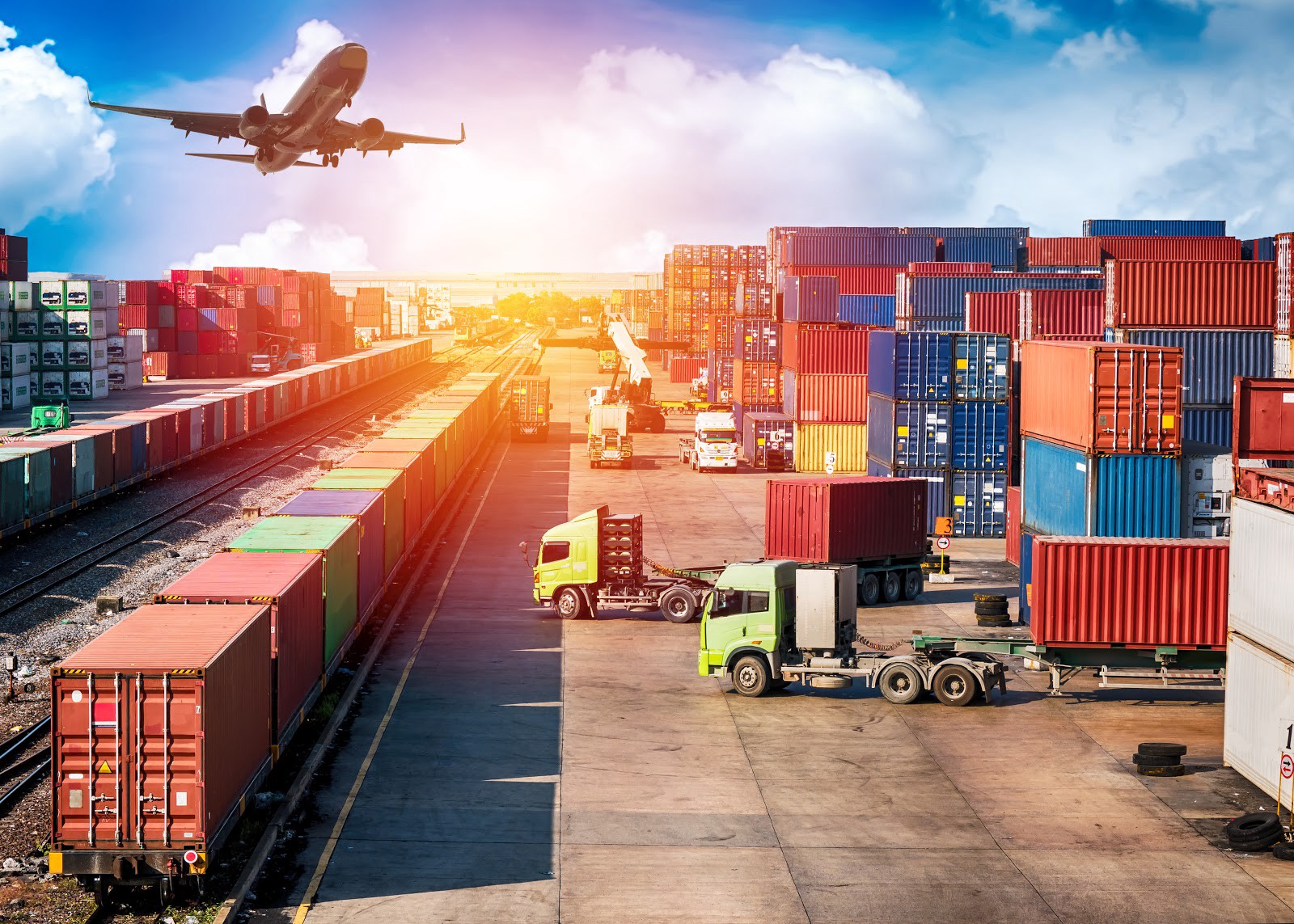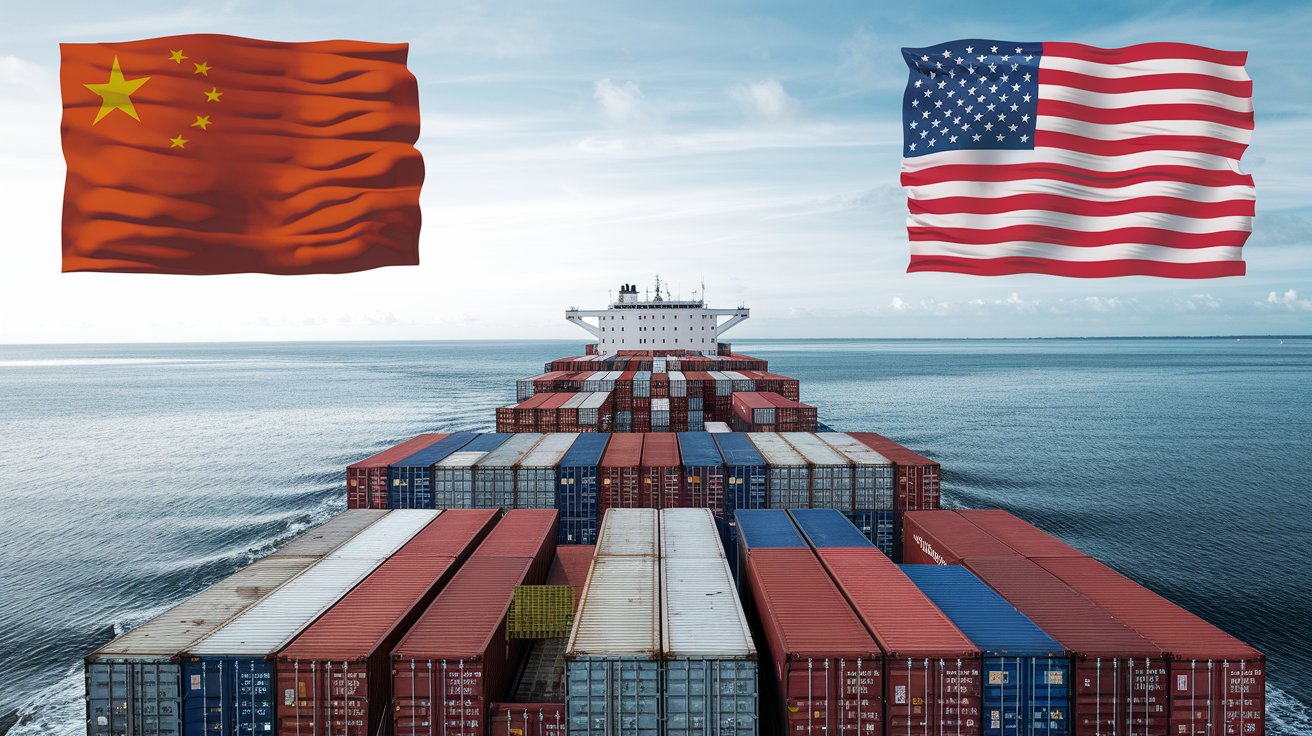
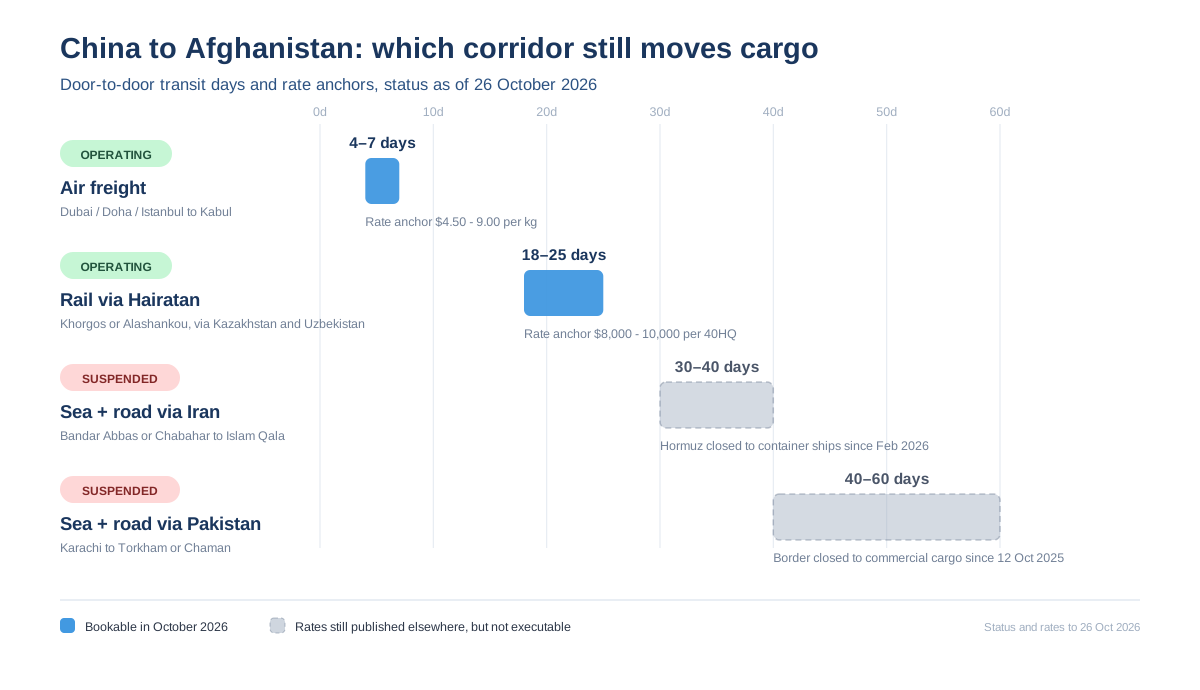
Shipping cost from China to Afghanistan in October 2026 is driven by one fact before any rate table matters: only one of the four traditional corridors is currently moving commercial cargo. A 40ft container sent door to door by rail through Hairatan costs about $8,000–10,000 and takes 18–25 days. Air freight to Kabul runs $4.50–9.00 per kg in 4–7 days. The sea route via Karachi, still quoted by most forwarders, cannot currently deliver into Afghanistan — the Torkham and Chaman crossings have been closed to commercial traffic since 12 October 2025.
That gap between what is published and what is executable is the single most expensive thing on this lane right now. Importers hold quotes built on the Karachi corridor, book against them, and then discover the container is sitting at a port in Pakistan with no onward transit. This guide sets out current rates by mode, the status of each corridor with dates, the rail economics that replaced the ocean route, and the duty structure you need to model before you commit.
As a Shenzhen-based forwarder working China–Afghanistan cargo since 2008, we route through Central Asia, the Gulf and Pakistan, and we would rather show you the corridor board — including the parts that are closed — than a price that cannot be executed. If you are still comparing the lane as a whole, our Shipping From China To Afghanistan service overview covers the ports, borders and modes in one place.
Table of Contents
How Much Does Shipping Cost from China to Afghanistan in 2026?
The table below gives the all-in, door-to-door planning ranges we are working with in late October 2026, per mode. “All-in” means factory pickup in China, export clearance, international freight, Afghan import clearance, duty assessment support and delivery to a named city — not just the line-haul rate.
| Shipping mode | Route in use | All-in cost (Oct 2026) | Door-to-door transit | Status |
|---|---|---|---|---|
| Rail FCL, 40ft (40HQ) | China → Khorgos/Alashankou → Kazakhstan → Uzbekistan → Hairatan → Mazar-i-Sharif / Kabul | $8,000 – $10,000 | 18–25 days | Operating |
| Rail FCL, 20ft | Same corridor | $6,500 – $7,500 | 18–25 days | Operating |
| Rail LCL | Consolidated at a Chinese rail hub | $180 – $300 per CBM | 22–32 days | Operating |
| Air freight, 100–500 kg | Shenzhen / Guangzhou / Shanghai → Dubai, Doha or Istanbul → Kabul | $5.00 – $7.00 per kg | 5–8 days | Operating |
| Air freight, 500 kg+ | Same hubs | $4.50 – $6.00 per kg | 4–7 days | Operating |
| Express courier, under 45 kg | DHL / FedEx / UPS network | $8 – $25 per kg | 5–10 business days | Operating, limited cover |
| Sea FCL to Karachi, 40ft | Shenzhen / Shanghai / Ningbo → Karachi | $3,400 – $3,800 (port-to-port) | 17–26 days at sea | Not deliverable onward |
| Sea + road DDP via Pakistan | Karachi → Torkham / Chaman → Kabul | $4,500 – $9,000 (published) | Not executable | Suspended |
| Sea + road DDP via Iran | Bandar Abbas or Chabahar → Islam Qala → Herat | $5,800 – $8,500 (published) | Not executable | Suspended |
Three things explain almost all of the variance in these numbers. First, Afghanistan has no coastline, so every shipment crosses at least one transit country and clears customs twice. Second, that transit country now determines whether the shipment moves at all — which is why rail carries the volume. Third, the Afghan side assesses duty and Business Receipts Tax on a CIF value that already contains a freight cost two to four times what it was on the ocean route, so duty rises with the freight bill.
What changed between the published rate tables and October 2026
Most Afghanistan freight pages you will find were written in mid-2026 and price the Karachi corridor as the workhorse. That cost structure is now historical. The comparison below shows what the same shipment was quoted at in February 2026, what it costs in October 2026, and why the two are not comparable.
| Cost item | February 2026 baseline | October 2026 | Why it moved |
|---|---|---|---|
| Ocean freight, Shenzhen → Karachi, 40ft | $1,250 – $1,550 | $3,400 – $3,800 | Gulf war-risk pricing and network rerouting pushed Indian Ocean rates up; Shanghai → Karachi spot was quoted near $3,600 per 40HQ on 15 October 2026 |
| Sea + road DDP to Kabul, 40ft | $4,500 – $6,500 | Not executable | Torkham and Chaman closed to commercial traffic since 12 Oct 2025 |
| DDP via Bandar Abbas, 40ft | $5,800 – 8,500 | Not executable | Hormuz effectively closed to container shipping since late Feb 2026; Chabahar congested with Afghan cargo stranded |
| Rail DDP to Kabul, 40ft | $2,500 – $4,000 (published, understated) | $8,000 – $10,000 | Rail became the only working corridor; capacity is booked in block-train slots, and forwarders quoting $2,500–4,000 are recycling 2025 numbers |
| Air to Kabul, 100–500 kg | $5.00 – $7.00 per kg | $5.00 – $7.00 per kg | Air capacity into Kabul is thin but continuous; the Gulf hubs still function for cargo aircraft |
The rail line deserves a specific warning. Several competitor pages still publish $2,500–$4,000 per 40HQ for the Chongqing–Hairatan service. That figure dates from early 2025, when the route was new, lightly used and competing with an open Karachi corridor. Current quotes from operators on the same corridor run $8,000–10,000 per 40HQ door to door, and independent marketplace listings for the same service sit in the same band. If a quote looks like the old number, ask on what date the space was secured.
Which Routes into Afghanistan Are Still Open in October 2026?
Afghanistan is reached through four gateways. Their status is not a matter of preference right now; it is a matter of fact, and it changes what a quote can physically deliver.
| Corridor | Transit port / border | Status in October 2026 | What it means for your cargo |
|---|---|---|---|
| Pakistan (south) | Karachi / Port Qasim → Torkham (Kabul) or Chaman (Kandahar) | Closed to commercial transit since 12 Oct 2025; only the return of undocumented Afghans is moving through Torkham | Containers can reach Karachi but cannot legally cross; storage and demurrage accrue while cargo waits |
| Iran (west) | Bandar Abbas or Chabahar → Islam Qala (Herat) | Cut off — Hormuz has carried under a tenth of pre-crisis commercial transits since late Feb 2026; Chabahar is congested with Afghan cargo already discharged | Not a planning option until Hormuz reopens and insurers reinstate cover |
| Central Asia (north) | Khorgos / Alashankou → Kazakhstan → Uzbekistan → Hairatan → Mazar-i-Sharif | Operating — Hairatan receives 280–300 freight wagons a day; new direct block trains from Zhengzhou (June 2026) and Linyi (departed 21 Oct 2026) | The default corridor for container freight; everything below is priced on it |
| Air | Shenzhen, Guangzhou, Shanghai → Dubai, Doha or Istanbul → Kabul (KBL) | Operating, with security and airspace caveats | The fast option; cost per kg is 4–6× rail per kg equivalent |
Why the Pakistan corridor stopped, and what it would take to restart it
Commercial crossings at Torkham, Chaman, Ghulam Khan, Kharlachi and Angoor Adda have been shut since the fighting of October 2025, and the hostilities of late February 2026 — which included airstrikes on Kabul and Kandahar — closed off any near-term reopening. Announced intentions to reopen in August 2026 did not turn into commercial transit; as of 24 October 2026 the crossing was still restricted to returning Afghans, with warning shots exchanged over a disputed border post.
The economic evidence of the shift is blunt. Afghan transit trade through Pakistan fell from roughly 89,000 containers worth about $5 billion to 11,592 containers worth $367 million in the 2025–26 fiscal year, and bilateral trade dropped about 74% to $358 million. Containers of Chinese consumer goods were reported stuck at Karachi with no onward route. If you are holding a Karachi-routed quote, the practical question is not the rate — it is who pays the storage while the border stays shut, and whether your forwarder will absorb a corridor change mid-transit.
When the crossings do reopen, three things will determine how quickly cargo clears: whether your product sits on Pakistan’s restricted list for Afghan transit (which covers categories including tyres, refrigerators, air conditioners, televisions, telephones, cosmetics and certain chemicals), whether the Afghan Transit Manifest was filed without error — Pakistan does not permit corrections after submission — and whether every document carries the transit annotation that stops Pakistani customs treating the load as a domestic import. Those are not formalities on this corridor; they are the difference between a week and a month.
Why the Iran corridor is not the workaround it was six months ago
When Pakistan closed, Afghan importers pivoted west. Iran became Afghanistan’s largest trading partner, and Chabahar — Iran’s only oceanic port, outside the strait — took over from Karachi, handling construction materials, fuel and general cargo. For a while that worked, and it is still the natural routing for Herat and western Afghanistan.
The Hormuz closure ended it. Since late February 2026 commercial transits through the strait have run below a tenth of pre-crisis levels, war-risk premiums have been quoted at multiples of normal, and carriers have suspended most Gulf bookings rather than test them. Chabahar and Bandar Abbas both lost their ocean connections, and Afghan cargo already discharged at Chabahar has been sitting in congestion rather than moving inland. A forwarder offering you a Bandar Abbas DDP rate today is offering you a corridor that cannot be booked, which is a different product from a corridor that is expensive.
For reference on how the Gulf itself is repricing, our Shipping from China to Saudi Arabia lane shows the same war-risk and routing pattern applied to a Gulf destination, and the container shipping costs from china to Iran page sets out what the Iranian gateways normally cost when they are open.
The northern rail corridor: what is actually running
The corridor that works runs by rail from Chinese inland hubs through Khorgos or Alashankou into Kazakhstan, across Uzbekistan, and onto the 75-km Hairatan–Mazar-i-Sharif line that connects Afghanistan to the Uzbek network. Hairatan port authorities reported 280–300 freight wagons arriving daily in mid-October 2026, carrying clothing, medical equipment, machinery and appliances.
The service pattern has thickened through 2026. A first direct Chongqing–Hairatan train ran in February 2025 with 55 forty-foot containers. A maiden Zhengzhou train arrived at Hairatan on 29 June 2026 — 54 wagons, about 1,700 tonnes, roughly $2 million of Henan textiles, exiting China at Khorgos. On 21 October 2026 the first Linyi (Shandong) train departed with textiles, chemical raw materials, tools and construction machinery, expected into Hairatan in about 20 days. Chinese traders on the ground describe collecting goods at Hairatan that moved “by freight train via Kazakhstan and Uzbekistan.”
Two structural limits are worth knowing before you plan around this corridor. The gauge changes at Khorgos and Alashankou from standard to CIS broad gauge, so containers are physically transferred, which is where a day or two of the transit time goes. And capacity is sold largely as block-train space rather than single boxes, which is why a one-container importer often pays a consolidation premium and why booking lead time matters more here than on an ocean lane.
The Wakhan road is not a corridor yet
On 4 October 2026 Afghan officials inaugurated a 121-km road through the Wakhan Corridor to the Chinese border, the first direct land link between the two countries. It is a genuine long-term change, and it is not something to route cargo on today: the road is partly gravel, construction is still in progress on the first 50-km section, and there is no established customs or transit regime at the border. Treat it as a 2027-and-beyond question.
Sea Freight from China to Afghanistan: What the Karachi Route Costs Today
Ocean freight is still the cheapest way to get a container out of China; it is simply not, at the moment, a way to get one into Afghanistan. The rates below are real and bookable to Karachi — they just stop at the port.
| Port of loading | 20ft (Q3 2026 basis) | 40ft / 40HQ (Q3 2026 basis) | Sea transit to Karachi |
|---|---|---|---|
| Shenzhen (Yantian / Shekou) | $700 – $850 | $1,250 – $1,500 | 18–22 days |
| Guangzhou (Nansha) | $750 – $900 | $1,350 – $1,600 | 18–24 days |
| Shanghai | $750 – $900 | $1,350 – $1,600 | 20–26 days |
| Ningbo | $750 – $900 | $1,350 – $1,600 | 20–26 days |
| Qingdao | $800 – $950 | $1,500 – $1,750 | 15–20 days |
| Tianjin | $850 – $1,000 | $1,550 – $1,800 | 18–24 days |
Those are forwarder port-to-port quotations from Q3 2026, and they should be read as a floor rather than a current price. Spot pricing moved up through the autumn: Shanghai → Karachi was reported at about $3,600 per 40HQ on 15 October 2026, roughly double the Q3 forwarder band, so benchmark any 40ft quote against that before you assume it is current. The gap is war-risk and network effects from the wider Middle East disruption rather than anything specific to Pakistan.
Scope matters more on this lane than almost anywhere else. A port-to-port quote covers the sea leg only. A “to border” quote adds transit customs and bonded trucking to Torkham, Chaman or Islam Qala. A DDP quote adds Afghan clearance, duty, Business Receipts Tax and delivery to your city. Published tables blend these three scopes into one number, which is how the same 40ft box appears at $1,350 and at $9,000 on different websites. Ask which of the three you are being quoted before comparing.
There is one more cost that only appears when the border is shut: detention. A Karachi–Kabul round trip normally takes 23–25 days against 10 free days of container use, so detention of $8–15 per day was routine even in normal conditions. With no onward transit, the clock runs without a delivery, and port storage stacks on top. If your cargo is already at Karachi, the commercial decision is usually to abandon the box and re-consolidate by rail rather than wait for a reopening date that has not been given.
When Pakistan reopens, the sea route returns to being the cheapest option for heavy, low-value cargo — machinery, construction materials, bulk — and the corridor logic of shipping from the Chinese port nearest your supplier still holds. Until then, Shipping From China To Pakistan is the lane that describes the port and trucking structure you would be re-entering.
Rail Freight from China to Afghanistan via Hairatan: Rates, Transit Time and Capacity
Rail is now the backbone of this lane, and it prices like a premium product rather than a discount to ocean freight. The table below reflects quotes we are seeing in October 2026 for door-to-door service.
| Service | Chinese origin / border | Afghan entry | Transit | All-in per 40HQ |
|---|---|---|---|---|
| Chongqing–Hairatan block train | Chongqing, via Khorgos | Hairatan → Mazar-i-Sharif | 20–25 days | $9,000 – $10,000 |
| Zhengzhou–Hairatan block train | Zhengzhou, via Khorgos | Hairatan | 20–25 days | $8,500 – $10,000 |
| Linyi–Hairatan block train (new, Oct 2026) | Linyi, via Khorgos | Hairatan | ~20 days | $8,000 – $9,500 |
| Xi’an / Chengdu–Central Asia service | Xi’an or Chengdu, via Alashankou | Hairatan | 22–30 days | $8,000 – $9,500 |
| Consolidated rail LCL | Any Chinese rail hub | Hairatan → Kabul | 22–32 days | $180 – $300 per CBM |
Two 20ft containers on the same service are typically quoted around $15,000, which puts a single 20ft in the $6,500–7,500 band — worth checking if your cargo is dense rather than bulky, because a 20ft carries 28 CBM but a much higher payload.
Transit time breaks down roughly as 4–6 days of domestic trucking and consolidation inside China, 11–15 days of rail movement including the gauge transfer, 1–2 days at Hairatan, and 1–2 days of trucking onward — to Mazar-i-Sharif in under an hour of driving, or to Kabul over the Salang Pass in about a day. That last leg is the one people underestimate in winter.
Rail has three practical advantages on this lane beyond the fact that it moves. It is not exposed to Hormuz or to a land border that can close overnight. Its schedule is fixed, so a booking made three weeks out tends to hold. And because it enters through the north, it avoids the double transit clearance that made the Pakistan corridor slow even when it was open.
The disadvantage is capacity structure. Block-train slots are sold in train lots, and a single container is often riding a consolidated slot, which adds handling at both ends. If your volume is one or two containers every few months, expect to pay toward the top of the range and to book earlier than you would for ocean freight. Our Shipping From China To Kazakhstan and Shipping From China To Uzbekistan pages cover the transit-country side of this route, and Shipping From China To Kyrgyzstan covers the road alternative through Osh that some consolidators still use for the Kashgar leg.
Air Freight from China to Afghanistan: Rates per Kg to Kabul
There are no scheduled direct freighter services from mainland China to Kabul. Every air shipment connects through a Gulf or Turkish hub — most commonly Dubai, Doha or Istanbul — before the final leg to Kabul, Kandahar, Herat or Mazar-i-Sharif.
| Chargeable weight | Rate per kg (door to door) | Typical transit | Best for |
|---|---|---|---|
| Under 45 kg | $8 – $12 | 5–10 days | Samples, documents, spare parts |
| 45 – 100 kg | $6 – $9 | 5–8 days | Urgent commercial samples, launch stock |
| 100 – 300 kg | $5 – $7 | 5–8 days | Electronics, medical supplies |
| 300 – 500 kg | $5.50 – $7.00 | 5–8 days | Consolidated urgent cargo |
| 500 – 1,000 kg | $4.50 – $6.00 | 4–7 days | Bulk urgent shipments |
| 1,000 kg+ | $4.50 – $5.50 | 4–7 days | Project cargo on charter or part-charter |
Chargeable weight is the greater of actual weight and volumetric weight, with the volumetric divisor at 6,000 — so 1 CBM of light cargo bills as 166.7 kg. Garments, foam products and packaging materials cube out long before they weigh out, and that is where air quotes surprise importers.
Air is the one mode on this lane whose price did not step-change with the corridor closures, because aircraft were never using Hormuz. That has compressed the usual sea-to-air multiple: on a normal China–Afghanistan lane air costs four to six times rail per kg; with rail at $8,000–10,000 per 40HQ and air at $4.50–6.00 per kg for volume shipments, the multiple is narrower than that for high-value cargo. If your product is above roughly $30 per kg of value and your margin depends on speed, air is now a closer call than it was a year ago.
Express couriers still reach Kabul, but cover is limited and the rates reflect it — $8–25 per kg with 5–10 business days is normal, and carriers routinely restrict service to account holders. If you need 20 kg of samples in Kabul next week, express is the answer; if you need 200 kg, air freight on a consolidated booking is both cheaper and more predictable.
LCL or FCL to Afghanistan: Where the Break-Even Sits
The textbook answer — “LCL below 12–15 CBM, FCL above” — is wrong on the current lane, and getting it wrong costs real money. The reason is that rail FCL carries a large fixed cost per container while LCL here is not cheap per CBM.
| Volume | LCL at $200/CBM | LCL at $250/CBM | LCL at $300/CBM | 20ft rail ($7,000) | 40HQ rail ($9,000) | Cheapest at this volume |
|---|---|---|---|---|---|---|
| 5 CBM | $1,000 | $1,250 | $1,500 | — | — | LCL |
| 10 CBM | $2,000 | $2,500 | $3,000 | — | — | LCL |
| 20 CBM | $4,000 | $5,000 | $6,000 | $7,000 | — | LCL |
| 26 CBM | $5,200 | $6,500 | $7,800 | $7,000 | — | LCL at $250; 20ft once above $270/CBM |
| 28 CBM | $5,600 | $7,000 | $8,400 | $7,000 | — | Tie at $250; 20ft above that rate |
| 30 CBM | $6,000 | $7,500 | $9,000 | $7,000 | $9,000 | 20ft |
| 36 CBM | $7,200 | $9,000 | $10,800 | above usable capacity | $9,000 | 40HQ |
| 45 CBM | $9,000 | $11,250 | $13,500 | above usable capacity | $9,000 | 40HQ |
At a $250/CBM LCL rate the 20ft at $7,000 becomes the cheaper option from about 28 CBM, and the 40HQ at $9,000 from about 36 CBM; at $300/CBM those thresholds fall to about 23 CBM and 30 CBM. Because a 20ft tops out around 28–33 CBM of usable space, anything between roughly 33 and 36 CBM is on a 40HQ by default. Compare that with the 12–15 CBM break-even quoted on ocean lanes and the difference in decision is a container’s worth of money.
Two practical rules follow. Below 20 CBM, consolidate — our LCL vs FCL Shipping: How to Choose the Right Option for Small Cargo guide covers the decision logic. Between 26 and 36 CBM, get both numbers on the same day, because which side wins depends on the LCL rate your consolidator can hold that week. Above 36 CBM, take the 40HQ: at 60-plus usable CBM you are paying $150 per CBM or less, which no LCL rate on this lane can match.
One more variable specific to Afghanistan: LCL cargo is deconsolidated and re-loaded at least once, usually at Hairatan or a Chinese rail hub. Each handling step on a route that already crosses two borders is a chance for damage and mis-labelling, and claims are slow. If your cargo is fragile or high-value, the LCL saving can be smaller than the risk.
Afghan Import Duty, BRT and Your Landed Cost
Afghan customs is administered by the Afghanistan Customs Department under the Ministry of Finance. Declarations are filed in ASYCUDA World by a licensed Afghan broker, and duty plus Business Receipts Tax are paid at the customs bank counter before a release order is issued. On a clean single-commodity shipment with correct documents, border clearance at a crossing like Islam Qala typically takes 1–4 days; restricted goods wait for permits and test reports, and that is where weeks go.
| Product category | Typical duty (percent of CIF) | Note |
|---|---|---|
| Essential food, seeds, certain medicines | 0 – 2.5% | Lowest band |
| Raw materials for manufacturing | 5% | Common for industrial inputs |
| Machinery (general) | 2.5 – 10% | Varies by HS subheading |
| Solar panels, LED lighting | 5% | Deliberately favourable energy band |
| Semi-processed goods, most agricultural inputs | 10% | — |
| Synthetic fabrics and yarn | 5 – 8% | Fabric composition must be itemised on the invoice |
| Electronics (general) | 2.5 – 16% | Averages around 16%; maximum near 20% |
| Motorcycles and parts, automotive spares | 15 – 16% | — |
| Finished consumer goods, luxury items, vehicles | 20 – 25% | Highest general band |
| Steel rebar and construction bars | Up to 30% | Raised in the 1404 tariff adjustment; confirm the current line |
The bands above are the general tariff. Afghanistan’s Tariff Committee also adjusts specific lines during the year, and the 1405 review moved several consumer categories sharply:
| Product | Rate before 2026 review | Rate after 2026 review |
|---|---|---|
| Plastic footwear | 50% | 80% |
| Leather footwear | 20% | 40% |
| Plaster | 50% | 80% |
| Building paint | 16% | 30% |
| Bottles | 12% | 16% |
| Nappies | 20% | 25% |
| Springs (single reduction) | 8% | 3.5% |
On top of duty, two charges matter. Business Receipts Tax (BRT) applies to imports at 2–5%, with 4% the general rate and no input-credit mechanism; it is assessed on the duty-paid value. A 2% advance income tax is collected at the border and is creditable against your annual corporate income tax liability, so it is a cash-flow cost rather than a final one.
One correction worth making explicitly: Afghanistan does not operate a VAT in practice, despite a VAT law on the books. Forwarders who quote a flat “10% VAT” on imports are usually rolling BRT and miscellaneous border charges into one line. Ask for the duty line, the BRT line and the advance tax line separately — a quote that cannot separate them is not a quote you can audit.
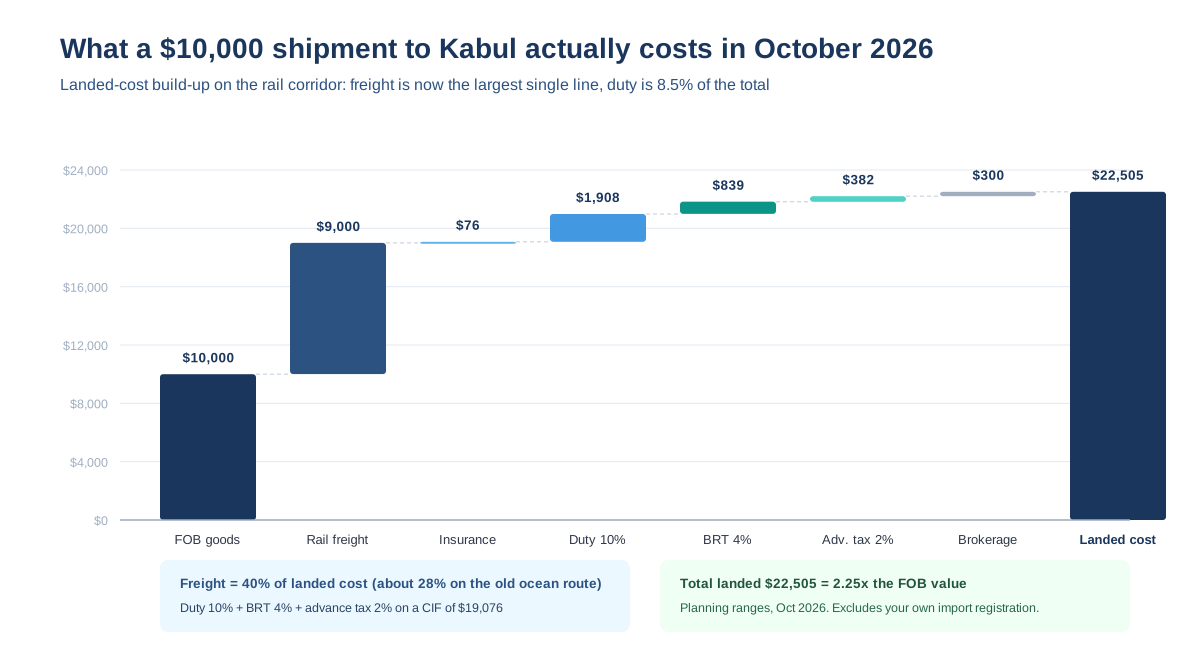
Worked example: a $10,000 container to Kabul in October 2026
Take a 40HQ of mixed consumer goods and machinery, FOB value $10,000, moving by rail door to door to Kabul at $9,000 all-in.
| Line | Amount | Notes |
|---|---|---|
| FOB goods value | $10,000 | Supplier invoice |
| Rail freight, door to door to Kabul | $9,000 | Includes Hairatan transfer and Salang trucking |
| Cargo insurance, 0.4% of goods plus freight | $76 | War-risk and transit riders recommended on this lane |
| CIF value at Afghan border | $19,076 | Duty and BRT base |
| Customs duty at 10% | $1,908 | Assumes a mid-band HS classification |
| Subtotal, CIF plus duty | $20,984 | BRT base |
| Business Receipts Tax at 4% | $839 | Paid at the bank counter before release |
| Advance income tax at 2% | $382 | Creditable against annual corporate tax |
| Brokerage and border handling | $300 | Licensed Afghan broker, ASYCUDA filing |
| Total landed cost | $22,505 | 2.25× the FOB value |
The number to internalise is that freight is now 40% of your landed cost and duty is 8.5%. On the old ocean route the same cargo put freight nearer 28%, because the sea-and-road leg was about half what rail now costs. That inversion is why corridor selection, not HS-code optimisation, is the largest lever available to an importer this quarter.
Two failure modes recur in this calculation. Valuing the goods low to reduce duty is heavily penalised by Afghan customs when assessed, and the penalty can exceed the duty avoided. And declaring a generic description — “electronics”, “spare parts”, “clothing” — triggers manual review; textiles in particular now require material type, fibre percentage and knit-versus-woven detail on the invoice.
EXW, FOB, CIF or DDP: who carries what into Afghanistan
| Cost element | EXW | FOB | CIF | DDP |
|---|---|---|---|---|
| Factory pickup and China export clearance | Buyer | Seller | Seller | Seller |
| International freight to the transit country | Buyer | Buyer | Seller | Seller |
| Cargo insurance | Buyer | Buyer | Seller | Seller |
| Transit-country customs and border handling | Buyer | Buyer | Buyer | Seller |
| Afghan import clearance, duty and BRT | Buyer | Buyer | Buyer | Seller |
| Delivery to Kabul, Kandahar or Herat | Buyer | Buyer | Buyer | Seller |
| Your total spend visibility | Lowest | Partial | Partial | One number |
On this lane DDP is not a convenience product, it is a risk-transfer product. Under CIF to Karachi or Bandar Abbas you are the importer of record in a country where you likely have no broker relationship, no bank channel and no way to manage a border queue. Our ddp explainer sets out the mechanics; on Afghanistan, insist that the DDP quote names the corridor, the border crossing and the date the space was secured.
Documents that decide how fast your container clears
A commercial invoice with specific HS subheadings and, for textiles, full fibre detail; a packing list with quantities, weights and dimensions per line; the rail waybill or bill of lading; a certificate of origin; the Afghan import licence or permit where the product is regulated; a fumigation certificate with IPPC marking where wooden packaging is used; and, for Pakistan-routed cargo when that corridor reopens, the transit manifest and the “goods in transit to Afghanistan” annotation on every document. Missing one line on the invoice is the most common cause of a three-day hold.
How Long Does Shipping from China to Afghanistan Take?
| Origin | Destination | Rail, door to door | Air, door to door |
|---|---|---|---|
| Shenzhen / Guangzhou | Kabul | 22–28 days | 5–8 days |
| Shenzhen / Guangzhou | Mazar-i-Sharif | 20–25 days | 5–8 days |
| Shanghai / Ningbo | Kabul | 22–28 days | 5–8 days |
| Qingdao / Tianjin | Kabul | 20–26 days | 5–9 days |
| Any Chinese hub | Kandahar | 25–32 days | 6–9 days |
| Any Chinese hub | Herat | 28–35 days | 6–9 days |
| All modes | Sea via Karachi (when open) | 40–60 days door to door | — |
The two variables that move transit time most are the Salang Pass and the Afghan calendar. Salang connects the northern railhead to Kabul, and heavy snow closes or slows it between December and February, which is when winter surcharges appear and trucks reroute. Herat and Kandahar sit at the end of long domestic legs and are 3–7 days behind Kabul regardless of mode.
| Period | Effect on cost and transit | What to do |
|---|---|---|
| Chinese New Year, 6 February 2027 | Factory shutdowns and a capacity crunch on every China export lane; rates typically rise 15–25% | Book 4–6 weeks before; confirm the last pre-CNY train departure |
| Ramadan, from about 8 February 2027 | Reduced staffing at border posts and customs; add 5–7 days | Build the buffer into the promise date, not the hope |
| Eid al-Fitr, early March 2027 | Short shutdown across the Afghan border and transport sector | Avoid tight delivery commitments in that week |
| Salang winter, December–February | Snow closures and rerouting on the Kabul leg | Ship northern-destination cargo early, or route to Mazar first |
| Nowruz, 21 March | Afghan new year; administrative slow-down | Plan clearance either side |
| Q4 peak, October–December | Ocean rates elevated; rail slots tighten | Lock rail space early, as it is the constrained mode |
February 2027 is the pinch point worth diarising now: Chinese New Year on 6 February and Ramadan from about 8 February fall in the same week, so factories stop producing at almost exactly the moment Afghan border staffing drops. Cargo that must land in Afghanistan in February needs to leave China in the first half of January.
How to Choose a Freight Forwarder for Afghanistan Cargo
This lane is three jobs in one quote — a Chinese rail booking, a Central Asian transit clearance and an Afghan import file — and the failure points sit between them rather than inside any one of them. Four checks separate a forwarder who runs this route from one who resells it:
- Ask which corridor, which border, and which departure date. A quote that says “via Karachi” or “via Bandar Abbas” in October 2026 is a quote for a closed corridor. You want a named rail service, a named border (Khorgos or Alashankou), and the week the slot is held.
- Ask how the gauge transfer is handled. Containers are physically transferred at Khorgos or Alashankou; ask who pays the handling, whether your cargo stays in the same box, and what the damage-liability position is at that handover.
- Ask who files the Afghan declaration, and in whose name. You want a named licensed Afghan broker filing in ASYCUDA World, and a written statement of whether duty and BRT are pre-assessed in the DDP rate or invoiced to you at the bank counter after release.
- Ask for the detention, storage and insurance terms in writing. Free time at Hairatan and Mazar dry ports, per-day storage after it, and whether the cargo policy carries war-risk and transit riders. On a route with two borders, these three lines decide whether a delay costs hundreds or thousands.
Dantful has been moving cargo out of China since 2008 from Shenzhen, as a Class-A licensed forwarder and NVOCC, FMC and Jctrans member, with direct carrier and rail-operator contracts rather than brokered space. On Afghanistan work that means corridor selection backed by an operator relationship, daily tracking updates with photographs at each handover, 50 operations staff and a 50-plus customer service team on 24/7 cover, and trilingual support across Chinese, English and Arabic. You can read more about how we operate as a freight forwarder in shenzhen china, and our how to choose the right freight forwarder guide sets out the questions in more depth.
Frequently Asked Questions
How much does it cost to ship a container from China to Afghanistan in 2026?
A 40ft container door to door to Kabul costs about $8,000–10,000 in October 2026, moving by rail through Hairatan. A 20ft runs $6,500–7,500. Ocean freight to Karachi is cheaper at $1,250–1,800 per container port-to-port, but the Pakistan land border has been closed to commercial cargo since 12 October 2025, so that route cannot currently complete a delivery.
Is the Karachi route to Afghanistan open again?
No. Torkham, Chaman and the other commercial crossings have been closed since 12 October 2025. Reopening was announced in August 2026 but had not been implemented for commercial traffic as of late October 2026; Torkham was still limited to Afghans returning to Afghanistan. Containers can still be shipped to Karachi, but they cannot legally transit onward.
How long does shipping from China to Afghanistan take?
By rail, 18–25 days door to door to Kabul and 20–25 days to Mazar-i-Sharif. By air, 4–7 days. By sea via Karachi, 40–60 days door to door when that corridor is open. Add 5–7 days during Ramadan and expect Salang Pass delays between December and February.
Is rail freight to Afghanistan cheaper than air freight?
Per kilogram, yes — broadly. A 40HQ at $9,000 carrying 20 tonnes works out near $0.45 per kg, against $4.50–9.00 per kg for air. Per shipment, air only wins on small, urgent, high-value consignments where the working-capital and lost-sales cost of 20 extra days exceeds the air premium.
What is the cheapest way to ship from China to Afghanistan right now?
Consolidated rail LCL at roughly $180–300 per CBM for volumes under 20 CBM; a 20ft rail container at $6,500–7,500 once you pass about 28 CBM; a 40HQ at $8,000–10,000 once you pass roughly 32–40 CBM, depending on the rate you secure. Full-train bookings are cheaper per container again if your volume can fill one.
What import duty and taxes will I pay in Afghanistan?
Customs duty runs from 0% to 25% of CIF value depending on HS code, with steel and some consumer categories higher after the 2026 tariff review. On top of duty you pay Business Receipts Tax at 2–5% (4% general rate) and a 2% advance income tax that is creditable against corporate tax. There is no operational VAT, so treat any quote showing a flat “10% VAT” as an estimate that needs breaking down.
Do I need an import licence to ship to Afghanistan?
Standard commercial goods generally clear without a special licence, but regulated categories — pharmaceuticals, food, chemicals and some electronics — need permits and test reports, and the consignee must be properly registered with Afghan customs. Confirm the position for your HS code before the container leaves China; it is the single most common cause of a multi-week hold.
Can I ship to Kandahar or Herat instead of Kabul?
Yes. Kandahar is reached overland from the northern railhead with a longer domestic leg, typically 25–32 days by rail; Herat is 28–35 days and is the city for which the Iran corridor would normally be used, once Hormuz reopens. Both add cost over Kabul because the domestic trucking leg is longer.
Is cargo insurance necessary on this lane?
Strongly recommended. The route crosses two borders, changes rail gauge, and includes road legs in areas insurers classify as higher risk. Marine cargo cover with war-risk and transit riders typically costs 0.3–0.5% of declared value — on a $19,000 CIF shipment, under $100 to protect the consignment.
Will the Wakhan Corridor change shipping costs to Afghanistan?
Not for several years. The 121-km road to the Chinese border was inaugurated on 4 October 2026, but it is partly gravel, still under construction in sections, and has no established customs or transit regime. It may eventually shorten the northern route; it is not a bookable corridor in 2026.

Young Chiu is a seasoned logistics expert with over 15 years of experience in international freight forwarding and supply chain management. As CEO of Dantful International Logistics, Young is dedicated to providing valuable insights and practical advice to businesses navigating the complexities of global shipping.