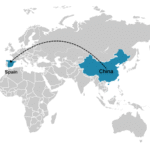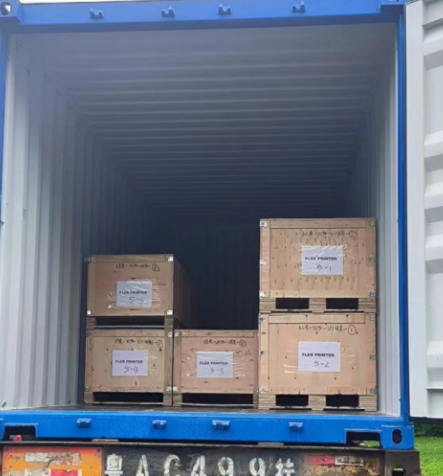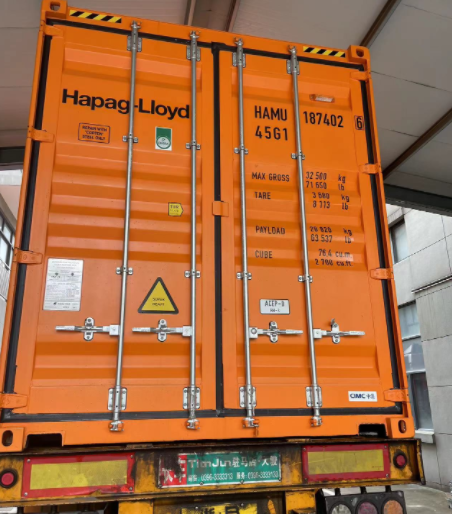
Shipping a container from China to Spain in 2026 typically costs $2,500–3,800 for a 20ft container and $3,500–5,000 for a 40ft container (port to port, August 2026 levels), plus Spanish import duty and 21% VAT on top. Sea freight takes 28–40 days to Valencia, Barcelona or Algeciras. This guide walks through every charge — ocean freight, port fees, destination charges, duty and VAT — with one worked example at the end, so you know exactly what to budget for before you book.
As a specialist in Shipping From China To Spain since 2008, we have moved thousands of containers on this lane. Rates below are the market consensus for August 2026, cross-checked against current forwarder data on China–Spain routes. They are a planning baseline — your exact quote depends on your cargo, ports and season — but they will put you in the right ballpark.
How Much Does Container Shipping from China to Spain Cost in 2026?
The fastest way to get your answer: a 20ft container costs roughly $2,500–3,800, a 40ft container $3,500–5,000, and LCL (shared container) space $60–180 per cubic meter, all before Spanish import duty and VAT. Transit is 28–40 days port to port for full containers. If you need the full all-in picture — freight, duty, VAT and delivery to your door — compare shipping rates from china to Spain or ask your forwarder for a single door-to-door quote.
| Container type | Sea freight (Aug 2026) | Best for | Transit time |
|---|---|---|---|
| 20ft (20GP) | $2,500–3,800 | Heavy, compact cargo — machinery, tiles, hardware | 28–40 days |
| 40ft (40GP) | $3,500–5,000 | Furniture, textiles, retail goods, larger volume | 28–40 days |
| 40ft High Cube (40HQ) | $3,700–5,200 | Light, bulky cargo that needs extra height | 28–40 days |
| LCL (shared container) | $60–180 / CBM | Small shipments under ~15 CBM | 30–45 days |
| Door-to-door (DDP) | From ~$6,000 per container | One price: freight + duty + VAT + delivery | 35–50 days |
These sea-freight figures are port-to-port: they cover the ocean leg from a major Chinese port (Shanghai, Shenzhen, Ningbo, Qingdao, Tianjin) to a major Spanish port (Valencia, Barcelona, Algeciras, Bilbao). On top of the line above you need origin handling, destination port charges, import duty and VAT, and inland delivery if your final address is not the port — the sections below break down each one, and Section 6 shows how they add up.
20 ft Container Shipping Cost from China to Spain
A 20ft container gives you about 33 cubic meters of usable space, and it is the right choice when your cargo is heavy but compact — machinery parts, hardware, ceramic tiles, stone, tools, metal products and industrial materials. For these goods the container fills by weight before it fills by volume, so paying for a 40ft box would be wasted space.
In August 2026, shipping a 20ft container from China to Spain costs $2,500–3,800 by sea, with most quotes from South China ports (Shenzhen, Guangzhou) landing between $2,650 and $3,400, and North China ports (Qingdao, Tianjin) running $300–500 higher because of the extra feeder distance. The table below shows typical ranges by loading port; the destination port in Spain matters less for the ocean rate than for transit time and local charges (Section 7).
| Loading port (China) | 20ft to Spain (Aug 2026) | Notes |
|---|---|---|
| Shenzhen / Yantian | $2,650–3,400 | Strong for Pearl River Delta suppliers |
| Shanghai | $2,850–3,600 | Most frequent sailings to Spain |
| Ningbo-Zhoushan | $2,950–3,700 | Competitive on the Europe trade lane |
| Qingdao | $3,050–3,750 | North China manufacturing base |
| Tianjin | $3,150–3,800 | Beijing/Tianjin area suppliers |
For a complete ocean quote, also ask for Sea Freight From China to Spain pricing that includes origin THC, documentation and destination charges — see Section 6 for what those are and how to plan for them.
40 ft Container Shipping Cost from China to Spain
A 40ft container holds about 67 cubic meters — nearly twice a 20ft — while the ocean freight is usually only 30–50% higher. That is why large or bulky shipments (furniture, textiles, garments, lighting, household goods, e-commerce inventory) are almost always cheaper per cubic meter on a 40ft box.
In August 2026, shipping a 40ft container from China to Spain costs $3,500–5,000 by sea, and a 40ft High Cube (40HQ, about 76 CBM with extra height for light, bulky goods) $3,700–5,200. As with the 20ft, South China origins sit at the lower end and North China ports add $400–600.
| Loading port (China) | 40ft to Spain (Aug 2026) | 40HQ to Spain (Aug 2026) |
|---|---|---|
| Shenzhen / Yantian | $3,450–4,400 | $3,650–4,600 |
| Shanghai | $3,550–4,600 | $3,750–4,800 |
| Ningbo-Zhoushan | $3,850–4,800 | $4,050–5,000 |
| Qingdao | $3,950–4,900 | $4,150–5,100 |
| Tianjin | $4,050–5,000 | $4,250–5,200 |
Rule of thumb: if your cargo is below roughly 15 CBM, LCL is usually cheaper; at 15 CBM and above, start comparing FCL — the next section shows the exact crossover with real numbers.
LCL Shipping Cost from China to Spain: When Is LCL Cheaper Than FCL?
Less-than-container-load (LCL) means your goods share a container with other importers’ cargo and you pay only for the space you use. LCL from China to Spain costs $60–180 per cubic meter (August 2026), with most shipments quoting $100–140/CBM — plus a small origin handling fee and a destination fee, typically $200–400 in total on top of the per-CBM rate. Transit is 7–10 days longer than FCL because of consolidation and deconsolidation at each end.
LCL makes sense for samples, spare parts and first test orders. But the per-unit price is higher than FCL: the moment your volume crosses roughly 15 CBM, a full 20ft container is usually the cheaper option. Here is the crossover math at a typical LCL rate of $120/CBM (we explain the difference between the two modes in detail in our guide to what is lcl and fcl in shipping):
| Cargo volume | LCL at $120/CBM + fees | 20ft FCL (from) | Verdict |
|---|---|---|---|
| 12 CBM | $1,440 + ~$400 = ~$1,840 | $2,500 | LCL wins — save ~$650 |
| 15 CBM | $1,800 + ~$400 = ~$2,200 | $2,500–3,800 | Break-even zone |
| 18 CBM | $2,160 + ~$400 = ~$2,560 | $2,500–3,800 | FCL wins at most quotes |
The exact crossover point shifts with your LCL rate and your port pair — if your forwarder quotes LCL at $180/CBM, the crossover moves down toward 13 CBM; at $60/CBM it moves up toward 20 CBM. The practical takeaway: below ~15 CBM compare LCL quotes; above ~15 CBM ask for FCL. For a fuller decision framework covering handling risk, transit time and when consolidation makes sense, see LCL vs FCL Shipping: How to Choose the Right Option for Small Cargo.
What Factors Affect Container Shipping Costs from China to Spain?
Two shipments on the same route can land at very different prices, and knowing the levers lets you plan — and negotiate — better. The main cost drivers on the China–Spain lane in 2026:
- Container size and type. A 20ft is cheaper in total; a 40ft is cheaper per cubic meter. Open-top, flat-rack and reefer containers cost $500–1,500 more than standard boxes because the carrier has to position special equipment.
- Cargo weight and volume. FCL is priced per container; LCL per cubic meter (with a chargeable-weight rule: if your cargo is dense, carriers compare weight against volume and bill the higher figure).
- Loading port. South China ports (Shenzhen, Yantian, Nansha) are closest to the main manufacturing belt and usually quote $200–500 less than Tianjin or Dalian on the same destination.
- Destination port. Valencia and Barcelona have direct China services on the main Mediterranean rotations, so they usually carry the lowest rates and shortest transit. Algeciras is a transshipment hub — excellent connectivity onward, but an extra leg if your final port is elsewhere. Bilbao, in the north, adds 2–4 days and often $100–300 versus Mediterranean ports.
- Season and demand. Rates climb before Chinese New Year (January–February), during the European summer peak (July–August) and into the Q4 holiday rush (October–December). Peak-season surcharges (PSS) of 10–25% are common in those windows.
- 2026 route context. Red Sea diversions around the Cape of Good Hope have kept Mediterranean services longer and costlier than pre-2024 levels, and capacity on China–Spain loops remains tight at peak. Book 2–4 weeks ahead in season to lock space and rates.
- Incoterms and service scope. Port-to-port, door-to-port, or full door-to-door (DDP) change the price dramatically — a door-to-door price bundles pickup, clearance, duty and final delivery, so it should always be compared like-for-like with port-to-port.
Most cost surprises happen when importers compare a port-to-port quote against a door-to-door quote, or forget that ocean freight is only part of the bill. Section 6 lists every standard charge so none of them catches you off guard.
Import Duties, VAT and Destination Fees in Spain: What Should You Budget For?
The ocean freight is roughly half the story. When your container arrives in Spain, a standard set of destination charges and taxes applies — none of them are hidden, they are simply the normal cost chain of an EU import, and a professional forwarder lists them all in the quote. Here is every line, what it is, and how to plan it.
Destination charges on arrival
| Charge | Typical cost (2026) | What It Is & How to Plan |
|---|---|---|
| Terminal handling (THC) | €150–400 per FCL container; €15–60/CBM for LCL | Port charges for unloading and moving the box. Baked into most all-in quotes; if you get a bare ocean rate, add this line yourself. |
| Documentation fee | €60–120 per shipment | Preparing the bill of lading, arrival notice and clearance documents. Ask your forwarder to itemize it — it is a fixed, standard charge. |
| Customs brokerage | €80–200 per shipment | Your broker files the import declaration with Spanish customs. If you use a forwarder’s in-house broker, it is usually one clear line on the invoice. |
| Fuel / BAF surcharge | 8–18% of the ocean freight | Carriers pass on fuel cost swings; it moves monthly with bunker prices. Check the surcharge level on your quote and compare it across quotes — it varies by carrier. |
| Demurrage & detention | ~€100–250 per day after free time | Charged if the container stays at the terminal or is returned late. Free time is usually 5–7 days at Spanish ports — plan your inland pickup and return inside it. |
| Inland trucking | €250–600 per container | Port to warehouse anywhere in mainland Spain. Get this quoted with the port pair, not after arrival. |
| ISPM-15 (wood packaging) | Compliance check; ~€50–150 if treated on-site | Wood pallets and crates must be heat-treated and stamped. Have your supplier stamp them in China — it costs almost nothing there and avoids border inspection delays here. |
Import duty and VAT (IVA)
Spain applies EU customs rules, and there is no free-trade agreement between the EU and China, so standard MFN duty rates apply. Duty is charged on the CIF value (goods + freight + insurance) and varies by HS code — a few typical bands:
| Product category | Customs duty (MFN, typical) | VAT (IVA) |
|---|---|---|
| Electronics (smartphones, laptops) | 0–14% | 21% |
| Clothing | 12% | 21% |
| Toys | 0–4.7% | 21% |
| Furniture | 0–2.7% | 21% |
| Machinery | 0–2.5% | 21% |
| Footwear | 8–17% | 21% |
| Automotive parts | 0–4.5% | 21% |
On top of duty, Spain applies 21% VAT (IVA) on the customs value plus duty plus freight. Three practical points Spanish importers use:
- Get an EORI number. Any business importing into the EU needs one — it is free, valid across all 27 EU countries, and usually issued within a few working days. Your forwarder or broker needs it to clear your goods.
- Defer the VAT (IVA diferido). Regular importers on the monthly VAT return can account for import VAT on their monthly return instead of paying it in cash at the border — a real cash-flow advantage. Ask your Spanish accountant whether you qualify.
- Watch the anti-dumping list. Some China-origin goods — certain steel, aluminium, ceramics and bicycles — carry extra anti-dumping duty on top of MFN rates. Confirm your HS code in the EU TARIC database before shipping. (For regulated or hazardous cargo, an experienced hazmat freight forwarder from china to Spain will pre-check the paperwork.)
Worked example: what a $10,000 shipment really costs
Let us put it together for a typical clothing order with a CIF value of $10,000, shipped LCL:
| Line | Calculation | Amount |
|---|---|---|
| CIF value | Declared goods + freight + insurance | $10,000 |
| Import duty (clothing 12%) | $10,000 × 12% | $1,200 |
| IVA 21% | ($10,000 + $1,200) × 21% | $2,352 |
| Total duty + VAT | $1,200 + $2,352 | $3,552 |
| Sea freight + fees (LCL ~5 CBM) | ~5 CBM × $120 + ~$400 | ~$1,000 |
| Destination charges (THC, docs, brokerage) | Standard lines from the table above | ~$300–500 |
| Total landed cost | CIF + freight + fees + duty + VAT | ~$14,850–15,050 |
So a $10,000 order lands at roughly $15,000 all-in — about half of that is the goods, and the other half is freight, fees, duty and VAT. Run the same math with your own CIF value and HS code and you have your real budget number. One more note: since July 2026 the EU’s €150 duty-free threshold for low-value consignments was replaced by a flat €3-per-item duty (running until 2028), so even small parcels are no longer duty-free — factor that in if you send samples or test orders by express.
Which Ports Handle Shipping from China to Spain?
Loading ports in China
Nearly all Spain-bound containers leave from the same handful of ports. Pick by where your supplier is:
- Pearl River Delta (Guangdong, Shenzhen, Guangzhou): Shenzhen/Yantian and Nansha — closest to the electronics, furniture and consumer-goods belt, and usually the cheapest ocean rates on this lane.
- Yangtze Delta (Shanghai, Ningbo): the highest sailing frequency to Spain and strong coverage of all four Spanish destination ports.
- North China (Qingdao, Tianjin, Dalian): right for Shandong/Hebei suppliers; expect $300–600 higher ocean rates and 2–4 days longer transit.
Destination ports in Spain
| Port | What it is | Best for |
|---|---|---|
| Valencia | Spain’s largest container port; direct China services | Mainland distribution, Mediterranean onward cargo — usually the most cost-effective choice |
| Barcelona | Major Mediterranean gateway, often on the same China rotation as Valencia | Catalonia and northeast Spain, e-commerce hubs |
| Algeciras | One of Europe’s biggest transshipment hubs, near the Strait of Gibraltar | Cargo routing on to other Mediterranean/Atlantic ports; excellent connectivity |
| Bilbao | Main northern gateway | Northern Spain and industrial cargo; add 2–4 days and ~$100–300 vs Mediterranean ports |
If your delivery address is in central or southern Spain, Valencia is the default recommendation; for the northeast, Barcelona; for onward distribution across the Med, Algeciras. Your forwarder should quote the port that matches your delivery point, not just the cheapest headline rate — see our Shipping from Shenzhen to Spain page for a South China starting point.
Transit times by route
| Route | Sea freight (port to port) |
|---|---|
| Shanghai → Valencia | 28–35 days |
| Shenzhen → Barcelona | 27–34 days |
| Ningbo → Algeciras | 30–38 days |
| Qingdao → Bilbao | 30–40 days |
| LCL (any route) | FCL time + 7–10 days |
| Door-to-door total | 35–50 days |
Port-to-port transit is the sailing time; add 1–2 days for customs clearance and 1–3 days for inland trucking to your door. For the full timing picture across sea, air and rail, see how long is freight from china to Spain.
EXW vs FOB vs CIF vs DDP: Which Incoterm Is Best for Shipping to Spain?
Your Incoterm decides who pays for what — and therefore what “the price” means in your budget. The four you will meet on this lane:
| Term | Who arranges freight | Who clears Spain import | Who pays duty + VAT | Your total spend | Effort |
|---|---|---|---|---|---|
| EXW | Buyer | Buyer | Buyer | Lowest price, most work | High |
| FOB | Buyer | Buyer | Buyer | Sea freight from China port; you handle the rest | Medium |
| CIF | Seller | Buyer | Buyer | Freight + insurance included to Spain port; duty/VAT and clearance still yours | Medium |
| DDP | Seller/forwarder | Seller/forwarder | Seller/forwarder | One all-in price, everything included | Low |
For a first-time importer without a Spanish customs setup, DDP is the lowest-effort option: one price covers pickup, ocean freight, clearance, duty, VAT and final delivery. The trade-off is that you pay a premium for that convenience — and you are not the importer of record, which matters if you want to claim the IVA deferral yourself (see Section 6). Many established Spanish importers prefer FOB or CIF and handle clearance with their own broker to keep control of the VAT position. The happy middle ground is a door-to-door service with your own EORI: your forwarder runs the operation while you stay importer of record. For a step-by-step look at that model, see door to door shipping from China to Spain.
How to Reduce Container Shipping Costs from China to Spain?
Shipping from China to Spain is a well-trodden lane with real negotiating room. The levers that actually move your bill:
- Ship in the right container. Under ~15 CBM use LCL; over ~15 CBM use FCL — the crossover math in Section 4 usually saves $500–1,000 per shipment versus the wrong choice.
- Load from the right port. Consolidate multiple suppliers’ cargo at one South China port (Shenzhen, Guangzhou) before shipping; the ocean saving versus North China ports can be $300–600 per container.
- Book outside the peaks. Avoid booking 3 weeks before Chinese New Year, in July–August, or in October–December for Q4 retail. Booking 2–4 weeks ahead in those windows locks better rates and guaranteed space.
- Use a consolidation/warehouse service. If you buy from several suppliers, a China-side warehouse consolidates everything into one FCL — one ocean freight bill instead of several LCL bills at a higher per-CBM rate.
- Get the HS code right. A correct classification avoids re-filing, storage charges and unexpected anti-dumping duty. Have your forwarder confirm the TARIC code before sailing, not after arrival.
- Choose Valencia or Barcelona when your delivery point allows. Direct-call Mediterranean ports carry lower rates and faster transit than transshipped or northern routings.
- Compare all-in quotes, not ocean rates. Ask every forwarder for the same scope (port-to-port vs door-to-door) with the same destination fees itemized — that is the only apples-to-apples comparison, and the cheapest shipping company from china to Spain is not the one with the lowest ocean line, but the one whose all-in number matches the quote.
A good forwarder saves you more in avoided mistakes than in rate cents — wrong container size, wrong port, and missed seasonal timing are the three biggest leaks in import budgets.
How to Choose a Reliable Freight Forwarder from China to Spain?
The China–Spain lane looks simple — one ocean leg — but the quote you get is really four jobs in one: the ocean freight, the Spain-side clearance (EORI, IVA, TARIC classification), the destination port choice, and the inland delivery. Before you sign, run these four lane-specific checks:
- Can they actually handle EU clearance — EORI, IVA deferral, TARIC codes? Spanish import means EU paperwork, not just a bill of lading. Ask for their process on your specific product’s HS code and whether they support your IVA deferral position.
- Do they have direct-call capacity on Valencia/Barcelona/Algeciras? Direct China–Mediterranean services are the difference between 28 days and 40. Ask which carriers and which rotations they book on this lane, and how they protect space in the July–August and Q4 peaks.
- Will they quote destination fees up front? A forwarder who itemizes THC, documentation, brokerage and inland trucking in the initial quote is telling you the truth about the total. One who quotes only the ocean line is leaving the surprise for later.
- Can they deliver across Iberia? Your cargo may land in Valencia but need to reach Madrid, Seville or Barcelona. Confirm their inland network and get the trucking quote with the port pair, not after arrival.
We are Dantful, a Class-A NVOCC freight forwarder in Shenzhen certified by FMC and Jctrans, shipping to Spain since 2008 with direct carrier contracts and 24/7 tracking on every shipment. Our 50 operators and 50+ customer-service staff handle FCL, LCL, and door-to-door freight forwarder from china to Spain services — and if you need a dedicated local contact on the ground in Spain, our partner shipping agent from china to Spain network covers the Iberian Peninsula. For full door-to-door with one all-in price, we also run a complete DDP service.
FAQs
How much does it cost to ship a 20ft container from China to Spain?
$2,500–3,800 port to port in August 2026, plus origin and destination fees, import duty and 21% VAT. South China loading ports sit at the lower end of the range.
How much does it cost to ship a 40ft container from China to Spain?
$3,500–5,000 (40HQ $3,700–5,200), same caveats as above. It is the better value per cubic meter once your cargo exceeds roughly 15 CBM.
How much does LCL shipping from China to Spain cost?
$60–180 per cubic meter, most quotes $100–140/CBM, plus roughly $200–400 of origin/destination fees. Transit runs 30–45 days.
How long does sea freight from China to Spain take?
28–40 days port to port for FCL (27–34 days on the fastest Shenzhen–Barcelona rotation), 30–45 days for LCL, and 35–50 days door to door.
What is the cheapest way to ship from China to Spain?
Sea freight, in the right container: LCL under ~15 CBM, FCL above it. Valencia or Barcelona as destination, loaded from a South China port, booked outside the peak windows.
Valencia, Barcelona or Algeciras — which port should I use?
Valencia for central/southern Spain (largest port, direct China services), Barcelona for the northeast, Algeciras if your cargo routes on to other Mediterranean ports. Your delivery address decides.
What documents do I need to import from China to Spain?
An EORI number, commercial invoice, packing list, bill of lading (or air waybill), HS code, and a certificate of origin where relevant. Wood packaging must be ISPM-15 compliant.
Ready to ship? Send us your cargo details — weight, volume, supplier city in China and delivery address in Spain — and we will quote you FCL, LCL and door-to-door side by side, with every fee itemized. As a freight forwarder in shenzhen china with 15+ years on the China–Europe lane, we will tell you exactly what your shipment costs before you commit — and we will make sure the number you approve is the number you pay.

Young Chiu is a seasoned logistics expert with over 15 years of experience in international freight forwarding and supply chain management. As CEO of Dantful International Logistics, Young is dedicated to providing valuable insights and practical advice to businesses navigating the complexities of global shipping.