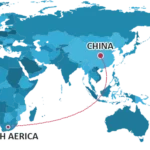
Shipping from China to Nairobi in late 2026 costs roughly USD 2,900–4,700 for a 20ft container and USD 4,200–6,500 for a 40ft or 40HQ on the ocean leg into Mombasa, plus USD 755–1,200 to move the box the last 500 km inland. LCL runs about USD 140–250 per CBM into Mombasa and USD 50–120 per CBM onward to Nairobi; air cargo leaves China at USD 4.30–7.50 per kg depending on weight break. Ocean transit is 20–32 days, the rail or truck leg adds 2–4 days, and air takes 4–8 days door to door.
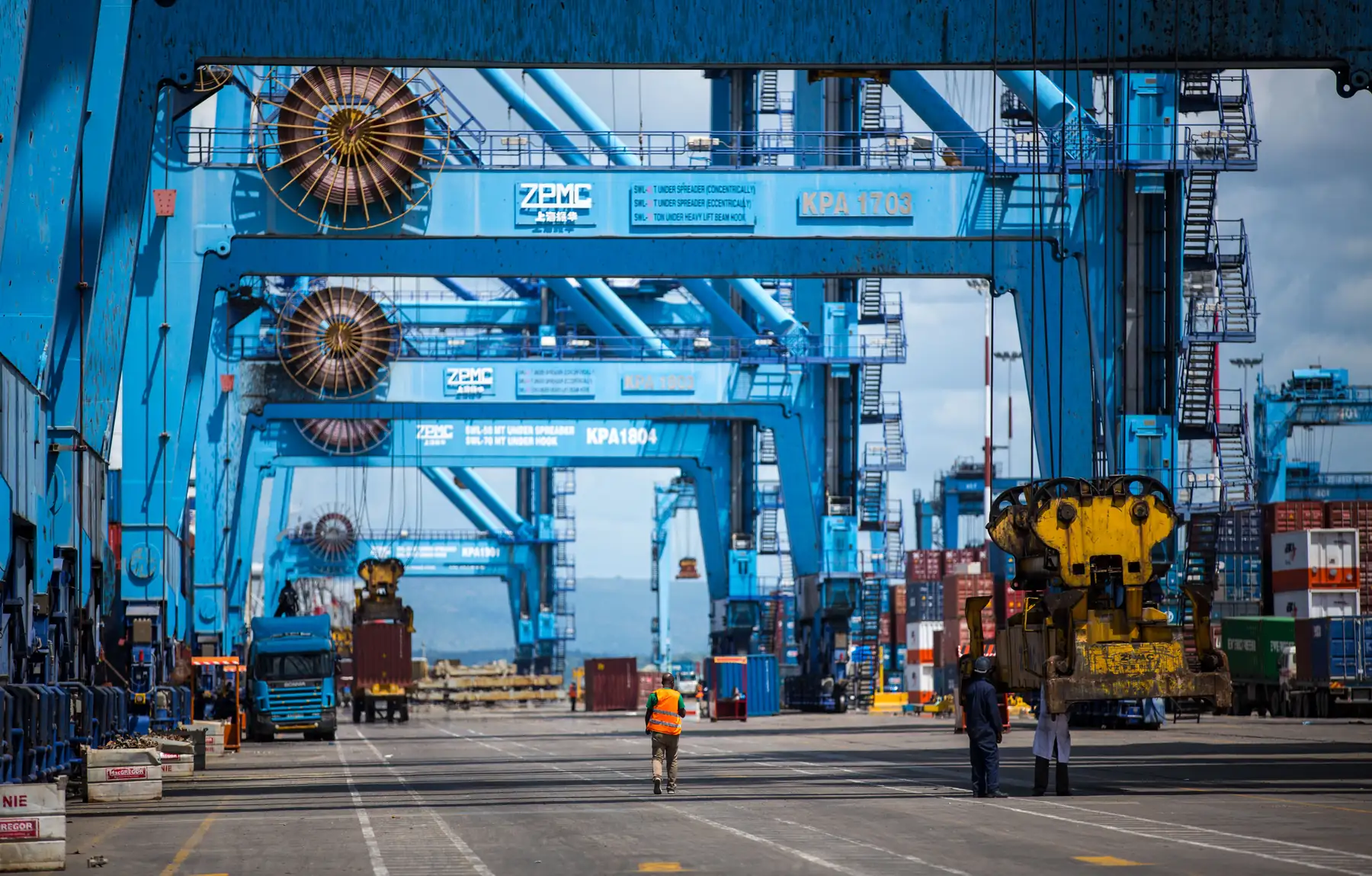
Nairobi is not a port city, and that single fact is the reason most China–Nairobi quotes read lower than the invoice that eventually arrives. Every commercial sea shipment in Kenya lands at Mombasa, clears there or at the Nairobi Inland Container Depot, and then travels roughly 500 km inland before it reaches a warehouse in Industrial Area, Athi River, Thika or Ruiru. The ocean freight is only the first of three cost layers.
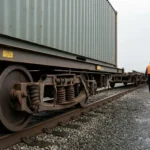
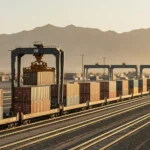
The third layer changed on 28 October 2026, when CMA CGM launched the first dedicated block train between Mombasa and the Nairobi-Embakasi Inland Container Depot (ICD) — 54 wagons, 108 TEU per train, one import train a week to start, run with the Kenya Ports Authority (KPA) and Kenya Railways Corporation (KRC). It is the clearest signal yet that the inland leg is becoming scheduled capacity rather than an ad-hoc truck booking, and it is where this guide spends most of its attention.
This article is written by the shipping team at Dantful, a Shenzhen-based forwarder working the China–East Africa lane since 2008. Every rate below is stamped with the month and the source it came from, because Kenya rates quoted without a date are the most common way importers get hurt.
Table of Contents
How Much Does It Cost to Ship from China to Nairobi in 2026?
The table below is the short answer, split by mode and by how far the cargo actually travels. Read the “ends where” column before comparing any two numbers — a Mombasa port-to-port rate and a Nairobi door rate differ by the inland leg plus clearance, and that gap is routinely 25–35% of the total bill.
| Mode | Typical range (late October 2026) | Ends where | Transit |
|---|---|---|---|
| 20GP FCL | USD 2,900–4,700 | Mombasa port | 20–32 days at sea |
| 40GP FCL | USD 4,200–6,300 | Mombasa port | 20–32 days at sea |
| 40HQ FCL | USD 4,400–6,500 | Mombasa port | 20–32 days at sea |
| Rail or truck, Mombasa → Nairobi | USD 755–1,200 per container | ICD Embakasi or your warehouse | 2–4 days |
| LCL | USD 140–250 per CBM | Mombasa CFS | 30–45 days |
| LCL onward to Nairobi | USD 50–120 per CBM | Nairobi warehouse | 3–6 days |
| Air freight | USD 4.30–7.50 per kg | Jomo Kenyatta International (NBO) | 4–8 days door to door |
Two things to note about those ranges. First, they are ocean-freight-plus-origin figures by default; Kenyan port charges, KRA duty and VAT, clearing agent fees and the inland leg sit on top and are broken out further down. Second, the spread inside each line is real market spread, not sloppiness. On 23 October 2026 Drewry’s World Container Index put Shanghai–Rotterdam at USD 3,632 per 40ft and Shanghai–Los Angeles at USD 8,007 per 40ft, and Xeneta’s market average for the Far East to North Europe was USD 3,698 per FEU — a market that has repriced hard since February. East Africa has moved less violently than the transpacific, but it has not stood still, and quotations that have not been refreshed since mid-year are now unreliable in both directions.
What is and is not included in a China–Nairobi quote
A forwarder quoting “China to Nairobi” may mean any of four different products. Ask which one you are being sold:
- Port-to-port: ocean freight to Mombasa only. Excludes KPA charges, clearance, duty and inland transport.
- Port-to-door: adds clearance and the Mombasa–Nairobi leg, but not duty and VAT.
- DDP / door-to-door: one price covering freight, clearance, duty, VAT and delivery. Useful for budgeting, but the duty component is an estimate until KRA assesses the entry. Our door to door shipping from China to Kenya service wraps all four legs into a single booking.
- Ex-works from a supplier: the most expensive line on paper and usually the cheapest in practice, because it prices in pickup from a factory that may be 1,500 km from the nearest port.
The June 2026 revision of the SGR inland-haulage tariffs is a good illustration of why scope matters: it changed the inland component without touching the ocean rate at all.
What do Kenyan port and destination charges add to the bill?
Every container pays a stack of port-side charges before it leaves Mombasa, and these are the lines importers most often forget to budget. None of them are unexpected — they are standard parts of the cost chain, and a professional forwarder will list them in the quotation rather than leaving you to discover them at release.
| Charge | 20ft | 40ft | What it is and how to plan for it |
|---|---|---|---|
| KPA shore handling | USD 120 | USD 180 | The port authority’s charge for moving the box between quay and yard. Fixed by KPA tariff — budget it from the start. |
| KPA wharfage | USD 88 | USD 132 | Levied on cargo passing over the wharf. Also tariff-fixed, also non-negotiable. |
| Carrier terminal handling | USD 100–150 | USD 150–250 | The line’s own destination handling. Confirm it is quoted at destination, not origin. |
| Documentation and delivery order | USD 50–120 | USD 50–120 | Issuing the release that lets you collect the box. Pay promptly — the delivery order gates everything after it. |
| Clearing agent fee | USD 100–250 | USD 100–250 | Lodging and releasing the iCMS entry. A cheap agent who misses a document costs more than a good one. |
| Inland haulage to Nairobi | USD 755 (rail) | USD 910 (rail) | The largest single add-on. Rail is scheduled; road at USD 800–1,200 is faster and more flexible. |
| Storage beyond free time | USD 30/day | USD 60/day | KPA allows five free days for domestic imports, then USD 30/60 per day to day 21, rising to USD 50/100. Clear within the free window. |
| Container demurrage | USD 30–50/day | USD 30–50/day | Charged by the carrier once free time expires. Free time is negotiable at booking — ask for 21 days rather than accepting the default. |
Two pieces of planning advice cover most of this list. Ask for the destination charge schedule with the rate quote, and diarise the free-time expiry the moment the vessel sails — the difference between clearing on day 4 and day 8 is usually a document, not a truck.
If you want the deeper month-by-month container price history for this lane, the container shipping costs from china to Kenya guide carries it, and the how long is freight from china to Kenya breakdown covers transits port by port.
How Long Does Shipping from China to Nairobi Take?
Total time from a Chinese factory door to a Nairobi warehouse is 28–40 days by sea plus rail, and 4–8 days by air. The number that gets quoted most often — “22 days” — is the vessel’s sea passage to Mombasa, and it excludes everything you actually wait for.
| Leg | Typical duration | What drives it |
|---|---|---|
| Supplier pickup and China export clearance | 3–7 days | Factory readiness, export declaration, consolidation cut-off |
| Ocean freight to Mombasa | 20–32 days | Origin port (Shenzhen fastest, Qingdao slowest), direct vs transhipment |
| Mombasa discharge and release | 2–5 days | Vessel berth, KPA handling, carrier release of the delivery order |
| Customs clearance (Mombasa or ICD Embakasi) | 2–7 days | iCMS entry quality, PVoC certificate validity, duty payment |
| Rail or road to Nairobi | 2–4 days by rail, 1–2 days by road | Train schedule (currently weekly on the new block service), truck availability |
| Door to door, sea | 28–40 days | Sum of the above, with realistic buffer |
| Door to door, air | 4–8 days | Flight frequency to NBO plus clearance |
Three timing details specific to this lane:
Consolidation adds a week you did not budget. LCL cargo waits for the consolidator’s cut-off, so an LCL shipment quoted at “35 days” typically means 30–45 days door to door.
Clearance cannot start before the documents are right. A missing PVoC Certificate of Conformity does not slow clearance — it stops it, and the cargo sits at KPA’s expense while a destination inspection is arranged.
Rail is scheduled, not on-demand. A box that misses the weekly block train waits for the next one, which is why a rail routing with a 2-day theoretical transit can still deliver on day 6.
Mombasa to Nairobi: Is Rail or Truck Better in 2026?
For most importers the answer now depends on volume and on how urgently the cargo is needed, rather than on a blanket rule. Rail is cheaper per container and more predictable; road is faster and goes exactly where you want it. The new CMA CGM block train has shifted the balance toward rail for regular importers moving more than a container or two a month.
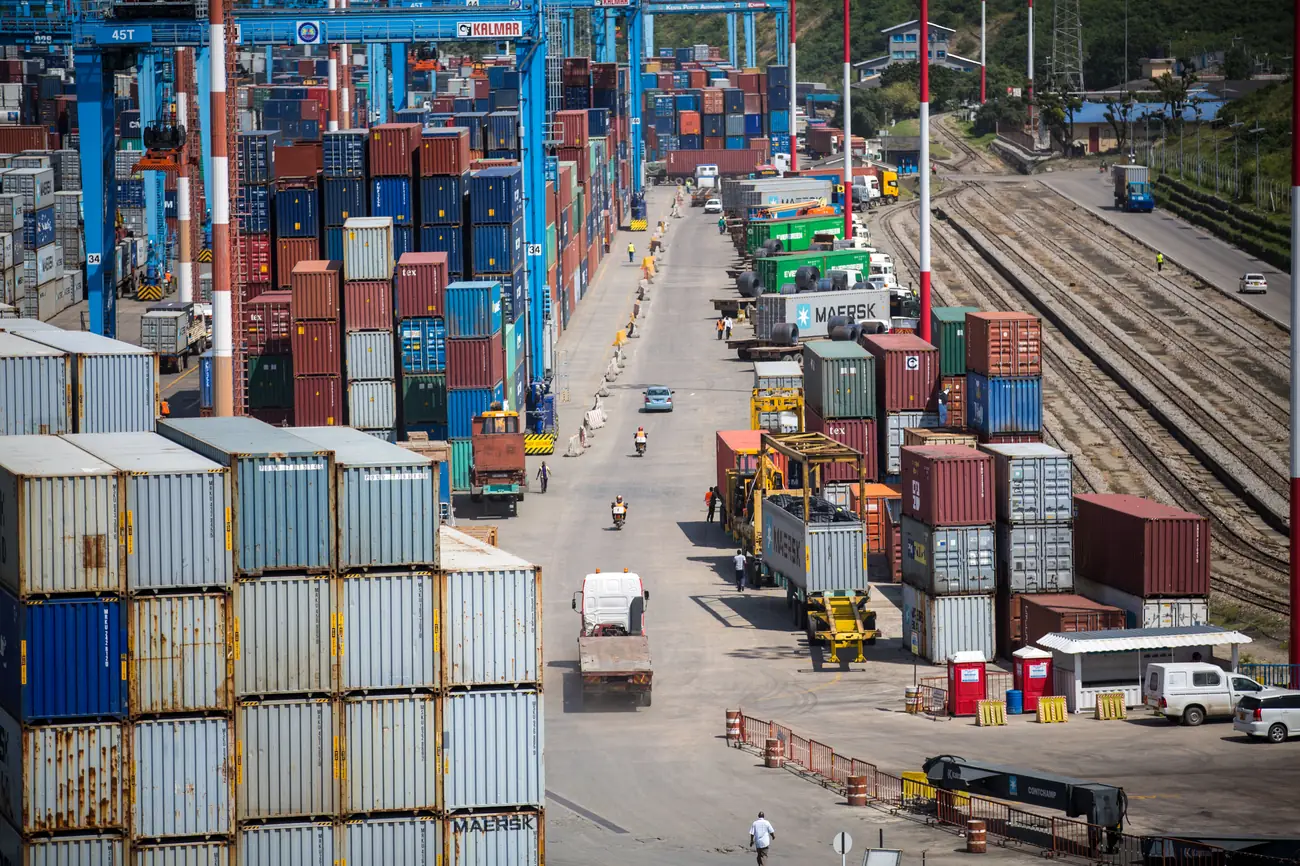
What changed in October 2026. CMA CGM’s dedicated service between the Port of Mombasa and the Nairobi-Embakasi ICD began operating on 28 October 2026 with 54 wagons and capacity for 108 TEU per train. It runs once a week at launch, carries imports only, and the carrier has said frequency and a return Nairobi–Mombasa leg depend on demand. The service is a joint arrangement with KPA and KRC, which matters practically: block-train capacity is booked through the carrier rather than scrambled for with a truck broker.
What it sits on top of. The tariff underneath the inland leg was repriced earlier in 2026. KRC published revised freight tariffs in April 2026, and carriers passed the change through from 1 June 2026. Maersk’s Kenya corridor notice set import inland haulage on the Mombasa–Nairobi rail leg at 755 for a 20ft and 910 for a 40ft container, plus a fuel surcharge of 96 and 113 respectively — consistent with the USD 800–1,200 per container that importers have been budgeting for this leg, and a reminder that the inland rate is repriced on its own calendar, separate from ocean freight.
| SGR rail (Mombasa → ICD Embakasi) | Road (Mombasa → Nairobi) | |
|---|---|---|
| Indicative cost | USD 755 (20ft) / 910 (40ft) + fuel surcharge | USD 800–1,200 per container |
| Transit | 2–4 days, on a fixed schedule | 1–2 days, subject to booking |
| Where it ends | ICD Embakasi — then a local haul to your warehouse | Directly at your warehouse or CFS |
| Best for | Regular importers, full containers, predictable delivery windows | Urgent cargo, oversize loads, destinations off the rail corridor |
| Watch out for | Weekly frequency at launch; arrangement needed for the final local leg | Road condition and corridor delays; spot pricing on peak weeks |
ICD Embakasi is not the same as delivery. A quotation ending at the ICD covers the train and the terminal, not the 10–25 km from Embakasi to a warehouse in Industrial Area or Baba Dogo. Budget a separate local haul, and confirm whether your clearing agent handles the ICD release or only the Mombasa entry.
A practical rule used on this lane: if the cargo is not time-critical and you ship more than two containers a month, book rail and accept the schedule; if you are paying for air or express anyway, road the container from Mombasa instead of waiting for the next train.
Sea Freight Rates from China to Mombasa: FCL and LCL in Late 2026
The Chinese origin port changes both the rate and the transit time, and the difference between the cheapest and most expensive origin on the same week is usually 10–20%. The matrix below is cross-validated against late-September and late-October 2026 market references and the published ranges of four competing forwarders.
FCL, per container, ocean freight to Mombasa (as of 30 October 2026):
| Origin port | 20GP | 40GP | 40HQ | Transit to Mombasa |
|---|---|---|---|---|
| Shenzhen (Yantian, Shekou) | USD 2,900–4,200 | USD 4,200–5,900 | USD 4,400–6,200 | 20–26 days |
| Guangzhou (Nansha) | USD 3,000–4,300 | USD 4,300–6,000 | USD 4,500–6,300 | 21–27 days |
| Shanghai | USD 3,100–4,500 | USD 4,500–6,200 | USD 4,700–6,500 | 24–30 days |
| Ningbo | USD 3,100–4,600 | USD 4,600–6,300 | USD 4,700–6,500 | 24–30 days |
| Qingdao | USD 3,200–4,700 | USD 4,700–6,400 | USD 4,800–6,500 | 26–32 days |
LCL, per CBM, to Mombasa CFS: USD 140–250 per CBM, charged on the greater of volume or weight (W/M, where one CBM or 1,000 kg is one revenue tonne). Peak-season and low-sulphur surcharges are quoted separately by most consolidators.
Port selection on this lane is straightforward compared with Europe, because Mombasa is the only deep-sea gateway of consequence for containerised imports into Kenya:
- Pearl River Delta suppliers (Shenzhen, Dongguan, Foshan, Guangzhou) should ship via Yantian, Shekou or Nansha — shortest origin haul and the most sailing options.
- Yangtze Delta suppliers (Ningbo, Yiwu, Hangzhou, Shanghai) ship via Ningbo or Shanghai, both with direct East Africa strings.
- Northern suppliers (Qingdao, Tianjin, Linyi) ship via Qingdao; expect two to six extra days at sea and a slightly higher rate.
What the surcharge layer looks like right now. As of 30 October 2026 the market is in a rising phase rather than a falling one: Drewry recorded eight blank sailings announced for the following week on the main east–west trades, up from two, and MSC and CMA CGM both filed November FAK levels — USD 4,500 per 40ft on Asia–North Europe and USD 4,900–5,200 on Asia–Mediterranean respectively. East Africa is a secondary trade on those same strings, so when capacity is pulled from the network to protect Europe rates, Mombasa bookings tighten a few weeks later. For a Kenya booking, that argues for confirming space two to three weeks ahead and locking the rate rather than waiting for a late deal.
For a fuller picture of how the surcharge layer interacts with the base rate, the shipping agent from china to Kenya page covers how local agents manage space and release.
Should You Ship FCL or LCL to Nairobi? The Break-Even Math
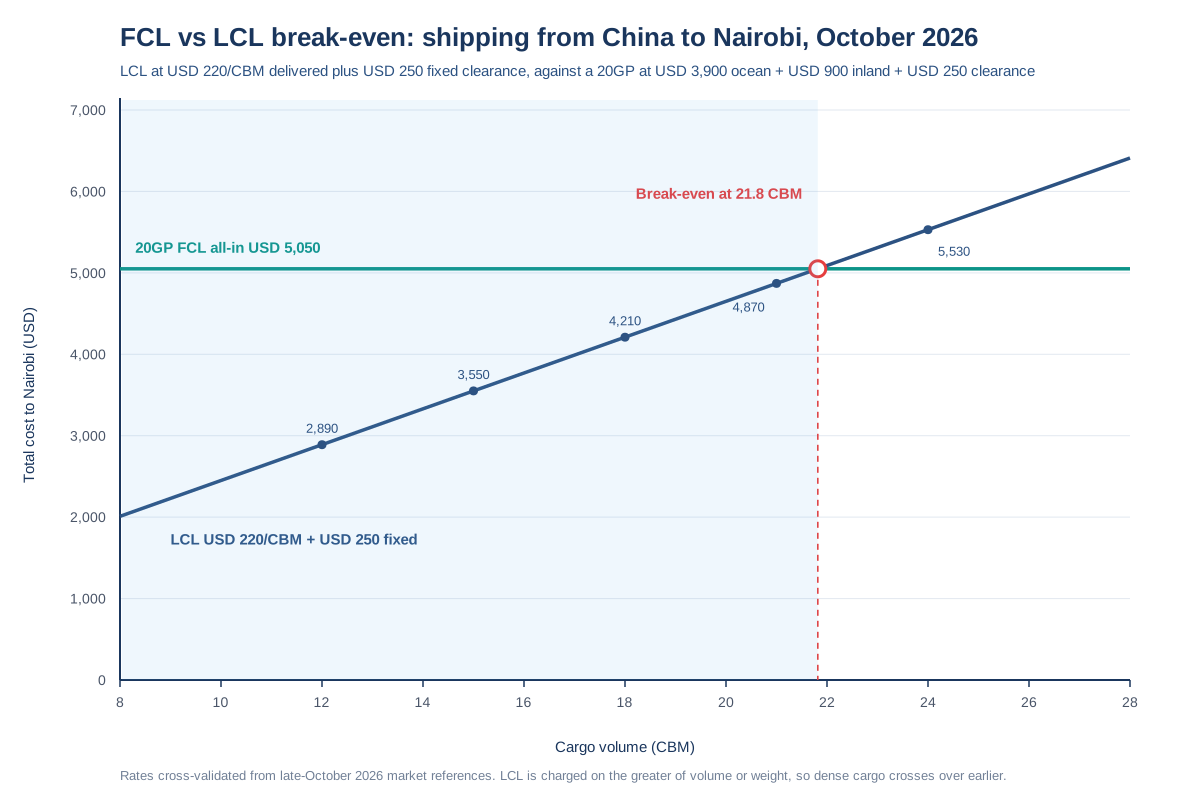
The usual advice — “switch to FCL above 15 CBM” — does not hold on this lane, because the Mombasa–Nairobi leg adds a fixed cost to a full container that LCL spreads per CBM. Run the numbers with late-2026 rates and the crossover lands just under 22 CBM.
Worked comparison (LCL at USD 220/CBM delivered to Nairobi, including deconsolidation and inland; plus USD 250 fixed clearing and documentation. FCL: 20GP at USD 3,900 ocean plus USD 900 inland rail/truck plus the same USD 250 clearing):
| Cargo volume | LCL cost to Nairobi | 20GP FCL cost to Nairobi | Cheaper option |
|---|---|---|---|
| 12 CBM | USD 2,890 | USD 5,050 | LCL, by USD 2,160 |
| 15 CBM | USD 3,550 | USD 5,050 | LCL, by USD 1,500 |
| 18 CBM | USD 4,210 | USD 5,050 | LCL, by USD 840 |
| 21 CBM | USD 4,870 | USD 5,050 | LCL, by USD 180 |
| 24 CBM | USD 5,530 | USD 5,050 | FCL, by USD 480 |
Three qualifications that change the answer:
Weight beats volume. LCL is charged W/M. Machinery or tiles at 1.8 tonnes per CBM hits the weight rate long before the volume rate, and the crossover moves sharply earlier.
Cargo mix matters. If a 20GP is only 60% full, LCL keeps the unused space out of your bill — but consolidators add destination CFS handling that full containers do not pay.
Damage exposure is not symmetric. LCL cargo is handled more times. For fragile or high-value goods, the FCL premium can be worth paying below the mathematical break-even.
Air Freight from China to Nairobi: When Does It Beat Sea Plus Rail?
Air into Nairobi is a door-to-door product, not a port-to-port one: cargo flies into Jomo Kenyatta International (NBO), clears, and delivers locally within a day. That removes the 500 km inland variable entirely, which is why air quotes on this lane feel more stable than sea quotes.
Market references for general cargo in late 2026 sit at USD 4.30–7.50 per kg, with the rate falling as weight rises and small lots paying the top of the band. Rates are per chargeable kilogram, where chargeable weight is the greater of actual weight and volumetric weight at 1 CBM = 167 kg (the ÷6,000 convention).
| Weight break | Indicative rate | Typical use |
|---|---|---|
| 45–99 kg | USD 6.50–7.50/kg | Samples, urgent spares, launch stock |
| 100–299 kg | USD 6.00–7.50/kg | Electronics restock, seasonal top-ups |
| 300–499 kg | USD 5.00–6.50/kg | FBA replenishment, medical consumables |
| 500–999 kg | USD 4.50–6.00/kg | High-value dense cargo |
| 1,000 kg and above | USD 4.30–5.90/kg | Continuous replenishment programmes |
Those bands are indicative ladders built from current market references; the actual number depends on the airline, the week and how much of the belly capacity is free. Two rules of thumb hold regardless:
- Air wins on value density, not on weight. Above roughly USD 20–25 per kg of cargo value, the cost of air is small relative to the working capital it releases. Software hardware, phone accessories and cosmetics routinely qualify. Cement does not.
- Air is currently the only mode that bypasses the inland question. With Hormuz-driven rate volatility pushing ocean quotes around and a weekly rail schedule on the Kenyan side, a shipment that must land in Nairobi on a date is better served by NBO than by a Mombasa booking with two connect legs.
Express courier sits above air on cost and below it on transit; for parcels under 30 kg it is quoted per shipment rather than per kilo, and small-parcel rates on this lane vary enough that a live quote is the only honest answer. The air freight from shenzhen china to nairobi kenya factory guide covers the airport-level detail.
What Import Duties and Taxes Apply to Cargo Cleared in Nairobi?
Kenya taxes imports on CIF value, and the effective load — duty plus VAT plus two levies — commonly lands between 22% and 63% of that CIF figure. Clearance happens either at Mombasa or at ICD Embakasi; the tax calculation is the same, only the location of the entry changes.
| Charge | Basis | Rate |
|---|---|---|
| Import duty (EAC Common External Tariff) | CIF value | 0%, 10%, 25% or 35% by product class |
| Import Declaration Fee (IDF) | CIF value | 3.5% |
| Railway Development Levy (RDL) | CIF value | 2% |
| Value Added Tax | CIF + duty + IDF + RDL | 16% |
| PVoC penalty if no Certificate of Conformity on arrival | CIF value | 15% |
Worked example — a USD 10,000 CIF shipment:
| Duty band | Duty | IDF (3.5%) | RDL (2%) | VAT (16%) | Total tax | Share of CIF |
|---|---|---|---|---|---|---|
| 0% (raw materials, some capital goods) | 0 | 350 | 200 | 1,688 | 2,238 | 22.4% |
| 10% | 1,000 | 350 | 200 | 1,848 | 3,398 | 34.0% |
| 25% (most finished consumer goods) | 2,500 | 350 | 200 | 2,088 | 5,138 | 51.4% |
| 35% (protected categories) | 3,500 | 350 | 200 | 2,248 | 6,298 | 63.0% |
Three practical notes that come up on almost every China–Nairobi shipment:
Older guides still quote the pre-2023 levies. IDF was raised to 3.5% and RDL to 2% in July 2023. Any article or quote that shows 2% and 1.5% is working from a superseded tariff schedule, and the difference on a USD 10,000 entry is about USD 230 once VAT on the difference is counted.
PVoC is cheaper before shipment than after. The Certificate of Conformity is issued by an approved inspection body in China before the goods leave. Arriving without one triggers a destination inspection and a 15% penalty on CIF — on a USD 10,000 entry that is USD 1,500, more than the inspection would have cost.
Marine cargo insurance must be placed locally. Imports into Kenya are required to be insured with a Kenyan-licensed insurer, so a policy bought in Shenzhen does not satisfy the requirement. Confirm your forwarder arranges cover through a Kenyan underwriter.
The full sequence of entries, releases and inspections is set out in the import procedure from china to Kenya walk-through.
Which documents does KRA need to clear cargo at Mombasa or ICD Embakasi?
Clearance runs through KRA’s iCMS platform, and the entry cannot be lodged until the document set is complete. Prepare these before the vessel berths:
- Bill of lading (original, telex release or sea waybill — confirm which your bank and carrier accept)
- Commercial invoice and packing list, with values matching the entry line by line
- PVoC Certificate of Conformity from the pre-shipment inspection
- Import Declaration Form (IDF) lodged through iCMS before arrival
- KEBS standards documentation where the product falls under a compulsory standard
- Certificate of origin if you are claiming a preferential rate
- Marine cargo insurance certificate from a Kenyan insurer
- Import permit or licence for restricted categories (pharmaceuticals, telecoms equipment, alcohol)
A clean entry clears in about 48 hours at Mombasa. The realistic planning number, allowing for a query on valuation or a missing annex, is 3–7 days — and the clock only starts once the documents are complete.
When Is the Cheapest Time of Year to Ship from China to Nairobi?
Rates on the China–Kenya lane follow three separate calendars, and knowing which one is affecting your quote is often worth more than shopping around.
| Period | What happens | How to plan |
|---|---|---|
| Mid-January to mid-February | Chinese New Year: factories close 2–4 weeks, bookings surge before and collapse after | Ship by early January or wait until the second half of February |
| March to May | Post-CNY trough, the softest spot-rate window of the year | Best period to book non-urgent containers |
| June to August | Mid-year restocking plus Kenya’s import season; carriers push PSS | Book 3 weeks ahead; confirm PSS amount in writing |
| September | Brief lull before Q4 | Good window for full containers |
| October to December | Q4 peak, blank sailings, equipment shortages at Chinese ports | Lock rates by early October; expect 2–3 week space lead time |
| Ramadan and Eid periods | Shifts demand and port working hours in East Africa; clearance queues lengthen | Add 2–3 days to clearance estimates |
The 2026 wrinkle is that the usual seasonal pattern has been overlaid by a capacity story: with carriers blanking sailings to defend rate levels rather than to match demand, the cheapest week is not always the quiet week. On the Kenya lane, the practical advice for the next quarter is to book early and fix the rate, rather than to wait for a seasonal dip that may not materialise. If price is the deciding factor rather than timing, the cheapest shipping company from china to Kenya comparison shows where the low-cost options cut corners.
How to Choose a Reliable Freight Forwarder from China to Nairobi?
This lane bundles three jobs into one quote — an ocean leg to Mombasa, a 500 km inland leg on a rail schedule that changes with carrier decisions, and a KRA clearance where a missing certificate stops the cargo. Most bad experiences on China–Nairobi come from a forwarder who was only priced for the first job. How we structure the three legs is set out in our freight forwarder from china to Kenya overview.
Four checks that actually matter here:
Does the quote name the inland leg separately? Ask for the Mombasa–Nairobi component as its own line, with the mode (rail or road) and the current rate basis. If it is bundled into one “Nairobi” price, you cannot tell whether a rail tariff change has been passed through or absorbed.
Can they clear at ICD Embakasi, not just Mombasa? Rail routing moves the customs entry inland. Confirm the agent can lodge and release at the ICD and handle the final local haul, otherwise you will pay for a train and then again for a truck from Embakasi.
Have they handled your product’s PVoC route before? The certificate is issued in China before shipment, by a body approved for that product category. A forwarder who has only shipped general cargo will discover the requirement at the port.
Do they show you the rate date and the surcharge basis? On a market that has moved as much as this one, a quote without a validity date is not a quote. Ask what happens if the vessel rolls and whether PSS or a fuel surcharge is capped.
Dantful has worked the China–East Africa lane since 2008 from Shenzhen — a freight forwarder in shenzhen china holding Class-A licensing plus NVOCC, FMC and Jctrans membership. We hold direct carrier contracts into Mombasa, publish daily tracking updates with photos at each handover, and run 50 operations staff and 50+ customer service people across time zones so a Nairobi delivery is not being managed from a different working day. For a lane where the inland leg and the clearance are the two things that go wrong, that operational density is the product. See how we handle shipping from Shenzhen to Kenya and shipping from guangzhou to kenya, or compare sea freight from china to Kenya options with our team.
Frequently Asked Questions
How much does it cost to ship a 20ft container from China to Nairobi?
A 20ft container runs about USD 2,900–4,700 in ocean freight to Mombasa, plus USD 755–1,200 for the rail or road leg to Nairobi, plus Kenyan port charges, clearance and duty. Budget USD 3,700–6,200 all-in before duty and VAT for a typical general cargo box.
Is it cheaper to ship to Mombasa or to Nairobi?
Mombasa is cheaper because the cargo stops at the port. Shipping to Nairobi adds the inland leg — roughly USD 755 per 20ft by rail or USD 800–1,200 by road — plus a separate local haul if you use the ICD. If your warehouse is in Mombasa, do not pay for an inland leg you do not need.
How long does sea freight from China to Nairobi take?
22–30 days at sea on the fastest strings and up to 32 days from northern Chinese ports, then 2–4 days by rail or 1–2 days by road to Nairobi, plus 2–7 days for clearance. Plan on 28–40 days door to door.
Can I clear my container at ICD Embakasi instead of Mombasa?
Yes, and on rail routings you usually must. The container moves under bond from Mombasa to the ICD, where the customs entry is lodged and duty paid. Confirm your clearing agent can release at Embakasi and arrange the final local delivery.
What is the cheapest way to ship from China to Nairobi?
For cargo above roughly 22 CBM, a 20ft container by sea and rail is the cheapest per unit. Below that, LCL by sea is cheaper than a part-filled container. Air only wins when the cargo value is high enough that the working capital released pays for the premium.
Do I need a PVoC certificate to import into Kenya?
For regulated product categories, yes. The Certificate of Conformity must be issued before shipment by an approved inspection body in China. Arriving without one triggers a destination inspection and a 15% penalty on CIF value.
How much is import duty on goods from China to Kenya?
Duty follows the EAC Common External Tariff at 0%, 10%, 25% or 35% of CIF depending on the product. Add IDF at 3.5%, RDL at 2% and VAT at 16%, and the total tax load typically lands between 22% and 63% of CIF.
Is air freight from China to Nairobi worth it?
For cargo worth more than about USD 20–25 per kg, usually yes: air at USD 4.30–7.50 per kg avoids the 500 km inland leg entirely and lands in 4–8 days. For low-value dense cargo, sea plus rail remains far cheaper per tonne.
When should I book to avoid peak-season surcharges?
Book by early October for Q4 delivery and by early January for pre-Chinese New Year sailings. March to May is the softest rate window of the year on this lane, and September is usually a good month for full containers.
Do I need a freight forwarder, or can I book directly with the carrier?
Carriers quote port-to-port and require a Kenyan clearing agent for release. A forwarder consolidates the ocean booking, the Mombasa or Embakasi clearance, the inland leg and the duty payment into one chain of custody — which is the part that goes wrong when each leg is bought separately.

Young Chiu is a seasoned logistics expert with over 15 years of experience in international freight forwarding and supply chain management. As CEO of Dantful International Logistics, Young is dedicated to providing valuable insights and practical advice to businesses navigating the complexities of global shipping.