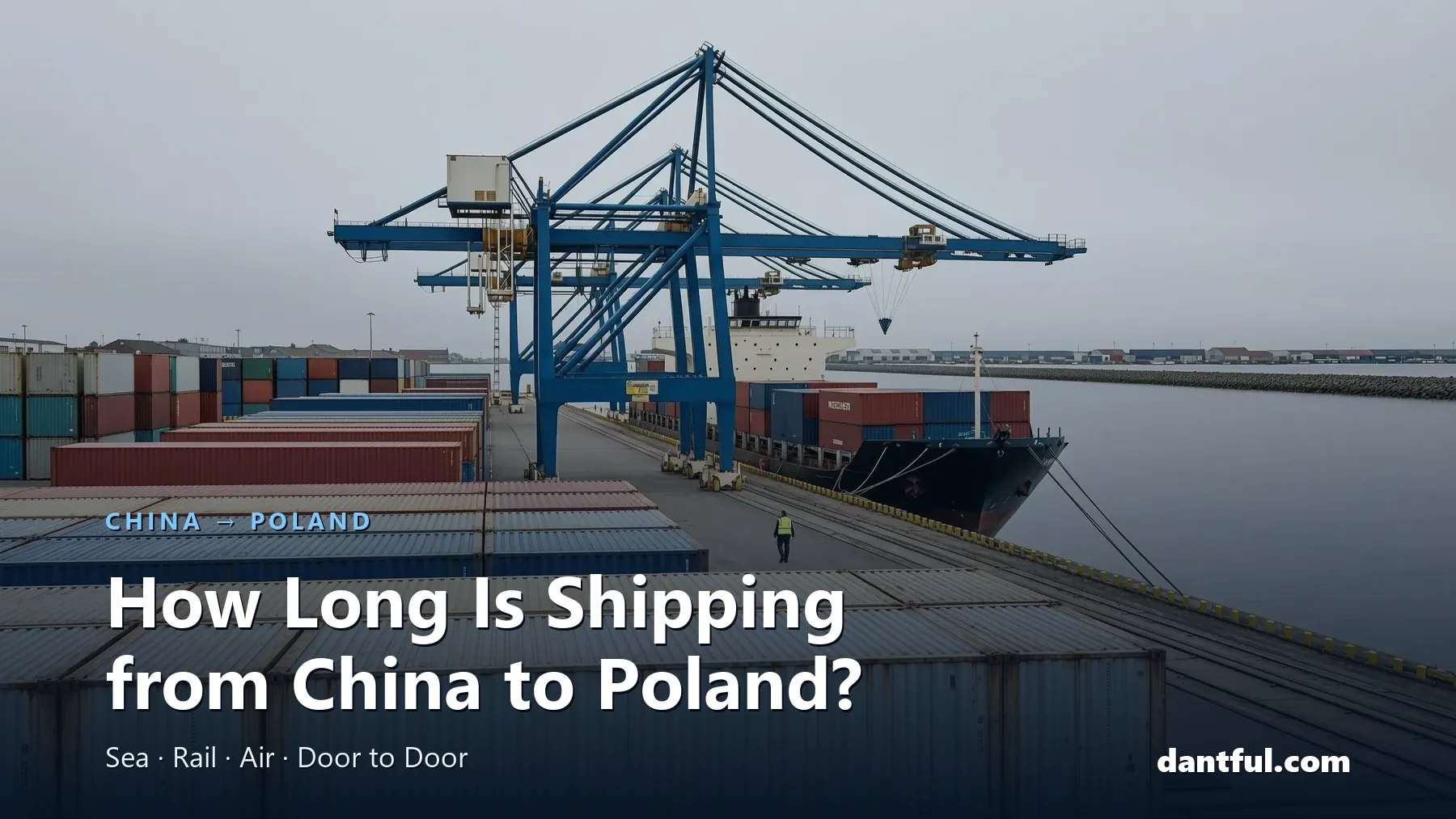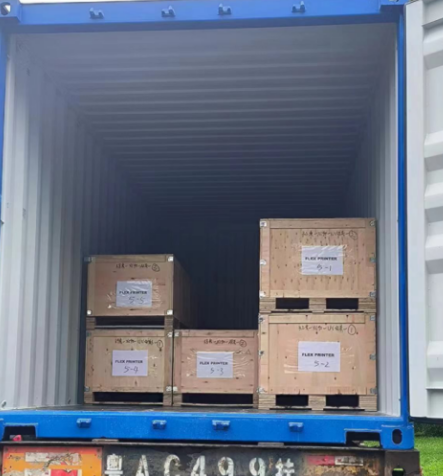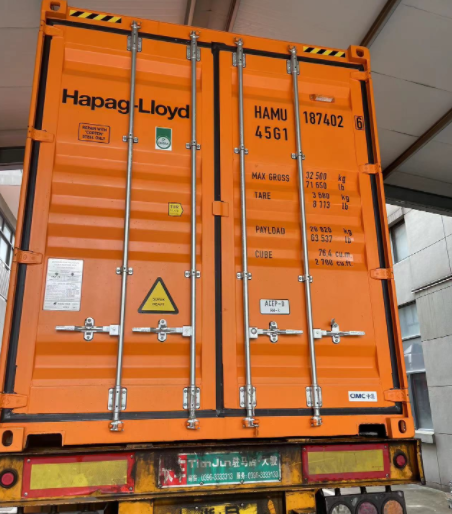
How long is shipping from China to Poland? In November 2026 the honest answer is a range, not a number: 28 to 37 days by sea from Shenzhen or Shanghai to Gdańsk, 12 to 18 days by rail to Małaszewicze, 3 to 7 days by air into Warsaw, and 35 to 54 days door to door by sea once clearance and the inland leg are counted. LCL adds about a week, and the difference between two forwarders quoting “32 days” for the same box is almost always the route — Suez versus the Cape, direct call versus Baltic feeder.
We book Polish cargo out of Shenzhen, Ningbo and Yantian every week: furniture and packaging into Łódź, machinery into Poznań, e-commerce stock into Warsaw fulfilment centres. This is the transit arithmetic behind those bookings — port pairs, the rail option that most importers ignore until they miss a season, the clearance days nobody puts in the headline figure, and the calendar windows that decide whether your container arrives a week early or three weeks late.
Table of Contents
How Long Is Shipping from China to Poland? The Short Answer by Mode
| Mode | Port/terminal to port, or airport to airport | Door to door | November 2026 rate anchor |
|---|---|---|---|
| Sea FCL, direct to Gdańsk | 28 – 37 days | 35 – 54 days | $2,430 – 2,970 per 20GP; $3,600 – 4,400 per 40HQ |
| Sea LCL via Gdańsk or Gdynia | 31 – 45 days | 38 – 52 days | $62 – 79 per CBM |
| Rail to Małaszewicze | 12 – 18 days | 18 – 26 days | $3,960 – 4,840 per 20GP; $5,895 – 7,205 per 40HQ |
| Air freight into WAW / KRK | 1 – 3 days flying | 3 – 7 days | $4.20 – 6.80 per kg |
| Express courier | 2 – 4 days | 3 – 8 business days | $9 – 14 per kg |
Read that table with one caveat: the port-to-port figures are sailing times on a booking that makes its connection. They are not a promise, because a rolled booking adds a full week before a single day of sailing is counted, and rollovers are routine in the three weeks before Chinese New Year.
Why Two Quotes for the Same Lane Differ by a Week
Three structural facts explain most of the spread on this lane, and none of them are about the carrier being slow.
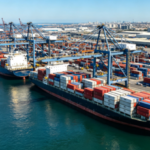
Gdańsk has direct Asia calls; Gdynia and Szczecin mostly do not. Gdańsk’s Baltic Hub is the largest container terminal in the Baltic and one of the few ports in the region with direct deep-sea services from China, which is why the fastest China–Poland sailings land there. Cargo consigned to Gdynia or the Szczecin–Świnoujście complex usually arrives on a feeder from Hamburg, Bremerhaven, Rotterdam or Gdańsk, which adds 3 to 10 days. If a quote says “Gdynia in 30 days” and the vessel actually calls Hamburg, the number is optimistic.
Suez versus the Cape is still unresolved in the same month. By early November 2026 roughly 60% of Asia–Europe capacity had returned to the Suez Canal, while other services still round the Cape of Good Hope. The Suez routing saves 10 to 14 days; the Cape routing adds them. Two forwarders quoting in the same week can both be accurate and still differ by two weeks, because they are booking different services.
Poland is a distribution country, not just a destination. A container “to Poland” may be cleared in Gdańsk and trucked to Prague, Vilnius or Berlin. That inland leg is 1 to 4 days and it belongs in the transit figure, not in a footnote.
What Happens When a Booking Is Rolled?
A rollover is when your container misses the vessel it was booked on and moves to the next sailing. It is the single largest source of transit-time disappointment on this lane, and it is not counted in any port-to-port figure.
Rollovers happen because the vessel is overbooked, because your container arrived after the cut-off, or because the carrier reallocated space to a contract customer. On Asia–North Europe and Baltic services, a roll costs a full week — the strings call weekly — and in the January rush two consecutive rolls are common. If your container reaches the terminal 24 hours before cut-off with the VGM submitted and the export declaration filed, the risk drops sharply. If it arrives the morning of the cut-off, it is the first box that moves.
The practical planning rule on this lane: take the transit figure, add one week for a single roll if you are shipping between mid-January and mid-February, and treat the arrival date you give your own customer as the top of the range rather than the bottom.
Sea Freight Transit Time from China to Poland by Port Pair
Sea is the default for anything heavy or bulky, and the transit spreads more by origin port than most importers expect — North China adds a coastal feed before the ocean leg.
Port-to-port transit, November 2026 (days, FCL):
| China origin | Gdańsk | Gdynia | Szczecin / Świnoujście |
|---|---|---|---|
| Shanghai | 30 – 37 | 32 – 40 | 35 – 42 |
| Ningbo | 30 – 36 | 32 – 40 | 36 – 43 |
| Shenzhen / Yantian | 28 – 35 | 30 – 38 | 34 – 41 |
| Guangzhou / Nansha | 30 – 38 | 32 – 40 | 35 – 43 |
| Qingdao | 38 – 45 | 40 – 47 | 42 – 50 |
The Qingdao line is the one that catches people out. A buyer sourcing from Shandong who compares “32 days from Ningbo” with their own quote of “44 days” is not being overcharged — the box has to reach a load port with a direct European call first.
Inland legs from Gdańsk, by road (approximate): Warsaw 340 km and 1 day, Łódź 340 km and 1 day, Poznań 300 km and 1 day, Wrocław 490 km and 1 to 2 days, Katowice 550 km and 1 to 2 days, Kraków 580 km and 1 to 2 days. Add a day if the container needs to be de-stuffed at a bonded warehouse before onward delivery.
Which China Port Gives the Shortest Transit to Poland?
Match the load port to where your supplier actually is, then check whether that port has a direct European call. Transit time is lost at the coastal feed, not in the Baltic.
| Supplier region | Sensible load port | Effect on transit |
|---|---|---|
| Pearl River Delta: Shenzhen, Dongguan, Foshan, Guangzhou | Yantian or Nansha | Shortest China–Poland routing, 28 – 38 days |
| Zhejiang: Ningbo, Yiwu, Wenzhou, Taizhou | Ningbo-Zhoushan | 30 – 36 days, strongest direct service choice |
| Jiangsu, Shanghai, southern Anhui | Shanghai | 30 – 37 days, more strings but higher congestion risk |
| Shandong, Hebei, Liaoning | Qingdao or Tianjin | 38 – 50 days; budget the coastal feed as 5 – 8 extra days |
| Inland: Chengdu, Chongqing, Xi’an, Zhengzhou | Rail hub, not a seaport | Rail to Małaszewicze in 12 – 18 days instead of trucking to a port |
That last row is the decision most importers miss. For a factory in Sichuan or Shaanxi, trucking 2,000 km to Ningbo to catch a 32-day vessel is slower end to end than loading onto a block train an hour from the plant.
How Much Longer Does LCL Take from China to Poland?
LCL runs 31 to 45 days port to port, roughly 5 to 10 days more than FCL on the same lane. Two of those days are spent waiting for the last co-loader’s cargo before the container is stuffed; the rest is de-consolidation at the destination CFS, which cannot begin until the whole box has cleared.
The Polish LCL network is unusually wide — consolidation runs into Gdynia and Gdańsk, with inland delivery to Warsaw, Łódź, Poznań, Wrocław, Kraków, Katowice, Szczecin and smaller cities. That coverage is genuinely useful for importers who buy from several factories, and the congestion risk is higher: one late supplier delays the whole container, not just their own pallets. Our consolidated freight shipping service exists for exactly that case.
Rail Freight from China to Poland: 12 to 18 Days, and the Border That Decides It
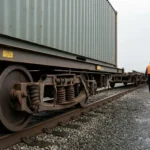
Rail is the option that changes the modal decision on this lane, and it is the one most Poland-bound importers under-use. A block train from Chengdu, Chongqing, Xi’an, Zhengzhou, Wuhan or Yiwu reaches the Polish border in 12 to 18 days, and station-to-door in Warsaw, Łódź or Poznań in 18 to 26 days.
| Rail leg | Typical time | What sets it |
|---|---|---|
| China hub to Alashankou / Khorgos | 3 – 5 days | Origin trucking, loading, export declaration |
| Gauge change at the China–Kazakhstan border | 1 – 2 days | Lifting containers between 1,435 mm and 1,520 mm wagons |
| Kazakhstan / Belarus transit | 5 – 7 days | Train path, border queues |
| Brest to Małaszewicze | 1 – 2 days | Second gauge change, EU entry |
| Małaszewicze to Warsaw, Łódź or Poznań | 1 – 3 days | On-carriage by rail or truck |
| Total, station to door | 18 – 26 days | Before customs clearance |
Two facts make rail a scheduling decision rather than just a speed decision. First, 85 to 90% of westbound China–Europe trains cross at Małaszewicze/Brest, so a single border problem is a network problem. Second, that border has closed or been restricted more than once on political grounds, and each closure rolls every downstream train. When our Polish customers ask for a rail booking with a hard delivery date, we quote it with a one-week buffer and an explicit sea fallback.
Rail costs more than sea and less than air: roughly $3,960 to $4,840 per 20GP and $5,895 to $7,205 per 40HQ to Małaszewicze in November 2026. That is two to three times the ocean rate for three weeks of saved time, which pays for itself on seasonal goods, restocks with a fixed in-store date, and anything where the cost of a late arrival exceeds the freight difference. The service detail sits on our rail freight page.
The Weight and Equipment Limits That Change a Rail Plan
Rail is not a like-for-like swap for a sea container, and three limits re-quote shipments more often than any rate movement.
Payload is tighter. Block trains on the northern corridor are weight-sensitive because of axle-load limits in Kazakhstan and Belarus, and dense cargo — tiles, steel, machinery, drums — hits the ceiling well before the box is full. Heavy 20GP loads sometimes need a weight declaration before the booking is accepted, and a box that moves by sea without comment can be refused for rail.
Equipment is scarcer. Carrier-owned containers on China–Europe routes carry a separate leasing charge — $1,500 to $1,700 per box on China–Germany in September 2026 — because equipment owners have been prioritising other trades. Shipping your own SOC box removes that line and is worth asking about on any rail booking above two containers.
The border is a single point of failure. With 85 to 90% of westbound trains crossing at Małaszewicze/Brest, a closure queues everything behind it. When that happens, the alternates are the Middle Corridor through Kazakhstan, Azerbaijan and Georgia into Europe, or a reroute to Kaliningrad, and both add a week or more. That is why we quote rail with a named fallback rather than as a standalone promise.
Air Freight and Express Transit Times from China to Poland
Air is a three-to-seven-day product door to door, and the gateway you fly into matters less than the clearance file.
| Route | Flight time | Door to door | Rate anchor (Nov 2026) |
|---|---|---|---|
| Shanghai Pudong (PVG) to Warsaw Chopin (WAW) | 1 – 2 days | 3 – 6 days | $4.20 – 6.80 per kg |
| Guangzhou Baiyun (CAN) to WAW | 1 – 2 days | 3 – 6 days | $4.20 – 6.80 per kg |
| Shenzhen (SZX) / Hong Kong (HKG) to WAW | 1 – 2 days | 4 – 7 days | $4.50 – 6.80 per kg |
| Any China gateway to Kraków (KRK), Katowice (KTW) or Wrocław (WRO) | 2 – 3 days | 4 – 7 days | Quote only, routing dependent |
Express tiering, business days, door to door: DHL Express and FedEx International Priority typically deliver in 3 to 5 business days to major Polish cities, UPS Worldwide Saver in 4 to 6. All three are priced per chargeable kilo (volumetric weight divided by 6,000) and all three are economically sensible only up to roughly 100 to 150 kg; above that a consolidated air booking is usually cheaper per kilo even though it is slower by a day or two.
The transit killer on air is not the flight. It is an incomplete commercial invoice at WAW — no HS code, no EORI on the consignee, or a declared value that does not match the supplier’s paperwork. That turns a 4-day shipment into a 9-day one.
Door to Door from China to Poland: The Full Timeline
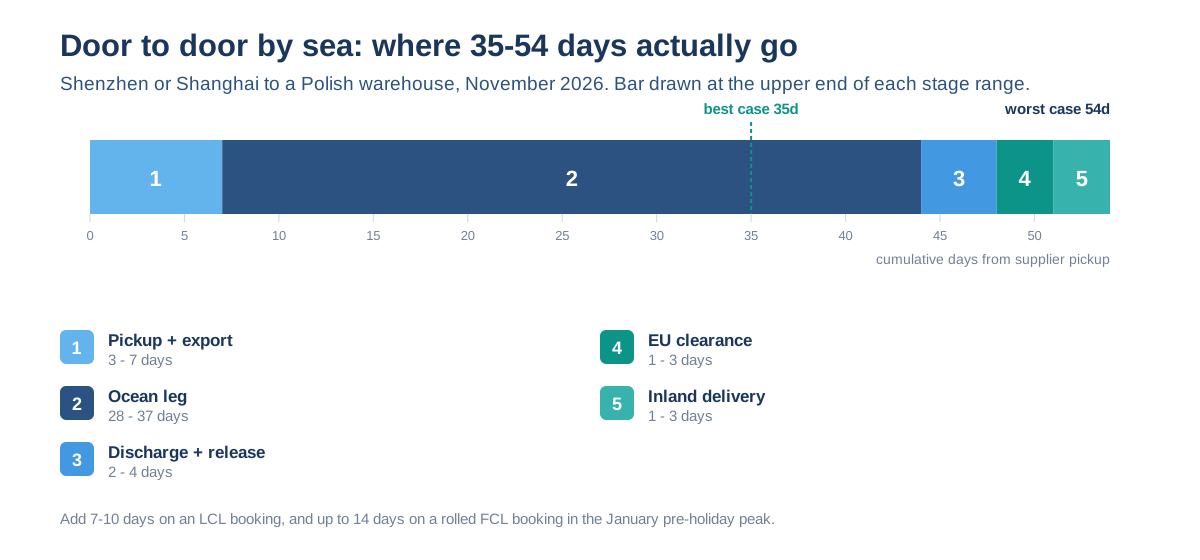
Door-to-door is where the honest numbers live, because it stacks every stage that a port-to-port quote leaves out.
| Stage | Typical days | What actually happens |
|---|---|---|
| Supplier pickup and origin handling | 2 – 4 | Truck from factory to port or CFS, booking confirmed against the cut-off |
| Export declaration and loading | 1 – 3 | Chinese export clearance, VGM, container loaded and sealed |
| Ocean leg (direct to Gdańsk) | 28 – 37 | As per the port-pair matrix above |
| Arrival, discharge and terminal release | 2 – 4 | Berth waiting, discharge, terminal release against the bill of lading |
| EU import clearance | 1 – 3 typical; 5 – 10 if inspected | Duty and 23% VAT assessed and paid, or deferred |
| Inland delivery to consignee | 1 – 3 | Warsaw, Łódź or Poznań next day; Kraków, Wrocław, Katowice 1 – 2 days |
| Total, door to door by sea | 35 – 54 | With a two-week tail on a rolled booking at peak |
On rail, the same door-to-door count is 18 to 26 days; on air, 3 to 7. The DDP version of this journey — where the forwarder clears and delivers against one price — is described on our door to door shipping from China to Poland page and on DDP Shipping Services.
Shipping Through Poland into Central Europe
Poland’s central position is why so much China–Poland cargo is not consumed in Poland at all. A container cleared in Gdańsk can reach most of Central Europe inside two days by road, which makes the Polish gateway a legitimate alternative to Hamburg or Rotterdam for buyers in landlocked markets.
| Destination from Gdańsk | Road distance | Transit |
|---|---|---|
| Warsaw | 340 km | 1 day |
| Berlin | 500 km | 1 day |
| Prague | 620 km | 1 – 2 days |
| Vilnius | 480 km | 1 – 2 days |
| Bratislava | 800 km | 2 days |
| Budapest | 900 km | 2 days |
Two conditions apply. First, EU goods must be cleared in the country of import — if the final destination is Czechia, clearing in Poland and moving the goods afterwards turns an import into an intra-EU movement that needs the right procedure, or the goods arrive with the wrong VAT treatment. Second, customs-free circulation does not mean toll-free or document-free: cabotage rules, ADR requirements for dangerous goods, and the driver’s CMR all still apply on the inland leg.
Customs Clearance in Poland: How Many Days It Adds
Clearance in Poland typically takes 1 to 3 days with a complete file. It takes 5 to 10 when something is missing, and the missing items are almost always the same three.
An EORI number. Without one, the declaration cannot be lodged. Polish and EU-registered companies apply through the PUESC portal; a non-EU seller without a local entity needs an indirect representative or a fiscal representative arrangement, and setting one up is a two-to-three-week project that cannot be done at the port.
A correct customs value and HS code. Duty is assessed on the customs value, which for CIF terms includes freight and insurance. Underdeclaring to reduce duty is the fastest route to a post-clearance audit.
The right procedure. Goods declared for free circulation pay duty plus 23% VAT immediately; goods to a bonded warehouse or under a special procedure are suspended. Choosing wrong does not stop the container, but it does stop the VAT treatment, and that is where the money is.
| Charge | Rate | Basis |
|---|---|---|
| Import duty | 0% – 17% by HS code, higher on some agricultural and anti-dumping lines | Customs value (CIF) |
| VAT | 23% | Customs value + duty |
| ICS2 / ENS filing | Per house bill, typically $25 – 40 | Before loading at origin |
| Brokerage | $150 – 400 per entry | Declaration, classification, release |
Poland’s 23% VAT is recoverable for a VAT-registered importer and is a cash-flow item rather than a cost — but it is charged at clearance, so it has to be funded before the goods are sold. Under EU ETS, ocean freight into the EU also carries an emissions cost pass-through in the freight rate from 2026, which is already inside the sea rate anchors in this guide rather than a separate line. The full document set and the procedure walk-through are on our import procedure from china to Poland page, and our Customs Clearance team files Polish entries daily.
When Is the Fastest and Slowest Time of Year to Ship from China to Poland?
| Window | Transit risk | Why |
|---|---|---|
| Mid-January to mid-February | Highest | Pre-CNY rush, rolled bookings, factories closing. CNY falls 6 February 2027 |
| Mid-February to mid-March | Falling, then normal | Production restarts slowly; sailings resume on schedule |
| March to June | Lowest | Stable schedules, few blank sailings, predictable rail paths |
| July to September | Moderate | Typhoon season in South China adds 2 – 5 days to origin handling |
| Early October | Moderate | Golden Week closes factories and CFS operations for a week |
| October to December | Rising | Q4 retail peak, hub congestion at Singapore, Rotterdam and Hamburg, blank-sailing adjustments |
| Late December to early January | Moderate | European holidays slow clearance and inland trucking, not the ocean leg |
Two 2027 dates are worth putting in the calendar now. Chinese New Year falls on 6 February 2027, eleven days earlier than 2026, which compresses the pre-holiday booking window into January. And Poland’s rail corridor through Małaszewicze is the single point that turns a political event into a two-week delay, which is why rail bookings for Q1 2027 should carry a sea alternative in the same quote.
FCL or LCL: How Mode Choice Changes Your Transit Time
The time difference between FCL and LCL on this lane is 5 to 10 days, and at the boundary volumes it is worth pricing both rather than assuming.
| Cargo volume | LCL at $62 – 79 per CBM | 20GP at $2,430 – 2,970 | Recommended |
|---|---|---|---|
| 8 CBM | $496 – 632 | $2,430 – 2,970 | LCL |
| 12 CBM | $744 – 948 | $2,430 – 2,970 | LCL |
| 15 CBM | $930 – 1,185 | $2,430 – 2,970 | LCL unless time-critical |
| 18 CBM | $1,116 – 1,422 | $2,430 – 2,970 | Judgement call: FCL buys 5 – 10 days |
| 20 CBM | $1,240 – 1,580 | $2,430 – 2,970 | FCL |
| 25 CBM | $1,550 – 1,975 | $2,430 – 2,970 | FCL |
The dollar crossover sits near 30 CBM at the cheap end of the LCL range, but the practical answer is earlier, because LCL carries de-consolidation days and a higher damage risk on the way. Above 18 CBM, book the container if the arrival date matters. The mechanics are explained in what is LCL and FCL in shipping.
How to Choose a Freight Forwarder from China to Poland?
This lane has three different transit answers — direct Baltic call, feeder via a North European hub, and rail through one border crossing — and a forwarder who only sells one of them will quote you the answer they have rather than the one your cargo needs. Three checks separate a lane specialist from a booking agent:
- Ask which service and which routing your quote is on. “Gdańsk direct, 30 days” and “via Hamburg, 38 days” are different products at different prices. A forwarder who cannot name the routing has not priced your box.
- Ask for the rail option with a date and a fallback. If they quote rail at all, ask what happens to the delivery date if Małaszewicze queues, and whether a sea alternative is held.
- Ask who lodges the Polish entry and under whose EORI. Clearance is the stage where 3 days becomes 10, and it is the stage most quotes leave undefined.
Dantful has shipped to Poland since 2008 from Shenzhen, with Class-A freight forwarding, NVOCC, FMC and Jctrans certification, direct carrier contracts on the Asia–North Europe and Baltic strings, and block-train space out of Xi’an, Chengdu, Chongqing and Zhengzhou. We quote sea, rail and air against each other in one document so the transit-versus-cost trade-off is visible rather than argued. Tracking updates and loading photos arrive daily while the cargo is still in China, and our Polish clearance partners file under your EORI with 24/7 cover from 50 operations and 50+ customer service staff. Details on our freight forwarder in Shenzhen page and in the freight forwarder from china to Poland guide.
For cost rather than time, the shipping rates from China to Poland and container shipping costs from China to Poland pages carry the full rate build-up, how much is shipping from China to Poland covers smaller shipments, and the sea-specific detail lives on sea freight from China to Poland. For the sourcing side, see shipping from Shenzhen to Poland and the country landing page at Shipping From China To Poland.
FAQ: Shipping Time from China to Poland
How long does sea freight from China to Poland take?
28 to 37 days port to port from Shenzhen or Shanghai to Gdańsk, and 35 to 54 days door to door once clearance and inland delivery are counted. Qingdao adds 8 to 10 days because the cargo needs a coastal feed first.
Is rail from China to Poland faster than sea?
Yes, substantially: 12 to 18 days to Małaszewicze and 18 to 26 days door to door, against 35 to 54 by sea. It costs two to three times the ocean rate, and it depends on one border crossing that has been closed more than once.
How long does air freight from China to Poland take?
3 to 7 days door to door, with 1 to 2 days of actual flying. Warsaw is the main gateway; Kraków, Katowice and Wrocław work for southern Poland but usually need a road leg from a Warsaw or Frankfurt arrival.
Which Polish port is fastest from China?
Gdańsk, because it is one of the few Baltic ports with direct deep-sea calls from Asia. Gdynia and Szczecin–Świnoujście are usually fed from Hamburg, Bremerhaven, Rotterdam or Gdańsk, which adds 3 to 10 days.
How long does customs clearance take in Poland?
1 to 3 days with a complete file, 5 to 10 if the declaration is inspected or documentation is missing. You need an EORI number before the container arrives, and VAT is 23%.
How much VAT and duty will I pay?
Duty is 0% to 17% by HS code on the customs value; VAT is 23% on the customs value plus duty. VAT is recoverable if you are registered, but it is charged at clearance.
Can shipping time to Poland be guaranteed?
No carrier guarantees a sailing date, and rollovers are routine at peak. What can be guaranteed is the routing and the booking: a named service with a confirmed cut-off, plus a buffer for the January peak and the February holiday.
How long does LCL take from China to Poland?
31 to 45 days port to port and 38 to 52 days door to door, roughly 5 to 10 days more than FCL because of consolidation and de-consolidation.
Does transit time change if the delivery address is Kraków, Wrocław or Poznań?
Yes, by 1 to 2 days. Gdańsk is the fastest gateway for Warsaw, Łódź and Poznań; for Kraków, Katowice and Wrocław the southern route via Hamburg or Koper can be competitive, and a Gdynia or Szczecin delivery is usually cheaper than Gdańsk once the truck leg is counted.
How long from placing the order to delivery in Poland?
Add production time to everything in this guide. A ready-stock order moves in 35 to 54 days door to door by sea, 18 to 26 by rail, and 3 to 7 by air. An order that needs 30 days of production lands at 65 to 80 days by sea — which is why the January cut-off for a March delivery is earlier than most buyers expect.

Young Chiu is a seasoned logistics expert with over 15 years of experience in international freight forwarding and supply chain management. As CEO of Dantful International Logistics, Young is dedicated to providing valuable insights and practical advice to businesses navigating the complexities of global shipping.