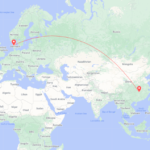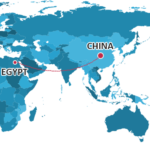
How long is freight from China to Denmark? In 2026, the honest answer is not one number — it is a range that runs from roughly 28 days port-to-port on a fast Aarhus sailing to 50 days door-to-door once ocean routing, EU customs and inland trucking are all counted. The gap between those two figures is not a marketing trick; it is the single most useful thing to understand before you book.
If you are holding two quotes for the same Shenzhen-to-Aarhus container — one saying “28 days, port-to-port” and another saying “50 days, door-to-door” — both can be true at once, because each stops at a different layer of the journey. This guide breaks the China–Denmark lane into the layers that actually consume your days, shows where the 2026 Cape of Good Hope diversion, EU clearance channels and Denmark’s 25% import VAT fit in, and helps you plan production against a realistic window.
How Long Does Shipping from China to Denmark Take in 2026?
The fastest answer: sea freight from China to Denmark takes 28–35 days port-to-port on a fast Aarhus service, 30–40 days on a typical sailing, and 40–50 days when the vessel rounds the Cape of Good Hope. Air freight runs 5–8 days airport-to-airport, express courier 3–6 days door-to-door, and a full door-to-door sea DDP service usually lands at 35–50 days.
The table below separates the two numbers most quotes blend together: port-to-port (from the origin port to the Danish port) and door-to-door (from your supplier to your warehouse).
| Shipping Method | Port-to-Port Transit | Door-to-Door | Best For |
|---|---|---|---|
| Sea Freight (FCL) | 28–35 days (fast) · 30–40 (typical) · 40–50 (Cape route) | 35–50 days | Bulk, heavy, non-urgent cargo |
| Sea Freight (LCL) | FCL + 7–10 days | 42–55 days | 2–15 CBM shipments |
| Air Freight (standard) | 5–8 days | 7–12 days | Urgent, high-value, time-sensitive |
| Express Courier | 3–6 days | 3–6 days | Parcels under ~100 kg |
| Door-to-Door / DDP (sea) | — | 35–50 days | Hands-off, all-in delivery |
Transit time is not delivery time. A schedule that says “28 days to Aarhus” describes the ocean leg only. It excludes origin consolidation, the feeder leg to Aarhus, EU customs clearance and the truck to your door — the parts that turn 28 into 45.
One-Sentence Answers by Mode
- Sea: roughly 28–35 days port-to-port to Aarhus on a fast service; 35–50 days door-to-door.
- Air: 5–8 days airport-to-airport; 7–12 days door-to-door.
- Express: 3–6 days door-to-door.
- DDP: one promised window — 35–50 days by sea, 7–12 days by air.
Why Denmark Is Not One Destination: Aarhus, Copenhagen and Fredericia
Denmark is compact, but it has three main sea gateways, and the one your cargo uses changes your last mile:
- Aarhus — Denmark’s largest container port, handling roughly 60–70% of national container volume, with APM Terminals and Maersk’s AE10 Asia service. Best for Jutland and the wider Nordic hinterland.
- Copenhagen–Malmö Port (CMP) — the Øresund gateway serving the capital region and cross-border cargo to Sweden.
- Fredericia — Jutland’s east-coast ro-ro and container hub, close to the European road network.
Aarhus is the fastest doorway for most importers, but if your warehouse sits on Zealand, Copenhagen can trim a day or two of trucking.
For a full lane overview — gateways, transit times and clearance in one place — see our dedicated Shipping From China To Denmark guide.
China to Denmark Transit Time Explained: The Six-Layer Time Stack
Every figure you have ever been given for how long freight from China to Denmark takes is a partial answer, because transit time is not one number — it is six. Each layer below runs on its own clock, has its own owner, and has its own reasons to slip. Add all six and you get the real delivery window; stop at layer two and you get the “28 days” printed on your quote.
The Six Layers, in Order
| Layer | What Happens | Typical Days | Who Controls It |
|---|---|---|---|
| 1. Origin consolidation & cut-off | Factory pickup, CFS stuffing, vessel / SI / VGM cut-offs, export declaration, loaded on board | 3–7 days | Forwarder + shipper |
| 2. Ocean transit & routing | Cape of Good Hope vs Suez, direct sailing vs transshipment | 28–35 days (fast) · 30–40 (typical) · 40–50 (Cape route) | Carrier |
| 3. Port & berth time | Berthing, discharge, container to yard or CFS | 1–3 days (peak 3–5) | Terminal + carrier |
| 4. EU / Denmark customs | Documentary review vs fysisk kontrol (physical inspection) | Same day–5+ days | Importer/forwarder + Toldstyrelsen |
| 5. Inland trucking | Aarhus → Jutland same day/next day; → Funen & Zealand 1–3 days | 0–3 days | Forwarder |
| 6. Booking & delivery | Warehouse receiving window, FBA appointment slot | 0–5 days | Consignee + forwarder |
Layers 1, 5 and 6 are where a good forwarder earns its fee, because they are genuinely controllable. Layers 2 and 3 belong to the carrier and the terminal. Layer 4 is the wildcard — it can take an afternoon or a week, and the difference is almost always documentation, not luck.
Why Quotes Differ: 28 Days or 50 for the Same Lane?
Two forwarders can quote the same Shenzhen-to-Aarhus container and land 20 days apart without either lying. Here is exactly where the gap is created.
| Factor | Impact on Days | How to Check It |
|---|---|---|
| Cape of Good Hope vs Suez | +10–14 days | Read the port rotation and B/L for Red Sea/Suez calls |
| Direct sailing vs transshipment | +5–10 days | Look for relay/feeder legs on the B/L |
| Port of loading choice | ±1–4 days | Shenzhen 28–35 days vs Qingdao ~32–40 days (port-to-port) |
| Port of discharge choice | +1–4 days | Aarhus vs Copenhagen (CMP) vs Fredericia |
| FCL vs LCL | +7–10 days | LCL adds consolidation and destination devanning |
| Customs channel | +2–5 days | Documentary vs physical inspection (see the clearance section) |
| Inland distance | +1–4 days | Aarhus vs Zealand or inland Jutland delivery |
This is where the two quotes in your inbox come from. One is a port-to-port number that stopped at layer two; the other is a door-to-door number that ran the full stack. Before you compare anything, ask your forwarder six questions: the Incoterm, the port of loading, the port of discharge and final delivery point, whether the vessel is routing via the Cape of Good Hope, the scope (port-to-port or door-to-door), and the quote validity date.
A Date-Stamped Walkthrough: One 40HQ from Shenzhen to Aarhus, Day by Day
Numbers only become real when they carry dates. Here is a de-identified planning scenario for a single 40HQ, port-to-port quote of 32 days against a door-to-door reality of 48.
| Stage | Date | Days Elapsed |
|---|---|---|
| Booking confirmed, SI & VGM submitted | Day 1 | 0 |
| Yantian cut-off, loaded on board (ETD) | Day 6 | 6 |
| Cape of Good Hope routing, ocean leg | Day 6–32 | 26 |
| Feeder/relay to Aarhus, berthing (ATA) | Day 35 | 35 |
| Toldstyrelsen clearance (documentary) | Day 36–37 | 37 |
| Truck to Jutland warehouse | Day 38 | 38 |
| Delivery window held by consignee | Day 40–42 | 42 |
| Total door-to-door | — | ~42–48 |
The “32-day” quote counted only the ocean leg and part of the origin week. The missing 10–16 days were layer 1 (six days before sailing), layer 3 (three days around berthing), layer 4 (two days of clearance) and layer 6 (a delivery slot the consignee could not take immediately). None of them were surprises — all of them were simply not in the number.
Transit time is not one number. It is six. When you request a China–Denmark quote — from Dantful or anyone else — see whether you get a single blended figure or a window broken down by layer. The answer tells you how they will handle your cargo.
Sea Freight Transit Time from China to Denmark
Sea freight is how the overwhelming majority of China–Denmark cargo moves, and the exact port pair changes your timing by several days. The matrix below keeps the same scope — port-to-port, Q4 2026 — across every row so the comparison is honest.
The China–Denmark Port-Pair Matrix
| Origin Port (China) | → Aarhus | → Copenhagen (CMP) | → Fredericia |
|---|---|---|---|
| Shanghai | 30–38 days | 32–40 days | 31–39 days |
| Ningbo-Zhoushan | 30–38 days | 32–40 days | 31–39 days |
| Shenzhen (Yantian / Shekou) | 28–35 days | 30–38 days | 30–37 days |
| Guangzhou (Nansha) | 30–37 days | 31–39 days | 31–38 days |
| Qingdao | 32–40 days | 33–41 days | 33–40 days |
| Xiamen | 31–39 days | 33–41 days | 32–40 days |
| Tianjin (Xingang) | 33–41 days | 34–42 days | 34–41 days |
Two things to note. First, Shenzhen is the fastest origin for this lane because of its dense Asia–Europe schedule — which is why a Shenzhen quote and a Qingdao quote for the same destination can differ by a week. Second, the Danish column you pick matters less than the ocean leg: Aarhus, Copenhagen and Fredericia sit within 1–4 days of each other, while Cape routing versus Suez routing moves the needle by 10–14.
If your cargo originates in Guangdong, the port-level detail for shipping from Shenzhen to Denmark feeds the fastest column in this matrix.
Aarhus vs Copenhagen (CMP) vs Fredericia: Choosing the Right Danish Gateway
| Gateway | Position | Best For | Fastest Inland Reach |
|---|---|---|---|
| Aarhus | Denmark’s largest container port (~60–70% of national volumes, APM Terminals, Maersk AE10) | Jutland, Nordic hinterland distribution | Jutland same day; Funen/Zealand 1–3 days |
| Copenhagen–Malmö (CMP) | Øresund gateway, capital region | Zealand, Copenhagen metro, cross-border Sweden | Zealand same day; Malmö same day |
| Fredericia | Jutland east coast ro-ro and container hub | Ro-ro cargo, onward European road network | Jutland south same day; Germany onward |
Aarhus is Denmark’s largest container port, not Copenhagen — a detail worth stating plainly, because several sources online get it backwards. Choose Aarhus when your cargo distributes across Jutland or the wider Nordics; choose CMP when your market sits on Zealand or crosses the Øresund to Sweden; choose Fredericia when you need ro-ro or a fast link onto the continental road network.
Sailing Frequency and the Pre-Loading Wait
Asia–Europe mainlines sail several times a week, but Aarhus has relatively few direct calls and often depends on a Rotterdam or Hamburg feeder. That means missing one feeder connection can add up to seven days of waiting before your container is even loaded — a hidden variable that never appears in a published transit time. In peak season (September–December and the weeks before Chinese New Year) book 2–3 weeks in advance to hold a slot.
Direct Sailing vs Transshipment: How to Read It Off Your B/L
You do not need to phone the carrier to find out whether your box is transshipped. Open the Bill of Lading and look for three signals: a single vessel and voyage (direct) versus two or more (relay/feeder), an on-carriage clause, and THC lines that reference a transshipment port. If your B/L names Rotterdam or Hamburg as a relay hub, add 5–10 days to the direct-sailing figure before you commit to a delivery date.
Cape of Good Hope vs Suez: Where the Extra 10–14 Days Hide
This is the single biggest reason the same lane produces a 28-day quote and a 50-day quote. For most of 2026, the majority of Asia–Europe services are still routing around the Cape of Good Hope rather than through the Red Sea and Suez Canal. If a quote silently assumes Suez, it is quoting a route your vessel probably is not taking.
| Route | 2026 Status | Added Days | How to Identify It | When It Returns |
|---|---|---|---|---|
| Cape of Good Hope | Standard for most Asia–Europe services | +10–14 days | Port rotation shows no Suez/Red Sea call; longer Asia–Europe schedule | When Red Sea transit risk eases |
| Via Suez | Only partially restored, far below pre-crisis levels | Baseline | Direct Suez/Red Sea calls in the rotation | As carriers progressively resume |
| Blended / multi-loop | Carriers mix both across loops | Varies by loop | Check the specific loop, not the carrier’s average | Ongoing |
The practical takeaway: never accept a “China to Europe transit time” written as if Suez were the default. In 2026 it is not. Ask which route your specific vessel is taking, and treat any number that ignores the Cape as optimistic by two weeks.
Transshipment Reality: Hubs, the +5–10 Day Delta and the Feeder to Aarhus
Denmark is a small market, so a large share of its Asia cargo reaches Aarhus and Copenhagen through a northern-European hub rather than a direct call.
| Hub | Why It Is Used | Added Days | B/L Fingerprint |
|---|---|---|---|
| Rotterdam | Deep-water, high-frequency feeders to Nordic ports | +5–8 days | Relay port named; feeder voyage number |
| Hamburg | Strong Baltic/Nordic feeder network | +5–8 days | On-carriage clause to Aarhus/CMP |
| Bremerhaven | Large gateway, efficient rail/road links | +5–8 days | Feeder leg; German THC |
| Antwerp | Dense intra-Europe connections | +5–10 days | Relay port named |
| Gdansk | Poland/Baltic routing, growing | +6–10 days | Baltic feeder leg |
| Piraeus | Mediterranean alternative | +7–12 days | Med relay, longer sea leg |
The rule is simple: one transshipment adds 5–10 days; a second adds another 5–10. Because most Aarhus and CMP arrivals depend on a Rotterdam or Hamburg feeder, this delta is close to unavoidable for Denmark — which is exactly why a Denmark quote should state its routing, not just its sailing speed.
Why Transshipment Is Not Always a Bad Thing
Transshipment is often framed as a defect, but it is a trade: you give up days to gain space and a lower base rate. When direct capacity to Aarhus is tight — which happens every peak season — accepting one relay hub can be the difference between shipping this month and shipping next. The rule of thumb: urgent or high-value cargo should prioritize a direct call; heavy, non-urgent cargo can trade a few days for a better rate.
Reading Your Routing Before Booking: The Four Questions
Before you sign, ask: (1) Is this vessel routing via the Cape of Good Hope or Suez? (2) Is it a direct call to the Danish port, or does it relay via Rotterdam/Hamburg? (3) Does the B/L show a relay or feeder leg? (4) Is THC already included at the transshipment port, or will it appear later as an extra? Front-loading these four questions removes most of the uncertainty that turns a 30-day plan into a 45-day surprise. For the Denmark-specific sea detail behind these timings, see Sea Freight From China to Denmark; for the wider routing picture across the continent, Sea Freight from China to Europe: Best Routes, Costs, and How to Avoid Delays covers the same Cape-vs-Suez trade-off for other EU destinations.
How Long Does Air Freight from China to Denmark Take?
Air freight is not simply “the fast option.” It is a set of options with different speeds, different minimums and very different costs — and the flight itself is the shortest part of any of them.
| Method | Transit Time | Cost Basis | Minimum | Reliability | Best For |
|---|---|---|---|---|---|
| Sea Freight (FCL) | 28–50 days | Per container | 1 container | High, weather-dependent | Bulk, heavy, non-urgent |
| Sea Freight (LCL) | FCL + 7–10 days | Per CBM / W/M | ~1 CBM | Medium | 2–15 CBM |
| Air Freight (standard) | 5–8 days | Per kg (chargeable) | ~45 kg | High | Urgent, high-value |
| Express Courier | 3–6 days | Per kg, door-to-door | ~0.5 kg | Very high | Parcels under ~100 kg |
| Air DDP (all-in) | 7–12 days | Per kg, door-to-door | ~45 kg | High | Hands-off, VAT handled |
Standard vs Express: The “Flight Is Hours, Prep Is Days” Gap
A China–Denmark flight takes under a day. Yet air freight quotes read 5–8 days airport-to-airport and 7–12 days door-to-door. Where do the rest go? Origin handling and booking take 1–2 days, the flight itself under 1 day, and Danish/EU clearance plus delivery 1–3 days. Add the seams and you have the gap. On the Danish side, Copenhagen Airport (CPH) is the dominant air-cargo gateway, with Billund (BLL) a secondary option for Jutland-bound cargo.
Airport Pairs and the Chargeable-Weight Math
China-side airports feeding this lane include PVG (Shanghai), SZX (Shenzhen), CAN (Guangzhou), HKG (Hong Kong), PEK (Beijing) and HGH (Hangzhou); on the Danish side, CPH leads and BLL serves Jutland. Airlines routing via FRA, AMS or CDG add 1–3 days versus a direct or quick-connection flight.
Air rates are billed on chargeable weight — the greater of actual weight and volumetric weight, calculated as L × W × H (cm) ÷ 6000 per piece.
| Piece | Actual Weight | Dimensions (cm) | Volumetric Weight | Chargeable Weight |
|---|---|---|---|---|
| Carton A (dense) | 100 kg | 80 × 60 × 50 | 40 kg | 100 kg |
| Carton B (bulky) | 100 kg | 120 × 80 × 100 | 160 kg | 160 kg |
| Cargo C (mixed pallet) | 250 kg | 120 × 100 × 120 | 240 kg | 250 kg |
Carton B weighs 100 kg on the scale but bills as 160 kg — a 60% cost surprise if you only planned by scale weight. Volumetrics, not gravity, decide many air freight invoices.
Sea vs Air vs Express: The Actual Decision Rule
Use one line: under ~45 kg and urgent → express courier; 45–300 kg and you can wait 5–8 days → air standard; over ~300 kg or oversized → FCL sea; time-sensitive but hands-off → air DDP. Air becomes economically rational not just for speed but for avoided costs — the lost-margin cost of a stockout and the interest cost of capital tied up in slow inventory can outweigh a premium air rate. That said, if the cargo is not truly urgent, sea freight almost always wins on unit economics.
How Long Does Customs Clearance Take in Denmark?
Customs is the layer that most quotes omit and most importers underestimate. Denmark’s customs authority is Toldstyrelsen, and how long your cargo sits there depends almost entirely on which channel it is routed into — something decided before you ever see it. Working with a Customs Clearance partner that files your declaration, EORI data and ICS2 entry before the vessel berths is the most effective way to stay in the green channel.
Denmark / EU Clearance Channel Times
| Channel | Trigger | Typical Time | What You Need Ready |
|---|---|---|---|
| 🟢 Documentary clearance | Clean declaration, low risk score | Same day–1–2 working days | Correct HS code, invoice, packing list, B/L, EORI |
| 🔴 Physical inspection (fysisk kontrol) | Risk flags, random selection, value/classification doubt | +2–5 days or more | Everything above, plus goods accessible and inspection fees budgeted |
| Product-compliance check | CE / WEEE / GPSR / REACH / EUDR / food-contact (DVFA) | +2–7 days additional | Certificates and declarations obtained before shipping |
A compliant, well-documented shipment typically clears in 1–3 working days. A flagged one can sit for a week. The difference is not the customs officer’s mood — it is your paperwork.
What Actually Decides Your Channel: Toldstyrelsen, EORI and the Risk Score
Toldstyrelsen (the Danish Customs Agency) is the authority that releases your goods; the EU’s shared risk systems decide whether your declaration is waved through or examined. Two prerequisites matter more than any other:
- An EORI number is mandatory. Danish importers often use their CVR number with a DK prefix. Obtaining an EORI before your first shipment is a precondition, not an afterthought — first-time importers without one can strand their first container on the quay.
- First EU entry is often not Denmark. Cargo frequently clears at first EU entry — Rotterdam, Hamburg or Bremerhaven — and then moves to Denmark under a T1 transit bond. This is why your “clearing port” and your “destination port” are frequently two different countries.
- ICS2 advance filing is now fully in force, meaning detailed entry data must be filed electronically before the cargo arrives in the EU. Missing or wrong data triggers holds.
A forwarder that clears Danish imports routinely — as Dantful does on the China–Denmark lane — will have your EORI details and ICS2 data filed before the vessel berths, which is often the difference between the documentary channel and a physical inspection.
The Documents and Compliance That Stop Cargo
| Item | Risk If Wrong | Consequence |
|---|---|---|
| HS / CN / TARIC 8–10 digit code | Misclassification | Hold, reassessment, back duty |
| SAD / import declaration / MRN | Errors or mismatch | Declaration rejected, resubmission |
| CE, REACH, WEEE, GPSR, EUDR, DVFA (food contact) | Missing certificates | Goods detained until compliance shown |
| ISPM-15 wood packaging | Non-compliant pallets | Treatment/return at your cost |
| Invoice, packing list, B/L consistency | Value or quantity mismatch | Valuation query, inspection |
| Anti-dumping exposure | Under-declared origin/product | Duty recovery plus penalties |
Anti-dumping duties catch more Chinese-origin goods than importers expect. High-exposure categories include e-bikes, ceramicware and steel products — all subject to EU trade-defence measures. Before shipping any of these, confirm the current rate; a “normal” quote that ignores AD duty is a landed-cost trap.
Watch the paperwork, not just the freight. A wrong HS code or a low declared value will pull your shipment into Toldstyrelsen’s risk system for valuation comparison — meaning back duty, a fine, and a switch to physical inspection. A missing EORI can hold a first shipment at the quay before it ever reaches your warehouse.
The Tax Layer That Decides Your Landed Cost: Duty + 25% Danish VAT
China and the EU have no free trade agreement, so Chinese-origin goods pay duty at EU MFN / TARIC rates — commonly 0–15% of CIF, with IT/electronics frequently at zero under the ITA. Then Denmark adds VAT (moms) of 25% — among the highest in the world, with no reduced rate for imports.
Two rules to fix in your head:
- Duty = TARIC rate × CIF value.
- VAT = 25% × (CIF + duty).
| Line | Worked Example (EUR) |
|---|---|
| Goods value | 10,000 |
| International freight + insurance (CIF element) | 1,500 |
| CIF value | 11,500 |
| Import duty @ 4% on CIF | 460 |
| VAT base (CIF + duty) | 11,960 |
| Danish VAT @ 25% | 2,990 |
| Total landed cost | ~14,950 |
The tax stack commonly lifts landed cost by 25–40% over the ex-works price. Crucially, import VAT is recoverable for VAT-registered businesses but not for private consumers — and that single fact is the real cost difference between DDP and DAP. Under DDP your forwarder handles clearance and the VAT exposure; under DAP/DDU your buyer does, and their cash flow and timing become an unknown in your delivery window. Postponed VAT Accounting can defer the cash impact for registered importers, which is why the invoicing structure is worth agreeing before, not after, the vessel sails.
The 1 July 2026 Low-Value Reform (and Why E-Commerce Sellers Must Act)
Today, consignments under EUR 150 enter the EU without import VAT or duty. From 1 July 2026 this exemption ends. The EU is moving low-value B2C parcels to a flat duty of roughly €3 per item and collecting VAT through IOSS — a change anticipated to run through at least 2028. For Denmark, with its 25% VAT, the impact on direct-to-consumer parcels is material: the landed cost of small shipments will rise, and sellers who have not registered for IOSS will face customs friction at the border. If your e-commerce model ships individual orders from China, plan the transition now rather than in July.
Free Time, Demurrage and Detention: The Cost of a Slow Clearance
Every extra day at the port has a price. Carriers grant a limited free time at the terminal before demurrage (container at port) and detention (container off-port, not returned) begin to accrue on a rising scale. A clearance that takes three days longer than planned does not just delay delivery — it can push you past free time and into daily charges at Aarhus, CMP or Fredericia. Where delays look likely, request extended free time before departure, and make sure your cargo policy includes demurrage cover — our Insurance Services can be written to cover inland legs and storage as well.
The 2026 Delay Calendar: Chinese Cut-Offs, Danish Holidays, Peak Season and the Red Sea
Most delays are not random — they are scheduled. Both China and Denmark close for known holidays, and peak season tightens capacity on both ends. Planning against the calendar is the cheapest delay insurance available.
| Period | Event | Layer Affected | Lead-Time Advice |
|---|---|---|---|
| 1 Oct–7 Oct 2026 | China Golden Week | Origin (layer 1) | Pull cut-offs forward; book 2 weeks ahead |
| Feb 2026 (mid-month) | Chinese New Year / Spring Festival | Origin (layer 1) | Ship before factories close; expect a post-holiday backlog |
| 1 May–5 May 2026 | China Labour Day | Origin (layer 1) | Advance cut-off by 7–10 days |
| Sep–Dec 2026 | Peak season, Black Friday, Christmas retail | Ocean (layer 2) + capacity | Book 2–3 weeks ahead; expect PSS/BAF surcharges |
| 11 Nov–31 Dec 2026 | Nordic winter build-up | Clearance + inland (layers 4–5) | Have Q4 stock pre-positioned by mid-October |
The Nordic Christmas / Winter Window: How Danish Holidays Strand Cargo
Denmark’s public holidays are not just days off — they are days when clearance, inspection and trucking all stop at once. Around Christmas and New Year, cargo that arrives on 24 December may not move until early January. The same Nordic shutdown pattern applies one market over — see how long is freight from china to Sweden for how it shapes lead times there.
| 2026 Date | Danish Holiday | Operational Impact |
|---|---|---|
| 1 Jan | New Year’s Day | Full stop |
| 2 Apr | Maundy Thursday | Full stop |
| 3 Apr | Good Friday | Full stop |
| 5–6 Apr | Easter Sunday & Monday | Full stop |
| 14 May | Ascension Day | Full stop |
| 24–25 May | Whit Sunday & Monday | Full stop |
| 5 Jun | Constitution Day | Partial (offices/reduced staffing) |
| 25 Dec | Christmas Day | Full stop |
| 26 Dec | Boxing Day | Full stop |
The Christmas/New Year block effectively disrupts operations for 7–10 days once you combine the closures, skeleton staffing and the trucking backlog that follows. If cargo lands in the last week of December, expect clearance and delivery to push into January. Note too that Great Prayer Day (Store Bededag) was abolished as a Danish public holiday from 2024 — it should not appear in your 2026 planning.
Winter also brings a Nordic-specific risk: November to March conditions, and the Øresund Bridge’s closure risk in high winds, can disrupt Zealand and cross-border trucking. Importers moving Q4 stock are advised to have it pre-positioned by 15 October rather than arriving into the holiday crush.
Pulling the Cut-Off: Backward Planning for Chinese Holidays
Work backwards from your target delivery date. Chinese factory closures push vessel, SI and VGM cut-offs earlier, so for Golden Week or Chinese New Year plan to pull the cut-off forward by 7–10 days and book 2 weeks in advance. A container that misses the pre-holiday cut-off may wait until factories reopen and the post-holiday backlog clears. Origin-side cut-off planning is where a China-based forwarder adds the most value, because it is the layer you cannot recover once the vessel has sailed.
The Red Sea Reality in 2026: Still Rounding the Cape
None of this calendar planning changes the biggest structural fact of 2026: most Asia–Europe services are still routing via the Cape of Good Hope, adding 10–14 days. This is why a “28-day” quote and a “50-day” delivery can coexist in the same market. Treat the Cape routing as the default, discount any quote that assumes Suez, and build those two weeks into your reorder cycle rather than discovering them at the port.
Door-to-Door and DDP Shipping Time from China to Denmark
Door-to-door is the full six-layer stack in one number — and DDP is the version where a single party also carries the customs and VAT exposure. It is the most predictable option, because nobody has to hand the shipment to a second, unknown party mid-journey.
| Option | Transit Time | What’s Included | What’s Usually Not |
|---|---|---|---|
| Sea DDP (door-to-door) | 35–50 days | Pickup, export, ocean, import clearance, 25% VAT, delivery | Duties in unusual cases; storage if consignee delays |
| Air DDP (door-to-door) | 7–12 days | Pickup, export, air, import clearance, 25% VAT, delivery | Oversize surcharges |
| LCL door-to-door | FCL + 7–10 days | Consolidation, devanning, clearance, delivery | Same as above |
| DAP / DDU | Same as DDP | Delivery only | Buyer pays duty and 25% VAT on arrival |
The core distinction: DDP keeps time and cost controllable, because one party manages clearance and the 25% VAT. DAP/DDU transfers the clearance and VAT step to your buyer, which moves the delay risk — and the tax cash-flow burden — to someone outside your planning. For B2B importers who are VAT-registered, DAP with postponed VAT accounting can be efficient; for e-commerce sellers and SMEs who want a single promised window, DDP is usually the simpler choice.
Time by Destination: Aarhus, Copenhagen, Fredericia and the Interior
| Destination | Likely Gateway | Inland Distance | Extra Days Over Port-to-Port |
|---|---|---|---|
| Aarhus area (Jutland) | Aarhus | Local | +0–1 day |
| Odense (Funen) | Aarhus / Fredericia | ~150–200 km | +1 day |
| Copenhagen metro (Zealand) | CMP or Aarhus | ~300 km / cross-Great Belt | +1–3 days |
| Fredericia / south Jutland | Fredericia | Local | +0–1 day |
| Aalborg (north Jutland) | Aarhus / Aalborg | ~120 km | +1 day |
| Esbjerg (west Jutland) | Aarhus / Esbjerg | ~200 km | +1–2 days |
The gateway choice is minor in the ocean leg (1–4 days) but decisive in the last mile. Match your gateway to where your market sits, and the inland layer shrinks to a day.
Time by Cargo Type: The Same Lane, Different Days
| Cargo Type | Extra Days Over Baseline | Reason |
|---|---|---|
| Electronics | +1–3 days | Higher inspection exposure; CE/WEEE checks |
| Machinery / project cargo | +2–7 days | Oversize handling and OOG approvals |
| Furniture | +1–3 days | Bulky LCL, damage risk, careful stowage |
| Auto parts | +0–2 days | Generally low-risk classification |
| Solar panels / energy storage | +2–5 days | Safety and compliance documentation |
| Textiles & apparel | +0–2 days | Standard clearance |
| Toys | +2–5 days | CE / safety compliance |
| E-bikes | +2–7 days | Anti-dumping exposure and battery compliance |
These are planning additions on top of the 35–50 day sea baseline, not separate timelines. A shipment of e-bikes or toys to Denmark is precisely where paperwork decides whether you add two days or seven.
Amazon FBA and E-Commerce Head-Haul Timing to Denmark
For sellers running Amazon FBA head-haul to Denmark, door-to-door timing must also absorb the delivery appointment slot at the fulfillment center. In peak season those slots are scarce, so add 2–5 days of queue to your plan and book the slot as soon as the shipment is en route. The 1 July 2026 low-value reform and IOSS (see the clearance section) directly affect B2C direct-to-consumer parcels; sellers shipping individual orders should register for IOSS and expect the flat per-item duty to enter their pricing.
LCL vs FCL: The Consolidation Penalty in Days
LCL adds 7–10 days: time spent consolidating at origin while other shippers’ cargo arrives, plus 2–4 days of devanning at destination. Around 12–15 CBM, FCL usually becomes the smarter choice — at that volume the per-CBM cost of LCL approaches a container rate, and FCL also removes the consolidation days. Below that threshold, LCL lets you avoid paying for space you do not use.
FAQs
How long is freight from China to Denmark?
Sea freight takes 28–35 days port-to-port on a fast Aarhus service, 35–50 days door-to-door, air freight 5–8 days, and express 3–6 days. The range exists because each quote stops at a different layer of the journey.
How long does sea freight from China to Denmark take?
28–35 days port-to-port on a fast service, 30–40 days typical, and 40–50 days when the vessel routes around the Cape of Good Hope. Add EU customs and inland trucking for door-to-door.
How long does it take to ship from China to Denmark by air?
Air freight runs 5–8 days airport-to-airport and 7–12 days door-to-door. The flight itself is under a day; the rest is origin handling, clearance and delivery to Copenhagen (CPH) or Billund (BLL).
How long does customs clearance take in Denmark?
A clean declaration clears in same day to 1–2 working days — typically 1–3 working days overall. A physical inspection (fysisk kontrol) adds 2–5 days or more, and product-compliance checks can add another 2–7 days.
Why does shipping from China to Denmark take so long?
Because it is not one journey but six layers: origin consolidation, ocean transit and routing, port and berth time, EU customs, inland trucking, and the delivery appointment. Sea transit is the longest, but the seams between layers add a week or more.
What is the fastest way to ship from China to Denmark?
Express courier (3–6 days door-to-door) is fastest for parcels under ~100 kg. For larger urgent cargo, air freight (5–8 days) beats sea, and air DDP (7–12 days) adds clearance and VAT in a single promise.
How much duty and VAT will I pay in Denmark?
Duty is 0–15% of CIF under EU TARIC, and Denmark adds 25% VAT (moms) on CIF plus duty. Registered businesses can reclaim the import VAT; private consumers cannot. The stack lifts landed cost by roughly 25–40%.
What is the Amazon FBA shipping time from China to Denmark?
Sea FBA head-haul runs 35–50 days door-to-door plus a 2–5 day delivery-appointment queue in peak season. Air FBA runs 7–12 days. From 1 July 2026, low-value reforms and IOSS change B2C parcel costs.

Young Chiu is a seasoned logistics expert with over 15 years of experience in international freight forwarding and supply chain management. As CEO of Dantful International Logistics, Young is dedicated to providing valuable insights and practical advice to businesses navigating the complexities of global shipping.