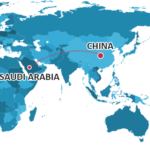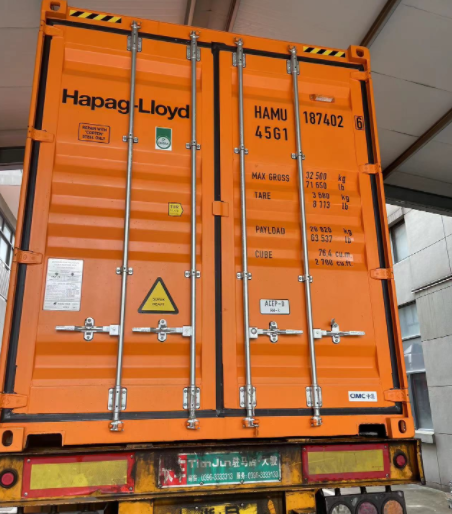
Shipping clothes from China to Saudi Arabia in October 2026 costs roughly $8,550–10,450 for a 20ft container and $9,450–11,550 for a 40ft container into Jeddah or Dammam, $350–550 per CBM by LCL, and $4.90–8.50 per kg by air. Sea transit runs 14–22 days port-to-port, air 3–7 days, express 3–5 business days. The part that decides whether your cartons clear or sit is not the freight rate — it is SABER: a product certificate per style and a shipment certificate before the vessel sails, plus Arabic fibre and care labels on every piece.
Those prices are roughly four to six times what the same container cost in February 2026. Clothing is one of the cargo types that feels that change most, because garments are light, bulky and seasonal: you pay for space, not weight, and a two-week delay can miss the retail window the order was built for.
This guide covers the practical chain for apparel, abayas and hijabs, fabric rolls and home textiles: what each mode really costs today, how much of a container your cartons actually fill, the Saudi conformity file you must assemble before departure, the duty and VAT arithmetic on a garment invoice, how the 2025 palletisation mandate changes your packing, and the 2027 Ramadan/Eid calendar that has already started to matter.
Dantful has moved apparel for Saudi retailers, wholesalers and marketplace sellers since 2008 — as a specialist in Shipping from China to Saudi Arabia, we quote the freight, the certificate path and the landing cost in one place.

Table of Contents
How Much Does It Cost to Ship Clothes from China to Saudi Arabia in 2026?
There are two honest numbers for every lane this year, and most rate pages publish only one of them. The first is the pre-disruption tariff level — useful as a reference, useless as a budget. The second is what carriers are actually charging in October 2026.
| Mode (China base ports → Jeddah / Dammam) | October 2026 | Notes |
|---|---|---|
| Sea FCL, 20GP | $8,550–10,450 | Port-to-port, dry container, ocean freight incl. surcharges |
| Sea FCL, 40GP / 40HQ | $9,450–11,550 | 40HQ is the right box for garments |
| LCL | $350–550 per CBM | All-in guide figure; must include war-risk and CFS |
| Air freight | $4.90–8.50 per kg | Weight bracket dependent, airport-to-airport |
| Express courier | ~$7.85 per kg | 3–5 business days door-to-door, small parcels |
| Sea transit (port-to-port) | 14–22 days | Jeddah/King Abdullah 14–20, Dammam 18–22 |
| Air transit | 3–7 days | Plus 1–3 days clearance |
Rates cross-checked 20 October 2026 against published carrier-index levels: Xeneta’s China→Jeddah average spot rate of $10,870 per FEU on 10 September 2026 (+256% since 28 February), the SCFI Shanghai→Persian Gulf reading of $6,489 per TEU on 30 September, and October 2026 forwarder rate pages. Ocean rates move weekly — for a live comparison of modes and seasons see how much is shipping from China to Saudi Arabia.
Why the same container costs four to six times what it did in February
Two waterways are doing two different things. The Red Sea is healing: Suez container transits in September 2026 were up 64% year on year, and the share of global capacity still diverting around the Cape of Good Hope has fallen to about 4.6%. That is why Asia–Europe rates have been falling for weeks.
The Strait of Hormuz is not healing. It has been effectively closed to container shipping for more than six months, which means upper-Gulf ports — Dammam and Jubail included — are served through landbridges and feeders rather than direct calls. Maersk’s operational update No. 50 (29 September 2026) sets emergency freight of $1,800 per 20ft and $3,000 per 40ft dry to Iraq, Kuwait, Saudi Arabia (Dammam and Jubail), Bahrain, Qatar, the UAE and Oman, plus $1,000 per container for any vessel transiting the strait.
| Cost line | February 2026 level | October 2026 |
|---|---|---|
| China → Jeddah, 20GP | $1,500–2,500 | $8,550–10,450 |
| China → Jeddah, 40GP/40HQ | $2,500–3,800 | $9,450–11,550 |
| China → Dammam, emergency freight | not applied | +$1,800 (20ft) / +$3,000 (40ft) |
| Hormuz transit fee | not applied | +$1,000 per container |
| LCL to Jeddah | $70–130 per CBM | $350–550 per CBM |
| Air to Riyadh/Jeddah | $4.50–8.50 per kg | $4.90–8.50 per kg (broadly flat) |
Two consequences matter for clothing importers. First, Jeddah and King Abdullah Port are now the cheaper gateways for anything bound for Riyadh, Jeddah, Makkah, Madinah and the western region, because they sit on the Red Sea side and avoid the strait premium entirely; Dammam only wins if your customer is in the Eastern Province and even then the emergency freight is a real line in the quote. Second, air freight has become relatively less expensive than sea freight: it did not carry the same war-risk premium, so the usual 8–9× cost multiple has compressed. For an urgent capsule collection, that changes the maths — which is what the next section works through.
Sea, Air or Express: Which Shipping Method Fits Your Clothing Order?
| Your situation | Recommended mode | What it costs in October 2026 | Why |
|---|---|---|---|
| 12+ CBM, not urgent, best unit cost | FCL 20GP or 40HQ | $8,550–11,550 per container | Lowest cost per garment; one seal, no co-loading |
| 2–15 CBM, mixed suppliers | LCL | $350–550 per CBM | Pay only for your cube; consolidation adds 5–7 days |
| 300 kg+ seasonal drop with a fixed launch date | Air freight | $4.90–8.50 per kg | Lands in 3–7 days; billed on volume, so pack tight |
| Samples, restocks, e-commerce orders under ~100 kg | Express | ~$7.85 per kg | Door-to-door, cleared, trackable |
| High-value woven garments, abayas, suits | FCL in a GOH container | Container rate + equipment surcharge | Arrives on hangers, no pressing at destination |
The volumetric rule: one cubic metre of clothes is not one cubic metre of freight
Air and express do not bill the weight on your packing list — they bill the greater of actual and volumetric weight. The industry divisors are 6,000 cm³/kg for air freight and 5,000 cm³/kg for express. In practice:
- Air: 1 CBM = 166.67 chargeable kg
- Express: 1 CBM = 200 chargeable kg
Take a realistic garment carton: 60 × 40 × 40 cm = 0.096 CBM, holding 40 polybagged t-shirts at 0.25 kg each = 10 kg. That is a density of about 104 kg per CBM — typical for apparel, and well under the 166.67 kg threshold. So the airline ignores your scale and charges the box.
| 100 cartons of the example above (9.6 CBM, 1,000 kg actual) | Billable | Cost at today’s rates |
|---|---|---|
| LCL | 9.6 CBM (W/M) | $4,320–5,280 |
| Air freight | 1,600 chargeable kg | $7,840–13,600 |
| Express | 1,920 chargeable kg | ~$15,100 |
| FCL 20GP | full container | $8,550–10,450, and 9.6 CBM fills a third of it |
That table is the most useful thing on this page for a clothing importer. Nine to ten CBM is exactly the volume where LCL still wins on cost but FCL starts winning on speed and damage risk; 1,600 chargeable kg is where air stops being an emergency tool and becomes a planned option, because at the current compression the air premium over LCL is roughly 2× rather than the 8–9× you would expect in a normal market.
Garments on Hangers (GOH) containers: when hanging beats folding
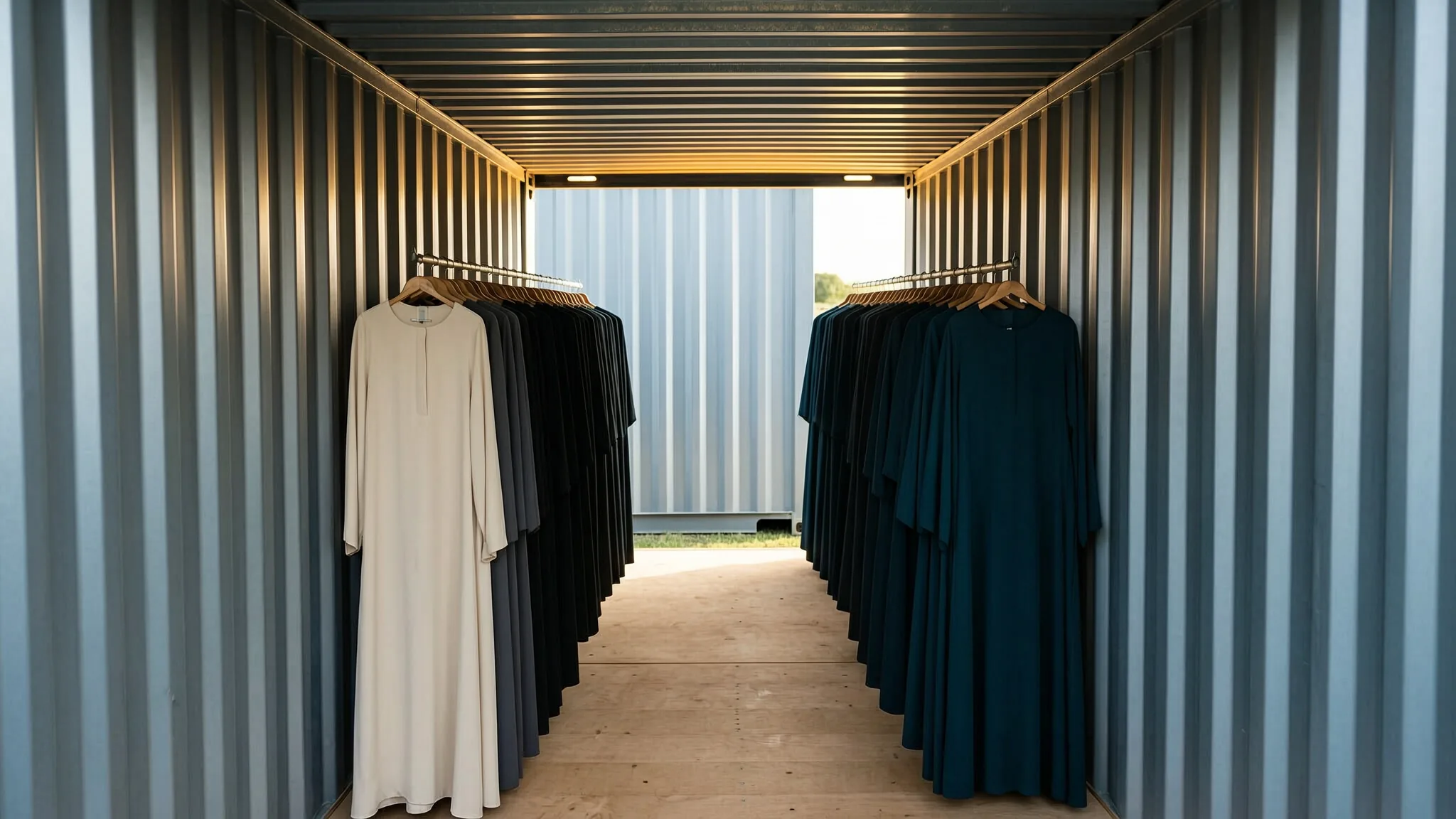
For woven dresses, abayas, suits and anything with a retail-ready presentation, a GOH container replaces cartons with a bar or string system so the goods travel on hangers and go straight to the shop floor. Capacity is close to a standard box — a 20ft GOH offers about 33.2 CBM and a 40ft about 67.7 CBM with roughly 28 tonnes of payload — but you lose cube to the hanging pitch, the equipment has to be requested at booking rather than assumed, and not every carrier or sailing offers it.
The trade is straightforward: higher freight cost per piece, materially lower destination handling and pressing cost, and far fewer creases on camera-facing products. For a fast-fashion jersey order, fold and flat-pack. For a SAR 400 abaya that must reach the mall looking like it left the atelier, hang it.
If you are deciding between container types and sailing windows in the same conversation, it helps to see the sea options side by side — our Sea Freight From China to Saudi Arabia page covers equipment, sailing frequency and the current routing picture, and door to door shipping from China to Saudi Arabia sets out what changes when you hand over clearance and delivery as well.
How Much Does a 20ft or 40ft Container of Clothes Cost from China to Saudi Arabia?
Garments never hit a container’s weight limit. They hit its walls. A 20GP carries about 28 CBM of loose cartons and a 40HQ about 67–68 CBM, and at an apparel density of roughly 100–130 kg per CBM that works out to 3–4 tonnes in a 20ft and 7–9 tonnes in a 40HQ — against payload allowances of 21.7 and 26.5 tonnes.
| Equipment | Nominal cube | Realistic cube, loose cartons | Realistic cube, palletised | Garments at 110 kg/CBM | October 2026 rate |
|---|---|---|---|---|---|
| 20GP | ~33 CBM | ~28 CBM | 24–25 CBM | ~2.7 t | $8,550–10,450 |
| 40GP | ~58 CBM | ~56 CBM | 48–50 CBM | ~5.3 t | $9,450–11,550 |
| 40HQ | ~76 CBM | ~67–68 CBM | 56–58 CBM | ~6.3 t | $9,450–11,550 |
Because the cargo is light, the correct decision variable is cube per dollar, not kilos per dollar. Two rules follow:
- A 40HQ almost always beats two 20GPs for apparel. One 40HQ gives you 56–58 usable CBM at the same rate band as a 40GP; two 20GPs cost roughly twice as much and cap you at about 50 CBM combined.
- Do not accept a quote built on nominal capacity. If a forwarder prices a 40HQ at 67 CBM for palletised cartons, the last 10 CBM does not exist, and the per-piece cost you approved internally is wrong.
Worked example, because this is where budgets drift: a 40HQ of jersey basics at 57 usable CBM and 110 kg per CBM carries about 6.3 tonnes — roughly 25,000 pieces if the average garment weighs 0.25 kg. At the low end of the October rate band ($9,450), ocean freight alone is about $0.38 per piece; at the high end ($11,550) it is about $0.46. Add duty, VAT, destination charges and inland delivery and the landed freight-and-tax component settles near $0.75–1.00 per piece for a low-value cotton line. That is the number to put in your margin sheet — not the container rate.
Container-level rate structures, surcharges and the difference between FAK and named-account pricing are covered in more depth on our container shipping costs from china to Saudi Arabia page.
FCL or LCL for Clothing: Where Is the Break-Even in 2026?
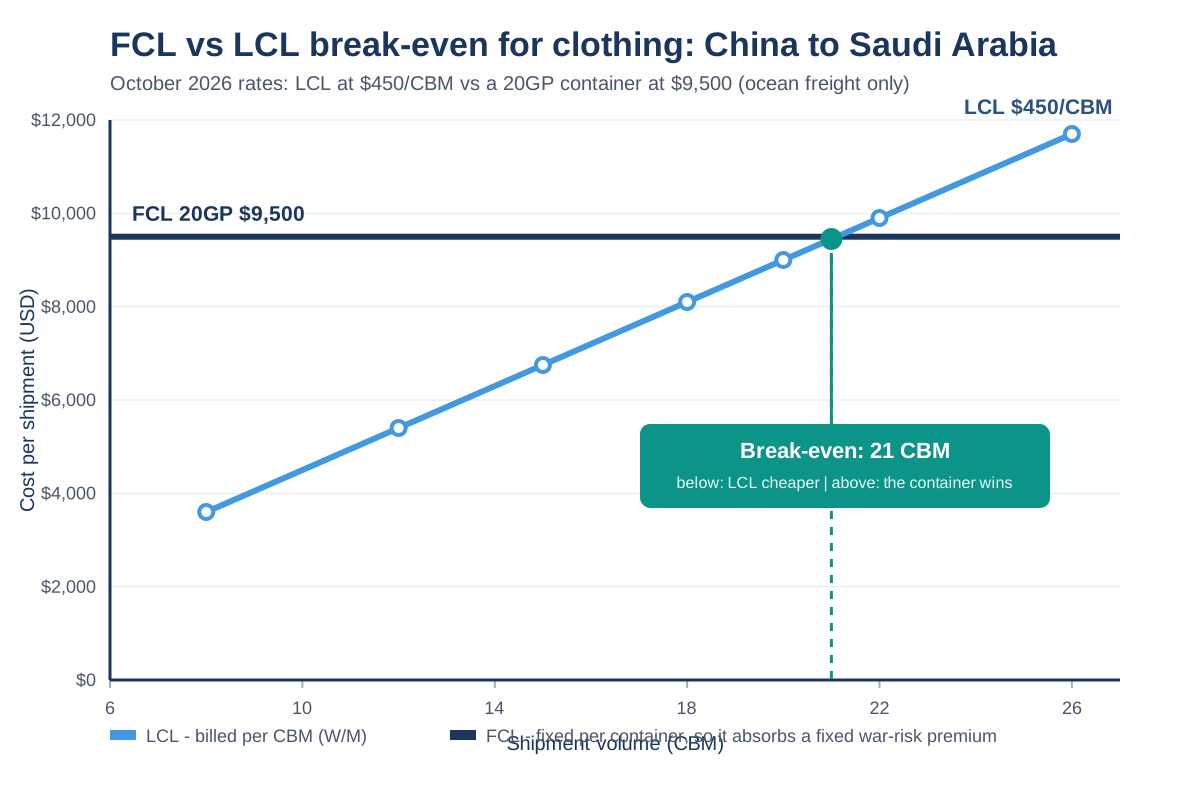
LCL is billed on W/M — one cubic metre or one tonne, whichever is greater — and garments are almost always billed on the metre. With a proper all-in LCL figure of about $450 per CBM into Jeddah, and a 20GP at $9,500 in the middle of October’s band, the switch point lands just above 21 CBM.
| Shipment size | LCL at $450/CBM | FCL 20GP at $9,500 | Lower cost |
|---|---|---|---|
| 12 CBM | $5,400 | $9,500 | LCL |
| 15 CBM | $6,750 | $9,500 | LCL |
| 18 CBM | $8,100 | $9,500 | LCL |
| 20 CBM | $9,000 | $9,500 | LCL |
| 21 CBM | $9,450 | $9,500 | Break-even |
| 22 CBM | $9,900 | $9,500 | FCL |
| 26 CBM | $11,700 | $9,500 | FCL (20GP full) |
Two things are worth understanding about that table.
The switch point moved. In a normal market — LCL at $110 per CBM and a 20GP at $2,000 — break-even sits at about 18 CBM, which is why the old rule of thumb was “12 to 15 CBM, book a container”. Today the war-risk premium is charged per container on FCL but proportionally on LCL, so a big box absorbs it more efficiently. Break-even has drifted up to roughly 21 CBM.
The table is ocean freight only. LCL adds CFS handling and destination THC per CBM at Jeddah; FCL adds fixed destination charges, a delivery order fee and inland trucking regardless of fill. Once those are included, the practical switch point usually comes back down by 2–3 CBM — which is why you should compare all-in door-to-warehouse numbers, not headline ocean rates. That is also the fastest way to test a suspiciously cheap quote: if an LCL rate is quoted well under $300 per CBM into Jeddah in this market, check what it excludes before you plan production around it. Our cheapest shipping company from china to Saudi Arabia comparison explains how to read a quote line by line.
SABER, SASO and Arabic Labels: What Must Be Ready Before the Vessel Sails?
Saudi Arabia does not assess conformity at the port; it assesses it upstream, in the SABER platform run by SASO. A clothing consignment without a valid shipment certificate cannot be released, no matter how clean the invoice is. This is the single largest cause of apparel delays at Jeddah and Dammam, and it is entirely avoidable.
The two certificates, and who has to request them
| Certificate | Covers | Validity | When to request | Who can request |
|---|---|---|---|---|
| PCoC — Product Certificate of Conformity | The style: fibre composition, labelling, restricted substances, conformity with the SASO Technical Regulation for Textile Products | Up to 1 year | Before bulk production, while sampling | The Saudi importer of record |
| SCoC — Shipment Certificate of Conformity | This consignment, matched against the PCoC | Single shipment | After production, before the vessel sails | The Saudi importer of record |
The division of labour is where first-time importers lose days. Only the Saudi importer of record — your buyer, your local entity, or the importer your DDP forwarder uses — can log into SABER and request certificates. Your Chinese supplier’s job is to supply what the certificate is built from: a fibre-composition test report from an accredited laboratory, restricted-substance test data, and label artwork that matches the actual garment. Agree that scope at the quotation stage, not after production.
Budget roughly $150–300 per product certificate and $100–150 per shipment certificate, depending on the conformity body and the number of styles, and treat it as a line in the landed cost rather than an afterthought.
Which clothing is in scope
The Technical Regulation for Textile Products applies to products that are at least 80% textile fibre by weight and intended for sale in the Kingdom — apparel, home textiles, carpets and upholstery fabrics. That covers HS Chapter 61 (knitted) and Chapter 62 (woven): dresses, abayas, hijabs, shirts, trousers, sets, kidswear and uniforms. Two categories carry extra requirements: underwear of all ages and children’s garments need a factory audit in addition to test reports, and children’s ranges are tested for restricted substances and flammability.
The label file, field by field
This is the checklist to send your factory before the first bulk order, because an English-only label fails inspection even when the garment itself is perfect.
| Label field | Requirement |
|---|---|
| Language | Arabic, or Arabic combined with English |
| Fibre composition | By mass percentage in descending order, using the generic names defined in the regulation |
| Country of origin | “Made in China” format; the origin mark must also appear on the goods themselves |
| Care instructions | ISO 3758 / SASO ISO 3758 symbols — wash, bleach, dry, iron, professional care |
| Size | EN 13402-3 based size labelling, or the applicable product standard |
| Identification | Product name, brand or manufacturer, model/style reference |
| Supplier / importer | Business identification of the supplier or importer |
| Warnings | Any use warnings required by the applicable standard |
| Attachment | Sewn in or permanently affixed — not a loose tag |
The five reasons clothing shipments get held
- No SCoC issued before departure. The container arrives, the certificate does not exist, and storage starts accruing.
- A style on the invoice has no valid PCoC, or the PCoC expired mid-season.
- English-only labels, or fibre percentages that do not match the test report.
- Wrong HS code — this routes the file down the wrong conformity path.
- Children’s or underwear lines without the restricted-substance pack and factory audit.
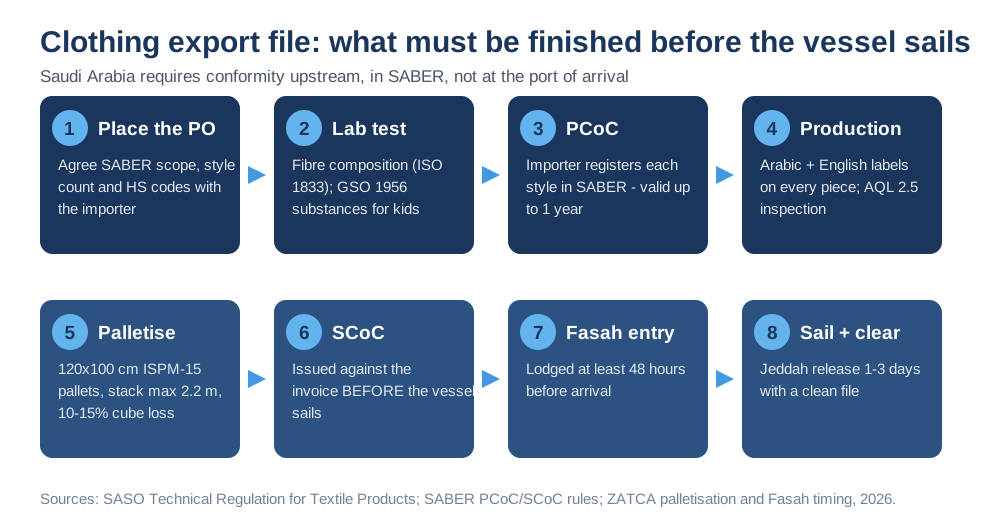
Get that sequence into your production calendar and clearance becomes routine: with a valid PCoC, a pre-issued SCoC and correct documents, Jeddah release typically takes 1–3 working days. Without them it takes as long as it takes to fix the file — and the goods are already in the Kingdom by then.
What Duty, VAT and Documents Apply to Clothes Imported into Saudi Arabia?
Most apparel lines enter under the GCC Common External Tariff at 5% ad valorem on the CIF value; a minority of lines sit at 12%, and the WTO’s measured average for clothing into the Kingdom is around 5.1%. VAT is 15%, charged on the CIF value plus the duty — a compounding step that many first quotes ignore.
| HS code | Product | Typical GCC CET band |
|---|---|---|
| 6109.10 | Cotton t-shirts, singlets (knitted) | 5% |
| 6110.20 | Cotton sweaters, pullovers (knitted) | 5% |
| 6203.42 | Men’s cotton trousers (woven) | 5% |
| 6204.62 | Women’s cotton trousers (woven) | 5% |
| 6205.20 | Men’s cotton shirts (woven) | 5% |
| 6206.30 | Women’s cotton blouses (woven) | 5% |
| 6211.42 | Women’s ensembles, abaya-type garments | 5% |
| 6214.30 | Synthetic scarves and hijabs | 5% |
| 5208 / 5407 / 6006 | Woven and knitted fabric rolls | 5–12% |
Bands shown are the typical GCC level for the heading; the binding rate is set at the 12-digit line, so confirm the exact code with your broker before you price a collection.
Worked example. A 40HQ of mixed apparel with a CIF value of $30,000:
| Step | Calculation | Amount |
|---|---|---|
| Duty at 5% | $30,000 × 5% | $1,500 |
| VAT at 15% on CIF + duty | ($30,000 + $1,500) × 15% | $4,725 |
| Total tax | duty + VAT | $6,225 |
| Effective tax rate | $6,225 ÷ $30,000 | 20.75% |
On a line that sits at 12% instead, the same consignment pays $3,600 duty and $5,040 VAT — $8,640, or 28.8% of CIF. That gap is worth checking at the 12-digit level before you commit to a price list.
Documents, and the Certificate of Origin change you should know about
| Document | Issued by | Why it matters |
|---|---|---|
| Commercial invoice | Exporter | Must show HS code and country of origin; the customs value basis is CIF |
| Packing list | Exporter | Cartons, pieces per carton, net/gross weight, CBM — the basis for both W/M and inspection |
| Bill of lading | Carrier | Release document; consignee must match the importer of record |
| Certificate of Origin | CCPIT / CCPIC | Since May 2026, ZATCA requires the consignor on the CO to be the actual manufacturer, and printed copies must carry an official wet stamp |
| SABER SCoC | Importer via SABER | Without it the consignment is not released |
| PCoC and test reports | Conformity body / lab | The evidence base for the SCoC |
| Arabic label artwork | Factory | The physical inspection point at the port |
| Commercial registration (CR) | Saudi importer | Required to hold a Fasah account and appoint a broker |
The Fasah declaration must be lodged at least 48 hours before arrival; a broker with a clean document set can have the entry ready before the vessel berths, which is the difference between releasing in 48 hours and paying storage. Note too that Jeddah Islamic Port has been running a 60-day incentive package since 19 July 2026 with a 15-day storage exemption for transit containers — useful if you are feeding another market, not applicable to import-for-sale cargo, which runs on standard free time.
How Should Clothes Be Packed and Loaded for Saudi Arabia?
Packing is the least glamorous part of apparel logistics and the one that quietly costs the most money. Three constraints now define it.
1. Containerised imports must be palletised. Since 8 May 2025, containerised imports arriving at Saudi ports must be palletised, phased in over twelve months, with exemptions for genuinely non-palletisable bulk, heavy machinery and oversized items subject to approval. Cartons of garments are not in that exempt category. Plan for it:
- Use 120 × 100 cm pallets, ISPM-15 heat-treated and marked.
- Keep stack height at or under 2.2 m so it clears a 40HQ door opening of 2.28 m.
- A 40HQ takes roughly 20 pallets in a 2-across layout; a 20GP takes roughly 8.
- Expect to lose 10–15% of usable cube to pallet footprint and stacking gaps — 67 CBM of loose cartons becomes 56–58 CBM loaded.
2. Moisture is a garment problem, not a general cargo problem. A container crossing the Red Sea swings between hot days and cool nights, and condensation forms on the steel roof — “container rain” — then drips onto the top cartons. Line the roof or use absorbent blankets, and use desiccant at roughly 0.5–1 kg per CBM for a 25–30 day voyage, more for a slow service. Polybag each piece in breathable PE rather than sealed PVC, and never load damp goods: a shipment packed the day after a steam-press finish is a mould claim waiting to happen.
3. Heat and handling shape what you can ship. Interior temperatures in a container standing in Gulf sun can exceed 60 °C, which is unkind to elastane, some prints and coated fabrics. If your range includes those, ask for a stowage note and, for premium lines, consider air.
Then the details that decide whether the file clears smoothly:
- One HS line per carton where possible. Mixed cartons slow inspection and invite classification arguments.
- Carton marks: PO number, style, colour, size ratio, pieces, net/gross weight, CBM and “MADE IN CHINA” in legible print.
- Flat-fold versus hang: flat-fold is denser and cheaper; hanging travels better in GOH but wastes cube inside a standard box.
- Inspection: AQL 2.5 at mid-production and pre-shipment, with the approved label artwork on the inspection sheet. A label that fails inspection at the factory is a container that fails at Jeddah.
- Consolidation: if your order spans several factories — Guangzhou for woven modest wear, Shantou for knits, Keqiao for fabric — consolidate at one warehouse before loading so the container is sealed once. Our Shipping from Shenzhen to Saudi Arabia page covers the Pearl River Delta pickup pattern.
How Long Does Shipping Clothes from China to Saudi Arabia Take?
| Leg | Sea FCL | Sea LCL | Air | Express |
|---|---|---|---|---|
| Origin handling and booking | 2–4 days | 2–4 days + consolidation | 1–2 days | same day |
| Main carriage | 14–22 days | 14–22 days | 3–5 days | 3–5 business days |
| Destination clearance | 1–3 days with clean SABER | 2–4 days | 1–3 days | included |
| Inland delivery | 1–2 days Jeddah → Riyadh | 2–4 days via CFS | 1–3 days | door |
| Typical total | 18–28 days | 25–38 days | 6–10 days | 3–5 days |
Two lane details change the arithmetic. First, Riyadh is an inland destination: containers discharge at Jeddah Islamic Port and either move by truck (1–2 days, roughly $1,000–2,500 per truck) or clear at Riyadh Dry Port; the port-to-port figure in any quote is not a city-to-city figure, and a forwarder who quotes it as one is quoting a number you cannot use. Second, Dammam is not interchangeable with Jeddah in the current market — routing east-coast cargo through the strait carries the emergency freight and transit fee, so for Riyadh-bound goods Jeddah is usually the better decision even though the sailing is longer on paper.
Clearance days are also certificate days. SABER adds 3–7 days at the start if the certificate was never pre-registered; if it was, clearance is 1–3 days and the goods move. The full month-by-month transit picture, including the inland split, sits on our how long is freight from china to Saudi Arabia page.
The 2027 apparel calendar has a collision in it
| Window | What happens | What it means for your booking |
|---|---|---|
| Now – Nov 2026 | Post-Golden Week capacity resets; carriers pushing FAK increases for late October | Book within 2 weeks; confirm vessel name and sailing date in writing |
| Dec 2026 | Last realistic sailing window for Ramadan/Eid stock | Goods must sail by mid-December to land in early January |
| 6 Feb 2027 | Chinese New Year — factories close for 2–4 weeks | Production must be finished before the shutdown; no “we’ll finish after the holiday” |
| ~8 Feb 2027 | Ramadan begins (moon-sighting dependent) | Saudi retail peaks; customs queues lengthen |
| ~9–10 Mar 2027 | Eid al-Fitr | Goods must be on shelf 2–3 weeks before, i.e. mid-February |
| May 2027 | Hajj season | Riyadh/Jeddah inland capacity tightens |
| 23 Sep 2027 | Saudi National Day | Import surge 2–3 weeks ahead |
| Oct 2026 – Mar 2027 | Riyadh Season and winter retail | Steady replenishment demand; hold buffer stock |
The collision is this: Chinese New Year falls on 6 February 2027 and Ramadan begins around 8 February 2027. The factories close exactly when Saudi demand peaks. For Eid 2027 stock, production has to be complete by early January, the container has to sail by mid-December 2026, and the booking should be placed in the next few weeks. If you are reading this in October with an Eid range still in sampling, that is the single most expensive delay available to you this year. Seasonal rate patterns are tracked on our shipping rates from china to Saudi Arabia page.
How to Choose a Freight Forwarder for Clothing from China to Saudi Arabia?
Clothing on this lane is three jobs disguised as one: a volume-priced freight booking, a SABER conformity file that has to be finished before departure, and a palletised loading plan that respects a mandate most forwarders have not updated their templates for. A forwarder who only does the first job will still get your container on a vessel — and then hand you a storage bill for the days it sat at Jeddah.
Four checks that only matter on this lane:
- Do they quote Jeddah and Dammam separately, with the emergency freight and transit fee shown as their own lines? A single blended “Gulf rate” hides the $1,800–3,000 that decides which port is cheaper this month.
- Is SABER inside the service, or is “customs clearance” just brokerage? Ask specifically who registers the PCoC, who issues the SCoC and by what date relative to ETD. If the answer is “your buyer does it”, make sure your buyer knows.
- Will they load to the palletisation mandate and price the cube loss? Ask for the CBM they will actually load into a 40HQ, not the nominal capacity.
- Do they bill garments on W/M and show you the chargeable weight? An LCL quote that ignores the 1 CBM = 1 tonne rule, or an air quote built on actual kilos, is a quote that will be revised.
Dantful has handled China-to-Saudi apparel, textile and consumer-goods shipments since 2008 as a Class-A licensed forwarder with NVOCC, FMC and Jctrans membership, working on direct carrier contracts and a 200-country agent network. In practice that means one team owns the booking, the SABER file and the delivery: 50 operations staff and 50+ customer-service staff across time zones, daily tracking updates with photos of loading and handover, and a door-to-door option that includes duty and VAT so the price you approve is the price you pay. Start with our freight forwarder from china to Saudi Arabia page, or compare what a local partner adds on shipping agent from china to Saudi Arabia. If you would rather evaluate the field first, the criteria in how to choose the right freight forwarder apply directly to this lane — and the operator behind them, freight forwarder in shenzhen china, is where our own file begins.
FAQ
How much does it cost to ship clothes from China to Saudi Arabia?
In October 2026 a 20GP container runs $8,550–10,450 and a 40GP/40HQ $9,450–11,550 into Jeddah or Dammam. LCL is about $350–550 per CBM all-in, air $4.90–8.50 per kg, express around $7.85 per kg. On a per-piece basis, a 40HQ of basic jersey carrying about 25,000 pieces works out to roughly $0.38–0.46 per piece in ocean freight alone.
Can I ship used clothes to Saudi Arabia?
No. Used clothing is on the prohibited-import list, alongside used tyres, alcohol and pork products. There is no permit, bond or temporary-admission route around a prohibition, and goods presented anyway are liable to seizure and re-export. New garments, surplus stock and production overruns are fine; second-hand bales are not.
Do I need SABER certificates for every single clothing shipment?
You need a PCoC per style (valid up to one year, so reorders reuse it) and an SCoC per shipment, issued before the vessel departs. Small orders are not exempt — a 100-piece trial still needs both. The practical consequence is that style count, not volume, drives your certificate cost, which is worth remembering when you plan a 40-style range.
Is it cheaper to ship clothes by air or sea to Saudi Arabia?
Sea, by a wide margin, for anything above a few CBM — but the gap is narrower than usual right now. Air is charged on volume at 1 CBM = 166.67 kg, so a typical garment carton costs about $1,000 per CBM by air against $450 per CBM by LCL. That is roughly 2× today, compared with 8–9× in a normal market, because the sea leg is carrying the war-risk premium and air is not.
How many garments fit in a 20ft or 40ft container?
At a typical apparel density of 100–130 kg per CBM, a 20GP holds about 24–25 CBM palletised (roughly 2.5–3 tonnes) and a 40HQ about 56–58 CBM (roughly 6–7 tonnes). In pieces, a 40HQ of 0.25 kg basics is around 25,000 units; heavier woven garments, coats or denim will be fewer because the same cube weighs more.
What is the import duty on clothes in Saudi Arabia?
Most apparel headings under HS Chapters 61 and 62 attract 5% on CIF under the GCC Common External Tariff, with a minority of lines at 12%. VAT of 15% is then charged on CIF plus duty, so a $30,000 CIF consignment pays $1,500 duty and $4,725 VAT — $6,225, or 20.75% of CIF. Confirm the exact 12-digit line before pricing a range.
How long does shipping clothes from China to Saudi Arabia take?
Sea FCL is 14–22 days port-to-port and 18–28 days door-to-door once clearance and inland delivery are added. LCL is 25–38 days because of consolidation and deconsolidation. Air is 3–7 days in the air and 6–10 days door-to-door; express is 3–5 business days. Clean SABER documentation takes 1–3 days off clearance; missing certificates add 3–7 days and storage.
What labels must be on clothes sold in Saudi Arabia?
Arabic, or Arabic plus English, showing fibre composition by mass percentage in descending order, care instructions as ISO 3758 symbols, country of origin in “Made in China” format, size, and the supplier or importer. Labels must be permanently affixed. The origin mark must also appear on the goods themselves, and every label field must match the test reports behind your PCoC.
Can I ship fabric rolls and home textiles the same way?
Yes — the logistics are the same, but the economics differ. Fabric rolls are denser than garments (often 250–400 kg per CBM), so they weigh out before they cube out, and a 20GP can hit its payload limit before it is full. Duty can also differ: some woven and knitted fabric lines sit at 12% rather than 5%. Home textiles follow the same textile regulation and labelling rules as apparel.
Do I need a Saudi commercial registration to import clothes?
To clear goods commercially in your own name, yes — a CR matching the imported products is required to hold a Fasah account and appoint a customs broker. If you do not have one, the workable route is a DDP service that imports under a local importer of record, which is how most first-time and marketplace sellers get stock in while they set up an entity. Either way, the SABER certificates are issued in the importer of record’s name, so decide which structure you are using before production, not after.

Young Chiu is a seasoned logistics expert with over 15 years of experience in international freight forwarding and supply chain management. As CEO of Dantful International Logistics, Young is dedicated to providing valuable insights and practical advice to businesses navigating the complexities of global shipping.