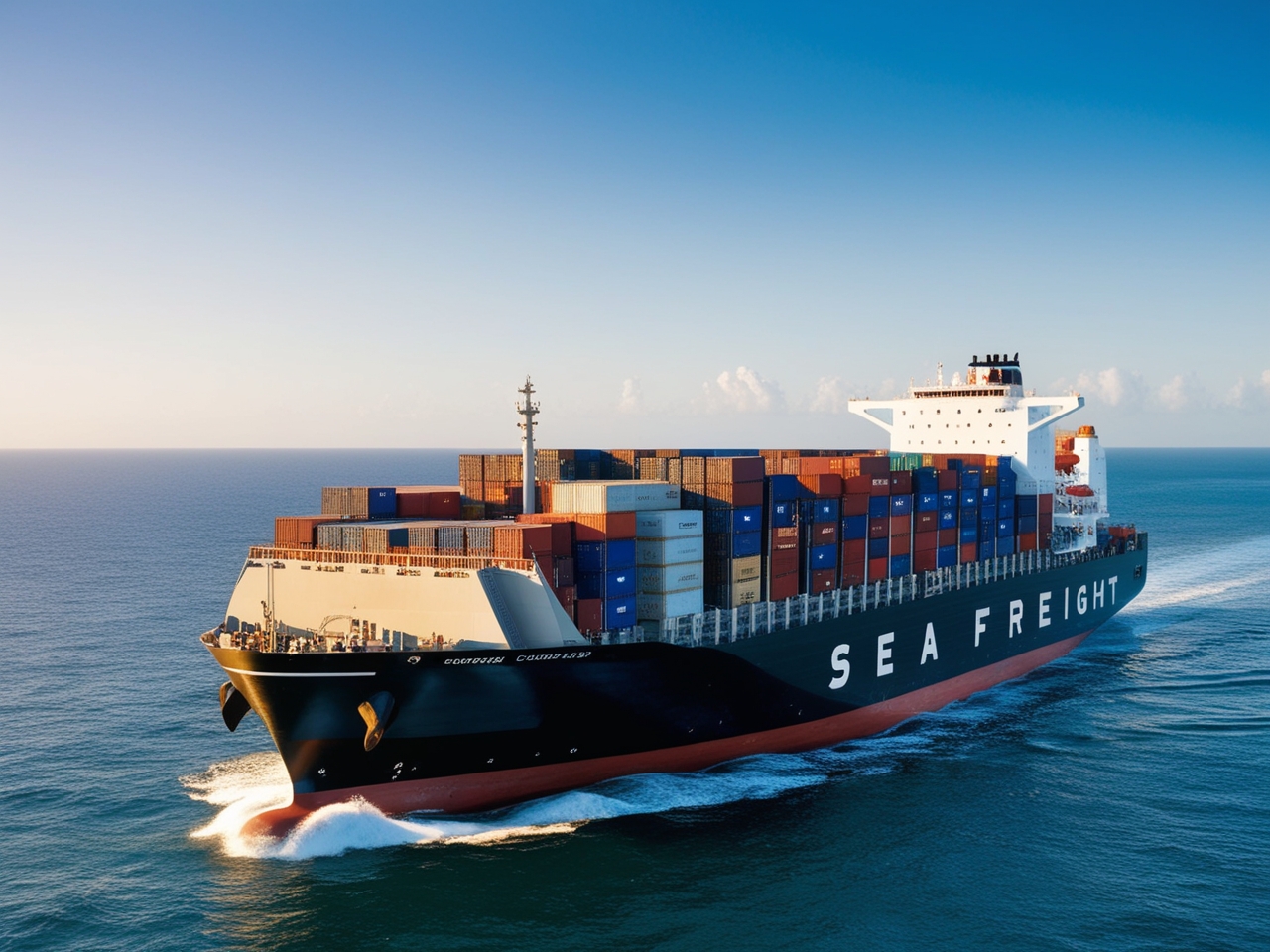
Rail freight from China to Europe costs about $10,400 per 40-foot container in October 2026 on a station-to-station, carrier-owned-container basis, and takes 12–16 days to the Polish border or 18–26 days door to door. The same month, a 40ft by sea from Shanghai to Rotterdam was quoted at $3,522 and averaged 42 days in transit.
So rail is running at roughly three times the ocean rate for three weeks of saved time. That trade-off is either excellent or indefensible depending on what is inside the box, and the numbers behind it have moved in both directions this year. Ocean rates are up 111% year on year while rail has climbed from roughly $7,000–8,500 per FEU in the first half of the year to about $10,400 in October, so the old rule of thumb (“rail costs a little more than sea”) no longer describes what shippers are being quoted.
This guide works from the October 2026 market, not from a rate card written last winter. It covers what each corridor actually costs, why two forwarders can quote the same container $3,000 apart, the weight limits that force a re-quote on dense cargo, the single border crossing that carries 85–90% of all westbound trains, and the customs steps — ICS2, EORI, duty, VAT — that a rail entry triggers at Małaszewicze.
Dantful has been booking block-train space out of Xi’an, Chengdu, Chongqing and Zhengzhou alongside ocean and air capacity since the CR Express brand was unified in 2016. We are a Shenzhen-based freight forwarder in shenzhen china with Class-A, NVOCC, FMC and Jctrans credentials, and we quote rail against sea and air in the same document so the comparison is honest rather than rhetorical.
Table of Contents
How Much Does Rail Freight from China to Europe Cost in 2026?
There is no single rail price, and that is the first thing to fix in your head. A China–Europe train rate is a function of five variables: which Chinese hub you load at, which European terminal you discharge at, whether the container is carrier-owned (COC) or shipper-owned (SOC), whether you are on a public block train or a dedicated service, and how far your cargo has to move domestically on either end. Change any one and the quote moves by hundreds of dollars.
What follows separates the contract baseline — what a regular shipper was paying in the first half of 2026 — from the current market, which is what a new booking costs this month.
| What you are pricing | Early-2026 level | October 2026 level | Source and date |
|---|---|---|---|
| 40ft / 40HQ, station to station, carrier-owned container (COC) | $7,000–8,500 | ~$10,400 average | Index1520, October 2026 |
| 40ft, Xi’an to Małaszewicze, public block train | ~$7,400 | $7,400–8,200 | Alichinafreight route table, August 2026 |
| 40ft, block-train quotations to Prague | $8,950–11,000 | $8,550–8,650 | Good Hope quotation log, April–August 2026 |
| 20ft, station to station | $3,900–5,500 | $6,800–7,300 (indicative) | Derived from the FEU average, 30–35% discount |
| LCL rail, per CBM, station to door | $138–162 | $140–220 | Hanhai rate card, June 2026; forwarder quotes 2026 |
| Ocean 40ft, Shanghai to Rotterdam (reference) | $4,401 (20 August) | $3,522 (15 October) | Drewry World Container Index |
| Air, per kg, Hong Kong to Europe (reference) | — | $4.80 | TAC Index, September 2026 |
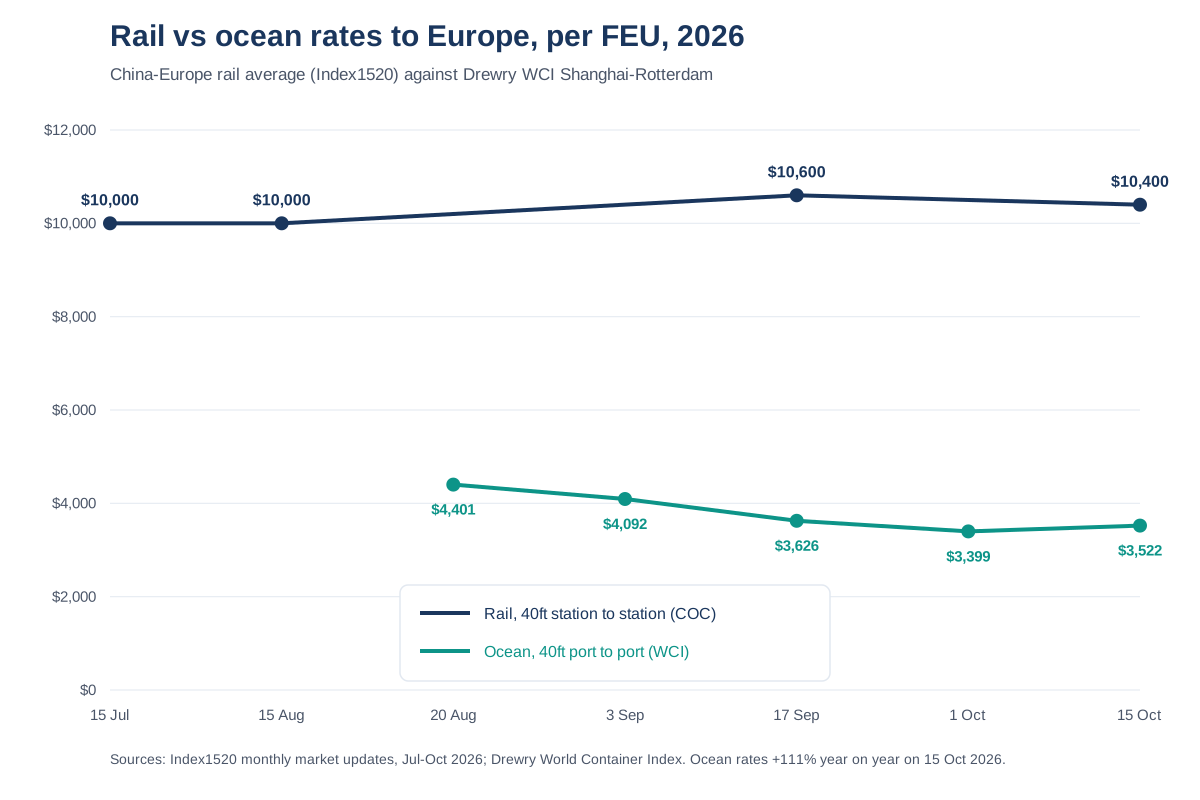
Two things in that table need explaining, because they are the two things importers email us about.
Why is the average $10,400 when forwarders quote “$7,400 from Xi’an”? Because they are not pricing the same product. The October average published by Index1520 covers all northern-corridor stations on a carrier-owned-container basis, and it includes the equipment cost that has become the dominant line this year: container leasing on China–Germany routes was running $1,500–1,700 per box in September 2026, up roughly 15% on inland hubs, because equipment owners have been prioritising more profitable US-bound flows. An SOC shipment, or a shipper who brings their own box, removes a large part of that. A public-train rate into Małaszewicze — the shortest leg, stopping at the EU border rather than running deep inland — is cheaper again. Both numbers are real. Neither is comparable to the other without stating the basis.
Why did rail get more expensive while everyone expected it to fall? Volume. China–Europe–China rail container volumes rose 27% year on year in January–September 2026, with the Middle Corridor up 64% and the Central Eurasian route up 21%. Q1 2026 alone carried 5,460 trains and 546,000 TEU, up 29% and 22% respectively on the year before, against a network that ran 20,022 train journeys in the whole of 2025. Capacity on the main corridor did not grow at that pace, and the price adjusted.
The direction of travel right now is mildly downward. October rates eased on several routes, most visibly from Chengdu and Chongqing at about −$200 per FEU, with Xi’an expected to follow, and container allocation costs in Chengdu, Chongqing and Xi’an fell $50–100 over recent weeks. If you are booking for December, the negotiation window is open — but book against the train date, not against a rate you saw in September.
The single figure that matters for your own budget is not the average. It is your lane’s station-to-station rate plus four fixed blocks: origin trucking, origin handling, transit documentation, and destination handling plus last mile. Those four blocks rarely move more than a few hundred dollars and they are where under-specified quotes quietly under-deliver.
What Is Included in a China–Europe Rail Freight Quote?
A rail quote is a stack, not a number. The reason two quotes for the same 40HQ can differ by thousands is usually that one is station to station and the other is door to door, or that one includes EU import clearance and the other expects you to have an EORI and a customs broker.
None of the lines below are unusual or concealed — they are standard parts of the cost chain, and a professional forwarder lists them in writing before you book. The right question is not “is there a catch” but “which of these are already inside the number I was given”.
| Charge | What it is | How to plan for it |
|---|---|---|
| Origin haulage | Truck from your supplier to the rail hub, often a different province | $100–500 per container; budget a full day per 500 km and do not assume a Shenzhen factory sits at a rail terminal |
| Export declaration | Chinese export customs filing at the hub | Bundled or $50–150; needs your invoice, packing list and HS code 48 hours before cut-off |
| Origin terminal handling | Lifting, stuffing, sealing, documentation at the rail hub | $150–400, sometimes shown as “included” |
| Main rail freight | The block-train leg, the largest single line | 60–80% of the total bill; moves monthly with corridor capacity |
| Gauge change and border transshipment | Lifting containers between 1,520 mm broad-gauge and 1,435 mm standard-gauge wagons at Khorgos/Alashankou and again at Brest/Małaszewicze | $200–500 per container, absorbed in most all-in rates but itemised by some operators |
| T1 transit guarantee | Customs transit document and guarantee covering the EU leg | $50–200 per bill |
| Container leasing / COC charge | The carrier’s box, if you are not using an SOC | $1,500–1,700 on China–Germany in September 2026 — ask explicitly whether your rate is COC or SOC |
| Destination terminal handling | Unloading and storage at the European terminal | $200–600, terminal-dependent |
| Deconsolidation | Splitting an LCL container at the destination CFS | $30–60 per CBM, plus 2–4 days |
| EU import clearance | Customs declaration under your EORI, duty and VAT assessment | $150–400 brokerage; duty and VAT are separate |
| Duty and import VAT | Tax on the customs value, not a freight charge | See the worked example below; VAT is recoverable if you are registered |
| Last-mile trucking | Terminal to warehouse or fulfilment centre | $150–400 within Germany or Poland; $500–900 to Iberia or Scandinavia |
| Storage and demurrage | Free time at the rail terminal is shorter than at a seaport | Usually 3–5 free days; agree the rate before the train arrives |
| Dangerous goods surcharge | RID declaration and acceptance per operator | $400–800 per container for most classes |
| Cargo insurance | All-risk cover on the door-to-door value | 0.3–0.8% of insured value for rail |
The practical test of a rail quote: ask for it twice — once as station to station and once as door to door with EU clearance included. If the two numbers differ by less than the sum of the destination lines above, one of them is missing something.
Which China–Europe Rail Route and Terminal Fits Your Cargo?
Two corridors carry essentially all commercial volume, and they are not interchangeable.
The northern corridor runs China → Kazakhstan → Russia → Belarus → Poland, entering the EU at Brest/Małaszewicze. It is the fast, cheap, dominant route: 85–90% of all westbound China–Europe trains cross there, according to European Rail Freight Association estimates. Station-to-station time to Małaszewicze is 12–16 days; to Duisburg or Hamburg, 15–20 days.
The middle corridor (Trans-Caspian) runs China → Kazakhstan → Caspian ferry to Aktau → Azerbaijan → Georgia → Türkiye or a Black Sea crossing into southeastern Europe. It avoids Russia and Belarus entirely, which matters if your buyer, bank or insurer objects to Russia transit. It is also slower and more expensive: 20–28 days and roughly 30% above northern-corridor rates, with the Caspian ferry as a hard capacity limit. When Aktau backs up — a 600–700 container backlog with waits over 20 days was reported in March 2025 — transit runs past a month. Volumes are growing fast off a small base (Middle Corridor block trains were 500 in 2025, about 2.3% of the total, and the route is up 64% year on year in 2026), but it is not yet a like-for-like substitute at scale.
| Corridor | EU entry | Station-to-station | Rate position | Choose it when |
|---|---|---|---|---|
| Northern (via Kazakhstan, Russia, Belarus) | Brest / Małaszewicze, Poland | 12–16 days to the border; 15–22 days to western terminals | Baseline | Speed and cost matter most, and the commodity is not sanctions-sensitive |
| Middle / Trans-Caspian (via Aktau, Azerbaijan, Georgia) | Türkiye or Black Sea port | 20–28 days | ~30% above northern | Your compliance position or your buyer rules out Russia transit |
| Central Eurasian (Kazakhstan–Azerbaijan–Georgia variants) | Georgia / Türkiye / Black Sea | 18–26 days | Between the two | You want to avoid Belarus but keep a rail-heavy routing |
Within the northern corridor, your origin choice is really a factory-location question. The Chinese hubs are not interchangeable either — each one has different departure frequency, different European terminal partners, and a different domestic trucking bill to reach it.
| China origin | Main European terminals | Station-to-station | What it suits |
|---|---|---|---|
| Xi’an | Małaszewicze, Duisburg, Budapest, Prague | 12–16 to Małaszewicze; 15–20 to Duisburg | Fastest and most frequent product; best for central and western Europe |
| Chengdu | Łódź, Małaszewicze, Tilburg | 18–21 | Central Poland and Benelux feeders; competitive rates, three departures a week on some services |
| Chongqing | Duisburg, Hamburg | 17–20 | Industrial and automotive cargo; strong German terminal links |
| Zhengzhou | Hamburg, Liège, Małaszewicze | 15–18 | Fast central-European routing, good for Belgium and northern France |
| Yiwu | Madrid, Duisburg | 20–24 | Iberia and southern Europe; long corridor, higher rate |
| Wuhan | Duisburg, Lyon | 16–18 | France and southern Germany |
| Shenzhen / Guangzhou (feeder) | Consolidated into the hubs above | +2–4 days domestic | South-China factories: cargo is trucked or moved by domestic rail to a CR Express hub first |
That last row is the one importers in Guangdong most often get wrong. There is no meaningful Shenzhen-origin block train to Europe; your cargo joins the network at Xi’an, Chengdu, Chongqing or Zhengzhou after a domestic leg that costs $300–700 per 40ft and two to four days. A forwarder who quotes “Shenzhen to Duisburg by rail” is quoting you a door-to-door product with that leg inside it — fine, as long as you know it is there and it appears in the transit time.
On the European side, terminal choice drives the last-mile bill:
- Małaszewicze is the fastest and cheapest EU leg because the train stops at the border. Clearance happens there and feeders reach Germany same or next day, Paris and Milan in about two days, London in two to four. It is also the corridor’s bottleneck.
- Duisburg is the largest inland hub and the natural choice for Germany, Benelux and northern France — see our Germany shipping page for the onward distribution picture.
- Hamburg adds seaport connectivity, useful if part of your cargo continues by vessel.
- Łódź and Warsaw serve Poland directly; Poland is the cheapest destination in the network because it is the first country the train reaches.
- Prague, Budapest, Liège, Tilburg, Lyon and Madrid each add two to four days of feeder time. Our Czech Republic, Hungary and Netherlands pages map those onward legs in detail.
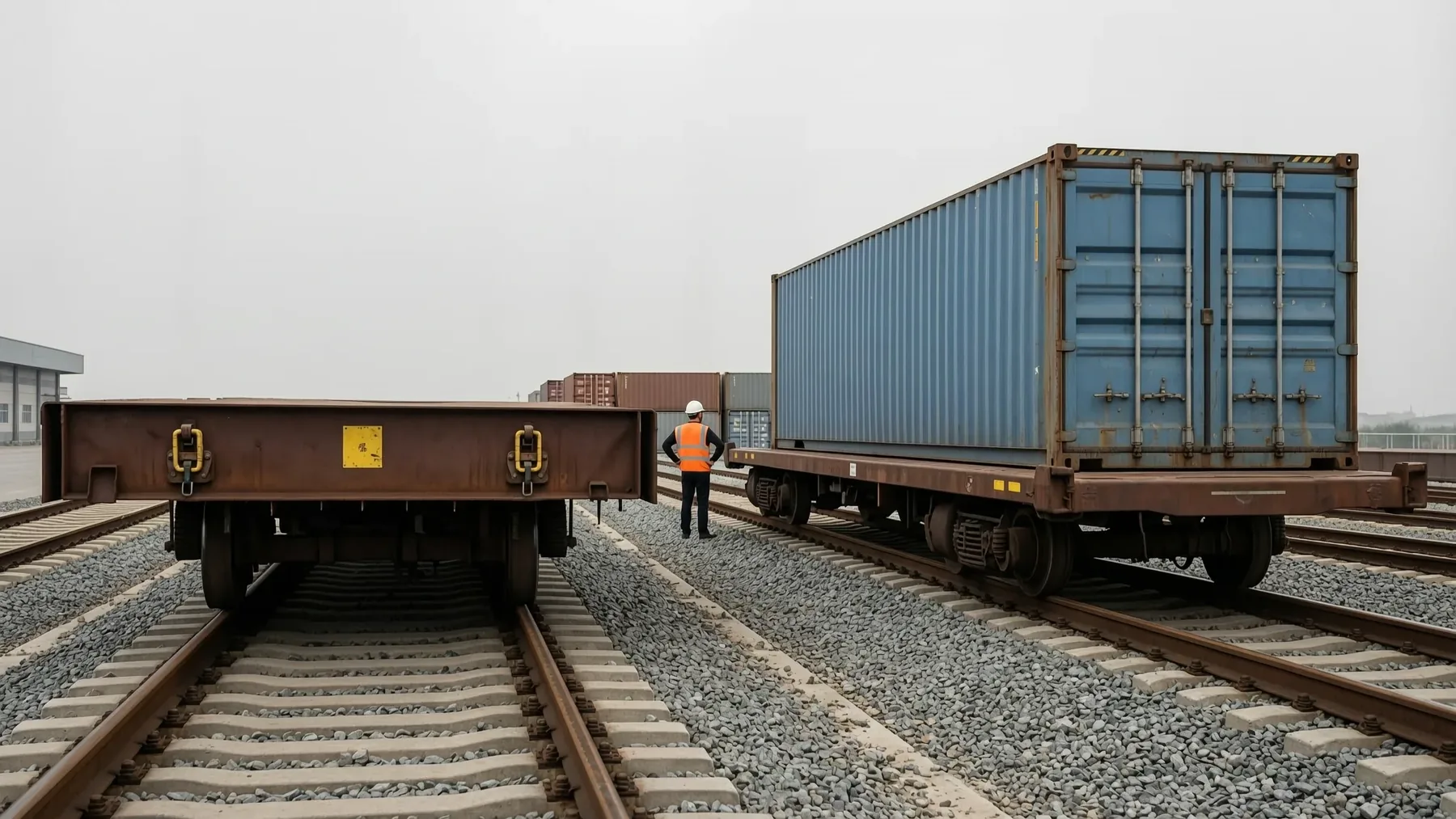
The gauge change is the physical reason rail transit has a floor. Containers are lifted twice — once at the China–Kazakhstan border, where transshipment typically takes about three days, and again at Brest/Małaszewicze, where it takes one to two. No schedule compresses that; it is a crane operation, not a customs delay.
FCL or LCL by Rail: Where Is the Break-Even Point?
Rail LCL is quoted per cubic metre, currently $140–220/CBM station to door, minimum 1 CBM, with consolidation adding three to seven days at each end. FCL is quoted per container. The interesting part is where they cross, because rail’s break-even is nothing like the sea-freight rule most importers carry in their heads.
By sea, the conventional advice is that LCL stops making sense somewhere around 12–15 CBM. That is a function of ocean FCL being cheap relative to ocean LCL. On rail, FCL is expensive relative to rail LCL, so the crossing point moves far to the right.
| Shipment volume | LCL at $180/CBM + $250 fixed | 20ft FCL all-in ($6,800 + $400) | 40HQ FCL all-in ($10,400 + $500) | Cheaper option |
|---|---|---|---|---|
| 12 CBM | $2,410 | $7,200 | $10,900 | LCL |
| 15 CBM | $2,950 | $7,200 | $10,900 | LCL |
| 18 CBM | $3,490 | $7,200 | $10,900 | LCL |
| 24 CBM | $4,570 | $7,200 | $10,900 | LCL |
| 60 CBM | $11,050 | Not possible (capacity) | $10,900 | 40HQ |
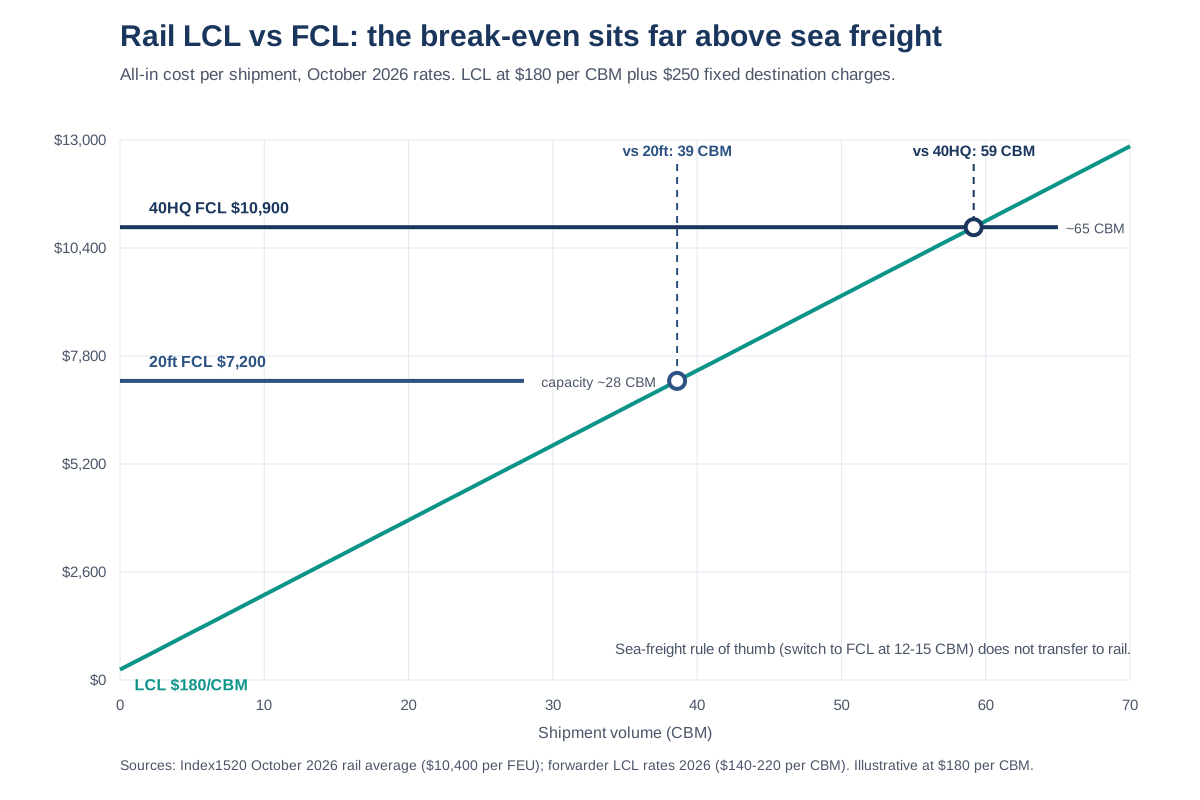
Straight-line break-even lands at about 39 CBM against a 20ft and about 59 CBM against a 40HQ. A 20ft only holds roughly 28 CBM in practice, which means rail LCL is cheaper on freight than a 20ft across that container’s entire usable volume — the 20ft only wins when something other than volume drives the decision:
- Density. A 20ft is capped at about 22 tonnes by rail and a 40ft at about 23 tonnes, against roughly 28 tonnes by sea. At 900 kg/CBM, 24 CBM is 21.6 tonnes and you are at the limit; LCL carriers apply a weight-or-measure rule (commonly 1 CBM = 1,000 kg), so dense cargo pays on weight and the per-CBM arithmetic above stops applying.
- Security and touch count. FCL is sealed at the hub and opened at destination. LCL is handled at both ends.
- Time. Three to seven days of consolidation at each end.
- Cargo value. High-value goods rarely want shared space regardless of the maths.
The LCL vs FCL comparison for smaller cargo covers the general decision framework; the rail-specific twist is that LCL remains competitive up to nearly a full 40HQ, which is the opposite of what sea-freight experience teaches.
Volume is not the whole story on the FCL side either. A 40HQ is the workhorse — about 65 CBM usable, 23-tonne cap — but a 20ft is the right call for dense industrial cargo that fills the weight before the volume, and a 45HC exists on some services for bulky low-density goods. On rail, asking for the equipment after you have agreed the rate is how a $7,400 quote becomes $9,000.
What Does Door-to-Door DDP Rail Cost from China to Europe?
DDP means the seller delivers to the buyer’s door with import duty and VAT paid. On rail it is the most commonly mispriced product in the market, because the freight leg is easy to quote and the tax leg depends on your cargo value, your HS code and your buyer’s VAT registration.
A word on terms first: FOB does not exist on rail. Incoterms 2020 rules for containerised rail are FCA (the rail equivalent of FOB), CIP, DAP and DDP. If a supplier offers you “FOB Xi’an”, they mean FCA, and the difference matters when you are allocating terminal charges.
| Term | Where risk passes | Who pays the main rail leg | Who clears EU import and pays duty/VAT |
|---|---|---|---|
| EXW | Supplier’s premises | You | You |
| FCA | Named rail hub in China | You | You |
| CIP | Destination terminal | Seller | You (unless agreed otherwise) |
| DAP | Buyer’s named place | Seller | You — DAP excludes duty and VAT |
| DDP | Buyer’s named place | Seller | Seller |
DAP is the term that catches people: the cargo arrives at your warehouse and the duty and VAT bill arrives separately, sometimes weeks later, sometimes with a customs penalty attached if the declaration was built on the wrong value. DDP moves that risk to the seller, at a price. Our primer on what DDP actually covers sets out the boundary in more detail.
A realistic DDP build for a 40HQ to Germany, mixed consumer goods, CIF value $40,000, duty 3.7%, VAT 19%:
| Line | Amount | Recoverable? |
|---|---|---|
| Rail freight, station to station (COC, October 2026) | $10,400 | No — cost |
| Origin trucking and hub handling | $400 | No — cost |
| EU import clearance and T1 | $350 | No — cost |
| Customs duty at 3.7% of $40,000 | $1,480 | No — cost |
| Import VAT at 19% of $41,480 | $7,881 | Yes, via your VAT return |
| Destination handling and last-mile delivery | $700 | No — cost |
| Total cash outlay | $21,211 | — |
| Net cost if VAT is recovered | $13,330 | — |
Freight is 78% of the non-recoverable number. That ratio is why the rail-versus-sea decision should be argued on freight and time, not on the tax line — duty and VAT are identical whichever mode brings the goods in, and identical whichever corridor you choose. The Corridor does not change your tax bill; only your HS code and your customs value do.
For destinations where the last mile dominates — Poland, Czechia, Hungary — door to door on rail is unusually competitive because the terminal is close to the customer. Our door-to-door service into Poland is the shortest DDP product in the network for exactly that reason.
How Long Does Rail Freight from China to Europe Take?
Plan on 18–26 days door to door to most of western and central Europe, and 12–16 days station to station if your terminal is Małaszewicze. Anything quoted at “12 days to Duisburg” is a train time, not a delivery time, and the gap between the two is where delivery promises fail.
| Route | Station to station | Door-to-door planning figure | Notes |
|---|---|---|---|
| Xi’an → Małaszewicze | 12–16 days | 18–22 days | Shortest EU leg; clearance at the border |
| Xi’an / Chongqing → Duisburg | 15–20 days | 20–26 days | Germany, Benelux, northern France |
| Zhengzhou → Hamburg or Liège | 15–18 days | 20–25 days | Fast central-European product |
| Chengdu → Łódź | 18–21 days | 22–27 days | Central Poland, Benelux feeders |
| Wuhan → Lyon | 16–18 days | 22–28 days | France, southern Germany |
| Yiwu → Madrid | 20–24 days | 25–30 days | Longest northern lane |
| Xi’an → Budapest (Middle Corridor variants) | 18–20 days northern; 20–28 days middle | 24–32 days | Corridor choice changes the number |
| Ocean reference, Shanghai → Rotterdam | 30–45+ days | 35–50 days | Averaged 42 days in August 2026 |
| Air reference | 4–7 days | 5–9 days | Airport to airport plus clearance |
The variability is concentrated at one place. With 85–90% of westbound trains entering the EU at Brest/Małaszewicze, a closure there is not a lane-specific problem — it is a network-wide one. The clearest recent example: Poland closed its Belarus border crossings from 12 to 25 September 2025 after joint Russia–Belarus military exercises and a drone incursion. More than 130 China–Europe trains were held at Brest, transit from Chinese cities to Małaszewicze stretched from 12–14 days to 20 days, and trains to Duisburg and Hamburg ran 25–28 days, five to six days behind schedule. Normal operations did not resume until after China’s National Day holiday on 8 October.
That was not a one-off. In July 2026, terminal congestion, maintenance and heat added three to four days to transit through Poland and Germany. The METRANS terminal at Małaszewicze reports the Brest–Terespol crossing running at only 60–70% of capacity, with Russian-side limits on freight paths, extra customs checks and Dostyk transshipment capacity being used for Russia’s domestic needs. Poland has also repeatedly restricted road crossings with Belarus through 2026, which affects feeder trucks even when the rail line is open.
The practical planning rules we apply:
- Quote the ETA and add four days for a normal-month buffer, seven days in Q4.
- Ask which border your train uses before you book, not after.
- Agree in writing what happens if Brest closes: does the operator re-route to the Middle Corridor, convert to rail-sea via Baltic ports, or hold? Who carries the storage cost?
- Do not schedule a retail launch or a promotional in-stock date off a rail ETA without those buffers.
When Should You Book Rail Space from China to Europe?
| Window | What happens | Booking lead time |
|---|---|---|
| September–November | Q4 retail peak; capacity tightens, congestion adds days | 3–4 weeks |
| Late January | Final westbound departures before Chinese New Year; cut-offs land 10–14 days before the holiday | 4 weeks |
| Chinese New Year, 6 February 2027 | Hub staffing drops for two to three weeks; trains thin out, then a post-holiday surge | Book December or wait until late February |
| March–June | The most predictable period of the year | 2–3 weeks |
| July–August | Heat and maintenance slow border handling; rates usually ease | 2–3 weeks |
Rail vs Sea vs Air to Europe in 2026: Which Wins on Total Cost?
Rail’s real competitor is not the ship. It is the aircraft. Against the ocean, rail is now three times the price; against air, rail is a fifth of the price for ten extra days. That asymmetry is what makes the mode decision tractable.
| Mode | Rate basis | October 2026 level | Transit, door to door | Best cargo | Where it loses |
|---|---|---|---|---|---|
| Sea FCL | Per 40ft, port to port | $3,522 (WCI, 15 Oct) | 35–50 days | Bulk, low value per kg, no deadline | Anything with a dated in-store requirement |
| Rail FCL | Per 40ft, station to station | $10,400 average (Index1520, Oct) | 18–26 days | Mid-value goods, 15–80 USD/kg, inland destinations | Very heavy cargo, where the 22–23 t cap bites |
| Rail LCL | Per CBM | $140–220 | 22–30 days | 1–15 CBM, mixed suppliers, samples | Dense cargo, where weight rules override volume |
| Air | Per kg | $4.80 (TAC, Sep) | 5–9 days | High value, launches, stockout rescue | Anything above about 10 tonnes |
| Express courier | Per kg, door to door | Quoted per parcel | 3–6 business days | Parcels, samples, documents | Cargo above a few hundred kilos |
Run the arithmetic on a real decision. A 40HQ carries roughly 60 CBM. Filling it with 10,000 kg of goods worth $12/kg:
- By sea: $3,522 freight, 42 days.
- By rail: $10,400 freight, 22 days. Premium $6,878, or $0.69 per kg, to arrive 20 days earlier.
- By air: 10,000 kg at $4.80 is $48,000 — $37,600 more than rail for another 15 days.
Two conclusions follow, and they are less comfortable than the usual “rail is the middle option” line.
First, inventory carrying cost alone rarely pays for the rail premium. Twenty days on $120,000 of goods at a 12% cost of capital is about $790. The premium is $6,878. If your only argument for rail is working capital, the numbers do not support it in the current market — they supported it far better when rail was $7,000 and ocean was $4,400.
Second, rail wins on specific, nameable risks, not on general efficiency: a Q4 restock that misses the sea window, a promotional calendar with hard dates, a supplier who cannot hit an air-ready schedule, cargo too heavy for air and too late for a 50-day ocean cycle. Per unit, the premium is the number to argue about: $6,878 across 500 units is about $13.76 per unit — if a stockout, an air upgrade or a markdown costs more than that per unit, rail is the rational choice and you can show your finance director why.
Where rail genuinely loses: cargo above about 25 tonnes per container, dangerous goods that the operator will not accept, and destinations far from a rail terminal where the last-mile truck eats the saving. Dantful quotes sea freight from China to Europe and air freight from China to Europe against the rail option for the same shipment, because on roughly half the lanes we quote, sea or air is the better answer. Our Germany container cost breakdown is the closest sea comparison for the largest rail destination.
What Customs Rules Apply When Your Train Enters the EU?
Rail clears customs once, at the EU’s external border, and then moves freely inside the single market. That is genuinely simpler than ocean groupage, where each member state can raise its own questions. It is not, however, simpler than ocean FCL in terms of what you must file — and since April 2025 there is a new pre-arrival requirement that catches first-time rail importers.
ICS2 applies to rail. Since 1 April 2025, rail carriers entering or transiting the EU must file a complete Entry Summary Declaration (ENS) in the EU’s Import Control System 2, and from 1 September 2025 that obligation is mandatory for every rail operator with no deployment window left. The ENS needs a full commercial description of the goods, the 6-digit HS code, and data on all parties — buyer, seller, consignee, carrier. In practice this means your forwarder needs accurate invoice data 48 hours before the train is loaded, not when it reaches Poland. Shipments arriving with vague descriptions are stopped at the border and cleared late.
You are the importer of record, not your forwarder and not Amazon. That requires an EU EORI number, a customs declaration filed in your name, and a VAT registration in the country of import (or a fiscal representative where the member state allows one). Under DDP the seller handles the mechanics, but the legal obligations — and the record-keeping — stay with the importer.
Duty is assessed on the customs value (goods plus international freight and insurance, CIF basis) at the MFN rate for your HS code. Anti-dumping duties apply to a specific and growing list of Chinese-origin goods, including ceramics, steel products, e-bikes and some glassware, and they are charged in addition to MFN. VAT is charged on the duty-paid value, at the rate of the member state where the goods are released for free circulation:
| Country | Standard import VAT | Note |
|---|---|---|
| Germany | 19% | Postponed VAT accounting available for registered importers |
| Poland | 23% | The most common rail entry point |
| Czechia | 21% | — |
| Hungary | 27% | The highest rate in the network |
| Netherlands | 21% | — |
| Belgium | 21% | — |
| France | 20% | — |
| Spain | 21% | — |
| Italy | 22% | — |
A worked line, using the same container as the DDP example above: CIF $40,000, duty 3.7% = $1,480, VAT 19% on $41,480 = $7,881, total tax $9,361 — 23.4% of the CIF value. Change the HS code to a 12% apparel line and the duty alone triples to $4,800. This is why the HS code, not the freight rate, is the line item most worth getting right.
Sanctions screening is part of the routing decision now. Transit through Russia is lawful for most ordinary commercial cargo, and that is worth stating plainly because the opposite is widely assumed. What is prohibited is transit through Russia of dual-use goods and of the listed items in Annex XXIII and related annexes, and the lists are amended often enough that a screening done last year is not a screening. The 21st sanctions package, adopted on 23 July 2026, added 218 designations and kept only a narrow exemption for necessary rail transport by JSC Russian Railways. Separately, many banks, insurers and buyers decline Russia-transit cargo regardless of legality, and a cargo policy may not respond normally on that routing. Two practical rules: screen the commodity against the current restrictions for the specific routing every time, and check the counterparties in the chain — operator, forwarder, terminal — against the sanctions lists.
Documents for a rail import, in the order customs will ask for them:
- Commercial invoice and packing list, with the HS code at 6+ digits and the Incoterm stated
- CIM/SMGS consignment note (the rail equivalent of a bill of lading — it is not a document of title, which matters if you finance the shipment)
- T1 transit declaration and guarantee for the non-EU leg
- EU import declaration under your EORI, with the customs value build-up
- Certificates where the product requires them — CE marking, conformity declarations, RID documentation for dangerous goods
- ISPM-15 treatment marks on any solid-wood packing, not just pallets
- Cargo insurance certificate covering the full door-to-door route, including any Russia transit
How to Choose a Reliable China–Europe Rail Freight Forwarder
Rail rewards operators and punishes improvisation, because there is no equivalent of the daily sailing that lets an ocean forwarder fix a mistake next week. The train leaves on its schedule with or without you. That makes four things worth checking before you book — and these are specific to this lane, not a generic due-diligence list.
1. Does the quote state station-to-station and door-to-door separately, and name COC or SOC? Equipment is $1,500–1,700 of the bill on China–Germany right now. A quote that does not say which box you are paying for is not a comparable quote.
2. Which train are you actually on? Ask for the departure hub, the train date, the cut-off time at the hub, and whether it is a public block train or a consolidated service. “Weekly departures” is not a schedule.
3. What is the border contingency, in writing? A serious rail forwarder will tell you which crossing the train uses, what the current queue looks like, and what the fallback is if Brest closes — Middle Corridor, rail-sea via the Baltic, or conversion to ocean. The September 2025 closure held 130+ trains; the shippers who recovered fastest were the ones whose forwarder had a pre-agreed alternative and knew who paid for the storage.
4. Can they clear at Małaszewicze under your EORI, and do they screen your HS code before booking? Clearance and sanctions screening are the two places where a cheap rail rate becomes an expensive shipment.
Dantful has been moving cargo out of China since 2008 and holds Class-A freight-forwarding, NVOCC, FMC and Jctrans credentials, with direct contracts with carriers and rail operators rather than sub-brokered space. We quote rail, sea and air side by side, publish the transit buffer we actually expect rather than the train time, and provide daily tracking updates with photos from hub receipt through border transshipment to final delivery. Fifty operations staff and a 50+ person customer service team cover the 24-hour window across Chinese, English and European time zones; our freight forwarder selection guide explains the rest of the evaluation criteria. For a lane-level view of transit and rates into the largest rail destination, see how long freight from China to Germany takes.
FAQ: Rail Freight from China to Europe
How much does it cost to send a 40ft container by rail from China to Europe?
About $10,400 on average in October 2026, station to station with a carrier-owned container. Public-train rates into Małaszewicze start near $7,400, while block-train quotations to Prague ranged $8,550–11,000 between April and August 2026. Door-to-door adds $1,200–2,000 depending on the destination.
How long does rail freight from China to Europe take door to door?
18–26 days to most of western and central Europe, with 12–16 days station to station to Małaszewicze. Add four days of buffer in a normal month and seven in Q4, and expect five to six extra days if the Polish border is disrupted.
Is rail freight cheaper than sea freight from China to Europe?
No. In October 2026 rail was roughly three times the ocean rate — about $10,400 per 40ft against $3,522 for Shanghai–Rotterdam. Rail buys 20–25 days; the premium is about $6,878 per container, or $0.69 per kg on a 10-tonne load.
What is the cheapest way to ship from China to Europe by rail?
Load LCL into a consolidated container if you are under about 30 CBM, ship into Małaszewicze or Warsaw rather than a deep-inland terminal, use an SOC container if you have one, and book in the March–June window when capacity is loosest. Rates from Chengdu and Chongqing are currently the most negotiable.
Can I ship LCL by rail from China to Europe?
Yes, from 1 CBM, at $140–220 per CBM station to door. Consolidation adds three to seven days at each end, and dense cargo is charged on a weight-or-measure basis rather than pure volume.
How much weight can a container carry by rail?
About 22 tonnes in a 20ft and 23 tonnes in a 40ft, against roughly 28 tonnes by sea. Rail axle-load limits across Kazakhstan and Russia drive that cap, and dense cargo frequently hits it before the container is full.
Do I need an EORI number to import by rail into the EU?
Yes. You need an EU EORI and a customs declaration in your name (or your EU entity’s). A forwarder can file on your behalf but cannot be the importer of record, and Amazon will not act as importer on FBA shipments.
Can my goods transit Russia by rail to the EU?
For most ordinary commercial goods, yes — transit through Russia is lawful as long as the goods are not Russian-origin and are not on the dual-use or Annex XXIII transit-ban lists. Screen the specific commodity and the counterparties each time, and check that your insurer covers the routing.
Is rail freight from China to Europe reliable in 2026?
Schedules are fixed and transit is predictable in normal months, but the network depends on one gateway: 85–90% of trains enter the EU at Małaszewicze. In September 2025 a 13-day closure held 130+ trains and pushed transit to 20 days; in July 2026 congestion added three to four days. Reliability is good with a buffer and poor without one.
Which Chinese city has the fastest train to Europe?
Xi’an, at 12–16 days station to station to Małaszewicze and 15–20 days to Duisburg, with the most frequent departures. Zhengzhou is close behind at 15–18 days to Hamburg or Liège; Yiwu to Madrid is the slowest northern lane at 20–24 days.

Young Chiu is a seasoned logistics expert with over 15 years of experience in international freight forwarding and supply chain management. As CEO of Dantful International Logistics, Young is dedicated to providing valuable insights and practical advice to businesses navigating the complexities of global shipping.