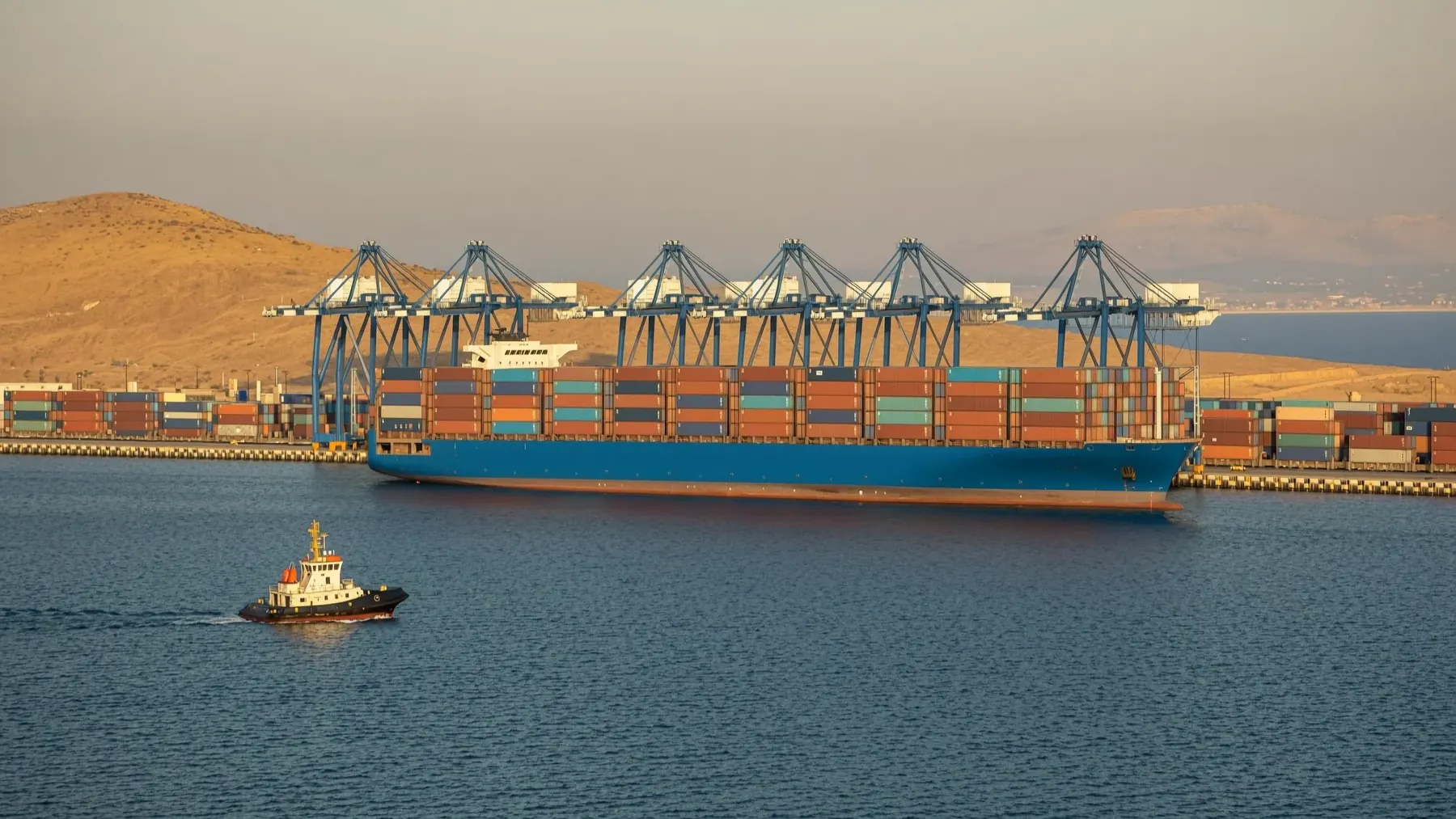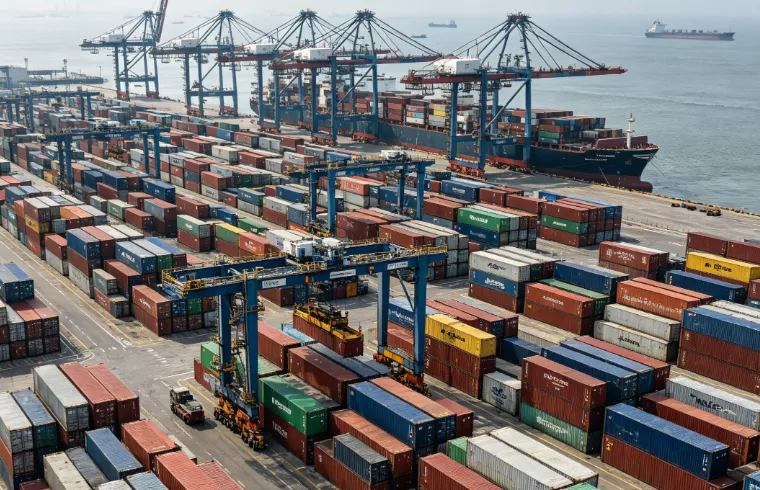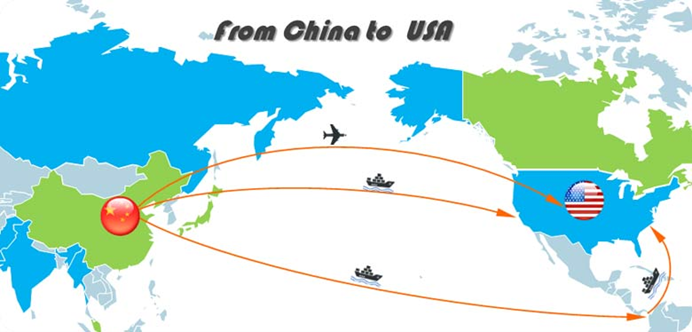
If you import steel, aluminium, cement, fertilisers, hydrogen or electricity into the EU from China, CBAM in 2026 costs you €178.63 per tonne of hot-rolled coil on default values, €212.86 per tonne of welded precision tube, €177.48 per tonne of slab and €157.44 per tonne of unwrought aluminium, priced at the official third-quarter 2026 certificate price of €82.32 per tonne of CO₂e. A single 20ft container carrying 25 tonnes of Chinese coil therefore carries €4,466 of carbon cost, which is more than the ocean freight for the same box at current Asia–Europe rates.
Those numbers will look wrong to anyone who has read the guides telling them CBAM costs about 2.5% of emissions in 2026, or “€3.10 per tonne” on Chinese steel. Those guides are wrong, and they are wrong in the same direction, because they apply the CBAM phase-in share to your emissions. The regulation applies it to the EU benchmark instead. On Chinese cargo, where the published default value is more than double the benchmark, that difference is the whole cost.
At Dantful we have moved steel, aluminium, cement and fertiliser cargo out of Shenzhen, Ningbo and Shanghai since 2008, as a Class-A licensed forwarder with NVOCC and FMC registration and direct carrier contracts on the Asia–Europe lanes. Since January 2026 the question our EU customers ask has changed from “what is the freight rate” to “what will customs want before you can release this box”. This guide answers both, with the arithmetic of the regulation, the official 2026 certificate prices, and the freight market as it priced on 22 October 2026.
Table of Contents
What Does CBAM Cost EU Importers Shipping from China in 2026? The Short Answer
CBAM became a charging regime on 1 January 2026. The cost depends on four published inputs: the default emission value for the goods and country of origin, the mark-up added to that default, the EU benchmark for that production route, and the CBAM certificate price for the quarter of import.
The table below is the short version for Chinese origin, at the Q3 2026 certificate price. Every figure is worked through in the sections that follow, so you can rebuild it for your own CN codes.
| Your position in 2026 | CBAM cost | What drives the number |
|---|---|---|
| Total CBAM goods imports stay at or below 50 tonnes for the year | €0 | De minimis, per importer per calendar year |
| Chinese hot-rolled flat steel, CN 7208, default values | €178.63 per tonne | Default 3.187, +10% mark-up, benchmark 1.370 |
| Chinese steel slab, CN 7207 12 10, default values | €177.48 per tonne | Default 3.169, benchmark 1.364 |
| Chinese welded precision tubes, CN 7306 30 18, default values | €212.86 per tonne | Default 3.565, benchmark 1.370 |
| Chinese unwrought aluminium, CN 7601, default values | €157.44 per tonne | Default 3.000, benchmark 1.423, direct emissions only |
| 25 tonnes of Chinese coil in one 20ft container | €4,466 | 54.25 certificates at €82.32 |
| Verified actual emissions of 2.0 tCO₂e per tonne of coil | €54.68 per tonne | Same benchmark deduction, much lower emission factor |
The certificate price is set quarterly in 2026, then weekly from 2027. These are the official prices published by the Commission so far, per tonne of CO₂e:
| Quarter | Price | Published | Applies to |
|---|---|---|---|
| Q1 2026 | €75.36 | 7 April 2026 | Goods imported January to March 2026 |
| Q2 2026 | €75.28 | 6 July 2026 | Goods imported April to June 2026 |
| Q3 2026 | €82.32 | 5 October 2026 | Goods imported July to September 2026 |
| Q4 2026 | to be published | 4 January 2027 | Goods imported October to December 2026 |
Note the timing, because it decides your cash flow. Nothing is paid in 2026. Certificates go on sale on 1 February 2027, and the first annual declaration covering 2026 imports is due by 30 September 2027. You are budgeting in 2026 for a bill that arrives in 2027.
Why the “2.5% in 2026” Figure Is Wrong for Chinese Cargo
The number you see everywhere is that the CBAM factor is 97.5% in 2026, so only 2.5% of emissions are payable. That reading is a misunderstanding of Article 31 of Regulation (EU) 2023/956, and it produces a cost estimate two orders of magnitude below the real bill for Chinese steel.
The deduction is computed against the EU benchmark for the production route, not against your goods’ emissions:
Certificates (tCO₂e) = [ default value × (1 + mark-up) − CBAM factor × benchmark ] × tonnes
Cost (EUR)           = certificates × certificate price
The CBAM factor is the share of free allocation that EU producers still receive. In 2026 it is 97.5%, which means the deduction is 97.5% of the benchmark. A European mill sitting exactly at its benchmark therefore pays for 2.5% of its emissions. A Chinese mill on default values does not, because its default value sits far above the benchmark that the deduction is calculated on. Whatever you emit above 97.5% of the benchmark is payable from the first shipment.
For Chinese hot-rolled coil the arithmetic is:
| Step | Figure | Source |
|---|---|---|
| China default value, CN 7208 | 3.187 tCO₂e/t | IR (EU) 2025/2621, as corrected by IR (EU) 2026/1740 |
| Default plus 2026 mark-up of 10% | 3.5057 tCO₂e/t | Regulation (EU) 2023/956, Annex IV |
| Benchmark, BF/BOF route | 1.370 tCO₂e/t | IR (EU) 2025/2620, Column B |
| Free-allocation deduction, 97.5% × 1.370 | 1.3357 tCO₂e/t | Article 31 |
| Certificates payable per tonne | 2.1700 tCO₂e/t | 3.5057 − 1.3357 |
| Cost per tonne at €82.32 | €178.63 | Q3 2026 certificate price |
| Payable share of the default value | 61.9% | 2.1700 ÷ 3.5057 |
That is the difference in one line: 61.9% of the default emissions are payable in 2026, not 2.5%.
Where the low estimates come from is worth knowing, because you will meet them in supplier meetings. The widely quoted “€3.10 per tonne for 100 tonnes of Chinese coil” does two things at once: it uses 1.370 tCO₂e/t as the Chinese default value, which is actually the EU benchmark, and then applies a 2.5% phase-in share to that figure. Two separate errors, both pointing the same way. If a number in a quote or a board paper implies that CBAM on Chinese steel is a rounding error, run the formula above before you accept it.
The phase-in does still matter, just not in the direction the guides suggest. What changes each year is the size of the deduction: the CBAM factor falls from 97.5% in 2026 to zero in 2034, while the mark-up on default values rises from 10% to 30% by 2028. Both movements increase what you pay.
| Year | Mark-up on defaults | CBAM factor | Certificates per tonne, CN 7208 | Cost per tonne at €82.32 |
|---|---|---|---|---|
| 2026 | 10% | 97.5% | 2.1700 | €178.63 |
| 2027 | 20% | 95% | 2.5229 | €207.69 |
| 2028 | 30% | 90% | 2.9101 | €239.56 |
| 2029 | 30% | 77.5% | 3.0813 | €253.66 |
| 2030 | 30% | 51.5% | 3.4375 | €282.98 |
| 2034 | 30% | 0% | 4.1431 | €341.06 |
The 2030 figure is not the end of the story, and neither is 2034: from 2028 the benchmark itself is republished for the 2028–2030 allocation period, and the certificate price from 2027 onward is a weekly average of EU ETS auctions rather than a quarterly one. Treat the table as the schedule of the deduction, priced at a constant €82.32, and reprice it each quarter.
CBAM Cost per Tonne by Product: Chinese Default Values in 2026
Chinese default values are published per CN code, and they vary more than most buyers expect. Steel flat products and slab sit around 3.1 to 3.2 tCO₂e per tonne; Chapter 73 fabricated articles are higher because they carry the emissions of the upstream steel plus processing; unwrought aluminium is 3.000 tCO₂e per tonne and is priced on direct emissions only.
| Good and CN code | China default | Default +10% | Benchmark | Deduction | Certificates/t | 2026 cost/t | 2030 cost/t | 2034 cost/t |
|---|---|---|---|---|---|---|---|---|
| Hot-rolled flat, CN 7208 | 3.187 | 3.5057 | 1.370 | 1.3357 | 2.1700 | €178.63 | €282.98 | €341.06 |
| Steel slab, CN 7207 12 10 | 3.169 | 3.4859 | 1.364 | 1.3299 | 2.1560 | €177.48 | €281.31 | €339.13 |
| Welded precision tubes, CN 7306 30 18 | 3.565 | 3.9215 | 1.370 | 1.3357 | 2.5858 | €212.86 | €323.43 | €381.51 |
| Unwrought aluminium, CN 7601 | 3.000 | 3.3000 | 1.423 | 1.3874 | 1.9126 | €157.44 | €260.72 | €321.05 |
All 2026 costs use the Q3 2026 certificate price of €82.32; 2030 and 2034 costs hold that price constant so the schedule is comparable, and hold the 2026 benchmark constant for the same reason. The 2034 column applies the 30% mark-up with no deduction, which is the full-coverage case.
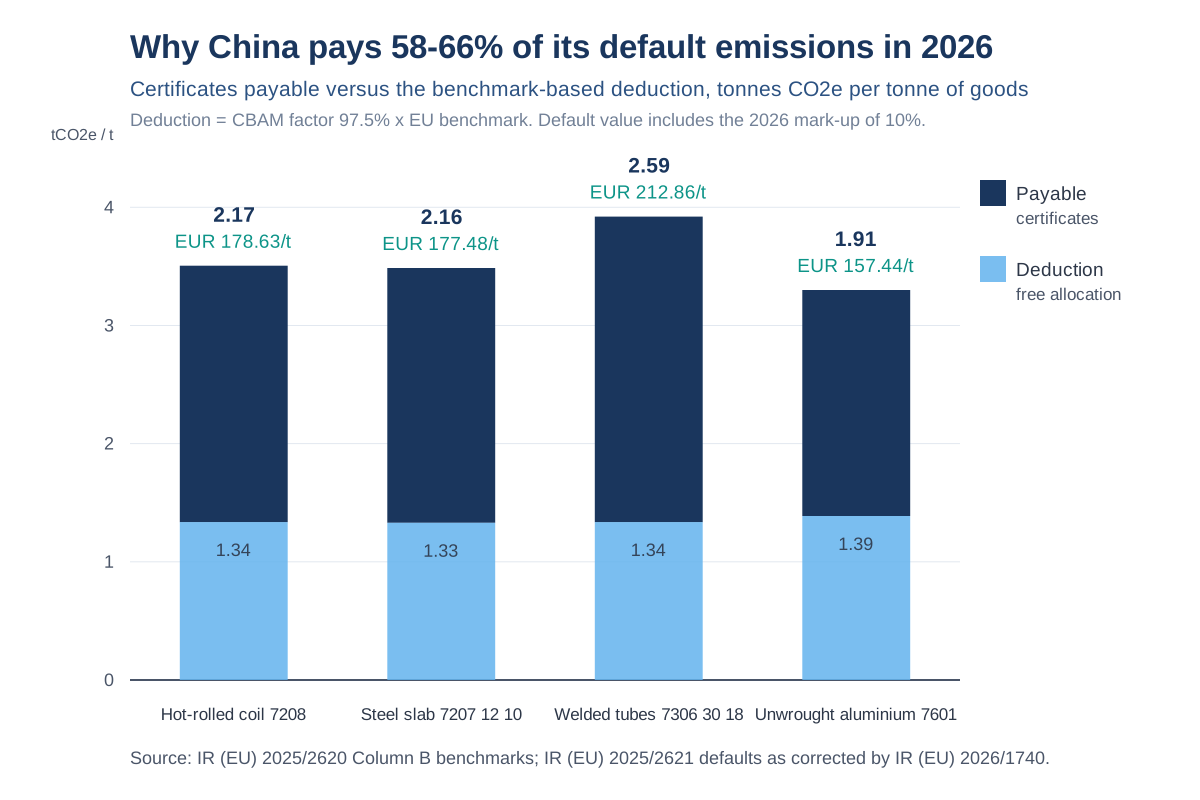
Three things follow from this table. First, the Chinese default values are roughly 2.1 to 2.6 times the EU benchmark for the same route, which is why the deduction removes less than half of the liability. Second, the spread between products is real: tubes cost 19% more per tonne than coil, so quoting a single “CBAM rate” for a mixed container overstates one line and understates the other. Third, aluminium looks cheaper per tonne than steel until you remember that aluminium is priced on direct emissions only, so a Chinese smelter’s grid-heavy indirect emissions are not in the figure at all.
Classification decides all of it. A coil declared under 7208 and the same coil cut into a welded tube under 7306 30 18 are different CBAM goods with different defaults, and a mis-classified entry flows straight into a wrong certificate declaration that you cannot quietly fix after 30 September. Since 1 January 2026 the customs declaration also transmits the CBAM data (Regulation (EU) 2025/2619), so classification, origin and net mass are all carrying compliance weight now, not just duty.
How Much Does CBAM Add to a Container of Chinese Steel or Aluminium?
Per-tonne figures are useful for negotiation. Per-container figures are what your cash flow sees. Heavy cargo fills a 20ft box on weight long before it fills on volume, so a 20ft of coil or ingots is the right unit for this calculation: about 25 tonnes payload.
| Shipment | Certificates | CBAM cost at €82.32 | Ocean freight reference | Carbon as a share of freight |
|---|---|---|---|---|
| 25 t Chinese hot-rolled coil, CN 7208 | 54.25 | €4,466 | $3,632 per 40ft Shanghai–Rotterdam, or about $145 per tonne | About 143% |
| 25 t Chinese aluminium ingots, CN 7601 | 47.81 | €3,936 | $3,632 per 40ft Shanghai–Rotterdam, or about $145 per tonne | About 126% |
| 100 t Chinese hot-rolled coil, CN 7208 | 217.00 | €17,863 | Five 20ft boxes or two 40ft plus | About 143% |
The freight reference is the Drewry World Container Index for 22 October 2026: Shanghai to Rotterdam at $3,632 per 40ft, up 3% week on week, and Shanghai to Genoa at $4,152. Dividing the 40ft rate by a 25 tonne heavy load gives about $145 per tonne, roughly €125 at $1.16 per euro. The carbon charge per tonne of that same coil is €178.63. Ocean freight is no longer the largest single line in a Chinese steel import.
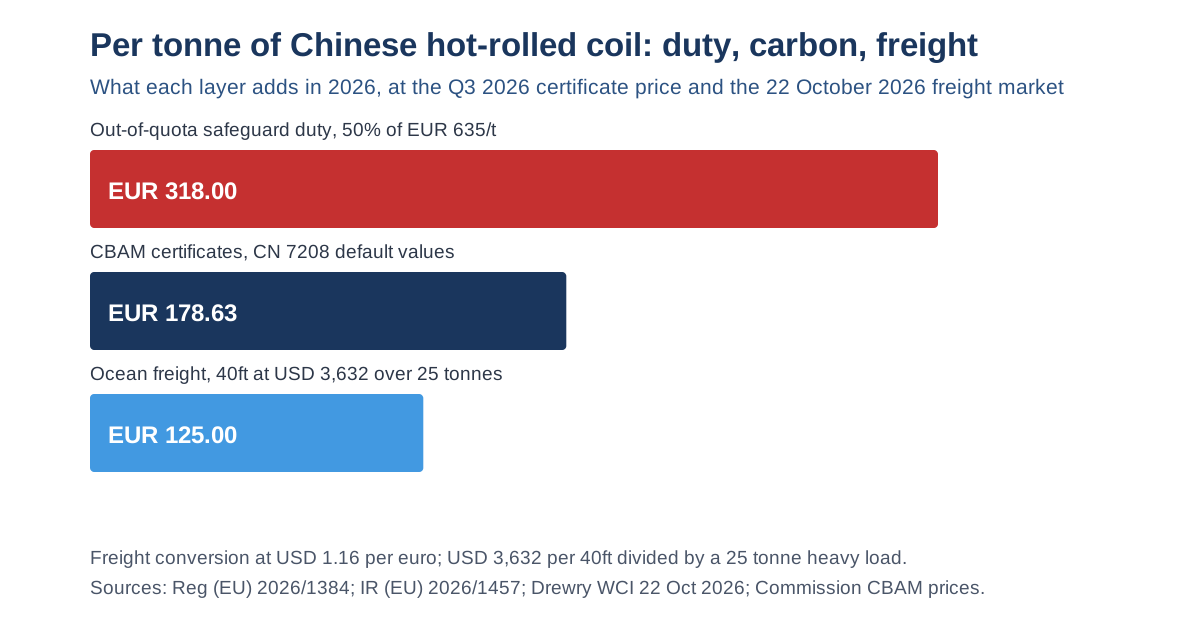
That comparison is the reason CBAM changes sourcing decisions rather than just adding a cost line. A buyer comparing a Chinese mill against a Turkish or Indian mill is no longer comparing ex-works prices plus a similar freight; they are comparing three different default values against one benchmark. At the Q2 2026 certificate price, the carbon cost on hot-rolled coil was reported at roughly €163 per tonne for Chinese origin, €100 for Turkish and €15 for US origin, with Indonesian material far higher. The same coil, the same ship, a cost difference that no freight negotiation can close.
Which Chinese Exports Are Covered, and Which Are Not Yet?
CBAM covers six sectors. What matters for a Chinese supplier is whether the exact CN code appears in Annex I, because coverage runs down to specific subheadings and stops there.
| Sector | Typical Annex I families | Emissions priced | 2026 mark-up | China relevance |
|---|---|---|---|---|
| Iron and steel | 7207 to 7229, 7301 to 7311, selected Chapter 73 articles such as CN 7306 tubes | Direct | 10% | Largest single exposure by value |
| Aluminium | 7601 to 7616, including plates, sheet, profiles and structures | Direct plus PFCs | 10% | 613 kt and €3.25 bn imported from China in 2025 |
| Cement | 2507 00 80, 2523 | Direct and indirect | 10% | Clinker and white cement |
| Fertilisers | 2808, 2814, 2834 21, 3102, 3105 | Direct and indirect | 1% | Urea, ammonium sulphate, NPK |
| Electricity | 2716 00 00 | Direct | None | Not applicable to China in practice |
| Hydrogen | 2804 10 00 | Direct | 10% | Small volume, no de minimis |
China is the largest origin of CBAM-covered goods entering the EU by value, at €17.09 billion in 2025, concentrated in steel and aluminium.
The threshold is the second filter. Under Regulation (EU) 2025/2083, an importer whose total CBAM goods imports stay at or below 50 tonnes of net mass in a calendar year is outside the obligation entirely. The number is per importer, per year, and cumulative across all six sectors: 30 tonnes of steel plus 25 tonnes of aluminium is 55 tonnes, and obligations then apply to the whole year’s imports, not just the tonnage above the line. Hydrogen and electricity get no threshold at all.
The Commission’s estimate is that this removes about 90% of importers, roughly 182,000 businesses, while keeping more than 99% of embedded emissions in scope. For a small buyer of Chinese steel this is genuinely good news, but it needs monitoring rather than assuming: several small consignments across a year can cross 50 tonnes without anyone noticing, and the crossing is not prospective.
What is not covered yet is the long list of manufactured goods made from these materials. Furniture, machinery, power tools, fasteners further downstream and appliances are outside Annex I today. That is the subject of the 2028 extension in the last section, and for a Chinese exporter shipping finished metal goods, it is the date that matters most.
Who Files What: the CBAM Compliance Chain from Shenzhen to Rotterdam
The single most common misunderstanding on the logistics side is that CBAM is handled by the forwarder as part of the customs entry. It is not. CBAM liability belongs to the authorised CBAM declarant, which from 1 January 2026 must be an EU-established importer or their indirect customs representative. A Chinese seller cannot hold that status, and a forwarder can only act as declarant if it takes on the role formally.
| Date | What happens | Who acts |
|---|---|---|
| 1 January 2026 | Definitive regime starts; only an authorised declarant may release CBAM goods for free circulation | EU importer applies for authorisation |
| 31 March 2026 | Application window closed for uninterrupted 2026 imports; applications filed by then may import provisionally | Importer, via national competent authority |
| 1 July 2026 | New EU steel tariff-rate quota regime applies alongside CBAM | Importer and customs broker |
| 1 February 2027 | CBAM certificate sales open on the common central platform, covering 2026 and 2027 imports | Declarant buys |
| Each quarter from 2027 | Account must hold certificates equal to at least 50% of cumulative embedded emissions since 1 January | Declarant manages |
| 30 September 2027 | First annual CBAM declaration and surrender, for calendar year 2026 | Declarant files |
| 1 January 2028 | Downstream extension proposed to apply, subject to the trilogue outcome | Both sides |
Authorisation is not a formality. In the Netherlands the competent authority is the NEa and processing can take up to 120 days; Germany’s DEHSt lists the same 31 March 2026 cut-off and permits provisional imports only where an application was already filed, flagged on the customs declaration with a specific document code. Importers below the 50 tonne threshold still have a customs obligation: their entries carry a different code (Y127 in the Dutch guidance) so the entry itself records that no authorisation applies.
Practically, this changes the booking conversation. When you book a container of Chinese coil to Rotterdam, the forwarder needs three things that were not standard before 2026: the declarant’s authorisation reference, the exact CN code with net mass per line, and the installation data behind the emission values. If any of those is missing when the vessel arrives, the declaration cannot be completed and the goods stay where they are. Demurrage on a 25 tonne coil lot runs faster than the CBAM saving on it.
Non-compliance has its own price. Failing to surrender the required certificates attracts €100 per tonne of CO₂e under Article 26(1), and importing above the threshold without authorisation carries three to five times that, €300 to €500 per tonne, on top of revocation risk for repeat cases.
Where CBAM Meets the Freight Quote: Ports, Incoterms and Documents
CBAM is an EU-wide charge: the certificate price does not change because you cleared in Rotterdam rather than Hamburg, and the deduction does not change because you discharged in Antwerp rather than Gdansk. What does change by port and by contract term is who carries the obligation, and whether the entry can be completed on arrival.
Start with Incoterms, because this is where the misunderstanding becomes expensive. Under DDP the seller delivers duty paid, and buyers often assume that includes CBAM. It does not. CBAM liability attaches to the authorised declarant, who must be established in the EU. A Chinese seller can only take that role through an EU-established entity, and if it does not have one, the obligation stays with the EU importer no matter what the invoice says. If you are quoted DDP from China in 2026, the contract needs a sentence that names who is the declarant and who bears the certificate cost. Otherwise you have bought a landed price that excludes a charge now larger than the freight.
Documents for a CBAM-scoped import from China, as we prepare them now:
| Document | What it must show | Why it matters |
|---|---|---|
| Commercial invoice | Exact CN code per line, net mass in kg, country of origin and melt-and-pour where steel | Drives classification, quota category and CBAM quantity |
| Packing list | Net mass per package matching the invoice lines | The 50 tonne threshold and certificates are calculated on net mass |
| Bill of lading | Consignee matching the declarant, or the indirect representative | Determines who may be the declarant |
| Mill test certificate or producer declaration | Heat number, melt-and-pour country, installation identifier | Required for safeguard origin and for actual-emissions route |
| Emissions data file | Installation-level values, verifier statement if actual values are used | Supports anything other than default values |
| Customs declaration | Declarant authorisation reference and the applicable CBAM document code | Without it, the goods are not released |
| EORI and VAT registration | Importer’s EU identifiers | Prerequisite for authorisation and for VAT treatment |
Port choice then becomes a service question rather than a carbon question. Rotterdam and Antwerp give the deepest Asia mainline coverage and fast barge connections into the German and Dutch steel-consuming regions, Hamburg suits southern German and Austrian buyers, and for inland steel hubs the discharge port is less important than the barge or rail leg that follows. What you want from the forwarder is continuity: the same team handling classification, the declarant reference and the emissions file, so the entry is complete on the day the vessel berths.
The freight market you are layering this onto, as of 22 October 2026: Shanghai to Rotterdam at $3,632 per 40ft, up 3% week on week after thirteen consecutive weeks of decline, Shanghai to Genoa at $4,152, and the Freightos Asia–North Europe index at $3,260 per FEU in mid-October. Carriers were pushing FAK increases of $4,500 to $4,800 per 40ft effective 19 October. For LCL lots the calculus is different and the per-CBM cost dominates; our note on LCL vs FCL Shipping: How to Choose the Right Option for Small Cargo walks through the break-even, and for aluminium samples or certification lots air freight from china to europe is occasionally the right answer despite the cost per kilo.
Default Values or Verified Emissions: What Chinese Supplier Data Is Worth
Using default values is legal and requires no verification. It also costs you the difference between China’s default and your supplier’s actual emissions, and that difference is large enough to be worth a commercial conversation.
| Emission basis | Emission factor | Certificates/t 2026 | Cost/t 2026 | Cost/t 2034 |
|---|---|---|---|---|
| China default with 10% mark-up | 3.5057 | 2.1700 | €178.63 | €341.06 |
| Verified actual, 2.0 tCO₂e/t | 2.0000 | 0.6643 | €54.68 | €164.64 |
| Verified actual, 1.5 tCO₂e/t | 1.5000 | 0.1643 | €13.52 | €123.48 |
| Verified actual at or below 1.336 tCO₂e/t | 1.3357 or lower | 0.0000 | €0 | €109.96 or lower |
The last row is the important one. Because the deduction is fixed at 97.5% of the benchmark in 2026, any Chinese mill that can evidence emissions at or below 1.336 tCO₂e per tonne owes nothing at all this year. That is not a loophole; it is the mechanism working as designed, rewarding production that matches the EU benchmark. Verified data at 2.0 tCO₂e per tonne cuts the bill from €178.63 to €54.68, a saving of €124 per tonne, or €3,098 on a 25 tonne box.
Getting there runs through the CBAM Operators Portal. The producer submits installation-level data, and where actual values are used, the figures must be verified by a verifier accredited under the Commission’s rules. That takes time and money on the producer’s side, which is why it needs to be a purchase-order condition rather than a request made after the vessel sails. In our experience on steel and aluminium out of Guangdong and Zhejiang, the producers who already report under China’s national carbon market can assemble the data, but they need to know it is a condition of the order, and they need it in the EU format, not a domestic report.
One deduction that is not available yet is the carbon price already paid in China. Article 9 allows it in principle, and the Commission published a draft implementing regulation on 13 May 2026 setting out four recognition pathways for third-country carbon prices, but as of 12 October 2026 no Chinese carbon price can be deducted. One part of the gap explains why the Commission is taking its time: the national ETS allowance closed at RMB 97.56 per tonne on 16 October 2026, about €11.90 at 8.2 CNY to the euro, against a CBAM certificate price of €82.32. The mechanism is for carbon prices actually paid, net of free allocation, and China’s steel sector has only just completed its first real compliance cycle, so the paper trail is thin. Budget as if no deduction arrives, and treat a future Article 9 implementing act as upside.
CBAM and the 2026 EU Steel Safeguard: the Double Stack for Chinese Steel
Carbon is only one of the two border costs that changed for Chinese steel this year. Since 1 July 2026, Regulation (EU) 2026/1384 has replaced the old safeguard with a permanent tariff-rate quota regime: the duty-free volume was cut to 18,345,922 tonnes a year, roughly 47% below 2024 levels, and the out-of-quota duty doubled from 25% to 50%.
| Cost layer, 25 t of Chinese hot-rolled coil | Rate or basis | Per tonne, on €635 per tonne ex-works |
|---|---|---|
| EU import duty, CN 7208 | 0% MFN | €0 |
| Out-of-quota safeguard duty | 50% ad valorem | €318 |
| CBAM certificates | €178.63 per tonne | €178.63 |
| Anti-dumping or countervailing duty, where applicable | Case by case | Variable |
| Combined duty plus carbon | about €497 per tonne |
The quota arithmetic is brutal for Chinese flat products specifically. China’s country allocation for hot-rolled coil is 9,515 tonnes a year, for cold-rolled coil 40,431 tonnes and for bar and light sections 3,585 tonnes, against an EU market that consumes close to 18 million tonnes of flat product a quarter. Once the allocation is used, everything else pays 50%. Quotas are managed quarterly and drawn first-come, first-served: by 46% of the way through the third quarter, 53.3% of the volume-weighted quota had already gone, and 59 order numbers of 283 were at zero.
Origin is now traced further back than the last processor. The melt-and-pour rule requires evidence of where the steel was first melted and poured, which in practice means the mill test certificate must carry it, and simple re-rolling in a third country no longer changes the quota that applies. Data collection started on 1 July 2026 and the rule formally governs quota attribution from 1 October 2027, with a review by 30 June 2028.
For a buyer, the practical consequence is sequencing. If you are importing Chinese flat product, the quota question has to be answered before the vessel loads, because the 50% duty is decided by which quarter you clear in, not by what you negotiated. CBAM is the slower-moving of the two costs and the easier one to plan; the quota is the one that can turn a profitable order into a loss between booking and arrival.
When Does CBAM Get Bigger? 2027 to 2034 and the 2028 Downstream Extension
Two things grow in parallel: the mark-up on default values and the share of the benchmark you are charged for. If you are importing on default values, the compound effect is that a tonne of Chinese coil costs €178.63 in 2026 and €341.06 in 2034 at a constant certificate price, an increase of 91% before any movement in the EU carbon price.
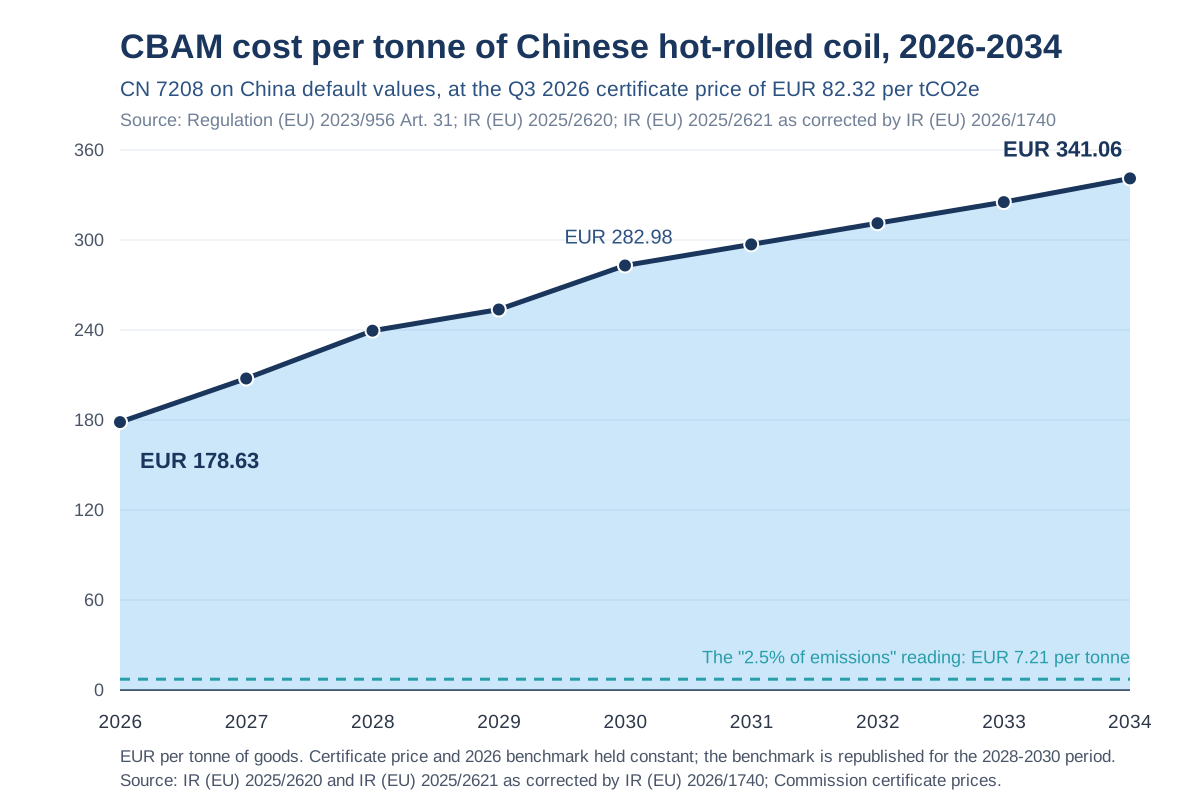
For a 100 tonne annual volume, the schedule looks like this:
| Year | Mark-up | CBAM factor | Cost per tonne | Total for 100 t |
|---|---|---|---|---|
| 2026 | 10% | 97.5% | €178.63 | €17,863 |
| 2027 | 20% | 95% | €207.69 | €20,769 |
| 2028 | 30% | 90% | €239.56 | €23,956 |
| 2029 | 30% | 77.5% | €253.66 | €25,366 |
| 2030 | 30% | 51.5% | €282.98 | €28,298 |
| 2031 | 30% | 39% | €297.08 | €29,708 |
| 2032 | 30% | 26.5% | €311.17 | €31,117 |
| 2033 | 30% | 14% | €325.27 | €32,527 |
| 2034 | 30% | 0% | €341.06 | €34,106 |
The 2028 date is the one to watch if you import finished metal goods rather than raw material. In December 2025 the Commission proposed extending CBAM to about 180 steel- and aluminium-intensive downstream products from 1 January 2028, averaging roughly 79% steel or aluminium content: machinery, industrial equipment, vehicle components, domestic appliances and metal construction goods. The Council adopted its position on 12 June 2026 with a revised list of about 200 items. The European Parliament adopted its negotiating mandate on 15 September 2026 by 464 votes to 50, backing a wider list of about 457 products, adding categories such as fasteners, wire, springs and household articles, and cutting the mass threshold for aluminium products from 50 tonnes to 5 tonnes.
Trilogue negotiations opened on 20 October 2026, with a second session provisionally scheduled for 30 November 2026 and a stated ambition to reach political agreement before the end of 2026. None of this is law yet, and the product list is the main sticking point. But the direction is settled, and the preparation is not complicated: make sure the CN codes on your Chinese purchase orders are precise enough to survive a scope extension, and start collecting installation-level emissions data for any product with high steel or aluminium content now, while your supplier still has time to produce it.
How to Choose a Freight Forwarder Who Can Handle CBAM Cargo from China
CBAM turns a freight booking into a data handover: the entry needs the declarant’s authorisation, the correct CN code, net mass, and either default values or verified installation data, and it needs all of it before the vessel arrives. Most service failures in 2026 are not rate failures; they are missing documents at the point of release. Four checks that actually matter on this lane:
- Does the forwarder ask for your CBAM status at quotation, not at arrival? If the first question about the declarant comes when the arrival notice lands, the goods are already at risk of sitting on the quay.
- Do they build the CN code and net mass into the commercial invoice and packing list template? Classification, quota category and certificate quantity all come from that line of data; a generic HS code copied from last year’s shipment propagates into a wrong declaration.
- Do they plan the steel quota quarter with you? With 50% out-of-quota duty and quarterly first-come quotas, the clear-on date is a commercial decision, not an operational detail.
- Is the carbon cost shown as its own line in the landed cost sheet? Duty, VAT, CBAM certificates and destination charges behave differently and are paid at different times; a single blended “all-in” number hides the one line that grows every year.
Dantful has handled China-origin steel, aluminium, cement and fertiliser cargo into European ports since 2008, as a Class-A licensed forwarder with NVOCC and FMC registration and Jctrans membership, booking directly with the carriers that serve Asia–Europe. Our operations team works the classification and document set before booking and tracks each shipment with daily updates and photographs through to release; with 50 operations staff and a 50-plus customer service team, there is someone on the file at every hour of the transit. For a lane where a missing document costs more than a rate difference, that is the part worth comparing. If you are shipping CBAM-scoped goods into Germany, the Netherlands, Italy, France, Spain or Belgium, the regional pages below are the place to start, or talk to our team directly through freight forwarder in shenzhen china.
FAQ: CBAM Costs for Importers Shipping from China
How much is CBAM per tonne of Chinese steel in 2026?
€178.63 per tonne for hot-rolled flat product under CN 7208, €177.48 for slab under CN 7207 12 10 and €212.86 for welded precision tubes under CN 7306 30 18, on default values at the Q3 2026 certificate price of €82.32. Those figures fall sharply if your supplier provides verified actual emissions: 2.0 tCO₂e per tonne works out at €54.68.
Do I pay CBAM if I import fewer than 50 tonnes a year?
No. Regulation (EU) 2025/2083 exempts an importer whose total CBAM goods imports stay at or below 50 tonnes of net mass in a calendar year, counted across all six sectors combined. Once you cross the threshold, obligations apply to the whole year’s imports, not just the excess, so cumulative tonnage needs tracking through the year. Hydrogen and electricity have no threshold.
When is the first CBAM declaration due, and when do I pay?
The first annual declaration, covering goods imported in 2026, is due by 30 September 2027, with certificate surrender on the same date. Certificate sales open on 1 February 2027. From 2027, the declarant’s account must hold certificates equal to at least 50% of cumulative embedded emissions at each quarter end.
Is CBAM included in a DDP price from China?
Not automatically. The CBAM obligation belongs to the authorised declarant, who must be established in the EU. A DDP quote from a Chinese seller only covers CBAM if that seller holds declarant status through an EU entity, or if the contract assigns the certificate cost explicitly. Check the clause before you compare landed prices.
Can I deduct the carbon price my Chinese supplier already paid?
Not as of 12 October 2026. Article 9 allows deduction of carbon prices effectively paid in the country of origin, and the Commission published a draft implementing regulation on 13 May 2026 covering recognition pathways, but no Chinese carbon price is currently deductible. China’s national ETS allowance was around RMB 97.56 per tonne in mid-October 2026, about €11.90, against an EU certificate price of €82.32.
What happens if the goods arrive without an authorised declarant?
CBAM goods above the threshold, and all hydrogen and electricity, may only be released for free circulation by an authorised declarant. Without that status the entry cannot be completed. Importing without authorisation carries a penalty of three to five times the standard rate, so €300 to €500 per tonne of CO₂e, and repeat breaches can lead to withdrawal of the authorisation.
Will furniture, machinery and appliances be covered by CBAM?
Probably from 1 January 2028, if the current extension is agreed. The Commission proposed about 180 steel- and aluminium-intensive downstream products, the Council proposed about 200, and the Parliament’s mandate of 15 September 2026 covers about 457, including fasteners, wire and springs. Trilogue negotiations were scheduled for 20 October and 30 November 2026; until a final text is adopted, the current Annex I list is what applies.
Does CBAM apply to aluminium profiles, sheets and foil?
Yes, where the CN code is in Annex I, which covers 7601 to 7616 including plates, sheet, strip, profiles, tubes and structures. Aluminium is priced on direct emissions plus PFCs, and the Chinese defaults run from 3.000 tCO₂e per tonne for unwrought metal to about 5.5 tCO₂e per tonne for foil and cast articles, so the exact subheading changes the bill by nearly a factor of two.
Which shipping documents does my forwarder need for CBAM goods?
The commercial invoice with exact CN codes and net mass, a packing list matching those lines, the bill of lading showing the declarant or indirect representative, the mill test certificate with melt-and-pour country for steel, the installation-level emissions file where actual values are used, and the declarant’s authorisation reference for the customs entry. Missing any one of them stalls release at the port.
Does CBAM apply to goods shipped through an EU port but cleared elsewhere?
CBAM applies at release for free circulation in the EU customs territory, so the obligation follows the entry, not the discharge port. A container discharged at Rotterdam and cleared in Germany is declared in Germany, with the German competent authority. Transit procedures that keep goods under customs control do not trigger CBAM until the goods are released, but the data still has to be ready when they are.
If you are moving steel, aluminium, cement or fertiliser cargo from China and want the carbon line built into the landed cost before you book, our team can price the certificate exposure alongside the freight. Start with Sea Freight from China to Europe: Best Routes, Costs, and How to Avoid Delays for the routing picture, then check the destination page for your market: Shipping From China To Germany, Shipping From China To Netherlands, Shipping From China To Italy, Sea Freight From China to Germany, Sea Freight From China to France, Sea Freight From China to Spain or How much is shipping from China to Belgium. For the contractual background on who carries duty and VAT, read DDP, and for the door-to-door version of the German lane see door to door shipping from China to Germany. If you are still comparing providers, how to choose the right freight forwarder sets out the questions that separate a forwarder who can carry CBAM data from one who cannot.

Young Chiu is a seasoned logistics expert with over 15 years of experience in international freight forwarding and supply chain management. As CEO of Dantful International Logistics, Young is dedicated to providing valuable insights and practical advice to businesses navigating the complexities of global shipping.