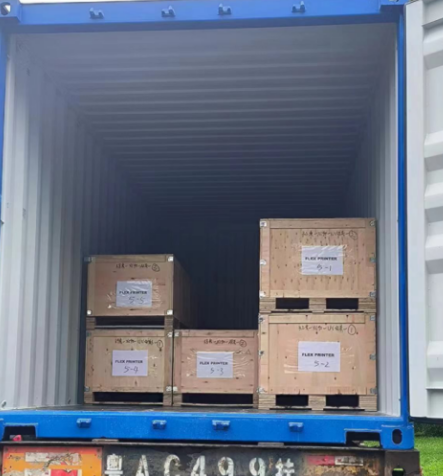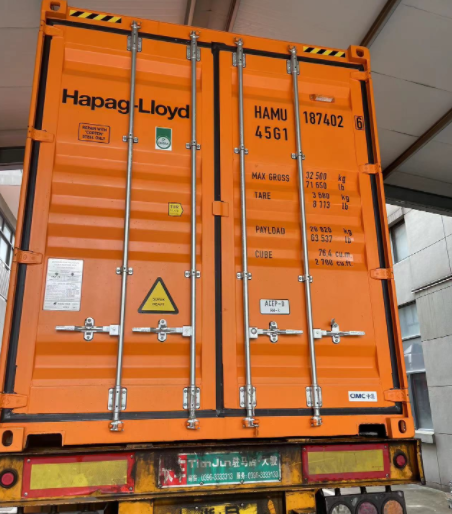
Sea freight from China to Mozambique costs roughly $2,000 to $3,200 for a 20GP and $3,400 to $5,600 for a 40GP or 40HQ port to port in November 2026, with LCL at $80 to $180 per cubic metre. Port-to-port transit runs 28 to 50 days depending on whether you discharge at Maputo, Beira or Nacala. The number that surprises most first-time importers is not the ocean rate — it is the Certificate of Conformity that has been mandatory since June 2025, and the fact that Beira and Nacala exist mainly to serve Zimbabwe, Zambia and Malawi rather than Mozambique itself.
We have booked Mozambique cargo out of Shenzhen, Ningbo and Nansha since 2008: quarry equipment and tiles into Beira, retail and electronics into Maputo, fertiliser and agri-inputs moving on to Malawi through Nacala. What follows is how we actually quote the lane — rates by port pair, the transit arithmetic behind them, the corridor choice that decides your inland bill, and the clearance documents that stop cargo at the gate.
Table of Contents
How Much Does Sea Freight from China to Mozambique Cost in November 2026?
Ocean rates into southern Africa have held firmer than the Asia–Europe lanes through the autumn. Drewry’s composite index sat at $4,389 per 40ft on 5 November 2026, still 124% above the same week last year, and while North Europe legs gave back 2% that week, Indian Ocean destinations priced off Singapore, Port Louis and Durban feeder capacity did not follow them down. Mozambique has no direct China string of any scale, so your price is built from a trunk leg plus a feeder, and both halves are being repriced monthly.
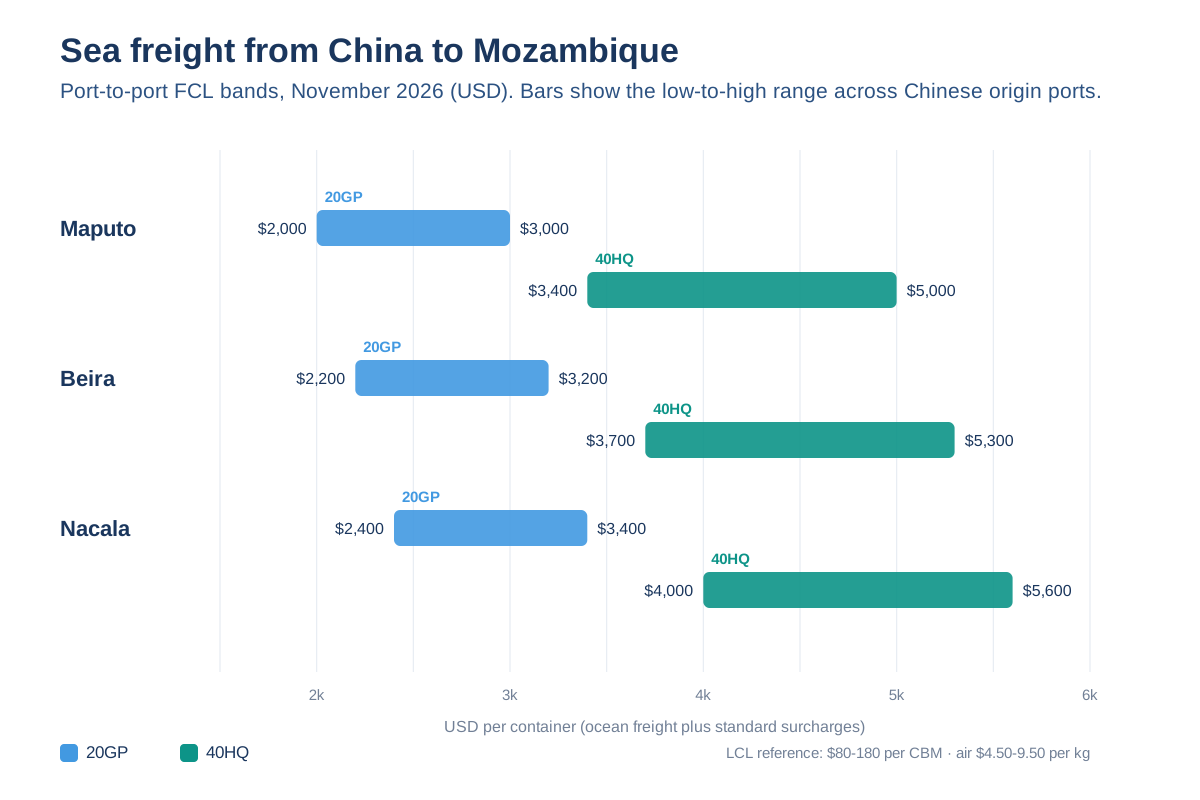
Working bands for November 2026, port to port — ocean freight plus the standard surcharges, excluding origin charges in China and destination charges in Mozambique:
| Service | November 2026 band | Port-to-port transit | Best suited cargo |
|---|---|---|---|
| 20GP | $2,000 – $3,200 | 28 – 50 days | Dense cargo: tiles, machinery, hardware, bagged goods |
| 40GP | $3,400 – $5,300 | 30 – 50 days | Palletised mixed freight, appliances, furniture |
| 40HQ | $3,500 – $5,600 | 30 – 50 days | Light bulky cargo: packaging, textiles, flat-pack |
| LCL | $80 – $180 per CBM | 35 – 55 days | 1 – 15 CBM part loads, multi-supplier consolidation |
| Air freight (reference) | $4.50 – $9.50 per kg | 5 – 12 days | Urgent spares, samples, high-value goods |
| Express courier (reference) | $8 – $18 per kg | 3 – 7 days | Documents and parcels under 30 kg |
Bands differ by destination port by $150 to $400 on a 20GP, which is why the port-pair matrix below matters more than any single headline number. They also differ by season: the same 40HQ that quotes at $4,100 in April can quote at $5,400 in the three weeks before Chinese New Year.
What Actually Moves the Number on This Lane
Four variables explain almost all of the spread between two quotes for the same box:
Transshipment, not distance. Nacala is further from Shanghai than Maputo in sailing days, but the gap between them in dollars is smaller than the gap created by which hub your box connects through. A booking that connects in Singapore with a four-day feeder window prices differently from one that waits nine days at Durban for space.
Container imbalance. Mozambique imports far more than it exports, and the southbound leg into Maputo is not an imbalance lane carriers are desperate to fill. Expect repositioning surcharges and empty-repositioning fees to appear on quotes in the first quarter, when northbound volumes are thin.
Weight and cargo type. Tiles, cement, steel and bagged fertiliser run into payload limits before they run out of cubic space, so a 20GP can be the cheaper box even when a 40HQ would hold more volume. Overweight 20GP bookings also attract terminal handling scrutiny at Beira, where the draft limit already forces lighter parcels.
Destination charges you did not quote. A $2,100 ocean rate plus $900 of Maputo terminal, broker and storage charges is a $3,000 container. We list the destination side separately in every quotation, and the section further down walks through what those charges are.
FCL and LCL Rates by Route: Five Chinese Ports to Maputo, Beira and Nacala
Mozambique is served by a limited number of strings, so origin port choice changes both price and schedule. South China ports get the shortest routing; North China ports add a coastal feed before the ocean leg.
FCL bands for November 2026, port to port, 20GP / 40HQ (USD):
| China origin | Maputo | Beira | Nacala |
|---|---|---|---|
| Shanghai | 2,000 – 2,800 / 3,400 – 4,800 | 2,200 – 3,200 / 3,700 – 5,300 | 2,400 – 3,400 / 4,000 – 5,600 |
| Ningbo | 2,100 – 2,900 / 3,500 – 4,900 | 2,300 – 3,200 / 3,800 – 5,300 | 2,400 – 3,400 / 4,000 – 5,600 |
| Shenzhen / Yantian | 2,000 – 2,900 / 3,400 – 4,900 | 2,200 – 3,100 / 3,700 – 5,200 | 2,300 – 3,300 / 3,900 – 5,500 |
| Guangzhou / Nansha | 2,100 – 3,000 / 3,500 – 5,000 | 2,300 – 3,200 / 3,800 – 5,300 | 2,400 – 3,400 / 4,000 – 5,600 |
| Qingdao | 2,200 – 3,200 / 3,700 – 5,300 | 2,400 – 3,400 / 4,000 – 5,600 | 2,500 – 3,500 / 4,200 – 5,800 |
Read the matrix as a decision tool rather than a price list. Maputo is consistently the cheapest gateway and Nacala the most expensive, by $300 to $500 on a 40HQ, because Nacala sits behind a thinner feeder network. If your consignee is in Matola or central Maputo, paying $400 more to reach Beira buys you nothing except a 1,200 km truck ride back south on the N1.
LCL Rates and the Real Break-Even Point
LCL into Mozambique consolidates at a Chinese CFS and de-consolidates at Maputo or Beira; Nacala LCL is thinner and often routes through Beira or Durban with an added feeder.
What LCL actually costs at different volumes, against a 20GP at the middle of the November band ($2,600):
| Cargo volume | LCL at $80/CBM | LCL at $130/CBM | LCL at $180/CBM | 20GP (33 CBM usable) |
|---|---|---|---|---|
| 10 CBM | $800 | $1,300 | $1,800 | $2,600 |
| 12 CBM | $960 | $1,560 | $2,160 | $2,600 |
| 15 CBM | $1,200 | $1,950 | $2,700 | $2,600 |
| 18 CBM | $1,440 | $2,340 | $3,240 | $2,600 |
| 20 CBM | $1,600 | $2,600 | $3,600 | $2,600 |
| 22 CBM | $1,760 | $2,860 | $3,960 | $2,600 |
On paper the crossover looks like 15 CBM at the top of the LCL range. In practice it lands nearer 18 to 20 CBM, because LCL carries its own cost stack: CFS handling in China, de-consolidation at destination, and a destination handling charge that is often higher per tonne than the FCL terminal fee. Below 12 CBM, LCL is clearly right. Between 12 and 18 CBM, it is a judgement call on how much you value not sharing a container — and on how much of your cargo is fragile. Above 20 CBM, book the 20GP even if it does not fill; you are buying schedule control and a sealed box. The mechanics of the two options are set out in our guide to what is LCL and FCL in shipping.
For consolidated loads from several suppliers, we run the goods through a Shenzhen or Ningbo warehouse first, check marks and packaging, then stuff one container — the process behind our consolidated freight shipping service. It is the single biggest cost lever available to an importer buying from five factories.
How Long Does Sea Freight from China to Mozambique Take?
Port-to-port sailing time from China to Mozambique runs 28 to 50 days. The spread is mostly about transshipment, not ship speed: no carrier runs a meaningful direct China–Mozambique string, so your container is almost always relayed through Singapore, Port Louis, Colombo or Durban.
Port-to-port transit, November 2026 (days):
| China origin | Maputo | Beira | Nacala |
|---|---|---|---|
| Shanghai | 35 – 45 | 38 – 48 | 40 – 50 |
| Ningbo | 35 – 45 | 38 – 48 | 40 – 50 |
| Shenzhen / Yantian | 30 – 42 | 35 – 45 | 38 – 50 |
| Guangzhou / Nansha | 30 – 42 | 35 – 45 | 38 – 50 |
| Qingdao | 35 – 50 | 38 – 50 | 42 – 55 |
Add 5 to 10 days for LCL, because consolidation at origin waits for the last co-loader’s cargo and de-consolidation at destination waits for the whole box to be stripped and cleared. Add 3 to 7 days for clearance in Maputo or Beira once the Certificate of Conformity question is resolved, and another 1 to 3 days for delivery inside Maputo or Matola.
Where the Days Actually Disappear
A 35-day booking is rarely 35 days of sailing. The realistic breakdown for a Shenzhen–Beira container is 3 to 5 days waiting for the weekly feeder window at the hub, 24 to 30 days on the water, 2 to 4 days of berth waiting at Beira (which works a tidal window), then clearance. In cyclone season, add a week without warning.
The three delay factors we plan around:
- Hub congestion. Durban feeder availability sets the schedule for Beira and Nacala more than Mozambique’s own port performance does. When Durban backs up, Mozambique schedules slip two to three weeks later.
- Beira’s draft constraint. Beira’s berths run 8 to 12 metres, but the authorised vessel draft is around 7 metres, so larger parcels are worked by feeders from a hub. That is a capacity limit, not a service failure, and it is why Beira quotes are the least stable of the three ports.
- Weather on the Beira approach. The Pungue river approach silts and the port works a tidal window; in the November–April cyclone season, berth windows close.
When Is the Cheapest Time of Year to Ship by Sea from China to Mozambique?
| Period | Rate pressure | Transit pressure | What to do |
|---|---|---|---|
| Late January – early February | High: pre-CNY rush | High: rolled bookings | Book 4 weeks ahead; CNY falls 6 Feb 2027 |
| February – March | Falls after the holiday | Factories restart slowly | Best window for rates, worst for production |
| March – May | Stable | Cyclone risk tail | Good value; keep buffer on Beira cargo |
| June – August | Firm, mild peak | Steady | Plan Q4 stock now |
| September – October | Rising | Rising | Lock rates early for Q4 |
| November – December | High: Q4 retail peak | Congested hubs | Book 3 weeks ahead, accept roll risk |
Two calendar facts matter more than the rest this year. Chinese New Year falls on 6 February 2027, eleven days earlier than 2026, which compresses the pre-holiday booking window into January. Ramadan 2027 begins around 8 February, which affects transshipment staffing at Gulf and East African hubs rather than Chinese production. And Mozambique’s cyclone season runs November to April, which is exactly when Beira berth windows are least predictable.
Maputo, Beira or Nacala: Which Port Should You Book?
Mozambique’s three container gateways serve three different hinterlands. Choosing on ocean rate alone is how importers end up trucking cargo 1,200 km in the wrong direction.
| Maputo | Beira | Nacala | |
|---|---|---|---|
| Berths / draft | 25 berths; channel dredged from 11 m toward 14.2 m | 10 berths, 8 – 12 m; vessel draft around 7 m | 6 berths; deepest natural harbour on the East African coast, about 14 m |
| Serves | Southern Mozambique, Matola, South Africa’s Gauteng via Ressano Garcia, Eswatini | Central Mozambique, Zimbabwe via Machipanda, Zambia via Tete | Northern Mozambique, Malawi, and onward to Zambia |
| 20GP band (Nov 2026) | $2,000 – 3,200 | $2,200 – 3,400 | $2,300 – 3,500 |
| Typical transit | 30 – 45 days | 35 – 48 days | 38 – 50 days |
| Main weakness | Road congestion around Matola; rail links underused | Draft limit, tidal window, feeder dependency | Thinnest carrier choice, highest ocean rate |
| Best for | Consumer goods, retail, project cargo for the south | Zimbabwe and Zambia transit cargo, mining and agri inputs | Malawi-bound cargo and northern Mozambique |
Pick Maputo when the consignee is in Maputo, Matola, Beira-south or South Africa. Maputo is a genuine regional gateway: the N4 highway reaches the Ressano Garcia border in about 100 km, and rail lines run to South Africa, Zimbabwe and Eswatini. If your buyer is in Johannesburg, Maputo plus a 550 km truck is often cheaper than Durban, and materially cheaper than Beira.
Pick Beira when the cargo is going to Zimbabwe or central Mozambique. The port sits at the end of the Beira corridor, with the Machipanda border roughly 300 km inland and Harare around 600 km by road. Beira is also the traditional entry for Zambian copperbelt inputs via Tete, although that routing competes directly with Dar es Salaam and Walvis Bay.
Pick Nacala when the destination is Malawi or Nampula province. Nacala is the deepest of the three — its approach needs no dredging — and the corridor rail line runs roughly 900 km inland through Malawi to Moatize. What you pay for is carrier choice: fewer strings, longer waits, higher rates.
One structural point that competitors rarely state: Mozambique’s domestic market is small relative to its ports. The country handles a volume of transit cargo for its landlocked neighbours that is out of all proportion to its own imports, which is why corridor questions dominate every serious quote on this lane and why the next section matters more than the port comparison itself.
The Beira and Nacala Corridors: Reaching Zimbabwe, Zambia and Malawi Through Mozambique
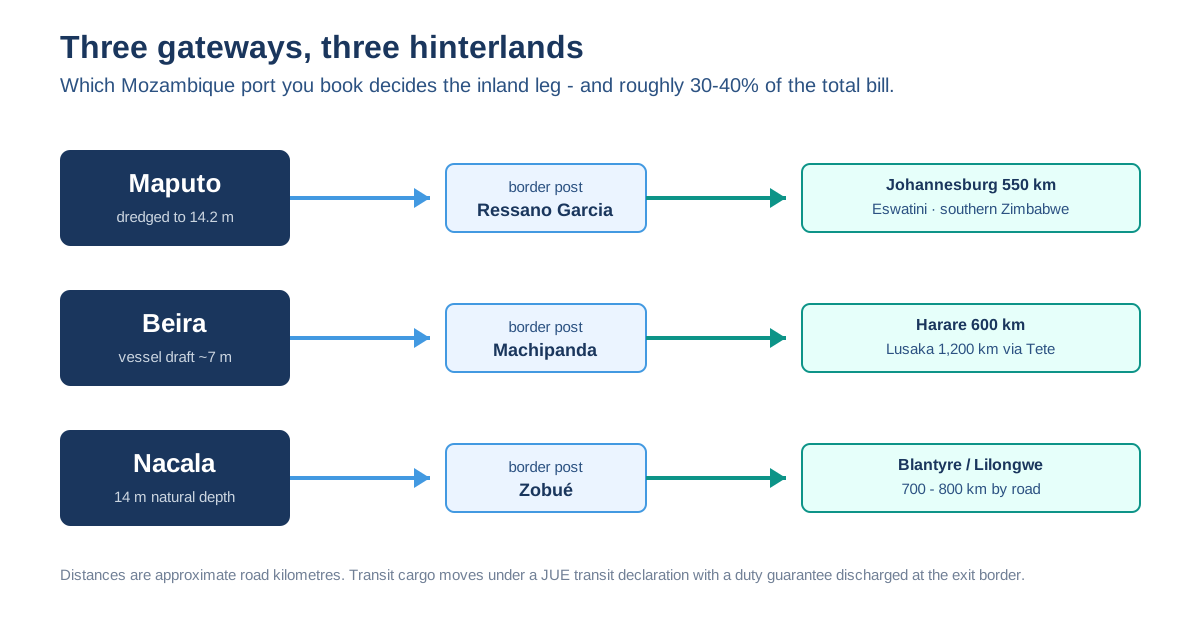
If your cargo is not staying in Mozambique, the ocean rate is the smaller half of the cost. The corridor decision — which port, which border, which guarantee — sets the inland leg and the transit risk.
| Corridor | Port | Main destinations | Approximate inland road distance | Border post | Rail option |
|---|---|---|---|---|---|
| Maputo corridor | Maputo | Johannesburg, Pretoria, Eswatini, southern Zimbabwe | 550 km to Johannesburg | Ressano Garcia | Yes: to South Africa, Zimbabwe, Eswatini |
| Beira corridor | Beira | Harare, Bulawayo, Lusaka via Tete | 600 km to Harare; 1,200 km to Lusaka | Machipanda (Zimbabwe); Cassacatiza (Zambia) | Yes: Sena line to Zimbabwe |
| Nacala corridor | Nacala | Blantyre, Lilongwe, northern Mozambique, eastern Zambia | 700 – 800 km to Blantyre and Lilongwe | Zóbuè (Malawi) | Yes: roughly 900 km line through Malawi |
How Transit Cargo Is Documented
Transit cargo is not cleared for consumption in Mozambique. It moves under a transit declaration in the JUE single window with a guarantee covering the duties that would be payable if the goods were sold locally — lodged by your Mozambican broker, usually against a bank guarantee or a cash deposit. The container is sealed at the port and stays under bond until it crosses the exit border, where the guarantee is discharged.
Three practical consequences:
- The guarantee is a real cost of capital. A transit container of consumer goods can tie up 100% of assessed duty as security for three to six weeks. On high-duty cargo, the guarantee can cost more than the ocean freight saving that made Beira attractive in the first place.
- Transit time is measured at the border, not the port. A Beira–Harare container that clears in two days at Machipanda and then sits at Beitbridge is a failed booking. Ask your forwarder for the border average, not the port average.
- Wrong-corridor cargo is expensive to fix. Once a container is discharged at Beira and bonded for Malawi, the paperwork cannot simply be rewritten for Zimbabwe.
We route this traffic with named partners at the destination end rather than a generic “Africa network”. The adjacent lanes are documented in our guides to Shipping From China To Zimbabwe, Shipping From China To Zambia and Shipping From China To Malawi, and the wider regional picture sits under Shipping from China to Africa.
Mozambique Customs Clearance: The CoC Certificate and the 16% VAT
Two clearance facts separate Mozambique from its neighbours, and one of them stops cargo before it ever leaves China.
The Certificate of Conformity Is Mandatory Before Shipment
Mozambique’s Conformity Assessment Programme (CAP) under Decree 8/2022 and Diploma 29/2024 has been enforced since 27 June 2025. Regulated products on the Mandatory Control List need a Certificate of Conformity (CoC) issued in the country of export, before shipment, and Intertek is the sole body appointed by INNOQ to issue it. Cargo without a CoC is refused customs clearance and can be re-exported or destroyed at the importer’s cost, with fines from INAE on top.
Fees scale with the certification route you qualify for, based on shipment frequency and whether the exporter is registered or licensed with Intertek:
| Route | Who qualifies | Fee basis | Physical inspection |
|---|---|---|---|
| Route A | Occasional exporters, or unregistered products | Per consignment, quoted by Intertek | Every shipment |
| Route B | Frequent exporters with registered products | 0.45% of FOB, min $250, max $2,750 | At least one shipment every 3 months |
| Route C | High-volume manufacturers with licensed products | 0.25% of FOB, min $250, max $2,750 | At least one shipment every 6 months |
| Route D | Destination verification | 0.80% of FOB, min $500, max $5,000 | Every shipment, at destination |
Consignments with an FOB value of $2,000 or less are outside the requirement, as are personal gifts — which is why sample shipments clear easily and a first commercial order does not. The CoC covers one consignment, is transmitted to the Revenue Authority and uploaded to JUE, and cannot be issued retroactively. If a supplier has never exported to Mozambique, ask for the certification route in writing before you pay a deposit.
Duties, the 1% Fee and the 16% VAT
| Charge | Rate | Basis |
|---|---|---|
| Import duty | 0% – 25% by HS code; vehicles up to 35% plus ICE | CIF value |
| Customs service fee | 1% | CIF value, charged even on zero-rated goods |
| VAT (IVA) | 16% | CIF + duty + service fee |
| SADC preference | Up to 100% duty reduction | Only for SADC-origin goods with a certificate of origin — not Chinese-origin cargo |
The VAT rate is 16%, reduced from 17% on 1 January 2023 and unchanged since. Several forwarder pages still publish 17%; that figure is stale and it inflates every landed-cost estimate built on it. There is no China–Mozambique free trade agreement, so Chinese goods pay MFN duty and the SADC preference line does not apply.
What a Real Mozambique Landed Cost Looks Like
A 20GP of general consumer goods from Shenzhen, CIF Maputo $12,000, duty band 20%:
| Cost element | Amount (USD) | How it is calculated |
|---|---|---|
| CIF value | 12,000 | Goods + freight + insurance |
| Import duty | 2,400 | 20% of CIF |
| Customs service fee | 120 | 1% of CIF |
| VAT base | 14,520 | CIF + duty + service fee |
| VAT at 16% | 2,323 | 16% of the VAT base |
| Total taxes and fees | 4,843 | Duty + service fee + VAT |
| CoC (Route B, minimum applies) | 250 | 0.45% of FOB, floor of $250 |
| Landed cost before destination handling | 17,093 | CIF + taxes + CoC |
That is 42% on top of the CIF value before a single terminal charge. It is why we quote landed cost rather than ocean freight once duty bands reach 20%.
The Paperwork the Broker Will Ask For
Commercial invoice, packing list, bill of lading, certificate of origin, the CoC for regulated products, and the importer’s registration with the Autoridade Tributária including the NUPC taxpayer number. Import and export activity requires a licence from the Ministry of Industry and Commerce, held by the Mozambican importer rather than the Chinese shipper. Invoices and labels should be in Portuguese; a Portuguese-language invoice is not a formality in Maputo, and a missing one produces a 3 to 5 day correction. Our Customs Clearance team coordinates the CoC and the destination broker as one file.
What the Destination Will Bill You After the Vessel Arrives
None of the charges below are hidden — they are the standard second half of the cost chain on any Mozambique booking, and a professional forwarder lists them in the quotation rather than revealing them at arrival. They are also where two quotes that looked $200 apart turn out to be $900 apart.
| Charge | Typical range | What it is and how to plan for it |
|---|---|---|
| Terminal handling (THC) | $300 – $500 per container | Charged by the Maputo or Beira terminal for discharging and moving the box. Fixed and unavoidable; ask for it as a number, not a note. |
| Documentation / import file | $50 – $120 | Broker’s file opening and manifest processing. Confirm whether it is per shipment or per container. |
| Broker fee | $150 – $400 per entry | Covers the declaration, HS classification and JUE filing. Worth paying more for a broker who has handled your product before. |
| Port storage | Starts after free time, terminal-specific | Free time is commonly 3 to 7 days and is confirmed in writing at booking. Plan the customs file to start before arrival, not after. |
| Demurrage and detention | Escalating daily scale | Applies once storage or free time expires, and rises with each day. The main reason a CoC problem becomes expensive. |
| Inland haulage | Quoted per lane | Maputo to Matola is short and cheap; Maputo to Beira on the N1 is 1,200 km and priced like a domestic long-haul. |
| Duty and VAT | Per the landed-cost table above | Paid by the importer of record through the broker. For DDP cargo the forwarder handles it, as described in our DDP Shipping Services and in what DDP means. |
Two planning habits cut this bill more than any negotiation. First, book with the free-time figure in the quotation so you can see whether you are buying 3 days or 14. Second, start the CoC and the customs file while the vessel is still at sea; on this lane, almost every demurrage invoice traces back to a document that was requested after arrival instead of before.
How to Choose a Freight Forwarder for Sea Freight from China to Mozambique?
This lane has three jobs in one quotation — an Indian Ocean ocean leg with a feeder on the end, a clearance file with a pre-shipment certificate that cannot be fixed later, and for transit cargo a bonded inland leg — and most forwarders are only genuinely good at one of them. Four checks tell you which kind you are talking to:
- Ask which hub your container will relay through, and on what day. A forwarder who names the hub, the feeder and the cut-off is booking the lane. One who says “via transshipment” is passing your booking to a consolidator.
- Ask who issues the CoC and when. The only correct answers are Intertek, in China, before shipment. Anyone who suggests the importer can sort it out on arrival has not shipped to Mozambique since June 2025.
- For transit cargo, ask for the border average, not the port average. A quoted 40-day Beira–Harare transit means nothing without the Machipanda clearance time behind it.
- Ask for the destination charges as numbers. THC, documentation, broker fee and free days, itemised. If they arrive as “local charges apply”, the quote is not finished.
Dantful has handled China-origin cargo since 2008 from Shenzhen, with Class-A freight forwarding, NVOCC, FMC and Jctrans certification, direct carrier contracts on the Indian Ocean strings, and 24/7 tracking that sends daily milestone updates and loading photos while your container is still in China. Our Mozambique team works in English and Portuguese at destination, and handles the CoC, the JUE filing and the corridor bond as one file. Fifty operations staff and more than fifty customer service staff cover the lane around the clock — details on our freight forwarder in Shenzhen page, and the service overview on ocean freight.
If you are still sizing the shipment, the container shipping costs from China to Mozambique breakdown covers per-container economics in more depth, and how much is shipping from China to Mozambique walks through the smaller-shipment cases. The corridor and clearances are also covered end to end in our freight forwarder guide from China to Mozambique, and the country landing page for Mozambique sits at Shipping From China To Mozambique.
FAQ: Sea Freight from China to Mozambique
How much does a 20ft container from China to Mozambique cost?
$2,000 to $3,200 port to port in November 2026, with Maputo at the low end and Nacala at the high end. Add origin charges in China ($250–$500), destination terminal and broker fees ($500–$1,000), and duty plus 16% VAT on the CIF value.
How long does sea freight from China to Mozambique take?
28 to 50 days port to port. Shenzhen to Maputo is typically 30 to 42 days; Beira 35 to 45; Nacala 38 to 50. LCL adds 5 to 10 days, and clearance adds 3 to 7.
Is there a direct service from China to Maputo?
There is no meaningful direct string. Almost all cargo relays through Singapore, Port Louis, Colombo or Durban, and the feeder window is the part of the schedule most likely to move.
What is the Certificate of Conformity and do I need one?
Yes, if your product is on Mozambique’s Mandatory Control List. A CoC issued by Intertek in China before shipment has been required since 27 June 2025. Consignments with FOB of $2,000 or less are exempt, and goods without a CoC are refused clearance.
Which port is best for Zimbabwe or Zambia?
Beira for Zimbabwe and central Mozambique, with Harare about 600 km inland via Machipanda. For Zambia, Beira via Tete competes with Dar es Salaam and Walvis Bay on total cost, and the bonded transit leg decides the winner rather than the ocean rate.
Can I ship LCL to Mozambique?
Yes, into Maputo and Beira, with Nacala LCL thin enough that we often consolidate through Beira instead. LCL runs 35 to 55 days and is cost-effective below roughly 15 to 18 CBM.
What documents are needed for clearance in Mozambique?
Commercial invoice, packing list, bill of lading, certificate of origin, CoC for regulated products, and the importer’s NUPC registration. Invoices should be in Portuguese, and transit cargo needs a bonded transit declaration in JUE.
Can you handle door-to-door delivery and duties?
Yes. We clear in Maputo, Beira or Nacala and deliver inland, including bonded transit to Zimbabwe, Zambia and Malawi. On DDP terms the quoted price includes duty and VAT, which means the 16% VAT and the 20%-band duty are already costed into the number you are comparing.
How much does it cost to ship 10 CBM from China to Mozambique?
$800 to $1,800 for the ocean leg at $80 to $180 per CBM, plus CFS handling in China and de-consolidation at destination. At 18 CBM and above, a 20GP is usually the cheaper and safer choice.

Young Chiu is a seasoned logistics expert with over 15 years of experience in international freight forwarding and supply chain management. As CEO of Dantful International Logistics, Young is dedicated to providing valuable insights and practical advice to businesses navigating the complexities of global shipping.