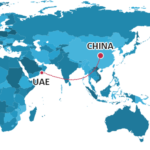
If you have been researching how to import cars from China to the UAE, you have probably noticed the same thing we have in our daily freight work: the Chinese auto industry has completely changed what is possible for Dubai, Abu Dhabi, and Sharjah buyers. A decade ago, importing a car from China to the UAE meant hunting for obscure brands with patchy support. Today, BYD, ZEEKR, Geely, Changan, and a dozen other manufacturers sell through official UAE dealerships, and the country’s 5% import duty remains one of the lowest in the world. The economics of buying direct from China — whether you are an individual importing one EV or a dealer filling a 40ft container — now genuinely compete with what you would pay locally.
What still stops most people is not the car itself but the logistics: Which shipping method fits your budget? Is the 5% duty charged on the invoice price or the landed price? Do Chinese EVs work with UAE charging networks? In this complete 2026 guide, we answer those questions with real cost breakdowns, current transit times, and the compliance steps that decide whether your car clears customs in days or gets stuck for weeks.
Why Import Cars from China to the UAE?
UAE buyers import from China for three practical reasons that keep compounding every year:
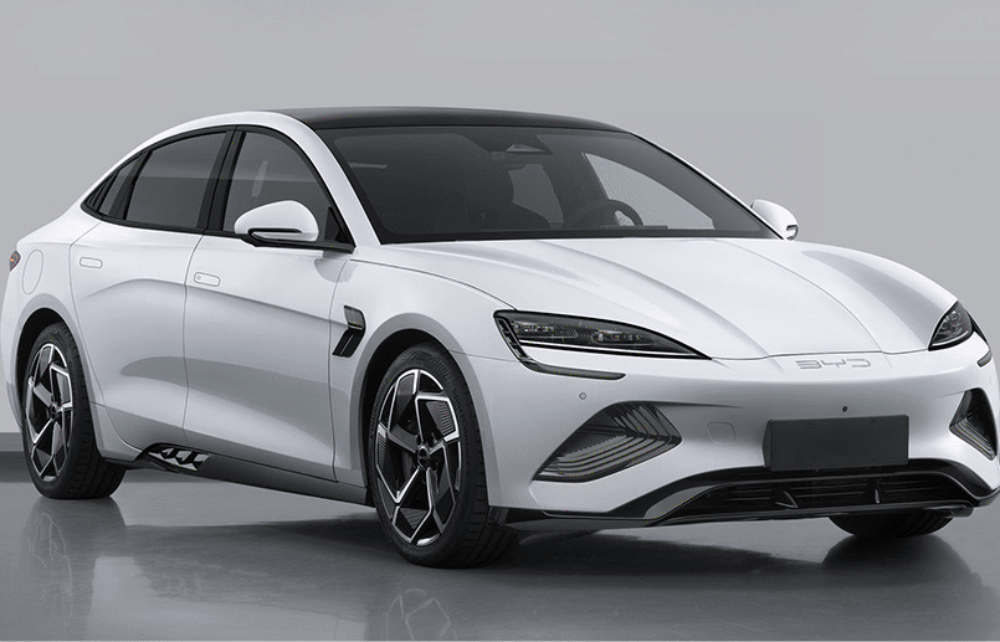
- Price advantage. Chinese manufacturers deliver comparable specification — and often more standard equipment — at a meaningful discount to Japanese, Korean, and European rivals of the same segment.
- Model variety. The range runs from compact city EVs like the BYD Atto 3 and Dolphin to premium SUVs and executive sedans, including luxury EVs such as the ZEEKR 001 and XPeng models that often carry long waiting lists in Europe.
- Technology leadership. Chinese EVs lead on battery range, charging speed, and smart-cockpit features — exactly what UAE buyers, who are among the world’s fastest EV adopters, now expect.
The market backdrop supports the trend. BYD opened official dealer operations in the UAE in 2022 and has grown rapidly since; ZEEKR, Geely, Changan, and Jetour have all followed with local networks. That brand recognition makes independent imports easier to resell later — an important point if you are buying for a dealership rather than personal use. The UAE also functions as a re-export hub: vehicles cleared into Jebel Ali Free Zone (JAFZA) can be sold onward to Saudi Arabia, Kuwait, or Oman without paying UAE duty twice. For a broader look at the corridor — including air freight and door-to-door options beyond vehicle transport — start with our Shipping from China to UAE overview.
UAE Import Rules You Must Check Before Buying
Before you spend a dollar on the car itself, verify that the vehicle can legally enter and be registered. This is where most first-time importers get caught out, because clearing customs is not the same as being allowed on the road.
| Requirement | What it means in practice | Why it matters |
|---|---|---|
| Left-hand drive (LHD) | All road-legal vehicles in the UAE must be LHD | China builds LHD for its home market, so export units comply automatically — RHD cars cannot be registered |
| GCC specification | Vehicle must meet Gulf-standard headlight beam, rear fog lamp, and cooling-system requirements | Chinese domestic-spec cars often need small pre-export adjustments (see below) |
| Emission standard | Minimum Euro 4 compliance | Most Chinese vehicles built since 2018 exceed this |
| Importer identity | Personal importers need a passport and UAE visa/residency; businesses need a trade licence | Determines which documents Dubai Customs requests |
| Registration inspection | After customs release, the car must pass an RTA-authorised vehicle test in the emirate of registration | A car can clear customs and still fail road registration |
Who needs a GCC Certificate of Conformity (GCC CoC)? For Dubai domestic registration, the RTA requires proof that the vehicle meets Gulf-region technical specifications. This is where many China-spec used cars trip up: in our experience, roughly 60% of Chinese used cars need minor pre-export modifications to pass — typically a headlight beam-pattern swap, activation of the rear fog lamp, and a coolant flush to a high-temperature grade. Authorised certification bodies such as Bureau Veritas and Intertek issue the GCC CoC in about 5–10 working days, and the retrofit work typically costs between $280 and $520 per car. Skip it and you will discover the problem at the RTA inspection stage, weeks after the vessel has sailed.
Real-life scenario — clearance is not registration. We once handled a shipment where a client’s premium SUV passed Dubai Customs in three days but failed RTA inspection on headlight alignment and an undeclared aftermarket radio that interfered with the vehicle’s safety systems. The fix took another ten days and extra transport between inspection centres. The lesson we now build into every quote: verify GCC compliance before the car is loaded in China, not after it lands in Jebel Ali.
Shipping Methods: RoRo vs. Container Shipping from China to UAE
Two mainstream ocean methods move vehicles from China to the UAE, and choosing correctly can save you hundreds of dollars per car.
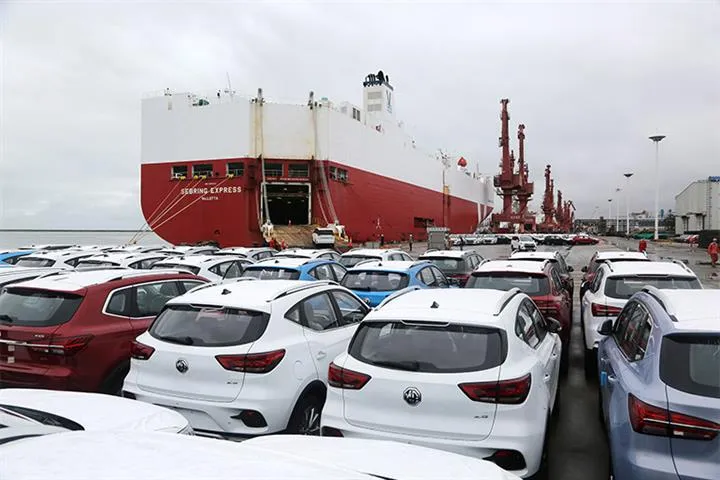
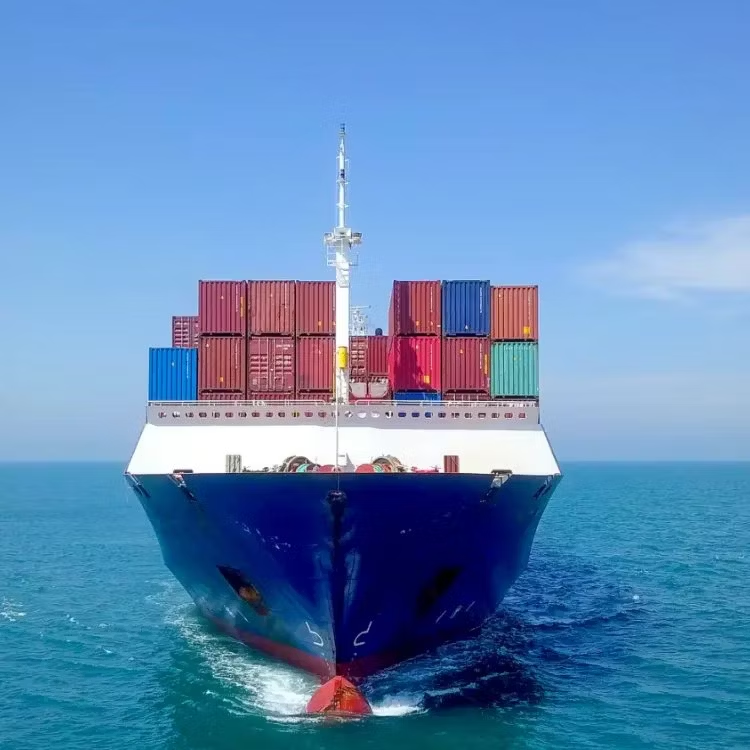
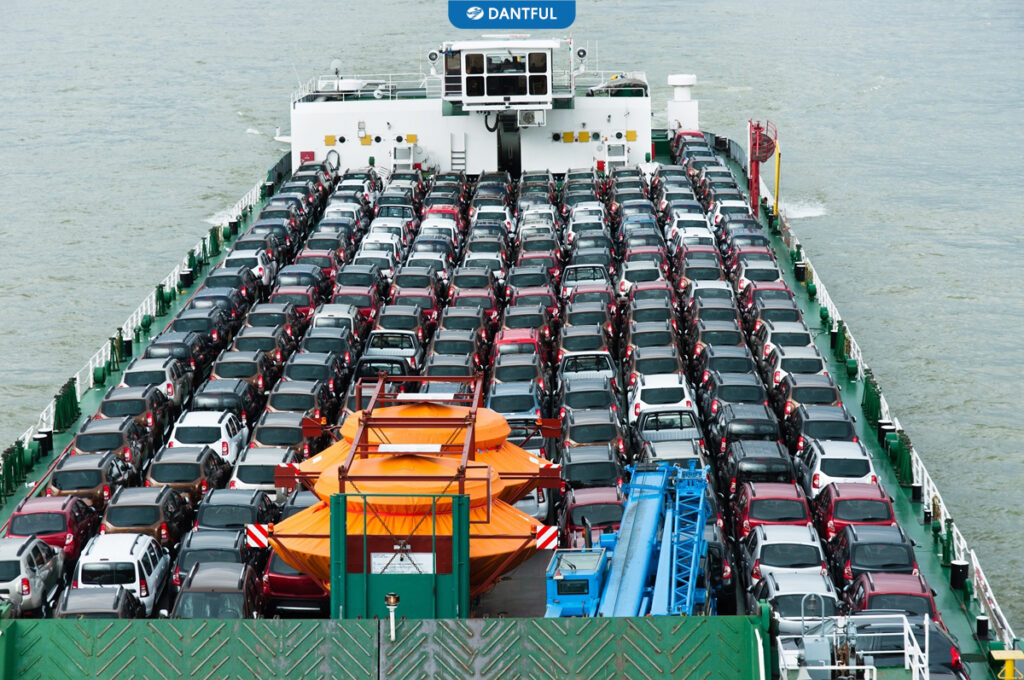
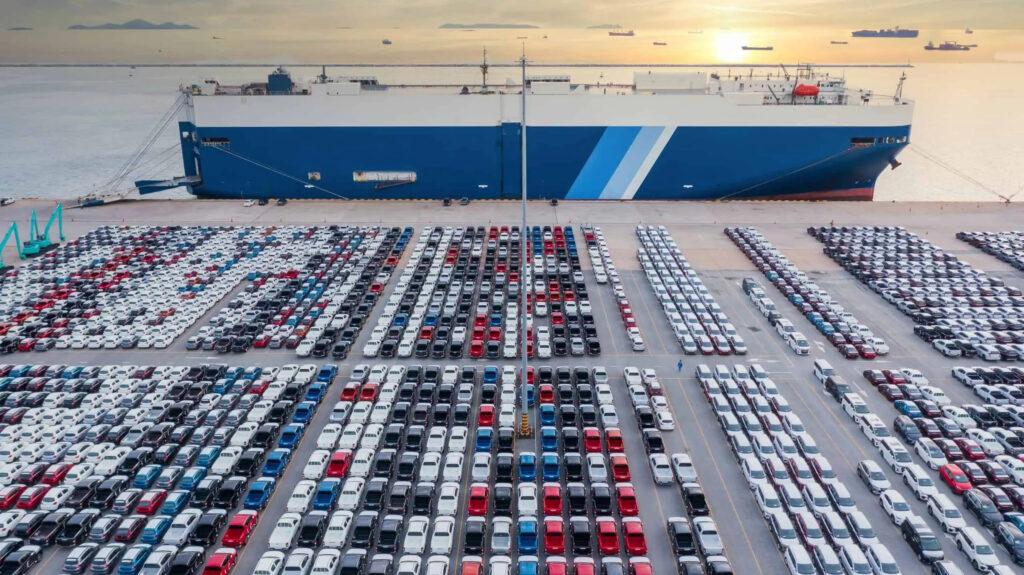
Roll-on/Roll-off (RoRo) shipping is the workhorse of the vehicle trade. Your car is driven onto a purpose-built vessel at the origin port and driven off at Jebel Ali. It is the most cost-effective option for running vehicles — especially when you ship several units at once — and loading/unloading is fast because no container handling is involved. The trade-offs: cars travel on open or semi-open decks exposed to weather and sea air, the vehicle must be in running condition, and carriers strictly prohibit personal belongings inside the cabin.
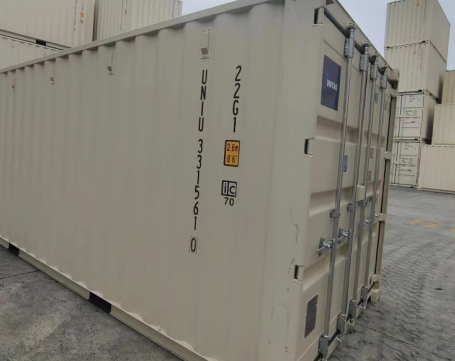
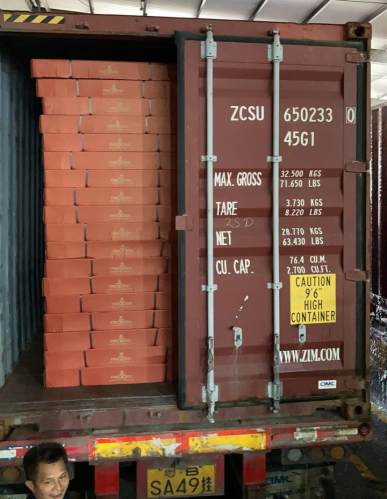
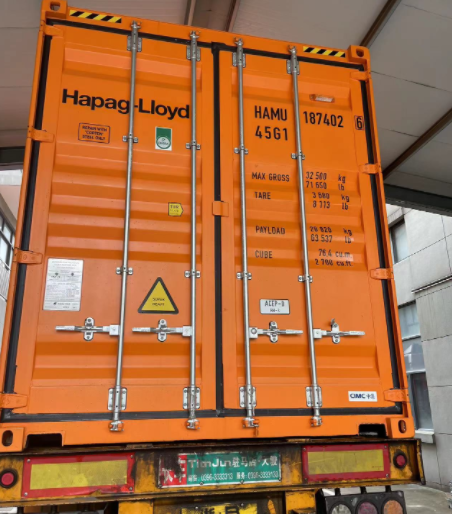
Container shipping places your car inside a 20ft or 40ft high-cube container. It costs more per car, but it is the right call for luxury or classic vehicles, non-running cars, and multi-car loads where you want maximum protection. A 40ft HC container typically holds two to three cars depending on size, which brings the per-car cost down. Containers also allow properly declared spare parts to travel with the vehicle — something RoRo never permits.
| Comparison | RoRo Shipping | Container Shipping (20ft / 40ft HC) |
|---|---|---|
| Best for | Standard sedans & SUVs, dealer bulk shipments, fleets | Luxury, classic, non-running, or high-value cars; EVs with battery restrictions |
| Typical cost per car (China–UAE) | $650 – $1,500 | $1,200 – $2,000 (20ft); $800 – $1,600 shared in 40ft |
| Protection level | Open to weather and handling | Fully enclosed, highest protection |
| Personal items / spare parts in car | Not allowed | Allowed if properly declared |
| Loading/unloading speed | Fastest (driven on/off) | Slower (crane + lashing) |
| EV (used) acceptance | Some carriers restrict used EVs | Generally accepted with battery declaration |
Which one should you choose? Our rule of thumb for individual buyers: if the car is worth under roughly $35,000 and runs perfectly, RoRo is usually the smart budget choice; above that threshold, or for any vehicle with a battery, the extra protection and easier insurance handling of a container justify the premium.
From our files — 50 SUVs in 18 days. When a regional dealership needed a fleet of 50 gasoline-powered SUVs in time for a major sales event, RoRo was the only option that worked — containerising 50 units would have taken weeks and multiplied the cost. We booked dedicated RoRo space from Shanghai to Jebel Ali, and the vessel delivered in 18 days with all units driven off and handed over on schedule. That is the volume scenario where RoRo’s economics are unbeatable.
How Long Does Car Shipping from China to UAE Take?
Transit times vary by origin port, shipping method, and the week you book. As a 2026 benchmark, expect the following for the main routes into Jebel Ali:
| Origin region (China) | Typical export port | Method | Transit time |
|---|---|---|---|
| East China | Shanghai / Ningbo | RoRo | 18 – 22 days |
| East China | Shanghai / Ningbo | Container | 22 – 25 days |
| South China | Nansha (Guangzhou) / Shekou | Container | 14 – 20 days |
| North China | Tianjin Xingang | RoRo & Container | 22 – 28 days |
Add time for the steps around the voyage itself. Pre-shipment inspection, export customs, and port handling typically take 3–7 days before sailing; after the vessel arrives, compliant shipments usually clear Jebel Ali customs in 2–5 working days, followed by 2–3 days for RTA inspection and registration. The realistic door-to-door timeline — from placing your order to driving the car in Dubai — is five to nine weeks, depending on schedule alignment and whether the vessel is direct.
One factor importers routinely underestimate is booking lead time. RoRo and container space on the China–Middle East lane tightens sharply during peak seasons and around Chinese New Year, so lock in space three to four weeks ahead if your delivery date is critical. If you are comparing methods on other lanes, our guide to how long does roro shipping take explains how vessel schedules and port rotations shape real transit times.
Import Duties, Taxes, and Other UAE Charges
The UAE applies the GCC Common External Tariff of 5% on passenger vehicles, one of the lowest import duty rates anywhere. The catch that surprises most people: duty is calculated on the CIF value — Cost, Insurance, and Freight — not on the invoice (FOB) price of the car. On top of that, 5% VAT is charged on the CIF value plus duty.
| Charge | Rate / basis | Example on a $23,000 CIF vehicle |
|---|---|---|
| Customs duty | 5% × CIF value | $1,150 |
| VAT | 5% × (CIF + duty) | $1,208 |
| Port handling & THC at Jebel Ali | Fixed per shipment | ~$150 – $220 |
| Customs clearance (broker) | Service fee | ~$200 – $300 |
| RTA registration, plates & inspection | Per vehicle | ~$300 – $400 (Dubai) |
| Vehicle insurance | Market rate | Varies by model & value |
Two structural points worth knowing:
- Free-zone deferral. Cars moved into JAFZA (or Khalifa/KIZAD) can be stored and traded without paying duty until they enter the UAE mainland. Dealers who hold stock or plan to re-export across the GCC use this to manage cash flow and avoid double taxation.
- No double duty on GCC re-export. If a vehicle transits the UAE to Saudi Arabia or another GCC state, duty is paid once at final destination under the GCC customs union — provided the vehicle never enters the UAE domestic market.
How Much Does It Cost to Ship a Car from China to the UAE?
Beyond the vehicle purchase price, budget for ocean freight, insurance, China-side local charges, UAE import duty and VAT, and registration. Freight rates on this lane are volatile and typically hold for only two to three weeks, so treat the figures below as a 2026 budgeting baseline, then confirm a live itemised quote before booking. For a dedicated benchmark of 20ft and 40ft FCL rates on the same corridor, see container shipping costs from China to UAE.
Worked example 1 — single used EV by container (individual importer). A 2024 BYD Atto 3 with a FOB price around $22,000, shipped in a shared 40ft HC container from Shanghai:
| Cost component | Amount (approx.) |
|---|---|
| FOB vehicle price | $22,000 |
| Ocean freight (container share) + loading/lashing | $1,160 |
| Marine insurance (~0.55% of CIF) | $127 |
| Export docs & lithium battery declaration | $95 |
| Subtotal — CIF Jebel Ali | ~$23,380 |
| UAE customs duty (5% of CIF) | $1,169 |
| UAE VAT (5% of CIF + duty) | $1,227 |
| GCC CoC / port handling / clearance | ~$460 |
| Total landed cost (before RTA registration) | ~$26,240 |
Worked example 2 — dealer bulk order by RoRo. Shipping 10 identical SUVs on one RoRo vessel from Shanghai to Jebel Ali, ocean freight typically runs $700 – $1,100 per car (versus $1,500+ per car for solo container shipment), and per-unit document and handling costs shrink with volume. Multiply a 5% duty rate on moderate CIF values, and the landed-cost advantage over buying through a local dealer often reaches $5,000 – $14,000 per vehicle in the premium-EV segment — which is why so many UAE dealerships now run their own China import programmes.
Our industry insight — the lowest freight quote rarely wins. We have seen importers choose a $200-cheaper RoRo quote and then pay triple that in demurrage because the booking had no guaranteed discharge window, or discover after arrival that the quote excluded the destination THC and customs brokerage. Ask for a line-item breakdown: ocean freight, origin charges, insurance, destination port fees, customs clearance, and any battery/GCC compliance surcharges. A transparent quote is worth more than a cheap one.
Is door-to-door (DDP-style) worth it? For first-time importers, yes. A true door-to-door service — pickup in China, export customs, ocean freight, UAE import clearance, duty and VAT payment, and delivery to your door or to the RTA inspection centre — removes the riskiest part of the process. You pay a service margin, but you trade it for certainty. If you already have a customs broker in the UAE and clear multiple cars per month, managing the destination side yourself can cut costs.
Importing Used Cars from China to the UAE
Used-car imports are a growing slice of this lane, driven by two very different buyer groups: UAE buyers chasing lightly-used German and Japanese luxury models, and dealers importing recent Chinese EVs and SUVs at strong margins.
For used cars, add these checks to your process:
- Independent inspection. Order a 150-point report covering paint thickness, chassis, interior, and an OBD-II diagnostic before payment. For EVs, request the battery health (SOH) report — battery condition drives resale value more than mileage.
- History verification. Confirm the car has no accident, flood, or structural damage history; Chinese exporters should provide the vehicle title and registration records.
- Hot-climate preparation. UAE summer temperatures exceed 48°C. Professional exporters pre-condition GCC-bound cars: an A/C pressure test, high-boiling-point brake fluid (DOT 5.1), high-temperature coolant, and verification that tyres are under four years old. Budget $250 – $400 per car for this package — the exporters who skip it leave you with failures in the first summer.
- Paperwork. Used cars require the original vehicle title or ownership certificate alongside the standard export documents.
From our files — the GCC prep trap. A client once imported a nearly-new EV that had been stored outdoors in northern China. It cleared customs smoothly, then its battery cooling system struggled in the first Dubai heatwave. The pre-export check we now recommend — coolant system pressure test and thermal-management review for EVs — would have caught it before sailing. Preparation at origin is always cheaper than remediation at destination.
Importing Chinese EVs to the UAE: Battery, Charging, and Incentives
The UAE is one of the most EV-friendly markets in the region, and Chinese EVs dominate the import conversation. Three technical points decide whether your EV import goes smoothly.
1. Battery shipping compliance. Lithium-ion batteries are classified as dangerous goods. Exporters must provide a UN38.3 test certificate and a lithium battery declaration (UN3480) covering state of charge and packaging. Many RoRo carriers restrict or refuse used EVs because of fire risk, so EVs are increasingly shipped in containers — another reason the container premium is worth paying.
2. The charging-port mismatch (the one nobody warns you about). Most Chinese EVs ship with GB/T charging inlets, while Dubai’s DEWA public network and most GCC chargers use CCS2. You have three options:
- A portable GB/T-to-CCS2 adapter ($600 – $1,200) for occasional public fast charging;
- A pre-export port swap to CCS2 (roughly $1,500) — the cleanest solution for daily driving, and it can add thousands to resale value for dealer stock;
- Home AC charging only (7 kW), which works on most Chinese EVs without modification if you have dedicated charging at home.
3. Heat and battery chemistry. Sustained 45°C+ heat affects range and charging speed. Models with strong thermal management — such as BYD’s Blade LFP battery and ZEEKR’s 800V architecture — have established track records in Gulf conditions. If you import outside official channels, verify the model has been validated for hot climates before buying.
The UAE government continues to promote EV adoption under its Green Mobility Strategy 2030, with incentives that have included registration-fee relief and other benefits. Incentive schemes vary by emirate and change frequently, so confirm the current programme before you budget around it.
Documentation and the UAE Customs Clearance Process
Getting the paperwork right in China is what keeps customs clearance in the UAE fast. Here is the complete set you will need:
| Document | Issued by | Purpose |
|---|---|---|
| Commercial Invoice | Chinese supplier | Customs valuation on CIF basis; must show vehicle details and price |
| Packing List | Chinese supplier | Declares contents of the shipment |
| Export Customs Declaration | China Customs | Proof of legal export |
| Certificate of Origin | CCPIT (China) | Confirms Chinese origin for duty calculation |
| Bill of Lading (original) | Shipping line | Release of cargo at Jebel Ali — courier the original |
| Vehicle Title / Registration | Chinese authority | Ownership proof (required for used cars) |
| GCC Certificate of Conformity | Bureau Veritas / Intertek (where required) | RTA registration compliance |
| Importer ID | UAE side | Passport/Emirates ID for individuals; trade licence for companies |
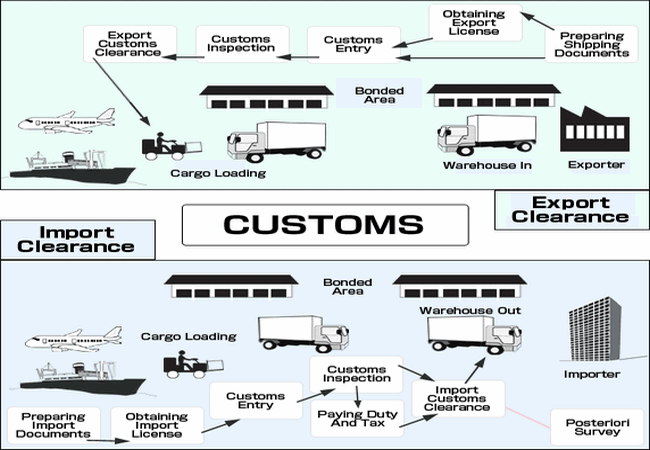
The clearance process itself runs in eight steps: book space and arrange China-side pickup → pre-shipment inspection → export customs declaration → load and sail → vessel arrival at Jebel Ali → customs declaration and duty/VAT payment (filed through Dubai Trade/Mirsal II) → physical inspection if selected → release, RTA vehicle test, and registration. For individual importers, Dubai Customs permits a simplified personal-effects procedure — typically the invoice plus a passport or Emirates ID copy — but commercial shipments follow the full procedure above.
FAQs
Can I personally import a car from China to the UAE?
Yes. Dubai Customs permits individuals to import new or used cars against their passport and UAE visa/residency, with duty at 5% of the assessed value. Registration then follows through the RTA (Dubai) or the equivalent authority in your emirate.
How much does it cost to ship a car from China to the UAE?
Budget $650 – $1,500 per car by RoRo, or roughly $1,200 – $2,000 for a sole-use 20ft container. Add marine insurance, China-side local charges, 5% UAE duty and 5% VAT on the CIF value, plus port and registration fees — a full landed-cost example is in the cost section above.
How long does it take to ship a car from China to the UAE?
Sea transit runs 14–28 days depending on the origin port and method; with inspection, clearance, and registration, plan for five to nine weeks end-to-end.
Is importing a used car from China to the UAE allowed, and is there an age limit?
Yes, used cars can be imported. There is no single UAE-wide age formula: Dubai’s published registration guidance does not set a fixed vehicle-age ceiling, while other emirates apply their own limits, and most trade guidance assumes vehicles should generally be no more than about ten years old at import. In every emirate the decisive test is practical — left-hand drive, a clean damage history, GCC compliance, and passing the local technical inspection. Confirm the current rules for your emirate before you ship, and favour newer, lower-mileage cars that clear RTA inspection far more reliably.
Is UAE import duty 5% on the car price or the landed cost?
Duty is 5% of the CIF value — the car price plus ocean freight and insurance — not the invoice price. VAT at 5% is then charged on CIF plus duty.
Will a Chinese EV charge on UAE networks?
Chinese EVs ship with GB/T ports; UAE public chargers are mainly CCS2. Use an adapter, swap the inlet to CCS2 before export, or rely on home AC charging — details are covered in the EV section above.
Can a freight forwarder handle the whole process, including UAE customs?
Yes. A licensed forwarder with destination agents can manage pickup, export customs, ocean freight, UAE import clearance, duty payment, and delivery to the RTA inspection point. For one-off imports, this door-to-door route is usually the lowest-risk option.

Young Chiu is a seasoned logistics expert with over 15 years of experience in international freight forwarding and supply chain management. As CEO of Dantful International Logistics, Young is dedicated to providing valuable insights and practical advice to businesses navigating the complexities of global shipping.