
Whether you’re importing machinery, electronics, auto parts, or consumer goods — getting your cargo from China to Nigeria efficiently comes down to making the right choices on freight mode, documentation, and local customs compliance. This page walks you through every decision, from ocean vs. air to SONCAP certification, with transparent cost benchmarks and a practical shipping timeline.
Freight Options From China To Nigeria: Ocean vs. Air to Nigeria
The first decision every importer faces is ocean or air. The right answer depends on three things: your cargo type, your timeline, and your budget. Here’s a quick comparison before we dive deeper into each mode.
| Factor | Ocean Freight | Air Freight |
|---|---|---|
| Best for | Bulk shipments, heavy machinery, vehicles, large-volume consumer goods | High-value electronics, urgent restocks, samples, perishables |
| Transit time (port-to-port) | 35–52 days | 5–10 days |
| Cost | $2,200–$5,100 per container (FCL) / $79–$135/CBM (LCL) | $5.3–$10.0/kg (100kg+) |
| Key Nigeria entry points | Lagos Apapa, Tin Can Island, Port Harcourt, Onne | LOS (Lagos), ABV (Abuja), PHC (Port Harcourt) |
| Documentation complexity | Higher — Form M, PAAR, SONCAP all required | Same documents required, but generally faster clearance |
When to Choose Ocean Freight
Ocean freight is the backbone of China–Nigeria trade. If your shipment weighs over 500kg and you can wait 5–8 weeks door-to-door, ocean is almost always the better choice on cost.
A few Nigeria-specific facts to keep in mind:
Lagos ports handle roughly 70% of Nigeria’s imports. Both Apapa and Tin Can Island are in Lagos. If your end customer is in Lagos, ocean freight direct to Apapa or Tin Can saves significant inland transport cost.
Port Harcourt and Onne are your best bets for oil & gas equipment, industrial machinery, or cargo destined for the Niger Delta / Southeast.
Ocean freight from China to Nigeria typically routes via the Suez Canal or around the Cape of Good Hope, depending on carrier and geopolitical conditions. Suez routing is faster but may carry a risk premium during periods of instability.
FCL vs. LCL vs. Breakbulk vs. RoRo — Which One for Your Cargo?
Instead of generic definitions, here’s a decision table tailored to the Nigeria route:
| Your Cargo | Recommended Mode | Typical Transit | What to Watch |
|---|---|---|---|
| Full container of machinery, furniture, tiles, or bulk goods | FCL (20’GP or 40’GP/HQ) | 35–45 days | Apapa congestion can add 1–3 weeks; Tin Can often clears faster for containers |
| Smaller shipments (1–15 CBM): spare parts, electronics, small batch consumer goods | LCL (Less than Container Load) | 38–52 days | LCL consolidation hubs are often in Lagos; add extra days for deconsolidation and customs examination |
| Used cars, trucks, construction vehicles | RoRo (Roll-on/Roll-off) | 30–40 days | Nigeria is one of Africa’s largest used-vehicle importers. Vehicles must comply with SONCAP and age restrictions |
| Oversized industrial equipment, cranes, generators that won’t fit a container | Breakbulk | 40–55 days | Onne and Port Harcourt are the preferred discharge ports for heavy-lift and project cargo |
For a detailed breakdown of sea freight from China to Nigeria — including vessel schedules, carrier options, and seasonal rate trends — see our dedicated sea freight guide.
Key Ocean Ports in Nigeria & What to Expect
| Port | Location | Best For | Congestion Reality |
|---|---|---|---|
| Lagos Port Complex (Apapa) | Lagos | General cargo, containers | Heavily congested. Pre-berthing delays of 1–3 weeks in peak season. Plan buffer in your schedule |
| Tin Can Island Port | Lagos | Containerized cargo | Slightly less congested than Apapa; many carriers prefer it for FCL discharge |
| Port Harcourt Port | Rivers State, Southeast | Industrial goods, oil & gas supplies | Moderate traffic. Good for cargo destined for the Niger Delta region |
| Onne Port | Rivers State (near Port Harcourt) | Oil & gas equipment, project cargo, breakbulk | Specialized facility; efficient for heavy-lift and offshore-related cargo |
Pro tip: If your shipment isn’t time-sensitive, avoid booking for August–November delivery — this is Nigeria’s pre-Christmas import surge and port congestion peaks.
When to Choose Air Freight
Air freight from China to Nigeria is the go-to when speed matters more than cost, or when your cargo’s value makes sea freight’s longer exposure to damage/theft unacceptable.
Air freight makes the most sense when:
You’re shipping high-value electronics (smartphones, accessories, computer hardware) where ocean transit’s longer insurance exposure erodes the freight savings
You need an urgent restock — your Lagos shop ran out of a fast-selling SKU and every week of stockout costs more than the air freight premium
You’re sending samples or prototypes ahead of a bulk order to validate quality before committing to a full container
You’re shipping perishable or temperature-sensitive goods where ocean transit time would compromise the product
Key Nigeria air cargo hubs:
| Airport | Code | Region Served | Notes |
|---|---|---|---|
| Murtala Muhammed International Airport | LOS (Lagos) | Southwest / National | Busiest cargo airport; most air freight from China lands here |
| Nnamdi Azikiwe International Airport | ABV (Abuja) | Central / North | Good for government and institutional imports |
| Port Harcourt International Airport | PHC | Niger Delta / Southeast | Important for oil & gas equipment and industrial spares |
Most China–Nigeria air freight routes via Dubai (DXB), Doha (DOH), Addis Ababa (ADD), or Istanbul (IST). Direct air freight service from Chinese airports to Lagos is limited — expect one connection unless you book dedicated cargo charters.
Shipping Routes from China to Nigeria
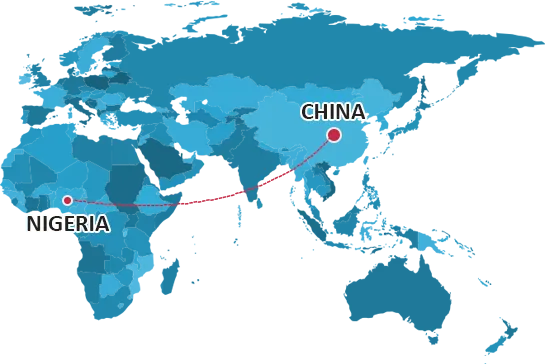
Understanding the physical routes your cargo travels helps you make informed decisions about transit time, cost, and risk. China to Nigeria is a long-haul corridor — approximately 11,000–12,000 km (6,800–7,500 miles) as the crow flies — and the specific route taken can vary significantly depending on the carrier, season, and geopolitical conditions.
Ocean Routes: The Two Main Corridors
Almost all ocean freight from China to Nigeria follows one of two corridors — via the Suez Canal or via the Cape of Good Hope.
Route A: South China Sea → Malacca Strait → Indian Ocean → Suez Canal → Mediterranean → Gibraltar → West Africa → Lagos (Apapa/Tin Can)
This is the standard route and the fastest for cargo originating from most Chinese ports. Key waypoints:
Shanghai / Ningbo / Shenzhen — Departure from major Chinese ports
South China Sea — Initial leg southbound from Chinese waters
Singapore Strait — Major transshipment and bunkering hub
Indian Ocean — Crossing via the Sri Lanka / Maldives corridor
Gulf of Aden → Bab el-Mandeb → Red Sea — Entry to the Middle East chokepoint
Suez Canal (Egypt) — Canal transit into the Mediterranean
Mediterranean Sea → Strait of Gibraltar — Exit into the Atlantic
West Africa coast — Down along Morocco, Senegal, Ghana into the Gulf of Guinea
Lagos (Apapa / Tin Can Island) or Bonny Fairway Buoy → Port Harcourt / Onne — Final discharge
Transit time: 35–45 days port-to-port
Best for: Cargo from Shanghai, Ningbo, Shenzhen, Guangzhou, Hong Kong
Service frequency: Multiple weekly sailings from major Chinese ports via CMA CGM, Maersk, COSCO, MSC, and PIL
Risk factors: Suez Canal transit fees add to freight cost; Red Sea / Bab el-Mandeb security concerns can trigger rerouting
Route B: South China Sea → Indian Ocean → Cape of Good Hope → West Africa → Nigeria
This longer alternative circumnavigates Africa via the southern tip. Carriers switch to this route when Suez Canal transit is disrupted (geopolitical instability in the Red Sea region, canal blockage events) or when lower canal fees offset the extra fuel cost over very long hauls.
Transit time: 45–55 days port-to-port (adds 7–14 days vs. Suez routing)
Best for: Cargo from Qingdao and northern Chinese ports (some carriers route via Cape regardless of Suez conditions due to schedule optimization)
Risk factors: Longer at-sea exposure (increased insurance cost); fewer resupply/shelter points
2026 note: Following Red Sea security disruptions in 2024–2025, many carriers have established dual-pricing for Suez vs. Cape routing, giving shippers the option to choose. Suez routing typically saves 10–14 days but carries a higher war-risk insurance premium. Your Dantful shipping specialist will discuss the current recommended routing when you book.
Key Transshipment Hubs for Nigeria-Bound Cargo
Not every China–Nigeria shipment is direct. Many LCL and smaller FCL shipments transship through regional hubs:
| Transshipment Hub | Country | Role in China–Nigeria Route |
|---|---|---|
| Singapore | Singapore | World’s busiest transshipment port; many China-origin containers are relayed here onto West Africa-bound vessels |
| Port Klang | Malaysia | Key Southeast Asian hub; common relay point for southern China ports (Shenzhen, Guangzhou) |
| Colombo | Sri Lanka | Indian Ocean relay hub; growing importance for South Asia–West Africa connections |
| Tangier Med | Morocco | Major Mediterranean–West Africa gateway; some carriers transship China cargo here onto feeder vessels serving Lagos |
| Lomé | Togo | West African regional hub; smaller feeder vessels distribute to Lagos, Apapa, and Port Harcourt |
| Abidjan | Côte d’Ivoire | Another West African relay point for regional distribution to Nigeria |
For the cheapest shipping from China to Nigeria, transshipment via a hub like Singapore or Port Klang can sometimes yield a lower freight rate than a direct sailing — at the cost of longer transit time and an additional handling step.
Air Freight Routes: Hub-and-Spoke via Middle East / East Africa
Air freight from China to Nigeria rarely flies direct. Most cargo routes follow a hub-and-spoke model through major Middle Eastern, East African, or European airline hubs:
| Connecting Hub | Typical Routing | Airlines |
|---|---|---|
| Dubai (DXB/DWC) | China → Dubai → Lagos | Emirates SkyCargo, flydubai Cargo |
| Doha (DOH) | China → Doha → Lagos | Qatar Airways Cargo |
| Addis Ababa (ADD) | China → Addis Ababa → Lagos/Abuja | Ethiopian Airlines Cargo (strong Africa network) |
| Istanbul (IST) | China → Istanbul → Lagos/Abuja/Port Harcourt | Turkish Cargo |
| Cairo (CAI) | China → Cairo → Lagos | EgyptAir Cargo |
| Nairobi (NBO) | China → Nairobi → Lagos | Kenya Airways Cargo / Astral Aviation |
Transit time: 5–10 days total (including 1–3 days for connection layover)
Direct flights: Hong Kong → Lagos and Guangzhou → Lagos operate limited direct cargo-only frequencies; these are the fastest option when available (4–6 days)
Busiest air corridor by volume: Shanghai Pudong (PVG) → Dubai (DXB) → Lagos (LOS), operated by Emirates SkyCargo
Route Selection: Practical Takeaways
| If you prioritize… | Choose this routing |
|---|---|
| Fastest ocean transit | Direct sailing Shanghai/Ningbo → Lagos via Suez Canal (35–40 days) |
| Lowest ocean freight cost | LCL consolidation via Singapore or Port Klang; or FCL via Cape routing when Suez premiums are high |
| Reliability / schedule stability | Major carrier direct service (CMA CGM, Maersk, COSCO) from Shanghai or Ningbo to Lagos |
| Fastest air transit | Hong Kong → Lagos direct cargo flight (4–6 days), or Guangzhou → Lagos where available |
| Cargo to Port Harcourt / Onne | Shenzhen or Guangzhou origin → transshipment at Lomé or Tangier → feeder to Port Harcourt |
| Cargo to Abuja (air) | Air freight via Ethiopian Airlines hub (ADD) — strongest connection to ABV |
Your route is ultimately determined by your origin port in China, your destination in Nigeria, and the current carrier schedules and conditions. Dantful’s freight team monitors all active China–Nigeria sailings and flights daily and can recommend the optimal route for your specific shipment.
Shipping Costs From China to Nigeria
As West Africa’s largest economy, Nigeria maintains consistently strong shipping volumes from China. Below are the latest market-reference freight rates across major origin–destination pairs.
2026 Freight Rate Reference
| Route | Air Freight (USD/kg, 100kg+) | Sea Freight — FCL (USD/Container) | Sea Freight — LCL (USD/CBM) | Notes |
|---|---|---|---|---|
| Shanghai → Lagos (Apapa/Tin Can) | $5.5 – $9.0 | 20’GP: $2,200–$2,800 40’GP: $3,600–$4,600 | $82–$120 (min 2–3 CBM) | Multiple weekly sailings; best for time-sensitive sea cargo |
| Ningbo → Lagos (Apapa) | $5.7 – $9.4 | 20’GP: $2,280–$2,900 40’GP: $3,700–$4,750 | $85–$125 | Peak season surcharges (Aug–Nov) can add $200–$400 per container |
| Shenzhen → Port Harcourt | $5.8 – $9.8 | 20’GP: $2,400–$3,050 40’GP: $3,950–$5,100 | $90–$130 | Transshipment required; sea lead time is longer than Lagos-bound cargo |
| Guangzhou → Lagos | $5.6 – $9.2 | 20’GP: $2,230–$2,850 40’GP: $3,680–$4,650 | $82–$120 | Strong air freight connectivity; sea congestion possible during peak |
| Qingdao → Apapa | $5.9 – $10.0 | 20’GP: $2,350–$3,100 40’GP: $3,950–$5,120 | $92–$135 | May transit via Shanghai or Singapore hub |
| Hong Kong → Lagos | $5.3 – $8.7 | 20’GP: $2,100–$2,750 40’GP: $3,500–$4,420 | $79–$115 | Highest service frequency among all origin ports |
Note: These are spot-market reference rates as of mid-2026. Your actual quote will depend on cargo weight/volume, BAF (Bunker Adjustment Factor), peak season surcharges, and specific destination port. Request a tailored freight quote for your shipment.
For a deeper look at pricing, see our dedicated guides on shipping costs from China to Nigeria, container shipping costs, and 20ft container shipping cost to Nigeria.
What Really Drives Your Total Cost
Eight factors make the difference between a quoted rate and your final landed cost:
Freight mode — Ocean is 5–10× cheaper per kg than air for heavy cargo, but slower
Weight & volume — Air freight charges on chargeable weight (gross weight vs. volumetric weight, whichever is higher); LCL charges on CBM
Route & transshipment — Direct sailings from Shanghai/Ningbo cost less than transshipment routes from northern ports
Cargo type — Hazardous goods, perishables, and oversized items incur handling surcharges
Seasonality — August through November (pre-Christmas rush) and January–February (pre-Chinese New Year) are peak; rates climb 15–30%
Fuel surcharges (BAF) — Passed through by carriers quarterly; ocean BAF tends to be more stable than air
Container type — Standard dry container is cheapest; reefer (refrigerated), open-top, or flat-rack containers each add premiums
Currency and payment terms — Freight rates are typically quoted in USD. Nigerian importers should factor Naira/USD exchange rate risk into total landed cost calculations
Nigeria-Specific Costs You Should Know
Beyond the freight itself, Nigeria adds several destination-side costs that first-time importers often overlook:
| Cost Item | Typical Range | Who Pays |
|---|---|---|
| SONCAP certification | $200–$500 per certificate (varies by product category and route) | Importer (or included in DDP if using a full-service forwarder like Dantful) |
| Form M processing | ₦50,000–₦150,000 (bank charges / processing fee via Authorized Dealer Bank) | Importer |
| PAAR (Pre-Arrival Assessment Report) | Typically included in customs broker’s fee | Importer |
| Customs duty & VAT | Varies by HS code under ECOWAS CET | Importer (unless DDP) |
| Port demurrage & storage | ~$20–$60/day after free storage period (typically 3–7 days at Lagos ports) | Importer |
| Inland trucking | $400–$1,200 (Lagos to Abuja/Kano/Onitsha) depending on distance and truck type | Importer |
| Customs broker / clearing agent fee | ₦500,000–₦2,000,000 depending on cargo value and complexity | Importer |
Important: Lagos port demurrage can spiral quickly if your paperwork isn’t ready. The biggest cause is waiting for PAAR approval or SONCAP certificate issues. We recommend starting all documentation before the vessel sails — not after it arrives.
Shipping Time From China to Nigeria
Ocean vs. Air Transit Time Reference
| Route | Air Freight (Door-to-Door) | Sea Freight (Port-to-Port) | Realistic Door-to-Door (Sea Freight)* |
|---|---|---|---|
| Shanghai → Lagos | 5–7 days | 35–45 days | 45–55 days |
| Ningbo → Apapa | 5–8 days | 36–48 days | 46–60 days |
| Shenzhen → Port Harcourt | 5–8 days | 39–52 days | 50–65 days |
| Guangzhou → Lagos | 5–7 days | 36–46 days | 46–58 days |
| Qingdao → Apapa | 5–9 days | 37–50 days | 48–62 days |
| Hong Kong → Lagos | 4–6 days | 34–44 days | 44–54 days |
*Door-to-door estimates include factory pickup in China, origin customs clearance, ocean transit, Nigeria port clearance (PAAR, SONCAP, inspection), and final inland delivery. These are realistic ranges — not best-case.
What Slows Down Shipments to Nigeria (And How to Avoid It)
Not all delays happen at sea. In our experience on the China–Nigeria route, the biggest bottlenecks are at the destination:
Port congestion at Apapa & Tin Can — This is the single most common cause of delays. During peak season (Aug–Nov), vessels can wait 1–3 weeks for a berth. Mitigation: Book with forwarders who have priority berthing arrangements or consider shipping via Tin Can instead of Apapa when possible.
PAAR delays — The Pre-Arrival Assessment Report must be issued by Nigeria Customs before your cargo can be cleared. If the declared value or HS code triggers a review, PAAR issuance can take 1–4 weeks. Mitigation: Submit Form M and PAAR application as early as possible — ideally before the vessel sails.
SONCAP certificate not ready at destination — Cargo without a valid SONCAP certificate at the time of clearance will sit at the port accumulating demurrage. Mitigation: Start the SONCAP process before or immediately after placing your order. Never wait until the cargo is at sea.
Incomplete or mismatched documentation — If the details on your Form M don’t match your Bill of Lading, Commercial Invoice, or Packing List, Nigeria Customs will flag the shipment for manual inspection, adding days or weeks. Mitigation: Use an experienced freight forwarder or clearing agent who cross-checks all documents against the Form M before the vessel arrives.
Customs inspection and valuation disputes — Nigeria Customs may dispute the declared value and issue a higher duty assessment. Negotiating this takes time. Mitigation: Ensure your commercial invoice reflects realistic market values and keep supporting documentation (manufacturer’s price list, purchase order, payment evidence) ready.
Last-mile delivery challenges — Once cleared, moving cargo from Lagos ports to inland destinations (Abuja, Kano, Onitsha, Kaduna) faces its own set of hurdles: road conditions, security checkpoints, and truck availability. Budget 2–7 days for inland delivery depending on distance.
Door-to-Door Shipping From China to Nigeria
Door-to-door shipping is the most popular choice for Nigerian importers who want a single point of responsibility — from the factory in China to the final address in Nigeria. For a complete overview, see our door-to-door shipping to Nigeria guide.
DDU vs. DDP: Which One Makes Sense for Nigeria?
| DDU (Delivered Duty Unpaid) | DDP (Delivered Duty Paid) | |
|---|---|---|
| Who pays duties & taxes? | You (the importer in Nigeria) | Dantful (we pay on your behalf) |
| Who handles Nigeria customs clearance? | You appoint a local clearing agent | Dantful’s team manages the full clearance |
| Who arranges SONCAP / Form M / PAAR? | Typically you, with your agent | Dantful handles all three |
| Best for | Experienced importers with their own clearing agents and banking relationships in Nigeria | First-time importers, SMEs without in-house logistics, businesses that want one invoice and zero surprises |
| Risk level | Medium–High — if your agent misses a document deadline, you pay demurrage | Low — Dantful owns the timeline and absorbs delays caused by our own errors |
Our recommendation for most importers: DDP is worth the premium in the Nigerian context. Nigeria’s customs process has enough moving parts (Form M, PAAR, SONCAP, valuation) that the cost of a single demurrage event from missing paperwork often exceeds the DDP service premium.
LCL / FCL / Air Freight Door-to-Door Compared
| Service | Best Cargo Size | Typical Door-to-Door Time | Cost Indicator |
|---|---|---|---|
| LCL Door-to-Door | 1–15 CBM | 50–65 days | $120–$200/CBM all-in (rough estimate, depends on cargo type and destination city) |
| FCL Door-to-Door | 20’GP, 40’GP, 40’HQ | 45–60 days | FCL freight + customs + inland delivery (quoted case-by-case) |
| Air Freight Door-to-Door | Any weight; best for <500kg high-value cargo | 7–12 days | $8–$15/kg all-in (rough estimate; depends on urgency and cargo type) |
How Dantful Handles Your Door-to-Door Shipment
With Dantful International Logistics, a door-to-door shipment to Nigeria means:
Factory pickup — We collect your goods from any supplier in China (Guangzhou, Shenzhen, Yiwu, Shanghai, Ningbo, Qingdao — anywhere)
Export customs clearance — We handle China-side export declaration
International freight — Ocean (FCL/LCL) or air, whichever fits your timeline and budget
Nigeria customs clearance — Our local team manages Form M validation, PAAR, SONCAP verification, duty/VAT payment, and inspection coordination
Inland delivery — Trucking from Lagos/Tin Can/Port Harcourt to your address — including inland cities like Abuja, Kano, Onitsha, Ibadan, Kaduna, and beyond
We offer this as either DDP (all duties and taxes paid upfront) or DDU (you handle destination charges yourself) — whichever fits your business model.
Nigeria Customs Clearance & Import Compliance
If there’s one section on this page you read carefully, make it this one. Nigeria’s import compliance framework is more layered than many other African markets, and getting it wrong means demurrage, fines, or cargo seizure. This section covers what you need to know before shipping.
SONCAP Certification — What It Is and How to Get It
SONCAP (Standards Organisation of Nigeria Conformity Assessment Programme) is a mandatory pre-shipment certification program for most imported goods into Nigeria. It is enforced by SON (Standards Organisation of Nigeria) and administered through accredited International Accreditation Firms (IAFs).
Does your product need SONCAP? Almost certainly yes — unless it falls into a narrow list of exemptions (certain raw agricultural products, crude oil, personal effects, diplomatic cargo). Electronics, machinery, auto parts, textiles, toys, construction materials, food products, and consumer goods all require SONCAP.
The three SONCAP routes:
| Route | Who It’s For | Process |
|---|---|---|
| Route A | Unregistered products, one-off shipments, first-time importers | Product sample testing in an accredited lab → Product Certificate issued → Shipment-specific SONCAP Certificate |
| Route B | Products with a history of compliant shipments | Product registration with SON → Product Certificate (valid 1 year) → Shipment-specific SONCAP Certificate (faster than Route A) |
| Route C | Licensed manufacturers with strong compliance records | SON license (valid 3 years) → simplified per-shipment certification (fastest and lowest cost per shipment) |
Typical cost: $200–$500 per shipment certificate (Route A), plus lab testing fees if required. Route B and C cost less per shipment but require upfront registration/licensing investment.
Critical timing: Start the SONCAP process before the goods are shipped from China. The Product Certificate (Route A) or registration (Route B) takes 1–4 weeks. If your cargo arrives at Lagos without a valid SONCAP, it sits at the port — and you pay demurrage every day.
Dantful handles SONCAP coordination as part of our door-to-door DDP service. We work with accredited IAFs to ensure your SONCAP is issued before your vessel departs China.
Form M and PAAR — The Two Documents You Can’t Skip
Nigeria’s import process hinges on two documents that don’t exist in most other countries:
Form M — The mandatory import declaration filed through Nigeria’s Single Window for Trade portal before any shipment. Key facts:
Form M is opened by the importer through an Authorized Dealer Bank in Nigeria (your bank)
It must be filed and approved before the goods are shipped from China
It declares: importer details, supplier details, product description, HS code, quantity, value, country of origin, and port of discharge
The Central Bank of Nigeria (CBN) monitors all Form M submissions for foreign exchange tracking
Rejection risk: Incomplete product descriptions, mismatched HS codes, or unrealistic declared values are the most common reasons Form M is rejected. Resubmission adds 1–2 weeks
PAAR (Pre-Arrival Assessment Report) — The clearance gatekeeper, issued by Nigeria Customs Service:
Generated after Form M data is transmitted to the Customs system
PAAR confirms the duty and tax assessment for your specific shipment
Without a PAAR, your clearing agent cannot lodge a customs declaration
PAAR delays are the #1 reason cargo sits at Lagos ports beyond the free storage period
The flow: Form M → (vessel sails) → PAAR issued → (vessel arrives) → Customs declaration lodged → Inspection → Release
For a complete walkthrough of the import steps, see our import procedure from China to Nigeria guide.
ECOWAS CET Tariffs at a Glance
Nigeria applies the ECOWAS Common External Tariff (CET) , which classifies all imports into five bands:
| Band | Duty Rate | Typical Product Categories |
|---|---|---|
| 0% — Social Goods | 0% | Pharmaceuticals, medical equipment, educational materials, agricultural inputs |
| 5% — Raw Materials & Capital Goods | 5% | Industrial raw materials, machinery, equipment, spare parts for manufacturing |
| 10% — Intermediate Goods | 10% | Semi-processed materials, components used in local manufacturing |
| 20% — Finished Goods | 20% | Most consumer goods, electronics, furniture, textiles, auto parts |
| 35% — Goods for Economic Development | 35% | Goods Nigeria specifically wants to protect (certain agricultural products, some textile categories, luxury items) |
VAT is an additional 7.5% (current rate as of 2026) on the CIF value + duty.
Example calculation for a 40’GP container of electronics with CIF value of $30,000:
Duty (20% band): $6,000
VAT (7.5% on $36,000): $2,700
Total import charges: $8,700 (before customs broker fees, port charges, and inland trucking)
Dantful can provide a pre-shipment landed cost estimate including duty and VAT for your specific HS codes. Contact us with your product list.
Restricted and Prohibited Items
Nigeria maintains both an Absolute Prohibition List (cannot be imported under any circumstances) and an Import Prohibition List (cannot be imported without specific government authorization or quota). Key items to be aware of:
Prohibited (no import allowed):
Firearms, ammunition, and military equipment (without specific government authorization)
Narcotics and psychotropic substances
Pornographic materials
Certain used tires (restricted for road safety reasons)
Counterfeit goods
Restricted (requires special permits):
Food, drugs, and cosmetics — may require NAFDAC (National Agency for Food and Drug Administration and Control) registration/permit
Pharmaceutical products — NAFDAC registration mandatory
Chemicals — may require NESREA (National Environmental Standards and Regulations Enforcement Agency) clearance
Used vehicles — subject to age restrictions and SONCAP compliance
Telecommunications equipment — may require NCC (Nigerian Communications Commission) approval
Always confirm regulatory requirements for your specific product category before placing a purchase order. We can help you navigate this.
Your Shipping Timeline: From China to Nigeria Step by Step
Here’s what a typical Dantful-managed shipment looks like — with Nigeria-specific steps that you won’t find in a generic shipping guide.
1. Consultation & Cargo Assessment
We start by understanding exactly what you’re shipping — product type, volume, weight, target delivery date, and destination city in Nigeria. From this, we recommend:
The best freight mode (ocean FCL/LCL, air freight, or multimodal)
Which Chinese port to ship from (proximity to your supplier matters for cost and transit time)
The SONCAP route you’ll need (Route A, B, or C)
A preliminary landed cost estimate including duty and VAT
2. Form M Registration & Document Preparation
This step is unique to Nigeria and happens before your goods leave China. We will:
Coordinate with your Authorized Dealer Bank in Nigeria to open Form M
Ensure the Form M product descriptions, HS codes, and values match your commercial documents exactly
Start the SONCAP certification process in parallel (testing → product certificate → shipment certificate)
Prepare the full document package: Commercial Invoice, Packing List, Bill of Lading / Air Waybill, Certificate of Origin, SONCAP Certificate
Critical warning: If your Form M product description says “spare parts” but your Bill of Lading says “auto parts,” Nigeria Customs may flag the mismatch and delay clearance. We double-check every document against the Form M before the vessel sails.
3. Export Booking & Origin Customs Clearance
Once documents are in order:
We book space with the shipping line or airline
Arrange trucking from your supplier’s factory to the port/airport of departure
Handle China-side export customs declaration
Load and dispatch the cargo
4. International Transit & Real-Time Tracking
During transit, you’ll receive:
Real-time tracking — vessel position / flight status updates
Document status alerts — PAAR progress, any Customs queries
Milestone notifications — departure, transshipment (if any), arrival at Nigerian port/airport
5. Nigeria Customs Clearance (PAAR, SONCAP, Duty Payment)
This is where most shipments hit delays — and where Dantful’s Nigeria team makes the difference:
PAAR validation: We ensure the PAAR has been issued and matches the arriving cargo before the vessel berths
SONCAP verification: SONCAP certificate is presented to SON officials at the port
Duty & VAT payment: We calculate and remit the assessed duties and taxes
Customs examination: We coordinate with the assigned Customs officer for physical inspection (if required — typically random or triggered by valuation review)
Release order: Once cleared, the cargo is released for delivery
6. Final Delivery Across Nigeria
After clearance, we arrange last-mile delivery to your address:
| Destination Region | From Lagos (approx.) | Notes |
|---|---|---|
| Lagos metro | 1–2 days | Same-day possible for priority shipments |
| Southwest (Ibadan, Abeokuta) | 1–2 days | Relatively short corridors |
| Abuja (FCT) | 3–5 days | 700km+ from Lagos; good road conditions on the Lagos–Abuja corridor |
| Southeast (Onitsha, Enugu, Aba, Owerri) | 3–6 days | High traffic volumes on the Lagos–Onitsha route |
| North (Kano, Kaduna, Jos) | 5–8 days | Longest distances; security checkpoint delays possible |
Why Dantful for Your China–Nigeria Shipments
Choosing the best shipping company from China to Nigeria is not just about finding the lowest freight rate. It’s about finding a forwarder who understands Nigeria’s import compliance framework and can prevent a $1,000 demurrage bill from eating your $500 freight savings.
What Dantful brings to your Nigeria route:
| What You Need | How Dantful Delivers |
|---|---|
| SONCAP, Form M, PAAR handling | Our Nigeria team coordinates all three — we don’t just ship your cargo and hope you figure out the paperwork |
| China-side coverage | Factory pickup from any Chinese city — Guangzhou, Shenzhen, Yiwu, Shanghai, Ningbo, Qingdao, and beyond |
| Reliable freight rates | Direct contracts with major shipping lines and airlines; competitive LCL consolidation rates |
| Port congestion management | We track berthing schedules and container terminal status in real time, choosing Tin Can over Apapa when it saves you days |
| Door-to-door DDP | One invoice covers factory pickup, freight, customs clearance, duties, and delivery to your door in Nigeria |
| 24/7 visibility | Real-time tracking and proactive status updates — you always know where your cargo is |
As a China shipping agent to Nigeria with Class-A freight forwarding credentials, NVOCC certification, and FMC membership, Dantful International Logistics combines Chinese supply-side expertise with Nigerian destination know-how. We’re also the cheapest shipping company from China to Nigeria among forwarders who actually handle Nigeria customs end-to-end — compare our all-in DDP quotes against anyone.
Specialized cargo we handle regularly on the Nigeria route:
Importing solar panels from China to Nigeria — complete with SONCAP and renewable energy duty concessions
Shipping cars from China to Nigeria — RoRo or containerized, SONCAP for vehicles included
General cargo, machinery, electronics, building materials, furniture, and more
FAQs
1. How much is shipping from China to Nigeria?
Ocean Freight — FCL: 20’GP: $2,200–$3,100 / 40’GP: $3,500–$5,120 (varies by origin port and season)
Ocean Freight — LCL: $79–$135/CBM (min 2–3 CBM)
Air Freight: $5.3–$10.0/kg (100kg+ shipments)
Door-to-Door DDP: Contact us with your product details and destination for a precise all-in quote. Rates above are port-to-port / airport-to-airport freight only.
2. What’s the cheapest way to ship from China to Nigeria?
LCL ocean freight is the cheapest per-CBM option for small shipments (under 15 CBM). For full containers, FCL from Hong Kong or Guangzhou to Lagos tends to have the lowest base freight rates. But always compare total landed cost, not just the freight rate — a slightly more expensive cheapest shipping company from China that gets your cargo cleared faster can save you money overall.
How much does it cost to ship a 20ft container from China to Nigeria? A 20’GP container from China to Lagos typically ranges from $2,100 to $3,100 depending on the origin port, shipping line, and season. See our 20ft container shipping cost guide for port-by-port breakdowns.
3. How long does shipping take from China to Nigeria?
Ocean freight (port-to-port): 34–52 days, depending on origin and destination ports
Air freight (airport-to-airport): 4–10 days
Door-to-door ocean: 44–65 days including factory pickup, customs clearance at both ends, and inland delivery in Nigeria
4. What documents are required for shipping from China to Nigeria?
The core documents are: (1) Form M (filed before shipment), (2) SONCAP Certificate (pre-shipment conformity), (3) Bill of Lading (ocean) or Air Waybill (air), (4) Commercial Invoice, (5) Packing List, (6) Certificate of Origin, (7) PAAR (Pre-Arrival Assessment Report — issued by Nigeria Customs after Form M submission), and (8) Insurance Certificate. Depending on the product, additional permits (NAFDAC, NESREA, NCC) may be required.
5. What is SONCAP and do I need it?
SONCAP is Nigeria’s mandatory product conformity certification. Almost all regulated products imported into Nigeria require SONCAP. Start the process before your goods leave China — we coordinate this for DDP shipments.
6. What is the import procedure from China to Nigeria?
The core steps are: supplier order → Form M registration → SONCAP certification → export from China → vessel/flight transit → PAAR issuance → Nigeria customs clearance → duty/VAT payment → delivery. Our import procedure guide walks through every step in detail.
7. Does Alibaba ship to Nigeria?
Alibaba is a marketplace, not a shipping company. Most Alibaba suppliers can arrange shipment to Nigeria through their preferred forwarder, but you must still handle Form M, SONCAP, and Nigeria customs clearance — or hire a forwarder like Dantful to do it for you. Dantful can pick up from any Alibaba supplier in China and manage the full journey to Nigeria.
8. Is door-to-door shipping to Nigeria available?
Yes. Dantful provides comprehensive door-to-door shipping to Nigeria via ocean FCL, LCL, and air freight. We offer both DDU (you pay duties separately) and DDP (all costs included in one quote).
9. Can you ship a car from China to Nigeria?
Yes. We handle car shipping from China to Nigeria via RoRo or container. Vehicle SONCAP certification and Nigeria Customs clearance are included in our DDP service.