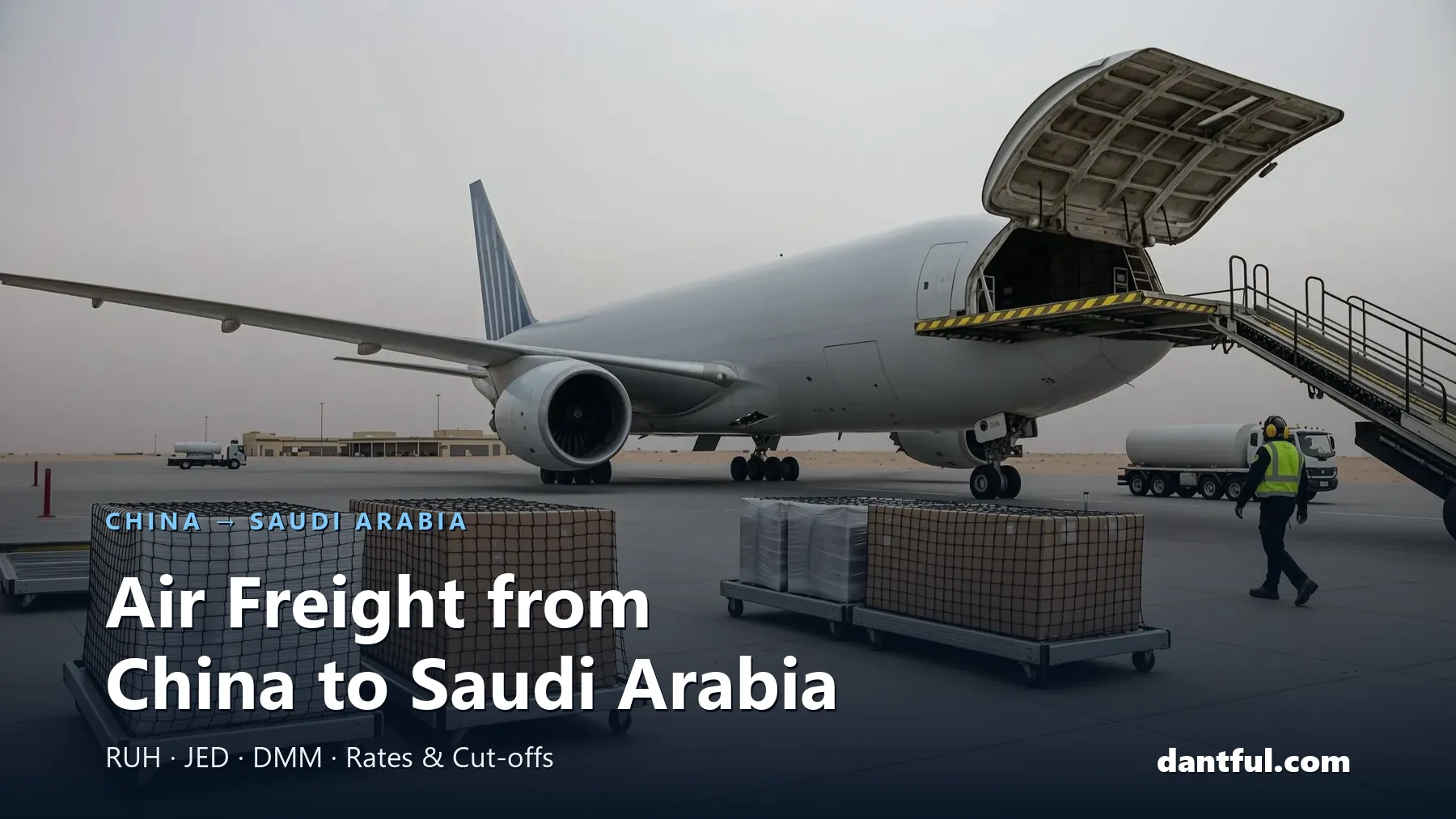
Air freight from China to Saudi Arabia costs $6 to $11 per kg for shipments of 100 kg and above in November 2026, against $4 to $8.50 per kg in the first half of the year. Transit runs 3 to 7 days door to door, and the single biggest constraint this month is not price — it is that Emirates SkyCargo’s Riyadh and Dammam services are suspended until 27 November, with only limited Jeddah capacity restored.
We book Saudi air cargo out of Shenzhen, Guangzhou and Hong Kong every week: electronics and spares into Riyadh, apparel and cosmetics into Jeddah, oilfield and industrial parts into Dammam. This guide covers what the market is actually charging this month, which airport still has space, how the cut-off chain works, and the SABER certificate that decides whether your cargo leaves the airport at all.
Table of Contents
How Much Does Air Freight from China to Saudi Arabia Cost in November 2026?
The rate story on this lane this quarter is a step change, not a drift, and it comes from capacity rather than demand.
| Weight bracket (chargeable) | Baseline band, Jan – Sep 2026 | November 2026 indicative | What moved it |
|---|---|---|---|
| +45 kg | $6.50 – 8.50 | $9.00 – 13.00 | Loose cargo competes with express; thinnest capacity |
| +100 kg | $5.00 – 7.00 | $8.00 – 11.00 | Gulf freighter space reduced after the October disruptions |
| +300 kg | $4.50 – 6.00 | $7.50 – 10.00 | Partial recovery on JED, little on RUH and DMM |
| +500 kg | $4.00 – 5.00 | $6.50 – 9.50 | Where most commercial cargo now prices |
| +1000 kg | $3.50 – 4.50 | $6.00 – 8.00 | One published November quote for 1,000 kg+ to RUH/DMM: $10.89 |
Read the two columns as different questions. The baseline is what the lane priced at through the first three quarters of 2026 on the published forwarder brackets. The November column is what a booking costs now, after Gulf airspace closures, the 8 October attack on Riyadh airport, and the suspension of Emirates SkyCargo’s RUH and DMM freighter calls through 27 November. WorldACD put average rates to and from the Gulf at $3.14 per kg in September, 57% above a year earlier, and jet fuel was up 108% year on year into October — the surcharges have not finished passing through.
Two numbers explain the spread inside the November column. First, weight breaks matter more than origin: a 900 kg shipment that could be built to 1,000 kg often saves $1.50 to $2.00 per kg, which is $1,500 to $2,000 on the booking. Second, the airport decides the price: cargo that can fly into Jeddah prices below cargo that must reach Riyadh or Dammam this month, because the capacity is not there.
Which Saudi Airport Should You Fly Into: RUH, JED or DMM?
| RUH — Riyadh | JED — Jeddah | DMM — Dammam | |
|---|---|---|---|
| Role | Capital, dry-port rail links, central and eastern distribution | Red Sea gateway, Hajj and Umrah traffic, western province | Eastern Province oil and industrial belt |
| November 2026 capacity | Thin: Emirates SkyCargo suspended through 27 November | Best of the three: limited service restored | Thin: same Emirates suspension, few alternatives |
| Typical air transit from China | 3 – 6 days door to door | 3 – 6 days door to door | 4 – 7 days door to door |
| Best for | Electronics, e-commerce restock, government and project cargo | Apparel, cosmetics, food, pilgrim-season stock | Oilfield spares, industrial parts, Bahrain-bound cargo |
| Road leg to the other cities | Riyadh to Dammam 400 km, 4 – 5 hours | Jeddah to Riyadh 950 km, 10 – 12 hours | Dammam to Riyadh 400 km, 4 – 5 hours |
The practical routing rule this month: if your consignee is in Riyadh or Dammam, ask whether the cargo can fly into Jeddah and move by road, or into Dubai and move by truck through the border at Batha or Salwa. A Jeddah landing plus a 10 to 12 hour road leg is often cheaper and faster than waiting for a RUH freighter slot, and it is what most forwarders are doing until the Emirates suspension lifts.
Jeddah has its own constraint. As the pilgrim gateway, its belly capacity is consumed by passenger traffic during Ramadan and the Hajj season, and cargo space tightens accordingly. Plan those windows two to three weeks earlier than the freight market alone would suggest.
Why Dubai Is a Legitimate Saudi Air Gateway
A large share of China–Saudi air cargo flies into Dubai or Sharjah and finishes the journey by road, and this month that share is higher than usual. Two conditions make it work: the cargo must be cleared for Saudi entry at the land border with the same SABER documentation as an airport arrival, and the transit time gains a day for the border crossing. It is not a workaround — it is a normal routing — but it must be quoted as a door-to-door product, not as an airport-to-airport rate.
Air Freight Rates by Chinese Origin
Origin choice moves the rate by more than most importers expect, and Hong Kong is not always the cheapest once the cross-border truck is counted.
| Chinese origin | November 2026 band (100 kg+) | Why |
|---|---|---|
| Shenzhen (SZX) | $8.00 – 10.50 per kg | Deep South China freighter capacity, strong electronics consolidation |
| Guangzhou (CAN) | $8.00 – 10.50 per kg | Broad carrier choice, good belly capacity |
| Shanghai (PVG) | $8.50 – 11.00 per kg | Largest hub, highest demand, premium on direct space |
| Beijing (PEK) / Tianjin | $9.00 – 11.50 per kg | Fewer Gulf connections, more transit routing |
| Hong Kong (HKG) | $7.50 – 10.00 per kg | Lowest airport-to-airport rate, but adds 1 – 2 days of cross-border trucking and a second security screen |
| Yiwu / Ningbo | $8.50 – 11.00 per kg | Truck to PVG or CAN first; the truck time is not in the air rate |
The Hong Kong trade-off is worth spelling out. HKG quotes the lowest per-kilo number on the lane because it has the deepest cargo network, but mainland cargo has to cross the border by truck, be re-screened and re-documented, and that costs one to two days plus a handling charge. For a shipment that has to be in Riyadh on a date, SZX or CAN direct is usually the better answer even at $0.50 per kg more.
Chargeable Weight: Why Light Cargo Pays Twice
Air freight is priced on the greater of actual weight and volumetric weight, and on this lane the volumetric rule decides more invoices than the rate table does.
The formula is length × width × height in centimetres, divided by 6,000. A carton of 60 × 50 × 40 cm is 120,000 cm³, which is 20 kg chargeable, whatever it actually weighs. Light, bulky cargo — packaging, textiles, furniture parts, e-commerce in oversize cartons, display units — is charged on cube rather than mass, and on a Saudi booking that difference can be 40% of the invoice.
| Cargo type | Typical density | Chargeable basis | Planning consequence |
|---|---|---|---|
| Electronics, small appliances | 150 – 300 kg/CBM | Actual weight usually wins | Rate per kilo is the real number |
| Apparel, soft goods | 80 – 150 kg/CBM | Volumetric often wins | Compress packaging; ask about garment-on-hanger rates |
| Packaging, display units | 40 – 90 kg/CBM | Volumetric wins decisively | Consider sea for anything above 2 CBM |
| Machinery spares, tools | 300 – 600 kg/CBM | Actual weight wins | Weight breaks are the lever |
| Cosmetics, liquids | 200 – 400 kg/CBM | Actual weight, but DG rules add cost | Check IATA dangerous goods classification early |
Two operational levers we use on this lane: build to the next weight break when the cargo is within 10% of it, because the rate drop usually beats the extra kilos; and screen the cube before booking, because a shipment that looks like 300 kg and charges as 650 kg is the most common invoice dispute we see.
Cut-off Times and What They Actually Mean
A Saudi air booking has four deadlines, and missing any one of them moves the cargo a day even though the flight still departs.
| Cut-off | Typical window | What it covers |
|---|---|---|
| Documentation cut-off | 24 – 48 hours before departure | Master and house air waybills, invoice, packing list, SABER certificate reference |
| Cargo acceptance cut-off | 6 – 12 hours before departure | Physical receipt at the carrier’s terminal, weighed and measured |
| ULD build and screening | 4 – 8 hours before departure | Pallet or container build, X-ray or explosive trace detection |
| Security status | Before acceptance | Known consignor or RA3 status, or screening at the terminal |
Three practical consequences. Loose cargo needs to be at the terminal earlier than palletised cargo, because the carrier builds the ULD itself and will not hold a flight for one shipment. Screening capacity is the real bottleneck at peak, not aircraft space — a shipment that arrives at 22:00 for an 02:00 departure is a coin toss. And the house waybill must match the SABER certificate, product by product, or the cargo flies and then sits at destination.
Transit Times from China to Saudi Arabia by Route
| Route | Flight time | Door to door | Notes |
|---|---|---|---|
| Shenzhen or Guangzhou direct to RUH | 8 – 10 hours | 3 – 5 days | Best case, subject to freighter availability |
| Shanghai to JED direct | 10 – 12 hours | 3 – 6 days | Most reliable routing this month |
| Any China gateway via Dubai (DXB) to JED or by road | 14 – 20 hours | 5 – 8 days | The volume route while RUH is constrained |
| Via Doha (DOH) | 16 – 22 hours | 5 – 8 days | Good belly capacity, one connection |
| Via Istanbul (IST) | 18 – 26 hours | 6 – 9 days | Wider weight options, longer door-to-door |
| Via Addis Ababa (ADD) | 20 – 28 hours | 6 – 10 days | Cheapest transit option, slowest |
| Express courier, door to door | 1 – 3 days flying | 3 – 6 business days | DHL, FedEx, UPS; priced per chargeable kilo |
The gap between 3 days and 9 days is almost never the flying. It is the wait for space on the first available flight, one connection instead of a direct call, and clearance at the Saudi end. In a month when RUH freighter capacity is suspended, the first of those three is doing most of the damage.
SABER Certification: The Step That Stops Cargo at the Airport
Saudi Arabia does not let regulated products in without a SABER certificate, and the requirement does not care that your cargo flew. This is where first-time air importers lose a week.
There are two certificates, and they are not interchangeable:
| Certificate | What it is | When it is issued | Typical lead time |
|---|---|---|---|
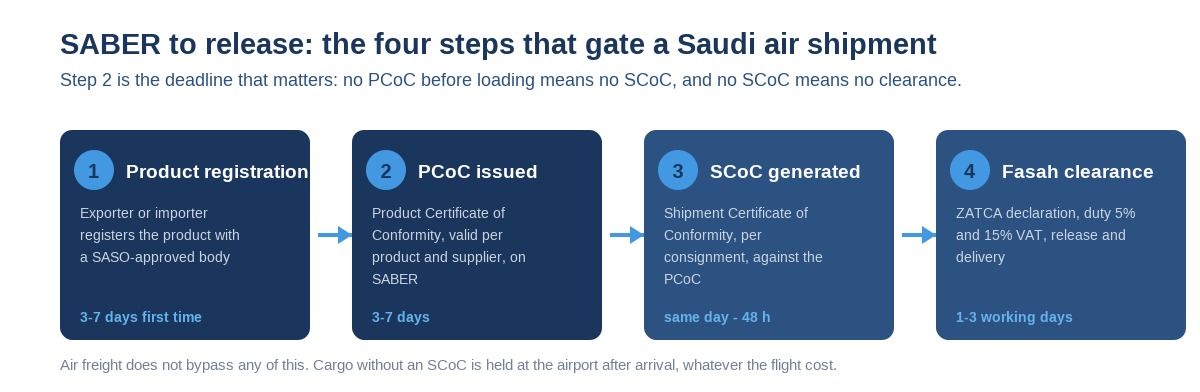
| PCoC — Product Certificate of Conformity | Confirms the product complies with the relevant SASO technical regulation or standard | Before shipment, per product and supplier, registered on the SABER platform | 3 – 7 days for a first registration; longer if testing is required |
| SCoC — Shipment Certificate of Conformity | Confirms the specific consignment matches the registered product | Per shipment, generated in SABER against the PCoC | Same day to 48 hours once the PCoC exists |
The sequence is what catches people: the exporter or importer registers the product and obtains a PCoC through a SASO-approved conformity assessment body, then generates an SCoC for each consignment referencing that PCoC, then the carrier can accept the cargo and ZATCA can clear it on the Fasah single window. If the PCoC does not exist, there is no SCoC, and without an SCoC the consignment is held.
Four categories need attention before you book: electrical and electronic goods (SASO and SALEEM technical regulations), toys, vehicle parts and tyres, and building materials. Food and cosmetics go through SFDA rather than SASO, wireless and telecom equipment needs CITC type approval, and pharmaceuticals need SFDA registration. Labels must be in Arabic, and the certificate of origin must be legalised where the product regulation requires it.
Batteries, Dangerous Goods and the Carriers That Will Not Take Them
Air is the mode where dangerous goods rules are enforced hardest, and Saudi importers hit this most often with lithium batteries.
Loose lithium-ion cells and power banks are Class 9 dangerous goods and need an MSDS, a UN 38.3 test summary, DG packing, and a carrier that accepts them on the specific routing. Many Gulf carriers restrict or refuse standalone batteries even when the paperwork is correct, and the restrictions tighten in peak season when space is scarce. Batteries built into a device are a lower category and are usually accepted with the right declaration.
Other goods that reprice or re-route a booking: aerosols and solvents (Class 2.1 and 3), magnets and magnetised assemblies, machinery with residual fuel, and any liquid cosmetic over the small-quantity limits. The practical rule is to declare the product accurately at quotation stage — a shipment reclassified at the terminal is a shipment that misses its flight and pays a re-handling fee.
How the Saudi Calendar Changes Air Capacity
Air capacity into Saudi Arabia is shaped by passenger traffic more than on most lanes, because a large share of cargo moves in the belly of scheduled flights.
| Window | What happens | Plan |
|---|---|---|
| Ramadan (approximately one month, moving earlier each year) | Belly capacity tightens as passenger traffic rises; retail restocking peaks before it | Book 2 – 3 weeks ahead |
| Hajj season | Jeddah is dominated by pilgrim traffic; cargo space and clearance attention both tighten | Fly RUH or DMM where possible; expect JED delays |
| September – November | Peak import season on top of the current capacity losses | Lock rates and space early |
| Chinese New Year (6 February 2027) | Chinese factories and consolidators close for 2 – 4 weeks | Ship before mid-January |
What Duty, VAT and Airport Handling Add
Once the certificate exists, the money side is simple and predictable — which is more than can be said for the air rate.
| Charge | Rate | Basis |
|---|---|---|
| Import duty | 5% on most goods; 12% to 25% on some lines | CIF value |
| VAT | 15% | CIF value + duty |
| SABER PCoC | Quoted per product by the conformity body | Per registration, valid for a period |
| SABER SCoC | Small per-shipment fee | Per consignment |
| Customs broker and Fasah filing | $150 – 350 per entry | Declaration and release |
| Airport terminal and handling | $0.10 – 0.25 per kg, minimum charges apply | Weight or volume |
The clearance sequence itself is fast once the documents exist: Fasah declaration, duty and 15% VAT settlement, release, then delivery. With a complete SABER file it runs 1 to 3 working days. Without one, it does not run at all. Our Customs Clearance team coordinates PCoC and SCoC with the Saudi broker before the cargo is handed to the airline, which is the only sequence that works.
Air or Sea to Saudi Arabia: Where the Switch Point Actually Sits
This is the one lane where the air-versus-sea decision is closer than importers expect, for a simple geographic reason: Jeddah is close. A container from Shanghai reaches Jeddah in 14 to 20 days on the current services, so air buys you roughly 10 to 15 days, not the 30 it buys on a Europe or US lane.
| Shipment | Air at $7.00 – 9.50 per kg | Sea LCL at $150 per CBM, or FCL | Time saved by air |
|---|---|---|---|
| 100 kg, 0.6 CBM | $700 – 950 | $90 plus fees | 10 – 15 days |
| 300 kg, 1.8 CBM | $2,100 – 2,850 | $270 plus fees | 10 – 15 days |
| 500 kg, 3 CBM | $3,250 – 4,750 | $450 plus fees | 10 – 15 days |
| 1,000 kg, 6 CBM | $6,000 – 8,000 | $900 plus fees, or a 20GP at $5,900 – 8,820 | 10 – 15 days |
| 3,000 kg, 18 CBM | $18,000 – 24,000 | 20GP at $5,900 – 8,820 | 10 – 15 days |
The arithmetic is blunt: beyond about 500 kg, air costs three to five times the sea option to save ten days. That is still the right trade for a launch date, a line-down spare, a tender deadline or stock that earns more than the freight premium in those ten days — and it is the wrong trade for routine replenishment. What the current market changes is the threshold: with air up roughly 40% and sea down 11% month on month, the crossover has moved further toward sea.
Two exceptions are worth knowing. A 20GP at $5,900 to $8,820 makes sea expensive for small volumes, because you cannot buy a fraction of a container — which is why LCL or air both beat FCL below 15 CBM. And project or oilfield cargo into Dammam often has a date that is contractual rather than commercial; in that case air is priced against the penalty, not against the sea rate.
How to Choose an Air Freight Forwarder for Saudi Arabia?
Four things decide whether a Saudi air booking arrives on the date you promised, and none of them is the per-kilo rate.
- Ask which carrier and which airport the cargo is actually booked on this week. RUH and DMM capacity is constrained until 27 November 2026; a forwarder quoting a Riyadh air rate without naming the carrier and the flight date has not checked.
- Ask for the SABER status in writing. PCoC number, product coverage, and whether the SCoC can be generated against it. If the answer is “the importer will handle it”, the cargo is at risk.
- Ask what the chargeable weight is, and how it was calculated. A quote in kilos without the volumetric calculation is a quote that will change at the terminal.
- Ask what happens if the flight is overbooked. On a constrained lane, the fallback matters more than the rate: a held alternative via Dubai or Jeddah, with a named road connection, is the difference between a day and a week.
Dantful has booked China–Saudi air cargo since 2008 from Shenzhen and Hong Kong, with Class-A freight forwarding, NVOCC, FMC and Jctrans certification, direct airline contracts across Gulf carriers and Chinese combination carriers, and Arabic-speaking coordination at destination. We track every consignment daily and send loading photos at origin; 50 operations staff and 50+ customer service staff cover the lane around the clock. Details on our freight forwarder in Shenzhen page and on Air Freight.
For the sea side of the same lane — and the comparison this article keeps pointing at — see sea freight from China to Saudi Arabia, shipping rates from China to Saudi Arabia and how much is shipping from China to Saudi Arabia. Transit-time detail sits in how long is freight from China to Saudi Arabia, the container-level economics in container shipping costs from China to Saudi Arabia, door-to-door including duty and VAT in door to door shipping from China to Saudi Arabia, and the country overview at Shipping from China to Saudi Arabia.
FAQ: Air Freight from China to Saudi Arabia
How much does air freight from China to Saudi Arabia cost per kg?
$6 to $11 per kg for 100 kg and above in November 2026, with the lower end at 500 kg and above and the higher end on loose cargo into Riyadh or Dammam. The first-half 2026 baseline was $4 to $8.50 per kg.
How long does air freight take from China to Saudi Arabia?
3 to 7 days door to door. Direct freighter routings take 8 to 12 hours of flying; the rest is the wait for space, a connection if there is no direct call, and clearance.
Why have air rates to Saudi Arabia risen so sharply?
Capacity. Gulf airspace closures through 2026, the 8 October attack on Riyadh airport, and Emirates SkyCargo’s suspension of Riyadh and Dammam freighter services until 27 November 2026 have all removed space while demand held. Jet fuel was up 108% year on year into October.
Is there still air capacity into Riyadh this month?
Limited, and it depends on the carrier. Jeddah has partial service restored. Many forwarders are routing Riyadh-bound cargo through Jeddah or Dubai with a road leg, which adds one to three days and must be quoted as door to door.
Do I need SABER certification for air freight?
Yes, for regulated products. A PCoC must exist before shipment and an SCoC must be generated per consignment. Air does not bypass the requirement — cargo without it is held on arrival regardless of how it flew.
What is the volumetric rule for air freight?
Length × width × height in centimetres divided by 6,000, with the greater of actual and volumetric weight charged. Light bulky cargo can charge at 40% above its physical weight.
Is air freight worth it compared with sea to Jeddah?
Only when the date is worth more than the premium. Sea to Jeddah is 14 to 20 days, so air saves 10 to 15 days at three to five times the cost above 500 kg. It pays for launches, line-down spares and tender deadlines, not routine replenishment.
What documents are needed for a Saudi air shipment?
Commercial invoice, packing list, air waybill, certificate of origin, SABER PCoC and SCoC for regulated products, and the importer’s CR and VAT registration for Fasah clearance. Arabic labelling is required.

Young Chiu is a seasoned logistics expert with over 15 years of experience in international freight forwarding and supply chain management. As CEO of Dantful International Logistics, Young is dedicated to providing valuable insights and practical advice to businesses navigating the complexities of global shipping.