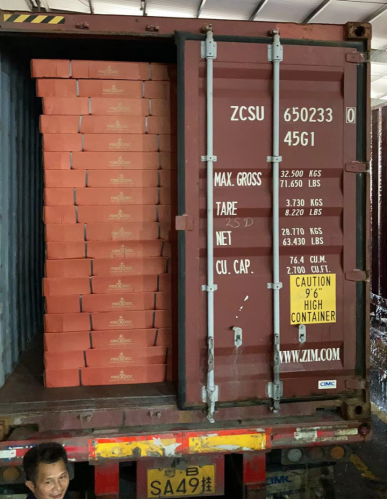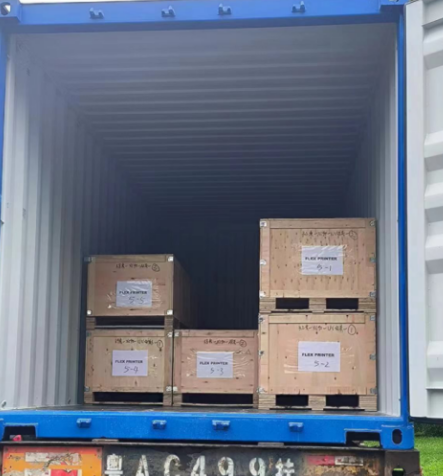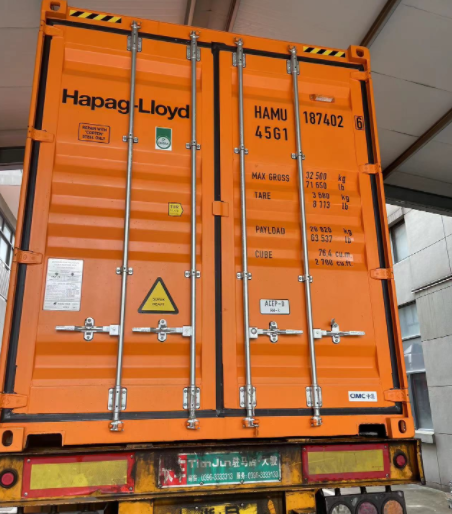
FCL shipping from China to Germany means one shipper books one container, seals it at a Chinese factory or CFS, and it stays sealed until a German terminal or the consignee’s yard. In November 2026 that costs roughly $2,250 to $2,700 for a 20GP and $3,450 to $4,050 for a 40GP/40HQ port to port into Hamburg or Bremerhaven, with 25 to 33 days on the water and another 5 to 10 days for clearance and inland delivery. This guide is written the way we actually quote the lane out of Shenzhen: what each box holds, which German gateway to book, what the German terminal will bill you after arrival, and where the FCL-versus-LCL line really sits in today’s rate market.
As a specialist in Shipping From China To Germany, we have booked full containers into Hamburg, Bremerhaven and Wilhelmshaven since 2008 — machinery from Ningbo, furniture from Foshan, auto parts from Guangzhou, industrial valves from Wenzhou. What follows is the operating knowledge behind those bookings, not a generic rate table.
Table of Contents
What Is FCL Shipping from China to Germany, and When Does a Full Container Pay Off?
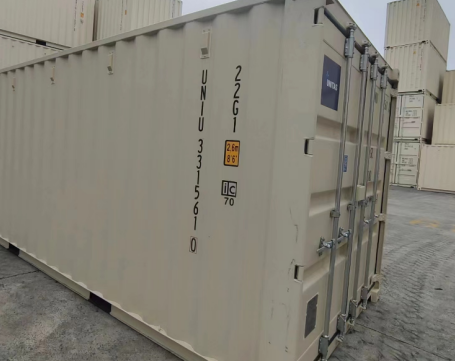
FCL is the mode where the ocean bill is priced per container instead of per cubic meter. You get the whole box: the full 33 CBM of a 20GP or the 67 to 76 CBM of a 40ft, a single seal number, and a bill of lading that names your cargo only. Nothing is co-loaded, nothing is deconsolidated at a German CFS, and no other importer’s paperwork touches your container.
That matters more on the Germany lane than on most routes, for three practical reasons.
Sealed cargo clears faster. A full container is declared at ATLAS as one customs position with one set of invoice lines and goes straight to a consignee or a bonded warehouse. LCL cargo has to be stripped at a CFS first, which means the box clears before your goods can physically move — an extra 3 to 5 days that nobody puts in the transit table.
The box protects the cargo. Furniture, machinery, tiles, and anything palletised survives a 30-day sea voyage better inside a sealed steel box that was stuffed under your own supervision than inside a shared container restacked twice.
Weight and dimension are under your control. An FCL booking lets you plan around the real constraint on this lane: German road weight limits and the payload of the box, not the chargeable-weight formula of a consolidator.
The trade-off is straightforward. FCL is only cheaper than LCL once your volume reaches a threshold that moves with the freight market — and in late 2026 that threshold is far higher than the 13 to 15 CBM figure still printed on most forwarder pages. We get into that in the break-even section below.
How Much Does FCL Shipping from China to Germany Cost in November 2026?
Ocean rates on Asia to North Europe fell hard through October, then carriers tried to push them back up on 1 and 15 November and mostly failed. The current market is worth pricing from two directions at once: what carriers publish, and what the spot market actually trades at.
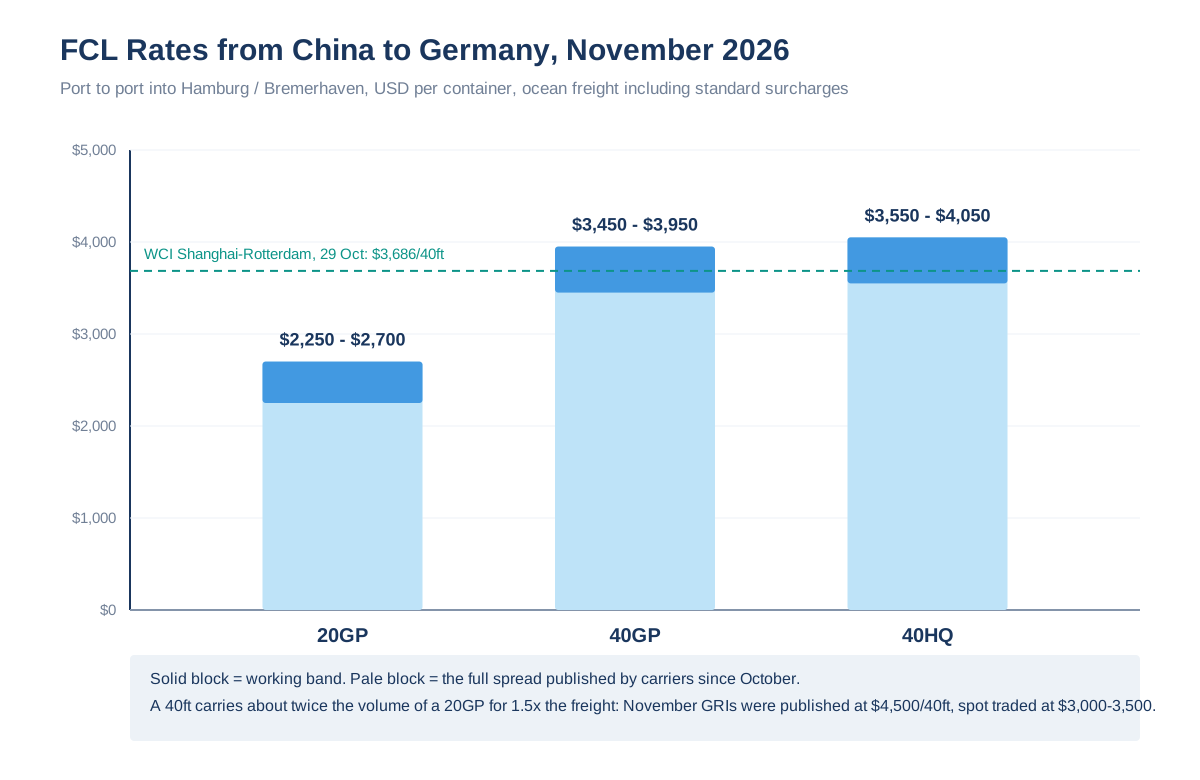
Working bands for November 2026, port to port (ocean freight plus standard surcharges including the EU ETS pass-through, excluding origin charges in China and destination charges in Germany):
| Container | November 2026 band | Typical payload | Best suited cargo |
|---|---|---|---|
| 20GP | $2,250 – $2,700 | up to ~28,200 kg | Dense cargo: machinery, hardware, tiles, chemicals in drums |
| 40GP | $3,450 – $3,950 | up to ~26,700 kg | Mixed palletised freight, furniture, appliances |
| 40HQ | $3,550 – $4,050 | up to ~26,500 kg | Light bulky cargo: flat-pack furniture, packaging, textiles |
| 40RH (reefer) | $5,200 – $6,200 (indicative, quote only) | ~27,000 kg | Temperature-controlled food, pharma, cosmetics |
| LCL (reference) | $75 – $130 per CBM | weight-or-measure | 1 to 13 CBM part loads |
Read that table against the benchmark data underneath it, because the two tell different stories:
| Benchmark | Date | Figure | What it tells you |
|---|---|---|---|
| Published forwarder band, 20GP Hamburg/Bremen | October 2026 | $2,160 – $2,640 | The market after the July peak surcharge unwound |
| Published forwarder band, 40GP Hamburg/Bremen | October 2026 | $3,330 – $4,070 | Down roughly 19% month on month |
| Drewry World Container Index, Shanghai to Rotterdam | 29 October 2026 | $3,686 per 40ft, +1% w/w | The all-in spot reference for North Europe |
| Linerlytica assessed Asia to North Europe spot | Early November 2026 | $3,000 – $3,500 per 40ft | Where carriers actually traded |
| MSC published FAK, North Europe | 1 November 2026 | $4,500 per 40ft (nominal) | The GRI that the spot market undercut |
Three things follow from this. First, the 20GP-to-40ft ratio is not fixed: a 40ft carries roughly twice the volume for only 1.5 times the freight, which is why a 40HQ is almost always the better buy above 33 CBM. Second, the November GRIs are nominal — with record weekly capacity deployed on Asia-Europe in October and November, carriers were already discounting their own published increases by the first week of the month. Third, the rate you are quoted in December will not be this number, so the only defensible planning method is to fix the ocean rate at booking and confirm the free time and destination charges in writing at the same time.
One more number that belongs next to these: the EU ETS pass-through. Shipping has been inside the EU Emissions Trading System since 2024, and the obligation phases in by reporting year — 40% of 2024 emissions, 70% of 2025 emissions, 100% from 2026 emissions onward, with allowances surrendered the following year. In practice carriers bill an ETS surcharge per container on EU calls, and it will step up once more in 2027 when the last 30% lands. Ask for it as a named line, not folded into a generic “all-in” rate.
20GP, 40GP or 40HQ: Which Container Fits Your German Order?
Container choice is a volume and weight decision, and on the Germany lane it is also an inland-transport decision, because the box you pick has to travel legally on a German road or rail wagon after it leaves the terminal.
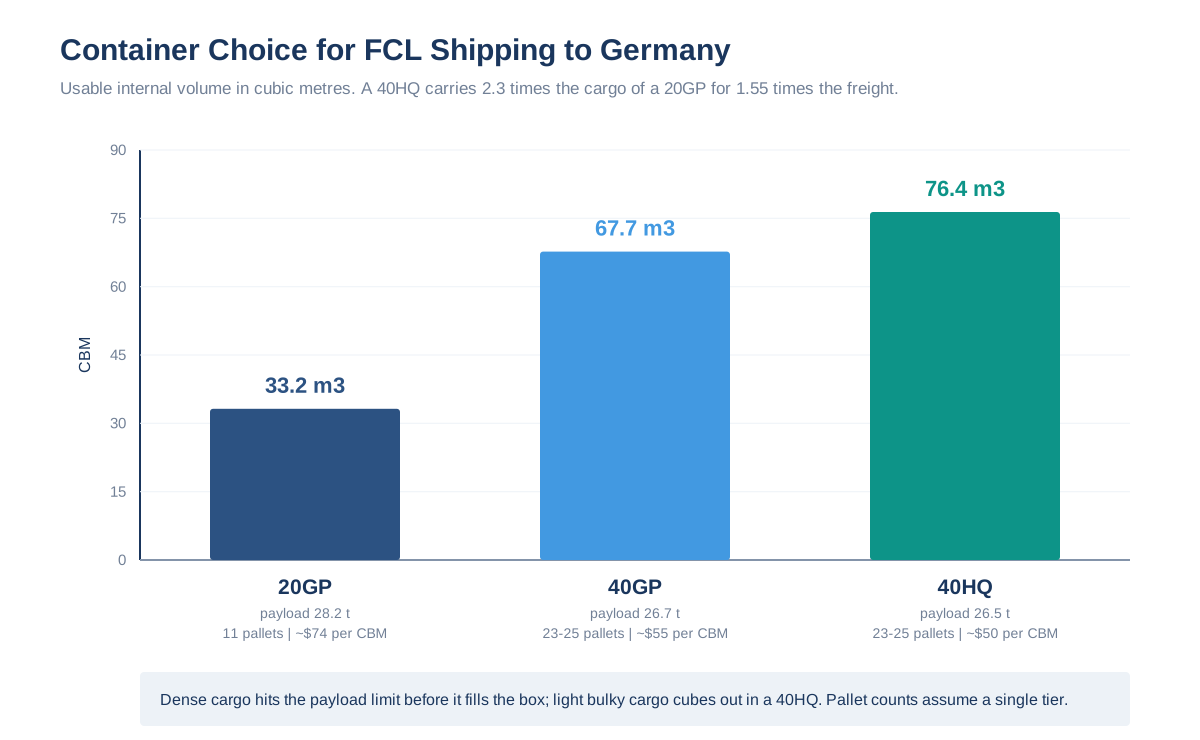
| Specification | 20GP | 40GP | 40HQ |
|---|---|---|---|
| Internal length | 5.90 m | 12.03 m | 12.03 m |
| Internal width | 2.35 m | 2.35 m | 2.35 m |
| Internal height | 2.39 m | 2.39 m | 2.69 m |
| Usable volume | ~33.2 CBM | ~67.7 CBM | ~76.4 CBM |
| Tare weight | ~2,300 kg | ~3,750 kg | ~3,900 kg |
| Max payload | ~28,200 kg | ~26,700 kg | ~26,500 kg |
| Euro pallets, single tier | 11 | 23 – 25 | 23 – 25 |
| Ocean freight versus 20GP | baseline | +50% | +55% |
| Ocean freight per CBM at full load | ~$74 | ~$55 | ~$50 |
How that plays out on real German orders:
- High-density cargo goes in a 20GP. Tiles, sanitaryware, steel fittings, bagged chemicals, and machinery bases hit the 28-ton payload long before they fill 33 CBM. Paying for a 40ft here buys air.
- Light bulky cargo goes in a 40HQ. Flat-pack furniture, mattresses, packaging, textiles, and plastic housewares cube out before they weigh out; the extra 30 cm of height is worth $100 to $150 in freight and roughly 9 extra CBM of cargo space.
- 40GP only makes sense when the cargo is heavy and long. It is the box for long steel, timber, and machinery that fills the floor but cannot use the high cube’s headroom.
- 45HQ is a specialist booking. It adds about 10 CBM, but German hinterland trucking for 45ft units is thinner than for 40ft, some regional authorities require a permit for the extra length, and not every terminal or rail wagon is set up for it. On this lane, book a 45ft only if the forwarder can name the trucker and the route before you pay the deposit.
- Reefer cargo needs a reefer plug slot, not just a box. A 40RH costs 1.5 to 1.8 times a dry 40ft and needs pre-trip inspection documentation. Book two to three weeks earlier than dry cargo.
One detail that catches first-time importers: pallets do not fill the floor efficiently unless you plan the pattern. A 20GP takes 11 euro pallets single-tier; a 40ft takes 23 to 25. If your cartons can safely bear a second tier, a light 40HQ effectively doubles to 46 to 50 pallet positions — which changes the per-unit maths more than any freight negotiation will.
Hamburg, Bremerhaven or Wilhelmshaven? Choosing Your German Gateway
Germany’s container imports land almost entirely at three North Sea gateways, and they behave differently enough that the choice is worth a real decision rather than defaulting to Hamburg.
| Gateway | 2025 container throughput | Draft / berths | Its real advantage | Its real cost |
|---|---|---|---|---|
| Hamburg | 8.3 million TEU (+7.3% y/y) | Tidal Elbe, draft set at high water | Largest carrier choice, deepest hinterland network in Europe by rail | Most congested berth windows, highest terminal charges |
| Bremerhaven | 5.21 million TEU | 14–16.5 m, 14 berths, 4,930 m quay | Handles the biggest Asia vessels without tidal waiting, strong for vehicles and project cargo | Fewer direct Asia calls than Hamburg, weaker southern-German rail links |
| Wilhelmshaven | Deepwater, 18 m | 18 m draft, purpose-built | Only German port taking the largest ships at full draft; cheapest THC of the three | Thin inland network, longer road/rail leg to southern Germany |
| Rotterdam / Antwerp gateway | Transshipment | n/a | Often the cheapest ocean leg; feeder or truck into Germany | Your B/L may name a non-German port, which changes the transit declaration and the inland cost |
Rate differentials we see in practice, against a Shanghai to Hamburg baseline:
| China origin port | Hamburg | Bremerhaven | Wilhelmshaven | Notes |
|---|---|---|---|---|
| Shanghai | baseline | +$40 to +$80 | quote only | Most sailings, best schedule choice |
| Ningbo | −$50 to $0 | +$60 | quote only | Strong for Zhejiang factories |
| Shenzhen / Yantian | +$60 to +$120 | +$100 | quote only | Premium for the extra coastal leg |
| Qingdao | +$20 to +$60 | +$80 | +$40 | Best for Shandong and northern suppliers |
| Tianjin / Xingang | +$100 to +$150 | +$120 | quote only | Cheapest inland trucking for Beijing/Hebei cargo |
| Xiamen | +$40 to +$90 | +$100 | quote only | Feeder to Ningbo/Shanghai on some services |
Which to pick, by destination:
- North Rhine-Westphalia, Hesse, Lower Saxony: Hamburg or Bremerhaven, then rail or truck. The Ruhr is the densest import market in Europe and both ports run daily block trains to Duisburg, which is the largest inland container hub on the continent.
- Bavaria, Baden-Württemberg: this is where the gateway decision changes the bill. Hamburg to Munich is roughly 800 km; Wilhelmshaven to Munich is over 900 km with fewer block trains. Add $600 to $1,200 for the inland leg and compare the total, not the ocean rate.
- Berlin, Saxony, Saxony-Anhalt: Hamburg, with rail via Leipzig or direct trucking.
- Anything on a tight delivery window: Bremerhaven, because it takes the largest ships at 16.5 m without a tidal window. Hamburg’s Elbe draft is the reason vessels occasionally sail short or wait for high water, and that shows up as schedule slippage rather than a line on the invoice.
FCL vs LCL on the China to Germany Lane: Where the Break-Even Actually Sits
Every forwarder page quotes a 13 to 15 CBM break-even for Germany. That number was calculated when a 40ft booked for under $2,000. In November 2026, with the 40ft spot market at $3,000 to $3,700, the arithmetic has moved — and it is worth understanding both thresholds, because cost and operational risk do not break even at the same point.
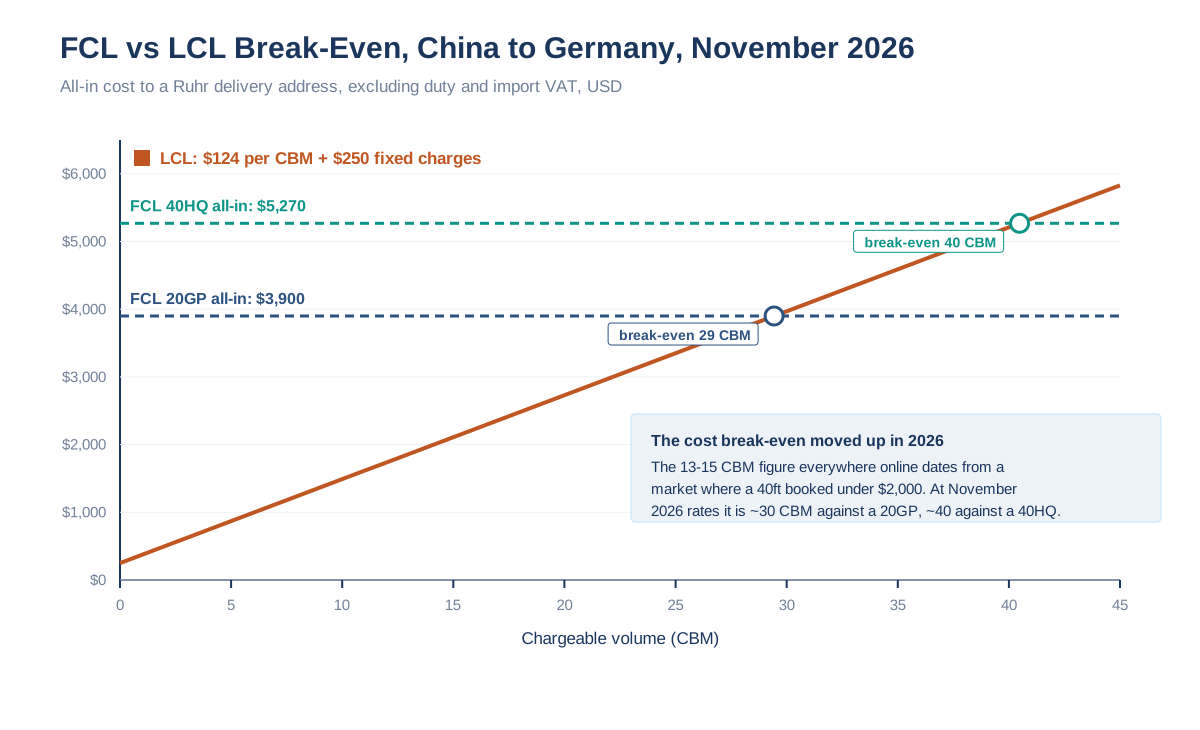
Comparing like with like. The FCL figures below are all-in to a Ruhr delivery address: ocean freight, origin charges in China, German THC, destination documents, and the inland leg, but excluding duty and import VAT. The LCL figures are ocean freight at $100/CBM plus German CFS and deconsolidation handling at roughly $24/CBM plus about $250 of fixed per-shipment charges (clearance, documents, delivery order).
| Cargo volume | LCL all-in | FCL 20GP all-in | FCL 40HQ all-in | Cheaper option |
|---|---|---|---|---|
| 10 CBM | $1,490 | $3,900 | $5,270 | LCL |
| 15 CBM | $2,110 | $3,900 | $5,270 | LCL |
| 20 CBM | $2,730 | $3,900 | $5,270 | LCL |
| 25 CBM | $3,350 | $3,900 | $5,270 | LCL |
| 30 CBM | $3,970 | $3,900 | $5,270 | FCL 20GP from here |
| 35 CBM | $4,590 | $3,900 | $5,270 | FCL 20GP |
| 43 CBM | $5,582 | — (exceeds 20GP) | $5,270 | FCL 40HQ from here |
So there are two break-evens, not one.
- Cost break-even: about 30 CBM against a 20GP, about 40 CBM against a 40HQ. Below that, LCL is genuinely cheaper on this lane at today’s rates, and pretending otherwise is how importers end up overpaying for half-empty boxes.
- Operational break-even: about 12 to 15 CBM. This is where most experienced importers switch regardless of cost, because at 15 CBM you are already paying LCL rates for cargo that will be restacked twice, handled by people who did not pack it, and released only after the CFS strips the container.
That second number is the one we act on. Above 15 CBM, FCL buys you seal integrity, no co-loading claims, a 3 to 5 day faster release at destination, and a container that can be delivered directly to a production line. Below 15 CBM, LCL or consolidation is the honest recommendation, especially when the volume is small but recurring.
If your volume is genuinely borderline, the deciding question is not the freight: it is what a damaged or delayed shipment costs you. A furniture importer with a retail launch date should book the 20GP at 18 CBM. A trader shipping sample stock can consolidate.
Every Charge on an FCL Invoice from China to Germany, Line by Line
The ocean rate is the smallest part of the surprise in most first shipments. Here is the full chain, and what to do about each line before you book.
| Charge | Billed by | Typical amount | What it is and how to plan for it |
|---|---|---|---|
| Ocean freight + BAF/LSS | Carrier, via your forwarder | 20GP $2,250–2,700 · 40HQ $3,550–4,050 | The base rate, including fuel and low-sulphur adjustment. Fix it at booking with a validity date. |
| EU ETS surcharge | Carrier | $120 – $260 per container | The carbon cost passed through on EU calls, currently at the 70% obligation level and rising in 2027. Ask for it as a separate line so you can check it each quarter. |
| Origin THC (China) | Terminal, via forwarder | RMB 900–1,500 (20GP) · RMB 1,400–2,200 (40HQ) | Handling at the Chinese terminal. Non-negotiable, but confirm whether the quote is all-in or excludes it. |
| Export declaration + docs | Forwarder | RMB 300–700 | Filing the Chinese export declaration and bill of lading. Included in most Dantful quotes. |
| VGM weighing | Terminal / forwarder | RMB 100–300 | The verified gross mass certificate. Missing or wrong VGM means a rolled container, so confirm who files it and by when. |
| Inland pickup in China | Trucker | RMB 800–2,500 | Factory to port. Depends entirely on distance and whether the factory can load a 40ft from its yard. |
| German THC (THD) | German terminal | €295–325 per container | Published by carriers for 2026: €325 at Hamburg and Bremerhaven for standard containers, €295 at Wilhelmshaven, ISPS and GermanPorts surcharge included. Dangerous goods €365, reefer €475, out-of-gauge €590. |
| Destination documentation | Carrier / agent | €50 – €90 | Bill of lading release and delivery order. Cheap, but nothing moves without it. |
| Import declaration / customs broker | Zoll agent | €80 – €200 per declaration | ATLAS filing, duty and import VAT payment. Confirm the broker’s name and whether they can file under your EORI. |
| Inland delivery | Rail / trucker | €250–600 (Ruhr) · €600–1,200 (Munich) | The leg that most often decides which gateway to use. Get this quoted with the ocean rate, not after arrival. |
| Demurrage / detention | Terminal / carrier | €60–120 per day (20GP) · €90–220 per day (40HQ) | Free time in Hamburg is 4 to 7 days after discharge depending on the carrier. Negotiate 14 days if the final destination is deep in Bavaria. |
| Duty and import VAT | Zoll | Duty 0–12% · VAT 19% | Calculated on CIF value. Import VAT is recoverable for VAT-registered German importers. |
None of these are hidden — they are standard parts of the cost chain, and a professional forwarder itemises them in the quote. What varies is who pays which line and whether the quote is port-to-port, door-to-door, or DDP. The ddp model rolls the German side into one price; the FOB or CIF model leaves the destination fees with the consignee.
Booking to Delivery: The 8 Steps of an FCL Shipment to Germany
An FCL shipment from China to Germany runs on eight checkpoints. Every delay we have ever had to explain traced back to one of them.
- Quote and space confirmation. You approve a rate with a validity date, the forwarder books with the carrier under a service contract and issues a booking confirmation with a cut-off date and a vessel name. Do not treat a rate as a space guarantee on this lane in November.
- Container release and empty pickup. The forwarder picks up an empty at the depot, and the factory or CFS gets a loading window. Confirm the empty’s condition (holes, smell, previous cargo residue) before it is stuffed — a rejected empty is a two-day delay.
- Stuffing, lashing and sealing. Cargo is loaded against a plan, braced, and sealed. The seal number goes on the bill of lading and the photos go into the shipment file. For machinery and furniture this is the step where damage claims are won or lost.
- VGM and shipping instructions. The verified gross mass is filed before the carrier’s cut-off under SOLAS rules; the shipping instruction confirms shipper, consignee, notify party, HS codes and marks. Wrong or late VGM equals a rolled container, no exceptions.
- Export declaration and loading. China customs releases the container, the terminal loads it, and the vessel sails. At this point the container is on the water and the only remaining variables are documentation and destination.
- Bill of lading. Original, telex release, or seaway bill. German consignees usually prefer telex or seaway bills to avoid courier time, but confirm with your broker before the vessel sails.
- ICS2 ENS filing. The EU requires an entry summary declaration before loading, filed by the carrier but built from your data: a six-digit HS code, the EU buyer’s EORI number, and an accurate goods description. Vague descriptions like “spare parts” trigger screening and delay release.
- Arrival, Zoll clearance and delivery. The container discharges, the broker files the ATLAS import declaration, duty and import VAT are paid or deferred, the terminal releases the box, and it moves inland by rail or truck. Free time starts at discharge, not at booking.
The two checkpoints that most often go wrong on the German side are 7 and 8. An incomplete ICS2 filing can hold a container at the terminal after it has already incurred demurrage, and a broker who cannot file under your EORI number adds days you cannot recover.
Clearing an FCL Container at German Customs: EORI, ATLAS, 19% VAT and 2026 Rules
German customs is administered by the Zoll under the Union Customs Code, with declarations filed electronically through ATLAS and duty rates taken from TARIC. Four things determine whether your container walks out of the terminal or sits there.
EORI. Every commercial import needs an EU EORI number. No EORI, no declaration, no release. If you buy on FOB or EXW terms and do not have a German entity, the importer of record has to be a German-established entity or an indirect representative — decide this before the vessel sails, not after arrival.
Duty. Rates come from TARIC by HS code and most industrial goods from China land in the 0 to 12% band: machinery and furniture are typically 0 to 2.7%, electronics 0 to 4.5%, textiles around 12%, footwear higher. Anti-dumping duties apply to specific categories — steel fasteners, ceramics and tableware, e-bikes — so check TARIC for your exact code rather than trusting a generic percentage.
Import VAT (Einfuhrumsatzsteuer). 19% standard, 7% for books, newspapers and most food. It is charged on the CIF value plus duty. A VAT-registered German importer recovers it, which makes it a cash-flow item rather than a cost — and a properly authorised importer can defer it into the regular VAT return under § 21 UStG instead of paying at the border, which is worth arranging in advance.
The 2026 compliance watchlist, in the order it affects container freight:
- CBAM is in its definitive regime. Since 1 January 2026, imports of steel, aluminium, cement, fertilisers, electricity and hydrogen are subject to the Carbon Border Adjustment Mechanism: an annual declaration, certificates surrendered against embedded emissions, and authorised CBAM declarant status above a 50-tonne-per-year de minimis threshold. The first declaration for 2026 imports is due by 30 September 2027. If your container holds steel or aluminium goods, this is now a customs obligation, not an environmental footnote.
- EU ETS pass-through. The maritime phase-in reaches 100% of 2026 emissions, surrendered in 2027, which is why the surcharge line on your invoice will rise once more.
- Low-value consignment duty. The EU’s €150 duty exemption for small consignments was replaced in 2026 by a flat €3-per-item duty on low-value e-commerce imports. It does not touch container freight directly, but it does affect the spare-parts and sample shipments you might otherwise send by courier.
- ISPM 15 and CE marking. Wooden pallets and crates need ISPM 15 treatment marks; regulated products need CE marking and a Declaration of Conformity. Both are checked at import, and both are the consignor’s responsibility, not the forwarder’s.
Worked example: a 40HQ of machinery components, CIF value $30,000, duty 4%.
| Cost element | Amount | Notes |
|---|---|---|
| Ocean freight incl. ETS pass-through | $3,800 | Mid-band of the November 2026 40HQ range |
| Origin charges in China | $520 | THC, documents, VGM, export declaration, pickup |
| German THC | $350 | €325 published 2026 rate, converted at €1 = $1.08 |
| Destination documents and delivery order | $120 | B/L release and DO |
| Hamburg to Dortmund rail | $480 | Ruhr delivery |
| Subtotal before duty and VAT | $5,270 | The number your forwarder quotes |
| Duty at 4% on CIF $30,000 | $1,200 | Paid at import |
| Import VAT at 19% on $31,200 | $5,928 | Recoverable if VAT-registered |
| Cash required at clearance | $12,398 | |
| Net landed logistics cost | $6,470 | After reclaiming the import VAT |
That gap between $5,270 and $12,398 is the single most common reason an importer’s cash flow breaks in the week a container arrives. Plan the duty and VAT before the vessel berths — and see container shipping costs from china to Germany if you want the same breakdown at other container sizes.
Transit Times from China to Germany, and What Moves Them
| Leg | 20GP / 40HQ sea | Notes |
|---|---|---|
| Shanghai or Ningbo to Hamburg, port to port | 25 – 33 days | The fastest direct services |
| Shenzhen or Guangzhou to Hamburg | 28 – 38 days | Extra coastal leg via the South China Sea |
| Bremerhaven instead of Hamburg | +0 – 3 days | Fewer direct calls, sometimes faster berthing |
| Zoll clearance and terminal release | +2 – 5 days | Faster with a clean ATLAS declaration and a broker who has your EORI |
| Inland delivery to Ruhr | +1 – 3 days | Rail or truck |
| Inland delivery to Munich or Stuttgart | +2 – 5 days | The leg that most often pushes door-to-door past 40 days |
| FCL door to door, total | 32 – 45 days | What to put in a customer promise |
Two variables move these numbers more than anything else. Routing: published schedules of 25 to 33 days are consistent with Suez routing; any service still avoiding the Red Sea takes the Cape of Good Hope and adds 10 to 14 days, so confirm the routing on the proforma schedule. Seasonality: Chinese New Year (6 February 2027), the Golden Week closure in the first week of October, and the Q3–Q4 European retail build-up all tighten space and push rates up 15 to 30%. If you can book in January or in the June–August lull, the same container costs materially less — see shipping rates from china to Germany for the seasonal pattern, and how long is freight from china to Germany for the transit-time breakdown by mode.
If speed matters more than cost, the comparison is usually sea FCL versus China-Europe rail, which reaches Duisburg in 12 to 18 days at roughly twice the ocean rate, or Air freight from china to germany at 5 to 8 days airport to airport. For most FCL cargo above 20 CBM, the rail premium rarely justifies itself unless the delivery date is contractual.
How to Choose an FCL Freight Forwarder from China to Germany
This lane has three jobs in one quote — ocean booking into a congested North Sea gateway, EU customs compliance, and an inland leg that can cost more than the freight — and a forwarder who is strong on one is often weak on the others. Four checks that actually separate them:
1. Do they contract directly with the carrier on this leg? Ask for the carrier name, the service name, and the proforma schedule. A forwarder buying on the spot market from another forwarder cannot protect your space in a November capacity squeeze, and cannot rebook you when a vessel is rolled.
2. Can they show the German side in writing before you book? The 2026 THC rates are published: €325 per container at Hamburg and Bremerhaven, €295 at Wilhelmshaven, with ISPS included. A quote that does not name the THC, the free time, or the per-day demurrage rate is not a quote — it is an ocean rate with a promise attached.
3. Do they file ICS2 and ATLAS themselves, with a named German broker? Ask who files the entry summary declaration, who holds the customs broker relationship, and whether import VAT can be deferred under § 21 UStG. On a Germany lane this is the difference between a 2-day and a 7-day terminal release.
4. Do they supervise stuffing and document the seal? FCL claims on this lane are almost always loading claims. Ask for the stuffing photos, the seal number record, and the VGM filing confirmation as standard deliverables rather than on request.
Dantful has been booking China to Germany full containers since 2008 as a freight forwarder in shenzhen china, Class-A licensed with NVOCC, FMC and Jctrans membership and direct carrier contracts. Fifty operations staff and 50-plus customer service agents cover the lane around the clock with daily milestone updates and loading photos, and our German partners handle Zoll clearance under your EORI — including import VAT deferral where you qualify. If you are comparing options, our freight forwarder from china to Germany and shipping agent from china to Germany pages explain the two service models, and cheapest shipping company from china to Germany covers what genuinely drives cost down. For port-level routing detail, see our Sea Freight From China to Germany guide, or start from a shipment booked out of Shenzhen in Shipping from Shenzhen to Germany. If you need the container delivered to your door with duty and VAT handled, our door to door shipping from China to Germany service covers that model end to end.
FAQs About FCL Shipping from China to Germany
How much does FCL shipping from China to Germany cost in November 2026?
Port to port, expect $2,250 to $2,700 for a 20GP and $3,450 to $4,050 for a 40GP or 40HQ into Hamburg or Bremerhaven, including standard surcharges. Add $800 to $1,500 for origin and German destination charges, then duty and 19% import VAT on top. Door to door to the Ruhr typically lands between $3,900 and $5,300 depending on container size.
How long does an FCL container take from China to Germany?
25 to 33 days port to port on direct services to Hamburg, 28 to 38 days from Shenzhen or Guangzhou, plus 2 to 5 days for Zoll clearance and 1 to 5 days for inland delivery. Plan 32 to 45 days door to door, and add 10 to 14 days if the service is routing via the Cape of Good Hope instead of Suez.
Is FCL cheaper than LCL from China to Germany?
Not at every volume. At November 2026 rates the cost break-even is around 30 CBM against a 20GP and 40 CBM against a 40HQ, because ocean rates are still elevated. Most importers switch to FCL at 12 to 15 CBM anyway, for faster release, seal integrity and lower damage risk rather than for the freight saving.
Should I ship to Hamburg or Bremerhaven?
Hamburg for carrier choice, hinterland rail depth and the Ruhr, Berlin and Leipzig corridors. Bremerhaven if your cargo is heavy, oversized, or needs the biggest ships without a tidal window, since its 14 to 16.5 m draft and 14 berths handle them directly. For southern Germany, price both plus the inland leg before deciding.
Can I book a 40HQ or a 45ft container into Germany?
A 40HQ is routine and usually the best value above 33 CBM. A 45ft adds about 10 CBM but German hinterland trucking is thinner, some regions require a permit for the extra length, and not every terminal or rail wagon handles it — book only when your forwarder can name the trucker and the route.
What is VGM and why does it stop my container?
Verified gross mass, required under SOLAS. The packed container’s weight must be declared before the carrier’s cut-off. A missing or inaccurate VGM means the container is not loaded, regardless of whether the cargo is ready, and you absorb the rollover cost.
What documents do I need to clear an FCL container in Germany?
Commercial invoice, packing list, bill of lading, EORI number, an ICS2 entry summary declaration filed by the carrier from your data, and an ATLAS import declaration filed by your customs broker. Wooden packaging needs ISPM 15 marks, regulated products need CE marking and a Declaration of Conformity, and CBAM goods need authorised declarant status.
Is the 19% import VAT a real cost?
For a VAT-registered German importer, no — it is recoverable, and with a § 21 UStG authorisation it can be deferred into the regular VAT return instead of paid at the border. For a non-EU importer clearing under an indirect representative, it is a genuine cash cost unless the arrangement passes it to a German entity.
How many free days do I get at Hamburg before demurrage?
Four to seven days after discharge, depending on the carrier. Deep-inland destinations like Munich need 14 days negotiated at booking, because the inland leg alone can consume a week. Demurrage runs €60 to €120 per day on a 20GP and €90 to €220 on a 40HQ.
Can I ship overweight cargo in a 20GP?
Yes, within limits: a 20GP carries roughly 28,200 kg of payload, but German road rules cap the gross vehicle weight and therefore how much a truck can legally move from the terminal. If your cargo is close to the box limit, tell the forwarder at quoting stage — the inland leg, not the ocean leg, is where overweight becomes expensive.
Rates in this guide are the market bands we are quoting in November 2026 and move weekly. Ask for a current quote with a stated validity date before you commit a delivery promise.

Young Chiu is a seasoned logistics expert with over 15 years of experience in international freight forwarding and supply chain management. As CEO of Dantful International Logistics, Young is dedicated to providing valuable insights and practical advice to businesses navigating the complexities of global shipping.