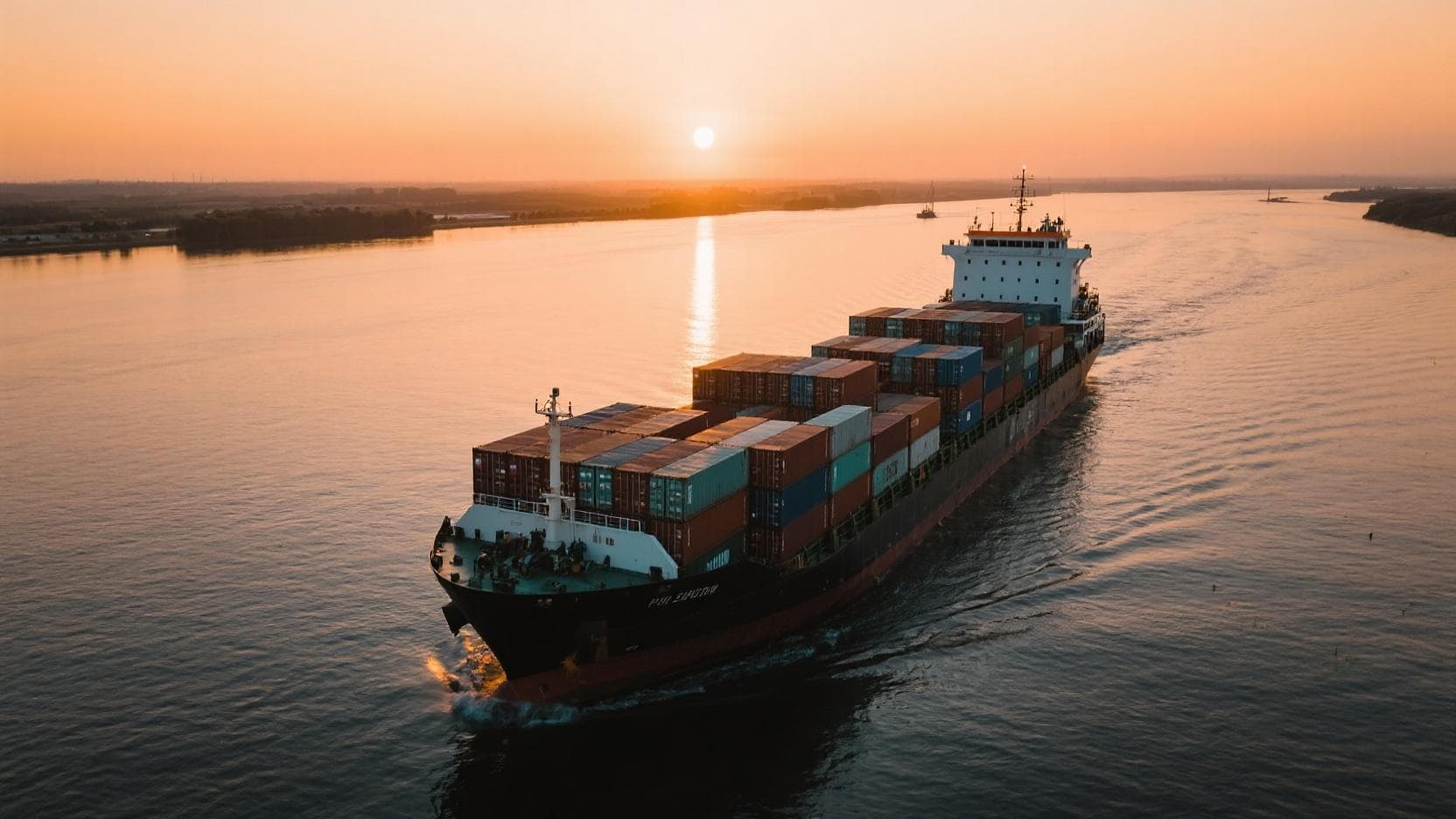
Los Angeles and Long Beach are the two busiest container gateways in the United States, and in the last week of October 2026 they became the most uncomfortable place in the trans-Pacific supply chain to have cargo sitting. As of 2 November 2026, 35,688 import containers were waiting on terminals for an on-dock train, 10,562 of them for nine days or longer. The ILWU Local 26 contract covering roughly 250 terminal watchmen was extended to 5 p.m. Pacific on 4 November, with a strike still possible. And on 7 November the Vincent Thomas Bridge closes for about 16 months, which changes how trucks move between San Pedro and Terminal Island.
That combination is unusual, and it is worth being precise about what it is and is not. There is no vessel queue offshore — one ship was waiting for a berth in the week of 26 October, which is normal for this complex. The pressure is on the landside: rail cars, terminal gates, chassis and truck turn times. For a Chinese exporter or a US importer, that distinction decides whether you should reroute an ocean booking, rebook a rail leg, or simply move your cargo off the dock faster.
This guide covers the current condition of the LA/Long Beach gateway, what the Local 26 dispute can actually stop, what a delay costs at today’s rates, which alternative gateways are genuinely available on short notice, and the customs work that has to happen if you change your discharge port. It is written for importers moving cargo from China — B2B distributors, Amazon FBA sellers and small firms without a logistics department — and every figure is dated, because the market moved twice this month. If you are new to the lane, start with our overview of shipping from China to USA before working through the disruption decisions below.
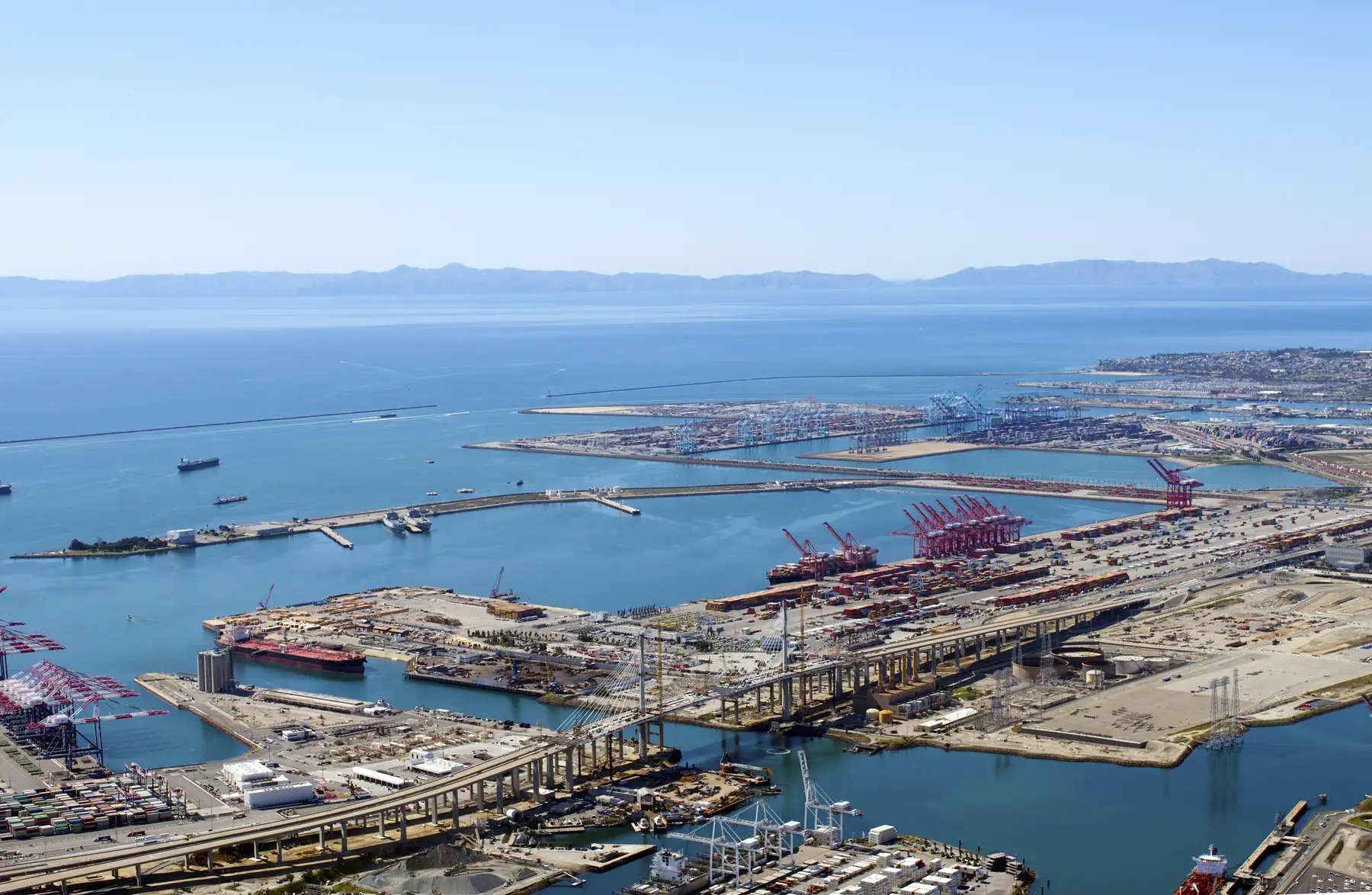
Table of Contents
How Bad Is Port Congestion at Los Angeles and Long Beach Right Now?
The short answer: worse than the headlines suggest on the rail side, better than the headlines suggest on the water side. The Port of Los Angeles operations report for Friday 30 October 2026 showed 17 container vessels at berth, 56 vessel gangs working and five gangs cut, local cargo dwelling 3.7 days on terminal, on-dock rail cargo dwelling 5.6 days, and 21,683 import containers on POLA terminals awaiting an on-dock train, of which 8,937 had been there nine days or more.
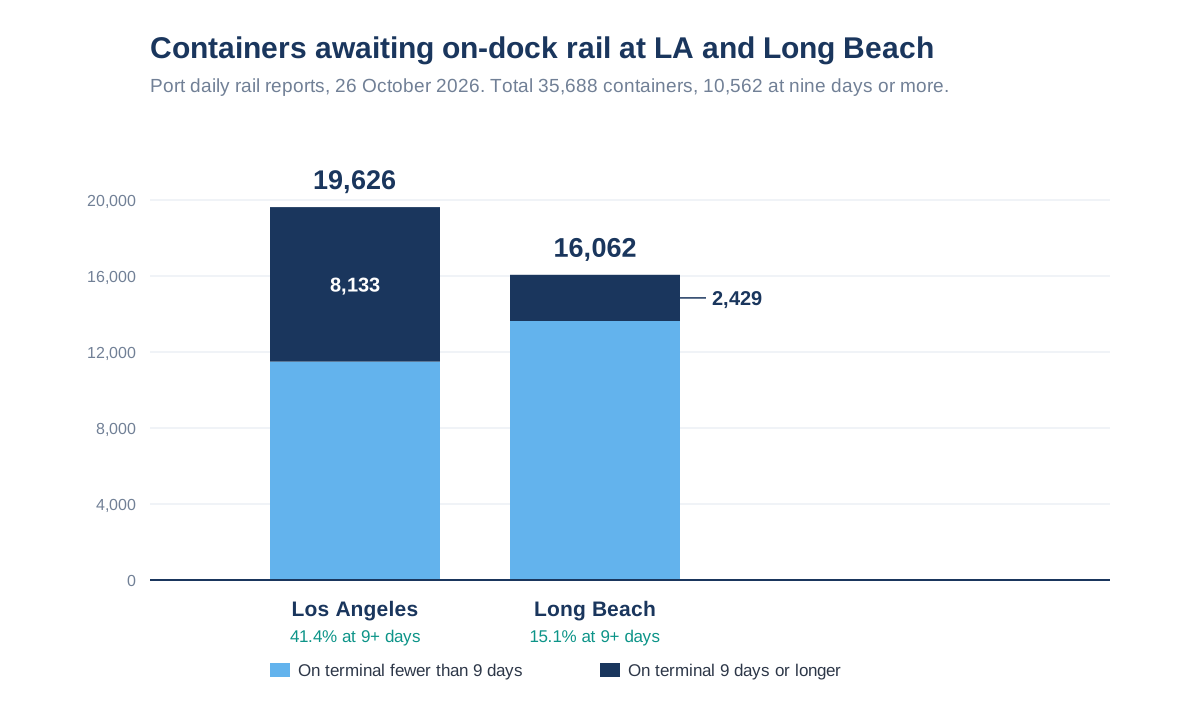
The number that matters most for anyone shipping inland is the split between the two ports. On 26 October, Los Angeles had 19,626 containers waiting for rail and 8,133 of them at nine days or more — 41.4% of the rail-bound stack. Long Beach had 16,062 waiting but only 2,429 at nine days or more — 15.1%. Both ports are busy; only one of them is currently burying its intermodal cargo.
| Gateway metric | Reading | Date | Source |
|---|---|---|---|
| Import containers awaiting on-dock rail, LA + LB | 35,688 | 26 Oct 2026 | Port daily rail reports, via FreightWaves |
| Of which on terminal nine days or longer | 10,562 (29.6%) | 26 Oct 2026 | Port daily rail reports, via FreightWaves |
| Los Angeles rail-bound stack | 19,626 (8,133 at 9+ days, 41.4%) | 26 Oct 2026 | Port of Los Angeles |
| Long Beach rail-bound stack | 16,062 (2,429 at 9+ days, 15.1%) | 26 Oct 2026 | Port of Long Beach |
| On-dock rail containers on POLA terminals | 21,683 (8,937 at 9+ days) | 30 Oct 2026 | POLA Operations Report |
| Total import containers on POLA terminals | 52,266 (12,645 at 9+ days) | 30 Oct 2026 | POLA Operations Report |
| Average local truck dwell, POLA | 3.7 days | 30 Oct 2026 | POLA Operations Report |
| Average on-dock rail dwell, POLA | 5.6 days | 30 Oct 2026 | POLA Operations Report |
| Average rail dwell, whole complex | 7.19 days (6.75 in August) | Sept 2026 | PMSA, via FreightWaves |
| Average truck dwell, whole complex | 3.18 days (2.95 in August) | Sept 2026 | PMSA, via FreightWaves |
| Container ships awaiting berth | 1 ship (normal 1–2) | Week of 26 Oct 2026 | MARAD / Marine Exchange |
| September volume, Los Angeles | 1.04 million TEU (record) | Sept 2026 | Port of Los Angeles |
| September volume, Long Beach | 997,177 TEU (record) | Sept 2026 | Port of Long Beach |
What produced this? Three things stacked on top of each other. September was a record month at both ports, and the peak season ran longer than usual — retail holiday goods, equipment for AI data-centre construction and auto parts all landed in the same window. Rail car supply tightened: C.H. Robinson flagged Southern California intermodal car shortages in its October market update, and Union Pacific has acknowledged that strong international volumes have tightened car supply. And empty-container repositioning is competing for the same chassis and yard space as loaded imports.
There is also an arrival-timing problem that has nothing to do with US terminals. As carriers return to the Suez route — Alphaliner counted 24 of 46 Asia–Europe direct services back through the Red Sea in late October, 63% of deployed capacity — ships built around the longer Cape of Good Hope rotation arrive ahead of their proforma schedules and bunch up at the first discharge port. Los Angeles and Long Beach are often that port for trans-Pacific strings.
One more landside change to diarise: the Vincent Thomas Bridge, the main link between San Pedro and Terminal Island, closes from 7 November 2026 for approximately 16 months. Trucks serving the inner terminals will use the I-710 and Queensway Drive instead. Our drayage partners on the San Pedro side are already quoting longer turn times, and the practical effect for importers is a slightly higher local cartage rate and a wider pickup window on the same-day moves.
What Is the ILWU Local 26 Strike Risk at LA and Long Beach?
ILWU Local 26 represents approximately 250 watchmen — the security staff who control and inspect truck and employee entry at terminal gates, patrol the yard and escort high-value cargo. The local’s contract expired in July 2025 and has been extended repeatedly while negotiations continue with the Pacific Maritime Association, which bargains for the terminal employers. On 30 October the two sides agreed to push the deadline from 1 November to 5 p.m. Pacific on 4 November, with the Federal Mediation and Conciliation Service at the table.
The arithmetic of this dispute is what makes it serious out of proportion to its size. Local 26 is about 2% of the ILWU workforce in San Pedro Bay, but its members work at six container terminals that handle roughly 85% of Long Beach’s cargo and 33% of Los Angeles’. Because other ILWU members — longshore gangs, marine clerks, yard equipment operators — are not expected to cross a Local 26 picket line, a walkout by 250 people could stop vessel, yard and gate operations at those six terminals. The coastwide ILWU agreement covering longshore workers runs to 2028 and is not part of this dispute.
| What a Local 26 stoppage would affect | Practical effect for your container |
|---|---|
| Terminal gate entry and exit | No truck appointments; laden and empty pickups stop at affected terminals |
| Yard and vessel operations | Discharge and loading halt where picket lines are honoured |
| On-dock rail loading | The 21,683-box rail stack at Los Angeles stops moving inland |
| Demurrage and detention clocks | They keep running; terminal free time does not pause for labour action |
| Cargo at unaffected terminals | Continues, but chassis and truck capacity get absorbed by diverted boxes |
The good news, as of this morning, is that no strike has been called and negotiations are still running under federal mediation. The bad news is that a settlement on 4 November would not clear the backlog: the rail stack did not appear because of the labour dispute, and it will not disappear if the dispute is resolved.
For importers, the correct posture is not to predict the outcome. It is to make your cargo indifferent to it. That means knowing which terminal each container is booked to, having a trucker on standby for anything already released, and deciding now — not on 4 November — whether your rail cargo should be pulled off the dock and transloaded.
Which China Ports and Services Feed the LA and Long Beach Gateway?
Almost every trans-Pacific service from South China and East China calls Los Angeles or Long Beach first, which is why the two ports handle around 40% of US containerised imports between them — the ranking of every US gateway is set out in the biggest ports in the US. Transit times below are port-to-port on direct calls; add three to seven days if your booking is routed through Busan, Kaohsiung or Singapore, and add the rail or truck leg on top. For a port-by-port breakdown of the ocean leg, see how long is ocean freight from China to Los Angeles.
| Origin port in China | To Los Angeles / Long Beach | Service pattern | Notes for this month |
|---|---|---|---|
| Yantian / Shenzhen | 14–18 days | Direct, highest frequency | Pearl River Delta factories; most sailings in the market |
| Shanghai | 13–17 days | Direct, multiple weekly strings | Vessel waiting time at Shanghai fell to 38 hours by Week 42, from 97 hours in Week 38 |
| Ningbo | 13–17 days | Direct | Zhejiang and Jiangsu cargo; heavy on furniture, tools, appliances |
| Xiamen | 15–20 days | Direct and via transshipment | Fujian footwear, apparel, stone |
| Qingdao | 14–19 days | Direct and via Busan | Shandong machinery, tyres, chemicals |
| Tianjin / Xingang | 16–22 days | Often transshipped | North China and Beijing-region cargo |
Two booking details decide whether congestion hurts you. First, ask whether your rate is port-to-port or includes the inland leg, because a port-to-port booking leaves the rail problem entirely in your hands. Second, ask which terminal the service calls — at Long Beach the rail stack is 15.1% aged, at Los Angeles 41.4%, and the difference is worth more than most rate negotiations this month.
If you are comparing ocean options, the published market level for Shanghai to Los Angeles was $8,007 per 40-foot container on 22 October 2026, according to Drewry’s World Container Index, up 2% on the week. Shanghai to New York was $10,166. Those are spot index levels, not contract rates, and the two can diverge sharply in a peak month. Current container shipping costs from China to USA are covered lane by lane in our dedicated guide, and the shipping rates from China to USA page tracks the monthly movement. Carriers had announced only two blank sailings on the trans-Pacific for the week following 22 October, down from six the week before, so capacity is not being cut aggressively — a sign the lines expect volume to hold rather than collapse.
What Does Congestion and a Strike Actually Cost an Importer?
Delay is not one cost. It is four or five costs that arrive on different invoices from different companies, and the reason importers get surprised is that only the first one is in the freight quote. The table below lists what each charge is, when it starts, and how to plan around it. None of these are hidden — they are standard parts of the cost chain on a US import, and a forwarder who quotes you properly will list them up front.
| Charge | Typical 2026 range | What it is and how to plan |
|---|---|---|
| Demurrage (import) | Free 4–5 calendar days, then roughly $150–350/day, escalating | Charged by the terminal on the container, once free time ends, for staying on the dock. Clock starts at discharge. Plan: check free time before booking, and never assume a labour action pauses it. |
| Detention | Free 5–7 days, then roughly $100–250/day | Charged by the carrier on the container once it leaves the terminal and is not returned empty. Plan: book the empty return before you collect, and keep the chassis with the box. |
| Chassis usage | $25–45/day after the free window | The wheeled frame your container sits on. Pool shortages in Southern California show up as “no chassis” rather than a rate rise. Plan: confirm chassis supply with your trucker for the exact terminal. |
| Per-diem and yard storage | $35–60/day per container at a near-dock yard | Charges from a transload or storage facility when a container waits between terminal and warehouse. Plan: book warehouse space only when you have a gate-out appointment. |
| Rail rebooking and reconsignment | $150–400 per container | Administrative charge plus any rate difference when an inland leg is changed or re-booked after the fact. Plan: decide the inland plan before the vessel berths. |
| Transload to domestic trailer | $350–600 per 40HQ, plus $0.30–0.60 per mile for the domestic move | Cargo is stripped at a near-dock warehouse and reloaded onto a 53-foot domestic trailer. Plan: the right answer when rail dwell exceeds about six days and the cargo is not oversized. |
| Expedited LTL or partial truck | 1.6–2.4× the standard truck rate | For deadline-critical cartons only. Plan: reserve it for the SKUs that carry the sales, not the whole container. |
| ISF amendment | $30–75 per filing | Refiling the Importer Security Filing when the discharge port, carrier or vessel changes. Plan: build it into the rerouting decision, not after it. |
Here is how that adds up on a real-shaped shipment — one 40HQ of consumer electronics from Shenzhen to a Los Angeles warehouse, then rail to Chicago. Duty is shown at an illustrative 12% effective rate; substitute your own HTS line, because the rerouting advice does not change with the rate.
| Line item | On-time move | Six-day terminal delay | Sixteen-day rail delay |
|---|---|---|---|
| Ocean freight, Shenzhen to Los Angeles, 40HQ | $6,800 | $6,800 | $6,800 |
| Destination terminal handling and doc fees | $450 | $450 | $450 |
| Local drayage, terminal to LA warehouse | $380 | $380 | $380 |
| Chassis, three days | $105 | $105 | $105 |
| ISF, entry, bond and broker fee | $185 | $185 | $215 |
| Duty and fees at 12% of a $60,000 CIF value | $7,200 | $7,200 | $7,200 |
| Demurrage, three chargeable days | — | $900 | $900 |
| Detention, two extra days | — | $240 | $240 |
| Extra chassis days | — | $210 | $210 |
| Rail rebooking | — | — | $300 |
| Domestic truck instead of rail to Chicago | — | — | $3,400 |
| Total cost to the importer | $15,120 | $16,470 | $20,200 |
Read the table by its deltas, because that is how the decision is actually made. Six extra days on the terminal costs about $1,350 — painful but survivable, and cheaper than a panic transload. A sixteen-day rail delay costs about $5,080, most of it the domestic truck that replaces the train. That is the threshold where transloading on day five and booking a 53-foot trailer starts beating waiting for a railcar, even though the invoice looks larger on the day you make the call.
For lower-value, denser cargo the maths changes quickly: on a 40HQ of furniture with a $18,000 CIF value, the same delay penalties are a much larger share of the goods’ value, and holding the container at a near-dock warehouse for a week to wait for rail is usually the rational choice. If your cargo is less than about 15 CBM, none of this applies to you in the same way — LCL shipping rates from China to USA move through a consolidator’s CFS, and the delay lands on the co-loader’s schedule rather than on your container’s demurrage clock.
Which Alternative Gateways Can Take Your Cargo Instead?
Rerouting is not a single decision, and it is usually not available inside a week. A booking can normally be changed before the container is loaded in China; once it is at sea, the discharge port is fixed and “rerouting” really means on-forwarding from the port of discharge or waiting for the next cycle. That is why the useful question is not “can I divert this shipment” but “which gateway should the next shipment use”.
| Alternative gateway | Transit from Shanghai | Ocean cost versus LA/LB | Best for | Trade-off |
|---|---|---|---|---|
| Oakland | +1–3 days | Roughly level, sometimes +$200–400/FEU | Northern California distribution; IPI cargo to the Midwest/Pacific Northwest | Fewer direct China calls than LA/LB; smaller terminal buffer |
| Seattle / Tacoma | +2–4 days | Roughly level to +$300/FEU | Pacific Northwest, Chicago and Midwest IPI, Alaska feeders | Longer ocean leg; rail still needed for the Midwest |
| Prince Rupert, BC (Canada) | 11–14 days at sea | Often lower ocean cost | Fastest sea leg to Chicago/Memphis/Toronto via CN | Canadian transit; US-bound boxes need in-bond movement and a US entry |
| Vancouver, BC (Canada) | 12–16 days | Roughly level | Canadian destination; some US Midwest IPI | Same in-bond and customs considerations as Prince Rupert |
| New York / New Jersey (all-water via Panama) | 28–35 days | +$800–1,600/FEU | East Coast distribution, dense Northeast markets | Two to three weeks longer than LA/LB |
| Savannah / Charleston (via Panama) | 30–38 days | +$600–1,400/FEU | Southeast distribution, Atlanta and Charlotte | Longest ocean leg; Panama transit capacity is a variable |
| Houston (via Panama) | 30–38 days | +$700–1,500/FEU | Texas and Gulf distribution, project cargo | Longer transit; Gulf service frequency is thinner |
Two points that experienced importers get right and first-time shippers get wrong. First, the ocean price difference between Los Angeles and the Pacific Northwest is often small; the cost difference is created by the inland leg, which is why a Seattle routing can be cheaper to Chicago and more expensive to Dallas. Second, the Canadian gateway is genuinely fast on the water and genuinely slow on paperwork if you have never moved an in-bond shipment — the cargo must travel under a bond from the Canadian port to a US port of entry, with a US entry filed and duty paid there. It works well; it just needs to be set up before, not after, the container sails.
Our own lane pages give you the port-level numbers to compare: shipping from China to Los Angeles for the southern gateway, shipping from China to Oakland for Northern California, and shipping from Ningbo to Seattle for the Pacific Northwest. If you are still deciding which coast suits your customer base, the shipping routes from China to USA overview maps the five main port pairs, and how long is freight from China to USA covers transit time by mode.
How Do You Reroute Without Breaking ISF and Your Customs Entry?
This is the part that quietly costs importers money, because the transport side is fixable and the compliance side can produce penalties that dwarf the freight saving.
The Importer Security Filing — ISF, also called 10+2 — must be filed at least 24 hours before the cargo is loaded at the foreign port. It contains the vessel and voyage, the foreign port of unlading, the US port of entry and the intended ship-to party. If you change the discharge port or the vessel, the ISF must be amended. Amendments are routine and inexpensive when they are made before loading; they are a problem when the cargo is already at sea and the entry is being prepared against a different port.
| What changes | Filing that has to change | Timing that matters |
|---|---|---|
| Discharge port moves from Los Angeles to Seattle | ISF amendment; entry filed at the new port of entry | Before vessel loading, ideally 72 hours before |
| Vessel or voyage changes on the same port pair | ISF amendment | At least 24 hours before loading; earlier is safer |
| Cargo moves in-bond from a Canadian port to the US | ISF plus US entry at the US port of entry, under bond | Before departure from the Canadian gateway |
| Inland leg switches from rail to truck after arrival | No ISF change; entry already filed | Reconsignment with the rail provider, then a new delivery order |
| Booking is cancelled and rebooked on a later vessel | New ISF filing for the new voyage | 24 hours before the new loading date |
Two things do not change when you reroute, and it is worth saying plainly because it is the first question every importer asks. Your duty rate does not depend on the port of entry: the same HTS classification and the same Section 301 or IEEPA treatment apply whether the container clears in Los Angeles, Seattle or Savannah. If you buy on ddp terms, the same logic reaches your supplier’s landed price — a port change moves the routing, not the tax treatment. And the current suspension of the Section 301 port fees on Chinese-linked vessels — the USTR extended it through 9 January 2027 in a notice published on 23 October 2026 — applies regardless of gateway. When that suspension was first designed, the exposure was $18 per net ton or $120 per container discharged, whichever was higher, plus a 100% duty on Chinese-built ship-to-shore cranes; none of that is being collected now, but 9 January 2027 is a date to keep in the calendar.
What does change is the entry itself: a different port means a different CBP port code, a different broker relationship if your broker is not national, and potentially a different exam queue. If your broker only operates in Southern California, a Seattle diversion needs a broker licensed and set up at the new port before the vessel arrives.
When Should You Transload, Hold Cargo, or Switch Rail to Truck?
These are three different tools and they suit three different cargo profiles. The decision table below is the one we use with clients during a disruption, and the thresholds are based on the numbers in this article — a rail dwell above six days, a nine-day-plus share above 35%, or a hard delivery date inside three weeks.
| Situation | Best move | Why |
|---|---|---|
| Rail-bound cargo at Los Angeles with a nine-day-plus share of 41% and a delivery date inside 21 days | Pull off dock, transload to a 53-foot trailer, truck to destination | The rail queue is the constraint, not the vessel; a truck bypasses the entire stack |
| Rail-bound cargo at Long Beach with a 15% nine-day-plus share | Leave on rail, but book the inland leg early and track the ramp | Long Beach is currently clearing intermodal cargo roughly three times faster than Los Angeles |
| Cargo already released and sitting at a terminal that may face a picket line | Gate it out before the deadline, even to a near-dock warehouse | Once the gates stop, released cargo stops too; storage is cheaper than a stoppage |
| Oversized, hazardous or heavy cargo that cannot be transloaded | Hold at the terminal and negotiate free time in writing | Transloading is not physically possible; the only lever is the free-time clock |
| Cargo under about 15 CBM | Ship LCL; the consolidator absorbs the schedule risk | Your exposure is a CFS cut-off, not a container demurrage clock |
| Cargo for Amazon FBA with a fixed appointment window | Move by truck from the port, or rebook the appointment now | A missed FBA appointment produces a rescheduling delay that is longer than the rail delay |
The transload calculation is worth doing explicitly. A 40HQ stripped and reloaded at a near-dock warehouse near Compton or Carson typically runs $350–600 for the handling, plus a domestic 53-foot move to Chicago at roughly $3,000–4,500 depending on the week. Waiting for rail costs about $300 a day in demurrage, detention and chassis once free time has run, plus the risk of a further week. If the rail stack at your terminal is more than about 35% aged at nine days, transloading is usually the cheaper path on a deadline shipment, and staying on rail is usually the cheaper path on a shipment that can float a fortnight.
What Is the Week-by-Week Playbook for the 4 November Deadline?
The useful way to handle a disruption window is to attach decisions to dates rather than to headlines. This is the sequence we are running with clients this week.
| Date | What is happening | What to do |
|---|---|---|
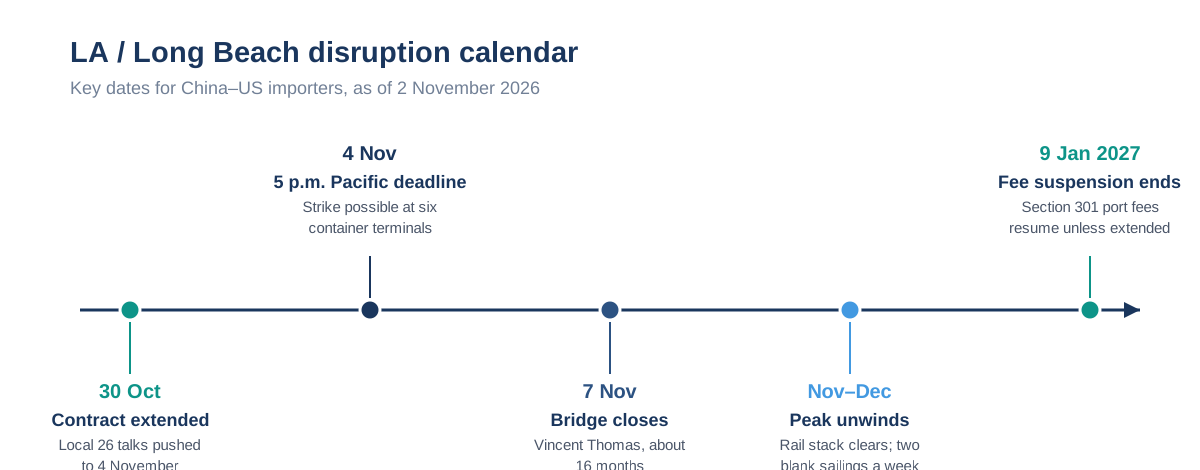
| Now, before 4 November | Local 26 contract extension runs to 5 p.m. Pacific on 4 November; mediation continues | Identify which terminal each container is at; gate out anything already released; confirm trucker availability for the 4th and 5th |
| 4 November, 5 p.m. Pacific | Extension expires | If a strike is called, stop booking drayage into affected terminals the same day and move to a transload plan |
| 7 November | Vincent Thomas Bridge closes for about 16 months | Re-quote local cartage on San Pedro and Terminal Island moves; expect longer turn times |
| Through November | Peak season winding down; carriers seeking November rate increases that forwarders are discounting | Lock contract space for December and January rather than chasing spot; blank sailings were only two a week on the trans-Pacific as of late October |
| 9 January 2027 | Section 301 port-fee suspension expires unless extended again | Model the $18/net ton or $120/container exposure into January bookings, and ask your carrier which ships are affected |
Three habits make the difference in a window like this. Book with a buffer: if the vessel’s on-time performance is around 50% — which is roughly where global schedule reliability sat at the end of October — a 30-day plan built on a 25-day transit is a plan that fails. Take the free time seriously: ask for 7 days instead of 4 at the terminal, in writing, before the container arrives, because no terminal grants it retroactively. And keep one trucker relationship outside your usual routing, because on the day a terminal closes, the hauliers with capacity are the ones who already know your account.
How to Choose a Freight Forwarder for US West Coast Disruption?
LA/Long Beach is not a difficult lane in a normal month; what it tests is whether your forwarder can hold three moving parts at once — an ocean booking that may need to change port, a rail leg that may need to become a truck, and a customs entry that has to be refiled either way. A forwarder who only quotes per-container rates will look fine until the week you need that coordination.
Four checks that matter specifically on this gateway:
- Do they have their own drayage and transload relationships at both ports, or do they broker them? Ask for the name of the trucking company and the near-dock warehouse they use at Los Angeles and at Long Beach. If both answers are the same single vendor, your options during a gate closure are that vendor’s options.
- Can they file ISF and entry at more than one US port? Confirm which CBP ports their brokerage can clear, and get it in writing. A broker who only files in Los Angeles cannot rescue a Seattle diversion.
- Will they quote the inland leg separately from the ocean leg? On this lane the ocean rate is the stable part and the rail leg is the variable one. A split quote lets you decide on day five whether to keep the rail booking, and it also tells you what the transload alternative costs before you need it.
- Do they track containers at the rail ramp, not just the vessel? Ask what visibility you get between discharge and gate-out, and whether you will be told when a box crosses the nine-day threshold. That single alert is worth more than a lower ocean rate during a backlog.
Dantful has been moving cargo from China since 2008 and holds Class-A freight forwarding, NVOCC, FMC and Jctrans credentials, with direct carrier contracts out of Shenzhen, Shanghai, Ningbo and Qingdao. On US West Coast routing we book the ocean leg, handle export clearance in China and coordinate drayage, transload and inland delivery at the destination, with daily tracking updates including terminal and rail milestones, and 50 operations staff plus more than 50 customer service staff on call. If your cargo is on the water and you need a plan for the week of 4 November, our freight forwarder in Shenzhen China team can quote the alternative routing against your current booking.
FAQ
Is there a strike at the Los Angeles and Long Beach ports right now?
No strike had been called as of 2 November 2026. The ILWU Local 26 contract covering about 250 terminal watchmen was extended to 5 p.m. Pacific on 4 November, and negotiations continue with federal mediators. If a strike is called, other ILWU members are not expected to cross picket lines, which could stop vessel, yard and gate operations at the six affected terminals.
How long is the rail backlog at Los Angeles and Long Beach?
On 26 October 2026, 35,688 import containers were waiting for on-dock trains, with 10,562 on terminal for nine days or longer. The backlog is concentrated at Los Angeles, where 41.4% of rail-bound boxes were nine days or older, against 15.1% at Long Beach. Average rail dwell across the complex was 7.19 days in September.
Should I reroute my shipment away from Los Angeles?
If your container is not yet loaded in China and your cargo is deadline-critical, compare a Pacific Northwest gateway or a truck from the port of discharge before you consider changing the ocean booking. If the container is already at sea, the discharge port is fixed — the practical options are transload to a domestic trailer, truck instead of rail, or accept the delay. A six-day terminal delay costs about $1,350 on a 40HQ; a sixteen-day rail delay costs about $5,080.
Does changing my discharge port change my duty rate?
No. Duty is set by HTS classification and the applicable Section 301 or IEEPA treatment, not by the port of entry. What changes is the CBP port code on your entry, the broker who files it and the exam queue at the new port.
Can I move my cargo in-bond from a Canadian port to the US?
Yes. Cargo discharged at Prince Rupert or Vancouver can move under bond to a US port of entry, where the entry is filed and duty paid. It is a fast sea routing and a paperwork-heavy one: the bond, the carrier’s in-bond capability and the US entry all have to be arranged before the vessel sails.
Why is there congestion when there is no queue of ships?
Because the constraint is on land, not on the water. One ship was waiting for a berth in the week of 26 October, which is normal. The pressure comes from record September volumes, tight intermodal railcar supply, chassis shortages and empty-container repositioning competing for the same terminal space.
Will the Vincent Thomas Bridge closure affect my drayage?
Yes, if your cargo moves through the San Pedro side of the complex. The bridge closes from 7 November 2026 for approximately 16 months, and trucks will use the I-710 and Queensway Drive instead. Expect slightly higher local cartage rates and longer turn times, particularly on same-day moves.
Are US port fees on Chinese ships being charged in 2026?
Not currently. USTR extended the suspension of the Section 301 port fees through 9 January 2027 in a notice published on 23 October 2026. The suspended measures include the vessel fee of $18 per net ton or $120 per container discharged, a 100% duty on Chinese-built ship-to-shore cranes, and additional duties on Chinese-built intermodal chassis.
What does a delay cost per day on a 40-foot container?
Once free time has run, budget roughly $300 a day for the combination of terminal demurrage, carrier detention and chassis usage on a 40HQ in Southern California. The exact figure depends on the terminal tariff, the carrier’s free days and how quickly the empty is returned.
How far in advance should I book China to Los Angeles cargo this month?
Three to four weeks before the cargo is ready is a sensible minimum while the rail stack clears, and longer if your buyer has a fixed delivery window. With trans-Pacific schedule reliability around 50%, a plan that assumes on-time arrival is a plan with a 50% chance of being late.

Young Chiu is a seasoned logistics expert with over 15 years of experience in international freight forwarding and supply chain management. As CEO of Dantful International Logistics, Young is dedicated to providing valuable insights and practical advice to businesses navigating the complexities of global shipping.