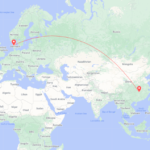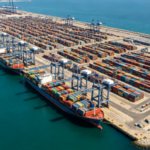
Shipping costs from China to Denmark rarely arrive as one number. Two quotes for the same 20GP from Yantian to Aarhus can read USD 2,400 all-in and USD 2,200 plus surcharges — and both can be honest. The gap is not the ocean rate; it is how many cost layers each quote counted before it stopped.
That gap bites hardest in Denmark, where 25% VAT (moms) and EU duty land before your container clears. This guide gives dated 2026 sea, air, express, rail and DDP rates by mode and port pair, then the number you actually pay — a seven-layer landed-cost model with worked duty and VAT examples. A USD 2,400 quote can become a USD 4,900 invoice; here is how to close that gap before you book.
How Much Does It Cost to Ship from China to Denmark in 2026?
In one sentence: a 20GP from China to Aarhus costs roughly USD 2,250–3,750 port-to-port, a 40HQ up to USD 7,050, LCL USD 28–100 per CBM freight-only, air freight USD 4.8–10 per kg, and express USD 6–15 per kg — before duty and 25% VAT. Add those and a modest sea shipment’s landed cost climbs 25–40%. For the full lane overview, see our dedicated Shipping From China To Denmark page.
| Mode | Typical rate (Q4 2026) | All-in DDP equivalent | Billed per | Best for |
|---|---|---|---|---|
| Sea FCL — 20GP | USD 2,250–3,750 | ≈ USD 200–400/CBM all-in | Container | 15–28 CBM of dense cargo |
| Sea FCL — 40GP / 40HQ | USD 2,850–7,050 | ≈ USD 200–400/CBM all-in | Container | Bulky goods, 25–65 CBM |
| Sea LCL | USD 28–100/CBM (freight-only); 150–200/CBM all-in | ≈ USD 200–400/CBM | Cubic metre (CBM) | Under ~15 CBM |
| Rail (China–Europe) | 20GP USD 4,100–5,000; 40HQ USD 6,000–7,300 | from USD 250/CBM (DDP) | Container / CBM | Mid-speed, mid-cost |
| Air freight (standard) | USD 4.8–10/kg | USD 5.5–12/kg | Chargeable kg | 45–300 kg, 5–10 days |
| Express courier | USD 6–15/kg | Duty + VAT billed by courier | Actual / chargeable kg | Under 45 kg, urgent |
| Sea DDP (door delivery) | — | USD 200–400/CBM | CBM | Buyers who want one price |
These are market reference ranges, not a rate card: every figure depends on origin port, sailing, season and commodity — which is why two honest quotes differ.
Why “the cost” is four different numbers
Most budget shocks come from one mistake: mixing up which cost you were quoted. Almost every “shipping cost” is one of four scopes.
| Scope | What it includes | Typical 20GP total |
|---|---|---|
| Freight-only | Ocean freight only | ≈ USD 2,250–3,750 |
| Port-to-port | Ocean freight + origin + destination charges | ≈ USD 3,000–4,500 |
| Door-to-door | Above + pickup and final delivery | ≈ USD 3,400–5,200 |
| Landed cost | Door-to-door + EU duty + 25% VAT | ≈ USD 4,000–6,500 |
A cost is not one number. It is seven. “USD 2,400” and “USD 4,900” are both true — they simply stopped at different layers of the model below. Before you compare two forwarders, ask each one: how many layers does your number include?
Door-to-Door and DDP Shipping Cost from China to Denmark
Door-to-door is the number you actually need: it is the only one that survives contact with customs. Build it by stacking seven layers — base freight, origin charges, surcharges, EU duty, 25% Danish VAT, clearance and last-mile delivery. Most published rates stop at layer one.
| Layer | What it covers | Typical amount | Who charges it | In a “from” quote? |
|---|---|---|---|---|
| 1. Base freight | Ocean/air freight, port-to-port | 20GP USD 2,250–3,750; air USD 4.8–10/kg | Carrier (via forwarder) | Yes |
| 2. Origin charges | Pickup, export customs, CFS/loading, VGM, doc | USD 80–150/B/L + local fees | Origin agent | Rarely |
| 3. Surcharges | BAF, THC, PSS, GRI, EU ETS | BAF USD 200–400/box; Aarhus THC USD 300–500; PSS/GRI +USD 200–600 | Carrier + terminal | Sometimes |
| 4. EU import duty | EU TARIC duty on CIF | 0–17% of CIF by HS code | Toldstyrelsen | Usually no |
| 5. Danish VAT (moms) | 25% on (CIF + duty) | 25% of CIF + duty | Danish tax authority | No |
| 6. Clearance / broker | Declaration, EORI, ICS2 | Broker fee; 1–3 working days | Customs broker | Rarely |
| 7. Last-mile | PostNord handling + inland trucking | ≈ DKK 160 (~USD 22); Aarhus → Jutland same day | Courier / trucker | No |
How a USD 2,400 headline becomes a ≈USD 4,900 invoice
Take a 20GP of consumer goods (value USD 2,200) moving Shenzhen → Aarhus. CIF — the customs value — is goods + freight + insurance = USD 2,200 + 2,400 + 30 = USD 4,630.
| Layer | Item | Amount |
|---|---|---|
| 1 | Base ocean freight (20GP, Shenzhen → Aarhus) | USD 2,400 |
| 2 | Origin charges (pickup, export customs, doc, VGM) | USD 230 |
| 3 | BAF + Aarhus THC | USD 600 |
| 4 | EU import duty (4% × CIF USD 4,630) | USD 185 |
| 5 | Danish VAT — 25% × (CIF + duty = USD 4,815) | USD 1,204 |
| 6 | Customs clearance / broker fee | USD 80 |
| 7 | Last-mile delivery (Aarhus → Jutland) | USD 200 |
| Total to move and clear the box | ≈ USD 4,900 |
The freight quote was USD 2,400; the bill to move and clear the box was roughly double — layers 2–7 doing their job, not a scam.
DDP vs DAP/DDU: who pays the 25% VAT
DDP (Delivered Duty Paid) bundles EU duty and the 25% VAT into one price; DAP/DDU leaves them to the importer. Our DDP Shipping Services quote a single, landed figure. Here is who pays what:
| DDP | DAP / DDU | |
|---|---|---|
| Freight | Seller / forwarder | Seller / forwarder |
| EU duty | Seller / forwarder | Buyer |
| 25% Danish VAT | Seller / forwarder | Buyer |
| Clearance | Seller / forwarder | Buyer |
| Time & penalty risk | Forwarder | Buyer |
| Cash flow | One landed price up front | VAT paid at import; recoverable later if VAT-registered |
| Best for | Private buyers, non-VAT-registered importers | VAT-registered businesses using Postponed VAT |
Our industry insight: A landed cost is hard to pin down because no single party owns all seven layers — unless one does. Dantful International Logistics controls pickup, export declaration, the ocean or air leg, EU clearance and inland delivery under one roof, so no layer is quietly marked up by a third party. We quote every layer of your landed cost — not one blended number.
VAT tip: A VAT-registered importer usually does better with DAP plus Postponed VAT Accounting on cash flow; a private buyer is simpler and safer with DDP.
Sea Freight Cost from China to Denmark: 20GP, 40GP, 40HQ and LCL per CBM
Sea freight is the default for volume, and the port pair moves the price as much as anything else. All figures below are port-to-port, Q4 2026, excluding surcharges.
| Origin port (China) | → Aarhus 20GP | → Aarhus 40HQ | → Copenhagen (CMP) 20GP | → Fredericia 20GP |
|---|---|---|---|---|
| Shanghai | USD 2,400–3,300 | USD 3,800–5,400 | USD 2,500–3,450 | USD 2,450–3,350 |
| Ningbo-Zhoushan | USD 2,350–3,250 | USD 3,700–5,300 | USD 2,450–3,400 | USD 2,400–3,300 |
| Shenzhen (Yantian / Shekou) | USD 2,250–3,150 | USD 3,600–5,200 | USD 2,350–3,300 | USD 2,300–3,200 |
| Guangzhou (Nansha) | USD 2,300–3,200 | USD 3,650–5,250 | USD 2,400–3,350 | USD 2,350–3,250 |
| Qingdao | USD 2,500–3,500 | USD 3,900–5,600 | USD 2,600–3,650 | USD 2,550–3,550 |
| Xiamen | USD 2,450–3,400 | USD 3,850–5,450 | USD 2,550–3,550 | USD 2,500–3,450 |
| Tianjin | USD 2,600–3,750 | USD 4,000–5,850 | USD 2,700–3,850 | USD 2,650–3,750 |
Aarhus is Denmark’s largest container port (APM Terminals, Maersk AE10 direct Asia call), so it carries the widest, most competitive options; Xiamen, Tianjin and Fredericia are rows most competitors simply don’t publish.
FCL 20GP vs 40GP vs 40HQ, and the ~15 CBM LCL break-even
A 40ft box costs 1.5–2× the 20ft rate but carries 2.3–2.5× the cargo (20GP ~28 usable CBM, 40HQ ~68). Per CBM, a 40HQ is usually cheapest for light, bulky goods — furniture, flat-pack, plastics. Watch the heavy-container surcharge: about USD 200 once a 20GP passes ~18 tonnes, USD 400 past ~21 tonnes. Rule of thumb: dense and heavy → 20GP; light and bulky → 40HQ.
LCL (groupage) runs USD 28–100 per CBM freight-only, or USD 150–200 per CBM all-in once origin consolidation and destination devanning are added — which is why a “cheap” LCL quote can double. The break-even against FCL sits at roughly 12–15 CBM:
| Shipment | Typical all-in cost | Notes |
|---|---|---|
| 18 CBM as LCL | ≈ USD 2,700–3,600 | Per-CBM deal plus CFS/THC/devanning |
| 18 CBM in a 20GP FCL | ≈ USD 2,400–3,100 | Exclusive use, lower damage risk, faster |
Rail, direct sailing and transshipment
Rail via the China–Europe Express (Poland/Germany hubs, then Denmark) sits between sea and air: 20GP ≈ USD 4,100–5,000, 40HQ ≈ USD 6,000–7,300, LCL from ~USD 210/CBM — for when sea is too slow for your season but air is too costly for your margin.
A direct call (Maersk AE10 into Aarhus) costs a little more but arrives faster; a relay via Rotterdam, Hamburg, Bremerhaven, Antwerp or Gdansk lowers the base rate but adds cost and 3–7 days. Check your B/L: a single vessel/voyage with no relay or feeder entry means direct.
Air Freight Cost from China to Denmark
Air freight is your tool for urgency and for goods too valuable to sit on the water: USD 4.8–10 per kg for standard freight, USD 5.5–12 per kg all-in via DDP, and USD 6–15 per kg for express couriers.
| Mode | Billed per | Rate (Q4 2026) | Transit | Best for |
|---|---|---|---|---|
| Air freight (standard) | Chargeable kg | USD 4.8–10/kg | 5–10 days | 45–300 kg, non-urgent |
| Express courier | Actual / chargeable kg | USD 6–15/kg | 3–6 days | Under 45 kg, urgent |
| Air DDP | Chargeable kg | USD 5.5–12/kg | 6–10 days | Urgent + one landed price |
Airport-pair rates and the chargeable-weight rule
| Origin airport | → Copenhagen (CPH) | → Billund (BLL) |
|---|---|---|
| Shanghai Pudong (PVG) | USD 5.0–9.5/kg | USD 5.4–10.0/kg |
| Shenzhen Bao’an (SZX) | USD 4.8–9.0/kg | USD 5.2–9.6/kg |
| Guangzhou Baiyun (CAN) | USD 4.9–9.2/kg | USD 5.3–9.8/kg |
| Hong Kong (HKG) | USD 4.8–8.8/kg | USD 5.2–9.4/kg |
| Beijing (PEK) | USD 5.1–9.6/kg | USD 5.5–10.2/kg |
Copenhagen (CPH) is Denmark’s dominant cargo gateway; Billund (BLL) serves Jutland and often handles CAN-origin freight directly. Routing through FRA, AMS or CDG adds cost and 1–3 days.
Airlines bill on the greater of actual weight and volumetric weight: chargeable weight = max(actual kg, L × W × H in cm ÷ 6000). A light, bulky carton pays for air it never weighs.
| Shipment | Actual weight | Dimensions | Volumetric weight | Charged |
|---|---|---|---|---|
| 10 cartons | 100 kg | 60 × 50 × 40 cm each | 10 × (120,000 ÷ 6000) = 200 kg | 200 kg |
At USD 6/kg that is USD 1,200 instead of USD 600 — the volumetric gap cost USD 600. Compress packaging, nest items and drop void space, and you pay for 160 kg instead of 200.
The decision rule
- Under 45 kg, urgent → express courier
- 45–300 kg, can wait 5–10 days → air standard
- Over 300 kg or oversized → FCL sea freight
- Time-critical but you want one price → air DDP
Air can be cheaper overall than sea for high-margin goods: a stockout costs more than the freight premium, and 25% VAT is due either way.
Why Is Shipping to Denmark So Expensive?
Denmark is not uniquely expensive to reach — it is expensive to land. Freight is comparable to any North European port; what surprises importers is everything attached to it: 25% VAT, EU duty, surcharges, and two forwarders quoting the same box USD 1,500 apart.
| Factor | Impact on the number | How to check it |
|---|---|---|
| FCL vs LCL | Break-even ~15 CBM; LCL all-in can double per CBM | Ask for both prices |
| Port of loading | Up to USD 300–600 between Shenzhen and Qingdao | Compare the same POL |
| Direct vs transshipment | +3–7 days and +USD 150–400 via relay hubs | Read the B/L for relay/feeder |
| Cape vs Suez routing | +10–14 days and higher BAF | Ask the routing and BAF basis |
| Peak-season PSS/GRI | +USD 200–600 per box | Check the surcharge line and date |
| Incoterm (FOB/CIF/DDP) | Shifts who pays duty and 25% VAT | Confirm in writing |
| Which charges are excluded | The single biggest gap | Demand an itemized quote |
That last row is the one that matters. On the same lane, published 20GP headlines have ranged from about USD 2,250 to USD 4,550 — a spread above USD 1,500 — and almost none reconcile it; one widely-read guide even contradicts its own table. Neither number is wrong; they were built on different layer counts and surcharge assumptions.
The hidden charges that are never in the headline
| Charge | Typical amount | In the headline rate? |
|---|---|---|
| BAF / fuel | USD 200–400 per container | No |
| Aarhus THC | USD 300–500 per container | No |
| Documentation fee | USD 80–150 per B/L | No |
| Cargo insurance | 0.8–1.5% of cargo value | No |
| Demurrage / detention | USD 15–25 per 20ft per day | No |
| Heavy-container surcharge | 20GP ≥18t +USD 200; ≥21t +USD 400 | No |
| EU ETS surcharge | Emissions-linked, varies | No |
| PostNord handling | ≈ DKK 160 (~USD 22) per parcel | No |
Cape of Good Hope vs Suez, and the port choice
In 2026, most Asia–Europe services still route around the Cape of Good Hope, adding 10–14 days and higher fuel/BAF cost; Suez transits are only partially restored. Check the port rotation on your B/L — if it lists Cape routing, your BAF is priced for the longer leg.
| Gateway | Strength | Cost note |
|---|---|---|
| Aarhus | Largest container port, Jutland/Nordics hinterland, AE10 direct | Fastest inland; THC at the higher end |
| Copenhagen–Malmö (CMP) | Capital region and Øresund cross-border market | Good for Zealand delivery, fewer direct Asia calls |
| Fredericia | Jutland east coast, ro-ro and container | Efficient for European short-sea and ro-ro |
The landing rule: goods bound for Jutland or the Nordics → Aarhus; the Copenhagen metro, Zealand or Øresund → CMP; ro-ro or European short-sea consolidation → Fredericia.
Transparency warning: A USD 1,500 difference between two quotes is not proof that someone is cheating you. It usually means one quote includes more layers than the other. Before you book, ask both forwarders to state, line by line, which of the seven layers their number contains — and whether it includes duty and the 25% VAT exposure.
How Much Import Duty and 25% VAT Will You Pay in Denmark?
Denmark applies EU-wide rules, so your duty comes from the EU TARIC schedule and your 25% VAT (moms) is charged on top. Two formulas govern almost everything:
Import duty = EU TARIC rate × CIF valueImport VAT = 25% × (CIF value + import duty)
CIF means goods + freight + insurance — so freight raises your VAT base: a higher ocean rate also costs you 25% of that freight again in VAT. The table takes a fixed CIF of USD 4,630 (a 20GP of consumer goods) and shows what duty and VAT add by cargo type.
| Cargo type | Typical TARIC duty | Worked duty on CIF USD 4,630 | Worked VAT (25% × CIF+duty) | Landed uplift |
|---|---|---|---|---|
| Electronics (laptops, phones) | 0–5% | USD 0–232 | USD 1,158–1,215 | +25–31% |
| Toys & games | 0–4.7% | USD 0–218 | USD 1,158–1,212 | +25–31% |
| Furniture & lighting | 0–5.7% | USD 0–264 | USD 1,158–1,224 | +25–32% |
| Machinery & parts | 0–2.7% | USD 0–125 | USD 1,158–1,189 | +25–28% |
| Textiles & apparel | 8–12% | USD 370–556 | USD 1,250–1,297 | +35–40% |
| Footwear (leather/textile) | 8–17% | USD 370–787 | USD 1,250–1,354 | +35–46% |
| Ceramics & glassware | 5–12% (+ AD risk) | USD 232–556 | USD 1,215–1,297 | +31–40% |
VAT dominates: even at 0% duty, moms adds a quarter of your CIF before you sell a unit — and the gap between a 0% and a 17% line is wider than most freight-rate differences, which is why classification matters more than haggling.
Classification, anti-dumping and the 1 July 2026 reform
The EU classifies goods with a ten-digit code: six global HS digits, two EU CN digits, then two TARIC digits — your duty rate lives in the last four. A bicycle part and a complete e-bike can share a chapter yet be taxed completely differently. Declare a “fitness machine” at 0% when customs classifies it as an e-bike at MFN plus anti-dumping duty, and you face back duty, penalties and a switch to physical inspection. Classification is not paperwork; it is the rate.
China and the EU have no FTA, so Chinese-origin goods pay full EU MFN/TARIC rates — no certificate drops duty to zero. For some products MFN is only the floor: the EU adds anti-dumping (AD) and countervailing (CVD) duties, notably on e-bikes, ceramics and tableware, and steel, where total duty can multiply and often exceeds the entire freight bill.
For years, consignments under EUR 150 entered the EU duty-free (VAT still applied). That ends 1 July 2026: the €150 exemption is removed, with a flat ≈€3 duty per item on low-value parcels, while IOSS keeps collecting B2C VAT at sale.
| Change | Before | From 1 July 2026 |
|---|---|---|
| Duty on consignments under €150 | Exempt | ≈ €3 per item |
| B2C VAT collection | IOSS at sale | IOSS at sale (to 2028) |
| Effect on direct-to-consumer sellers | Duty-free head-haul | Every parcel carries duty |
If you ship direct to Danish consumers, €3 per item on a €12 product is a ~25% margin hit on top of 25% VAT. Model it now and consolidate into bulk FCL or Amazon FBA head-haul rather than paying duty parcel by parcel.
Import VAT recoverability, Postponed VAT, and compliance cost
Whether that 25% is a real cost or a temporary loan depends entirely on who you are.
| Importer | 25% VAT | Is it a real cost? | How it is handled |
|---|---|---|---|
| VAT-registered Danish business | Recoverable | No — a cash-flow item only | Deducted on the moms return; or Postponed VAT |
| Private consumer | Not recoverable | Yes — permanent | Paid at import, absorbed into price |
| Non-VAT-registered importer | Not recoverable | Yes — permanent | Paid at import, absorbed into price |
This is the root of the DDP vs DAP price gap: DDP bundles VAT into one price, while DAP leaves it to the importer, where a registered business can reclaim it. A business choosing DDP “for simplicity” may pay VAT it could have recovered. Postponed VAT Accounting changes only the timing — you declare the 25% on your VAT return and reclaim it in the same cycle, so the cash never leaves your account.
Duty and VAT are not the only mandatory costs. Depending on your product you may also face CE marking, REACH, WEEE/EPR registration, GPSR, EUDR, food-contact rules under DVFA, and — from 1 July 2026 — Denmark’s PFAS footwear ban (total fluorine ≥ 50 mg F/kg), each able to force re-labelling, re-testing or a returned shipment. Confirm three basics before you ship: an active EORI number, your importer’s CVR (DK-prefixed), and ICS2 advance filing by your forwarder — our customs clearance team handles all three.
Cheapest Way to Ship from China to Denmark: Sea vs Air vs Rail vs Express
“Cheapest” depends on what you ship and when you need it. The most expensive decision is the wrong mode — paying air rates for cargo that could have waited, or demurrage because sea was too slow. Match the mode to the cargo first. If your priority is simply the lowest number, our cheapest shipping options from China to Denmark comparison is the place to start.
| Mode | Unit cost | Transit | Minimum | Best for | Choose it when |
|---|---|---|---|---|---|
| Sea FCL | ≈ USD 200–400/CBM all-in | 30–45 days | 1 container | 15+ CBM, dense or bulky | Volume is high, time flexible |
| Sea LCL | USD 150–200/CBM all-in | 32–48 days | ~1 CBM | 1–15 CBM | Small, mixed loads |
| Rail | 20GP USD 4,100–5,000 | 20–30 days | Flexible | Mid-size, mid-urgency | Sea too slow, air too costly |
| Air standard | USD 4.8–10/kg | 5–10 days | ~45 kg | 45–300 kg, high value | Stock-out costs more than freight |
| Express courier | USD 6–15/kg | 3–6 days | 1 parcel | Under 45 kg, urgent | Speed is the priority |
| Air DDP | USD 5.5–12/kg | 6–10 days | Flexible | Urgent + one price | No customs admin wanted |
| Sea DDP | USD 200–400/CBM | 35–50 days | Flexible | Bulk + one price | A single landed number wanted |
The one-line rule: over 15 CBM and not urgent → FCL sea; under 15 CBM → LCL or rail; under 300 kg and time-sensitive → air; under 45 kg and urgent → express. But never compare modes on freight alone — compare them on landed cost per sellable unit.
The 8 levers that actually cut your cost
Most guides stop at a quote. These eight moves change the number itself:
- Apply the FCL/LCL break-even. Above ~15 CBM, FCL usually wins on cost and protection — don’t ship 18 CBM as LCL.
- Consolidate suppliers. Route several factories to one origin port and stuff a single container instead of paying charges on multiple LCL lots.
- Choose the right Incoterm. FOB lets you control the freight and shop the market; DDP is hands-off but carries the freight and VAT margin inside the price.
- Match the box to the cargo. Heavy goods → 20GP; light and bulky → 40HQ.
- Cut volumetric weight for air. Compress packing and remove void space so you pay for real weight.
- Avoid peak PSS/GRI. Book before peak-season surcharges land, or shift volume to a shoulder month.
- Control demurrage and detention. File documents early and negotiate free time where volume justifies it.
- Use the right VAT mechanism. VAT-registered importers should use Postponed VAT Accounting to keep 25% out of the cash cycle.
Used together, these routinely move a landed cost by 10–25% — more than any single freight-rate negotiation.
When “cheaper” is not cheaper, and how rates move
Two traps catch headline optimisers. The cheap-LCL trap: a low per-CBM rate often excludes destination CFS, THC and devanning — add them and the all-in figure can double, sometimes past the FCL price. The under-declaration trap: declaring low value to save duty is a deferred penalty — re-valuation brings back duty, fines, inspection delays and storage. Compare cost per sellable unit, landed: freight + surcharges + duty + irrecoverable VAT + compliance, divided by the units that arrive intact and on time.
Freight moves weekly with GRI and PSS, so a quote is a snapshot with a 7–14 day validity window. Spot rates flex with the market — cheaper when capacity is loose, exposed when it tightens; contract rates fix a level for a defined volume and give budget certainty. For a one-off, ask for the spot rate and its expiry; for recurring volume, ask what volume unlocks a contract rate — often your single biggest lever.
Cost to Ship by Cargo Type and Amazon FBA from China to Denmark
Two shipments can weigh the same and share a lane, yet land at very different costs. What moves the number is the cargo itself: its duty rate, its volume-to-weight ratio, whether it triggers anti-dumping, and how much compliance it carries.
| Cargo type | Best mode | TARIC duty | Compliance cost | Cargo character | Landed-cost signature |
|---|---|---|---|---|---|
| Electronics | Air / FCL | 0–5% | CE, WEEE, EPR | High value, light | Low duty, but WEEE/EPR fees |
| Furniture | FCL / LCL | 0–5.7% | CE (some), EPR | Bulky, fragile | Volume-driven freight; handling risk |
| Machinery / project cargo | FCL / breakbulk | 0–2.7% | CE, machinery rules | Heavy, often OOG | Project quote; OOG surcharges |
| Textiles & apparel | LCL / FCL | 8–12% | REACH, labelling | Light, bulky | Duty + 25% VAT on a light load |
| Footwear | LCL / FCL | 8–17% | PFAS ban (2026), REACH | Light, bulky | Highest duty band; PFAS testing |
| Toys & games | LCL / FCL | 0–4.7% | CE safety testing | Mixed | Testing + duty + VAT |
| Auto parts | Air / FCL | 0–4.5% | ECE, REACH | Dense | Weight-driven freight |
| Solar panels / storage | FCL | 0% (AD risk on cells) | CE, WEEE, battery rules | Bulky, heavy | Anti-dumping risk |
| E-bikes | FCL | AD duty on top of MFN | CE, EN 15194, battery | Bulky, heavy | AD can exceed freight |
| Oversized / heavy-lift | Breakbulk / OOG | Varies | Route survey, permits | Out-of-gauge | Engineering + permits, not per CBM |
The pattern is clear. Electronics cost less in duty but more in compliance. Textiles and footwear cost more in duty. E-bikes and solar carry anti-dumping risk that can outweigh freight. Oversized cargo is priced by engineering and permits, not by cubic metre.
Amazon FBA head-haul and oversized cargo
For Amazon FBA sellers, the “shipping cost” is a chain: freight + EU duty + 25% VAT (recoverable if VAT-registered) + prep and labelling + destination handling into the fulfilment centre. The 1 July 2026 low-value reform changes the maths: once the €150 exemption ends, small parcels carry ≈€3 duty each, pushing sellers toward bulk FCL or consolidated FBA head-haul instead of per-parcel shipping.
| Cost element | Who charges | Typical amount |
|---|---|---|
| Freight (sea FCL or air) | Forwarder | See mode tables above |
| EU duty | Toldstyrelsen | TARIC rate × CIF |
| 25% VAT (moms) | Danish tax authority | 25% × (CIF + duty) |
| Prep: labelling, poly-bagging | Origin warehouse | Per unit / per carton |
| Destination handling into FC | Carrier / 3PL | Per shipment |
Model the landed cost per unit before you price on Amazon, and build the coming €3-per-item duty into any direct-to-consumer channel.
Our out-of-gauge cargo handling covers loads too wide, tall or long for a standard container — they need special equipment, route surveys and sometimes escorts, and are priced on their own basis, not per CBM. Breakbulk freight — cargo that cannot be containerised at all — moves as loose units priced per freight tonne or cubic metre. Main drivers: route surveys and permits, lifting equipment, port handling and insurance — and because these shipments are installation-critical, schedule risk matters as much as price.
Cargo insurance: the 0.8–1.5% that protects the other 98.5%
Comprehensive cargo insurance runs about 0.8–1.5% of cargo value — on a USD 20,000 shipment, USD 160–300, a rounding error against a total loss. Carrier liability is far smaller than most importers assume: it is capped by international convention and rarely covers full commercial value, especially on the sea leg. The real question is not “can I skip insurance?” but “can I absorb a total loss?” — for most importers, the answer is no.
FAQs
How much does it cost to ship from China to Denmark?
A 20GP to Aarhus costs about USD 2,250–3,750 port-to-port, a 40HQ up to USD 7,050, LCL USD 28–100/CBM freight-only, and air USD 4.8–10/kg. EU duty and 25% VAT push the landed cost up another 25–40%.
How much does a container cost, and when does LCL beat FCL?
A 20ft runs USD 2,250–3,750 and a 40ft USD 2,850–7,050 port-to-port, excluding surcharges. A 40ft carries 2.3–2.5× the cargo for 1.5–2× the rate. LCL costs USD 28–100/CBM freight-only or USD 150–200 all-in; above roughly 12–15 CBM, FCL wins on cost and protection.
How much does air freight cost per kg?
Standard air is USD 4.8–10/kg, express USD 6–15/kg, and air DDP USD 5.5–12/kg. Airlines bill the greater of actual and volumetric weight (L × W × H ÷ 6000).
What is the cheapest way to ship?
15+ CBM, not urgent → FCL sea (about USD 200–400/CBM all-in); 1–15 CBM → LCL or rail; under 300 kg and time-sensitive → air; under 45 kg and urgent → express. Compare on landed cost per unit.
How much is DDP shipping?
DDP air runs USD 5.5–12/kg and DDP sea about USD 200–400/CBM, duty and VAT included. DDP suits private and non-VAT-registered buyers; VAT-registered businesses may prefer DAP plus Postponed VAT Accounting.
How much import duty and VAT will I pay?
Duty is EU TARIC (0–17%) × CIF; VAT is 25% × (CIF + duty). On a CIF of USD 4,630 that is USD 0–787 duty and USD 1,158–1,354 VAT. Add clearance and last-mile to a USD 2,400 20GP quote and it lands near USD 4,900.

Young Chiu is a seasoned logistics expert with over 15 years of experience in international freight forwarding and supply chain management. As CEO of Dantful International Logistics, Young is dedicated to providing valuable insights and practical advice to businesses navigating the complexities of global shipping.