If you’re sourcing products from China and need them delivered to Lithuania, you’re probably asking one question before anything else: how much is shipping from China to Lithuania going to cost your business? The short answer is that it depends — on your cargo volume, how fast you need it, and which shipping method you choose. But the real answer — the one that helps you budget accurately and avoid surprise fees — requires understanding the full picture: freight rates across sea, air, and rail; import duties and Lithuania’s 21% VAT; and the door-to-door logistics that get goods from a factory in Shenzhen to your warehouse in Vilnius.
In this guide, we break down every component of shipping costs from China to Lithuania with real market rates, port-specific pricing tables, and practical scenarios you can use to estimate your own shipment. Whether you’re a first-time importer exploring LCL sea freight, an e-commerce seller comparing DDP door-to-door services, or a procurement manager evaluating FCL container shipping, you’ll find the numbers and context you need to make a confident decision. For a complete overview of all service options on this corridor, visit our dedicated Shipping From China To Lithuania page.
Shipping Methods & Costs at a Glance
Before diving into the details, here’s a bird’s-eye view of all major shipping options from China to Lithuania, their typical cost ranges, and who each method works best for:
| Shipping Method | Cost Range | Transit Time | Best For |
|---|---|---|---|
| Sea Freight — FCL (20ft container) | $1,800–$3,500 | 30–45 days | Large-volume importers, heavy goods |
| Sea Freight — FCL (40ft / 40ft HC) | $2,500–$5,200 | 30–45 days | Maximum bulk savings, full container loads |
| Sea Freight — LCL (per m³) | $55–$130/m³ | 35–50 days | Smaller shipments (< 15 m³), flexibility |
| Air Freight | $3.50–$9.00/kg | 3–8 days | Time-sensitive, high-value, perishable cargo |
| Rail Freight (FCL 40ft) | $6,000–$10,000 | 16–22 days | Mid-size cargo, faster than sea but cheaper than air |
| Rail Freight — LCL | $200–$450/m³ | 18–25 days | Smaller volumes, rail-speed advantage |
| DDP Door-to-Door | All-inclusive (varies by mode) | Varies by mode | First-time importers, hassle-free logistics |
| Express Courier (DHL, FedEx, UPS) | $5–$15/kg | 2–5 days | Small parcels, e-commerce samples |
Important: These rates represent market ranges as of mid-2026. Ocean and air freight prices fluctuate with fuel costs (BAF), seasonal demand, and carrier capacity. Always request a live quote from your freight forwarder for an accurate price.
Sea Freight from China to Lithuania
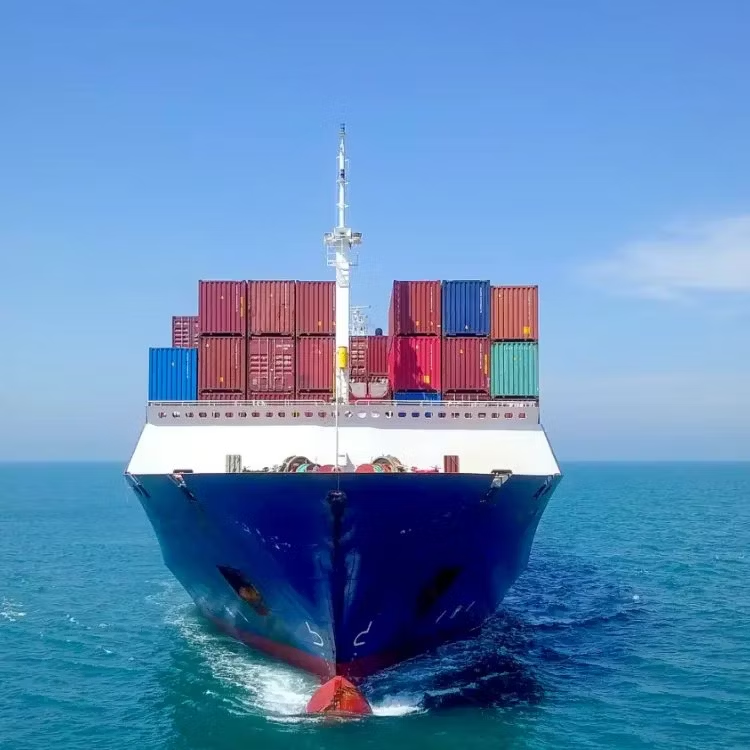
Sea freight is the backbone of China–Lithuania trade, carrying the vast majority of commercial cargo. It’s the cheapest way to ship from China to Lithuania per unit for volumes above 2–3 m³, though it requires patience — typical transit times range from 30 to 50 days depending on your departure port and whether you book a direct or transshipment service.
For an in-depth look at all sea freight options on this corridor — including route maps, sailing schedules, and cost-saving strategies — see our complete Sea Freight From China to Lithuania guide.
FCL (Full Container Load) Shipping Costs
When you have enough cargo to fill an entire container — or when the per-unit economics favor a dedicated box — FCL shipping is the most efficient option. Here’s what you can expect to pay by origin port in China:
| Origin Port → Klaipėda | 20ft GP | 40ft GP | 40ft High Cube |
|---|---|---|---|
| Shenzhen (Yantian / Shekou) | $2,200–$3,500 | $2,800–$4,500 | $3,000–$5,000 |
| Shanghai | $2,000–$3,300 | $2,500–$4,200 | $2,700–$4,500 |
| Ningbo | $1,800–$3,200 | $2,400–$4,000 | $2,600–$4,300 |
| Qingdao | $2,400–$3,800 | $3,000–$4,800 | $3,200–$5,200 |
| Guangzhou (Nansha) | $2,100–$3,400 | $2,700–$4,300 | $2,900–$4,600 |
Rates are higher for northern ports like Qingdao and Tianjin because of the longer sailing distance to reach the Suez Canal route. Shenzhen and Ningbo — being southern ports with frequent sailings — typically offer the most competitive pricing.
Several surcharges influence your final FCL cost beyond the base ocean rate. The Bunker Adjustment Factor (BAF) accounts for fuel price fluctuations; the Currency Adjustment Factor (CAF) hedges exchange-rate risk; and the Peak Season Surcharge (PSS) kicks in during the August–October pre-Christmas rush. Your freight forwarder should quote you an all-in rate that includes terminal handling charges (THC), documentation fees, and seal fees.
Real example: In Q2 2026, a 40ft HC container of furniture shipped from Shenzhen to Klaipėda with COSCO cost approximately $3,200. The same container loaded from Qingdao ran closer to $4,200 due to the extended transit and fewer direct sailing options.
LCL (Less than Container Load) Shipping Costs
If your shipment is smaller — say, 2 to 12 cubic meters — LCL sea freight lets you share container space with other shippers and pay only for the volume you use. Here are representative rates from major Chinese hubs:
| Origin → Destination | Rate (per m³) | Transit Time | Minimum Volume |
|---|---|---|---|
| Shenzhen → Vilnius | $60–$90/m³ | 34–40 days | 1 m³ |
| Shenzhen → Klaipėda | $65–$95/m³ | 35–42 days | 1 m³ |
| Shanghai → Klaipėda | $60–$130/m³ | 42–50 days | 1 m³ |
| Hong Kong → Vilnius | $55–$85/m³ | 35–40 days | 1 m³ |
Hong Kong and Shenzhen consistently offer the most competitive LCL rates due to high shipment consolidation volume and frequent sailings.
When does LCL beat FCL? The break-even point is typically around 12–15 m³. (Not sure which option fits your cargo? Our LCL vs FCL Shipping: How to Choose the Right Option for Small Cargo guide walks through the decision step by step.) Below that volume, LCL is cheaper per shipment. Above it, a dedicated 20ft container (which holds roughly 28–33 m³ depending on palletization) becomes more cost-effective per cubic meter. Keep in mind that LCL involves extra handling — consolidation at origin and deconsolidation at destination — which adds 5–10 days to overall transit time compared to FCL.
Sea Freight Transit Times & Routes
The standard ocean route from China to Klaipėda follows this path:
Chinese port → Singapore Strait → Indian Ocean → Suez Canal → Mediterranean Sea → Strait of Gibraltar / English Channel → North Sea → Baltic Sea → Klaipėda
Many services transship via major European hubs — Hamburg, Rotterdam, or Bremerhaven — where the container is loaded onto a feeder vessel for the final leg into Klaipėda. Direct calls to Klaipėda are less frequent than to larger North European ports, so transshipment is the norm. This adds 3–7 days compared to a direct call but is reflected in the rate.
Air Freight from China to Lithuania
When speed is non-negotiable, air freight delivers goods from major Chinese airports to Vilnius International Airport (VNO) in as little as 3 to 8 days. You’ll pay a premium for that speed, but for high-value electronics, seasonal fashion, medical devices, or urgent replacement parts, the math often works out.
Air Freight Rates by Weight Bracket
Airlines price cargo by chargeable weight — whichever is greater between the actual gross weight and the volumetric weight (calculated as Length × Width × Height in centimeters ÷ 6,000). This means bulky, lightweight goods (like pillows or foam packaging) can cost more than their actual weight suggests.
| Weight Bracket | Rate (per kg) | Example: 200 kg Shipment |
|---|---|---|
| 45–100 kg | $5.50–$9.00/kg | — |
| 100–300 kg | $4.50–$6.50/kg | $900–$1,300 |
| 300–500 kg | $4.00–$5.50/kg | — |
| 500–1,000+ kg | $3.50–$5.00/kg | — |
As your shipment weight increases, the per-kilogram rate drops significantly. A 500 kg shipment might cost $4.00/kg, while a 45 kg package could run $9.00/kg. This tiered structure rewards consolidation — if you can batch multiple orders into one air shipment, you’ll capture a meaningfully lower rate.
Major Airports, Airlines & Transit Times
Key departure airports for China–Lithuania air cargo include Shanghai Pudong (PVG), Shenzhen Bao’an (SZX), Guangzhou Baiyun (CAN), Hong Kong (HKG), and Beijing Capital (PEK). On the Lithuanian side, Vilnius International (VNO) is the primary cargo gateway, with some shipments routing through Kaunas Airport for regional distribution.
Major airlines serving this corridor include Turkish Airlines (via Istanbul), China Southern Airlines (CZ), Air China (CA), Lufthansa (via Frankfurt), and Finnair (via Helsinki). Transit times range from 3–5 days for priority services with one-stop connections to 5–8 days for economy air freight.
For the most urgent shipments — samples, prototypes, or critical spare parts — express air freight via integrated carriers (DHL, FedEx, UPS) delivers door-to-door in 2–5 days at $5–$15/kg. This is faster but significantly more expensive than consolidated air freight, and is best reserved for shipments under 50 kg.
Rail Freight: The China-Europe Railway Express Option
Often overlooked by importers who default to sea or air, rail freight has matured into a compelling middle-ground option for shipping from China to Lithuania. The China-Europe Railway Express network now connects over 60 Chinese cities to European destinations, with transit times of 16–22 days — roughly half of sea freight and at 30–50% lower cost than air freight.
| Rail Method | Cost Range | Transit Time |
|---|---|---|
| Rail FCL (40ft container) | $6,000–$10,000 | 16–22 days |
| Rail LCL | $200–$450/m³ | 18–25 days |
A typical rail route runs from major Chinese rail hubs — Chengdu, Chongqing, Xi’an, Zhengzhou, and Yiwu — westward through Kazakhstan, across Russia and Belarus, to the Polish border terminal at Małaszewicze. From there, containers are trucked or moved by rail into Lithuania, typically arriving at Vilnius or Kaunas intermodal terminals within 2–3 days of clearing the EU border.
Rail freight is ideal for mid-size commercial cargo — machinery components, auto parts, consumer electronics, and seasonal goods — where 35+ days on the water would miss a sales window, but air freight is cost-prohibitive. It’s also gaining traction among e-commerce sellers who use Lithuania as an EU distribution hub.
Geopolitical note: Sanctions on Russia and Belarus have introduced complexity to some rail routes since 2022. However, freight forwarders with active rail programs have adapted routings and use sanctioned-entity screening to maintain compliant service. If you’re considering rail, work with a forwarder who can explain the current routing and any applicable restrictions for your commodity type.
DDP Door-to-Door Shipping: The All-Inclusive Option
For many importers — especially those new to international logistics — the most valuable number isn’t the freight rate. It’s the total landed cost: what you pay, all-in, to move goods from a factory floor in China to your door in Lithuania. This is where DDP (Delivered Duty Paid) shipping earns its reputation as the simplest way to import.
What DDP Covers: A Step-by-Step Walkthrough
Under a DDP arrangement, your freight forwarder handles every step:
- Factory Pickup — Trucking from your supplier’s facility to the port/airport in China
- Export Customs Clearance — Filing the Chinese export declaration and obtaining necessary permits
- International Transportation — Sea, air, or rail freight to Lithuania
- Arrival at Klaipėda or Vilnius — Port/airport handling and unloading
- Import Customs Clearance — Filing the Lithuanian import declaration, paying duties and 21% VAT
- Last-Mile Delivery — Trucking from the port/airport to your warehouse, store, or residence
- Delivery Confirmation — You receive your goods and sign off
In contrast, under EXW (Ex Works), you’re responsible for every step from the factory gate onward. Under FOB (Free on Board), the seller handles Chinese export clearance and delivery to the port, but you manage ocean freight, insurance, and destination clearance. DDU (Delivered Duty Unpaid) is similar to DDP but leaves import duties and VAT for the buyer to pay upon arrival — a middle ground that some experienced importers prefer when they have a deferred VAT account. The right Incoterm depends on your experience level and whether you have a trusted customs broker in Lithuania.
DDP Cost Estimate Scenarios
Here are three realistic DDP cost scenarios to give you a sense of all-in pricing:
| DDP Scenario | Cargo | Mode | Estimated All-In Cost |
|---|---|---|---|
| Small shipment | 1 m³ / 200 kg general merchandise, Shenzhen → Vilnius | Sea LCL + DDP | $250–$450 |
| Mid-size commercial | 20ft container of consumer goods, Shanghai → Kaunas | Sea FCL + DDP | $3,500–$5,500 (incl. duty + VAT on ~$20,000 cargo) |
| Time-sensitive | 100 kg electronics, Shenzhen → Vilnius | Air + DDP | $800–$1,200 (incl. duty + VAT on ~$5,000 cargo) |
These are estimates based on typical consumer goods with duty rates of 3–7%. Actual DDP costs will vary based on your product’s HS code, declared value, and applicable duty rate. Always share your product details with your forwarder for a precise DDP quote.
For a step-by-step walkthrough of how door to door shipping from China to Lithuania works in practice — including real transit timelines, customs handling, and customer case studies — see our dedicated door-to-door service page.
Lithuania Import Duties, VAT & Customs Clearance
This is the section that no other shipping guide to Lithuania covers — and it’s where many importers lose money to unexpected charges. Understanding how Lithuania calculates import costs isn’t just helpful; it’s essential to accurate budgeting.
How to Calculate Your Total Import Cost
Lithuania, as an EU member state, applies the EU Common Customs Tariff (TARIC) to all imports from outside the EU. Here’s the formula every importer should know:
Total Landed Cost = CIF Value + Import Duty + VAT
Where:
- CIF Value = Product Cost + Freight + Insurance
- Import Duty = CIF Value × Duty Rate (%) — varies by HS code, typically 0–12%
- VAT = (CIF Value + Import Duty) × 21%
Worked example — LED lighting:
You import $10,000 worth of LED luminaires (HS Code 9405.40, EU duty rate 3.7%) from a supplier in Shenzhen. Ocean freight costs $2,500, and cargo insurance costs $100.
- CIF Value = $10,000 + $2,500 + $100 = $12,600
- Import Duty = $12,600 × 3.7% = $466
- VAT = ($12,600 + $466) × 21% = $2,744
- Total Landed Cost = $12,600 + $466 + $2,744 = $15,810
Second example — consumer electronics (0% duty):
The same $10,000 value in smartphones (many electronics carry 0% EU duty under the Information Technology Agreement) yields a very different result:
- CIF Value = $12,600 (same freight and insurance)
- Import Duty = $12,600 × 0% = $0
- VAT = ($12,600 + $0) × 21% = $2,646
- Total Landed Cost = $12,600 + $2,646 = $15,246
The difference? Electronics enjoy a duty-free classification, saving $466 compared to the lighting example. This is why getting your HS Code classification right is one of the highest-ROI activities in international sourcing — a small misclassification can mean overpaying duties or, worse, facing customs penalties.
To check the duty rate for your specific product, use the EU’s TARIC database — the European Commission’s official Access2Markets portal maintained by DG Trade. You can search by HS code or product description to get the exact duty percentage that applies to your commodity.
Required Documentation Checklist
To clear customs in Lithuania, you’ll need:
- Commercial Invoice — Detailed description, unit and total value, buyer and seller information, HS Codes
- Packing List — Per-package contents, weights, dimensions
- Bill of Lading (sea freight) or Airway Bill (AWB) (air freight) — Contract of carriage
- Certificate of Origin — May qualify your goods for reduced or zero duty rates under EU trade agreements
- EORI Number — Economic Operators Registration and Identification number, mandatory for all EU importers
- Import Declaration (Single Administrative Document / SAD) — Filed electronically via the Lithuanian Customs system
- Product-specific certificates — CE marking documentation, health certificates for food/medical products, etc.
How the Customs Process Works
The clearance process in Lithuania follows a predictable sequence: goods arrive at the port or airport → your customs broker (or your forwarder under DDP) submits the electronic import declaration → Lithuanian Customs reviews the documentation and may inspect the shipment → duties and VAT are assessed and must be paid before release → goods are released for final delivery.
Common causes of customs delays include incorrect HS code classification, undervaluation of goods (customs authorities compare declared values against market norms), and missing supporting documents. A competent freight forwarder reviews all documentation before departure, catching issues at origin where they’re far cheaper to fix — a lesson we learned the hard way years ago when a single digit error in an HS code for machinery parts triggered a five-day hold at Klaipėda. Today, our team runs a pre-clearance document audit on every shipment before the container leaves China. For shipments where you’d prefer to offload all customs complexity, Dantful’s Customs Clearance service handles both Chinese export and Lithuanian import formalities under one roof.
Pro tip: Because Lithuania is an EU member state, goods that clear customs here can be distributed duty-paid to any of the 27 EU countries — Latvia, Estonia, Poland, Germany, the Nordics, and beyond — without additional customs formalities. This makes Lithuania an exceptionally efficient first entry point for businesses serving the broader European market.
Klaipėda Port & Lithuania’s Logistics Infrastructure
Most shipping guides treat “Klaipėda” as just another port name on a rate sheet. But understanding Lithuania’s logistics infrastructure helps you make smarter routing, warehousing, and distribution decisions.
Klaipėda — The Baltic Gateway
The Port of Klaipėda is the largest seaport in the Baltic States and the northernmost ice-free port on the eastern Baltic Sea, handling approximately 45 million tons of cargo annually (according to the Port of Klaipėda Authority’s latest throughput report). Its key advantages for China importers include:
- Deep-water berths up to 14.5 meters, accommodating Panamax and post-Panamax vessels
- Klaipėda Container Terminal with modern gantry cranes and on-dock rail connections
- RO-RO (Roll-on/Roll-off) facilities for wheeled and tracked cargo
- Year-round operations — unlike ports further north in the Gulf of Finland (St. Petersburg, Helsinki), Klaipėda remains ice-free through winter
Most FCL containers from China arrive via transshipment at Hamburg, Rotterdam, or Bremerhaven, where they’re loaded onto feeder vessels for the 2–3 day Baltic Sea leg to Klaipėda. An increasing number of services now include Klaipėda as a direct port of call on Far East–Baltic strings.
Inland Distribution: From Port to Your Door
Once your cargo clears customs at Klaipėda, inland trucking is straightforward:
| Route | Distance | Approx. Driving Time |
|---|---|---|
| Klaipėda → Vilnius | ~310 km | ~4 hours |
| Klaipėda → Kaunas | ~215 km | ~2.5 hours |
| Klaipėda → Panevėžys | ~240 km | ~3 hours |
Cross-border distribution is equally practical. Riga, Latvia, is only 230 km from Klaipėda, making Shipping From China To Latvia a natural complement to your Lithuania supply chain. Tallinn, Estonia, is reachable within a day. And for Nordic markets, short-sea shipping from Klaipėda to ports in Sweden, Denmark, and Finland adds a cost-effective distribution layer.
Lithuania’s growing logistics park infrastructure — particularly around Vilnius and the Kaunas Free Economic Zone — offers bonded warehousing, fulfillment, and value-added services ideal for Amazon FBA sellers and e-commerce brands using Lithuania as their EU distribution hub.
7 Cost-Saving Tips for Shipping from China to Lithuania
Knowing the rates is half the battle. These seven strategies — gathered from 15+ years of freight forwarding experience — can meaningfully reduce your shipping costs.
1. Ship during off-peak windows. Ocean freight rates spike from August through October (pre-Christmas rush) and during the weeks surrounding Chinese New Year (late January to mid-February). The cheapest windows are typically March–May and November. If your inventory plan has flexibility, timing your shipments to avoid peak season can save 15–30% on ocean freight alone.
2. Know your FCL/LCL break-even point. At around 12–15 m³, a 20ft container becomes more economical than LCL on a per-unit basis. Don’t default to LCL “because my shipment is small” — calculate both options. If you’re at 10 m³ and trending upward, it may be worth consolidating orders to reach FCL volume.
3. Consolidate multiple suppliers at origin. Instead of shipping three 5 m³ LCL shipments from three different suppliers, consolidate them at a warehouse in Shenzhen and ship one 15 m³ FCL container. This approach — known in the industry as consolidated shipments — can cut your per-unit freight cost by 30–50% compared to shipping each order individually. The freight savings often outweigh the consolidation handling fee.
4. Choose the right Incoterm for your situation. FOB gives you control over the main carriage and the ability to use your own forwarder, often yielding better rates. DDP trades some cost efficiency for total peace of mind. There’s no universally correct answer — but there’s a correct answer for your business.
5. Insure your cargo — always. Marine cargo insurance costs approximately 0.3–0.5% of the cargo’s declared value. For a $20,000 shipment, that’s $60–$100. One damaged container or a single customs seizure without coverage can erase your margin on dozens of shipments.
6. Partner with a certified freight forwarder, not a rate aggregator. Class-A licensed forwarders with NVOCC accreditation maintain direct contracts with carriers. They secure space and rates that spot-market buyers and digital platforms simply cannot match — especially during peak season when capacity tightens.
7. Classify your HS codes before booking. Send your product specifications and photos to your forwarder before booking. A 15-minute classification review can prevent days of customs delay and hundreds of dollars in incorrect duty payments at the destination.
Why Partner with a Professional Freight Forwarder?
Coordinating a shipment from China to Lithuania involves at least five separate parties: your factory, a Chinese customs broker, an ocean carrier or airline, a Lithuanian customs broker, and a trucking company. Each handoff is an opportunity for delay, miscommunication, or unexpected cost.
A professional freight forwarder replaces this fragmented chain with a single point of accountability. (If you’re evaluating providers, our guide on how to choose the right freight forwarder covers the five criteria that actually matter — beyond just the price per kilo.) This is particularly important for the China–Lithuania corridor, where language barriers, time zone differences, and unfamiliarity with EU customs procedures can compound into costly problems.
At Dantful International Logistics, we’ve specialized in China-to-Europe freight for over 15 years, including extensive experience with the Baltic region. Our operation is built on credentials that matter in the real world:
- Class-A Freight Forwarder License issued by China’s Ministry of Commerce
- NVOCC accreditation from China’s Ministry of Transport
- FMC membership for compliant ocean freight contracting
- Jctrans membership, connecting us to a network of vetted agents in 200+ countries
What this means for your Lithuania shipment: direct contracts with COSCO, Maersk, MSC, CMA CGM for ocean freight and Turkish Airlines, China Southern, Air China for air freight. Competitive rates, guaranteed space allocations — even during peak season — and a team of 50 operations specialists backed by 50+ customer service professionals providing 24/7 support.
Our DDP door-to-door service covers every step from factory pickup in China to final delivery at your door in Vilnius, Kaunas, or anywhere in Lithuania — including all customs clearance, duty payments, and VAT processing, wrapped into one transparent invoice with no hidden fees and no surprise surcharges.
We encourage every importer to request quotes from at least 2–3 forwarders and compare not just the bottom-line price, but the service scope: who handles customs? Is insurance included? What tracking visibility do they provide? The cheapest freight quote often proves the most expensive when hidden fees and delays stack up.
FAQs
Q: How much does a 20ft container cost from China to Lithuania?
A: A 20ft container typically costs $1,800–$3,500 depending on the departure port. From Shenzhen or Ningbo, expect $1,800–$3,200; from northern ports like Qingdao or Tianjin, plan for $2,400–$3,800. Rates vary with seasonality and carrier capacity.
Q: How long does sea freight take from China to Lithuania?
A: FCL sea freight takes approximately 30–45 days from major Chinese ports to Klaipėda. LCL shipments add 5–10 days for consolidation and deconsolidation, typically taking 35–50 days total. Transit via transshipment hubs like Hamburg or Rotterdam is standard.
Q: What is the cheapest way to ship from China to Lithuania?
A: For shipments under 12–15 m³, LCL sea freight at $55–$130/m³ is the most economical. For larger volumes, FCL sea freight offers the lowest cost per cubic meter. Rail freight provides a middle ground when you need goods faster than sea delivery but can’t justify air freight pricing. For rate comparisons across multiple forwarders serving this corridor, see our analysis of the cheapest shipping company from china to Lithuania.
Q: Do I need to pay import duties and VAT when shipping to Lithuania?
A: Yes. Lithuania applies the EU Common Customs Tariff (duty rates typically 0–12% based on HS code) plus 21% VAT on the CIF value plus duty. Choosing DDP shipping bundles these costs into one all-in price paid upfront.
Q: Can I ship from China to Lithuania without a freight forwarder?
A: Technically yes, but managing export/import customs, carrier booking, documentation, and last-mile delivery yourself is complex and error-prone. A freight forwarder’s volume discounts often offset their service fee, making the DIY approach both riskier and potentially more expensive.
Q: What documents are required to import goods from China to Lithuania?
A: Essential documents include a Commercial Invoice (with HS codes), Packing List, Bill of Lading or Airway Bill, Certificate of Origin, and an EORI number. Product-specific certificates (CE marking, health/safety) may also be required depending on your commodity type.
Q: Is rail freight from China to Lithuania reliable?
A: Yes. The China-Europe Railway Express has achieved consistent 16–22 day transit reliability on established corridors. Sanctions-related routing adjustments have been managed by major operators. Work with a forwarder who can confirm the most stable routing for your timeframe.

Young Chiu is a seasoned logistics expert with over 15 years of experience in international freight forwarding and supply chain management. As CEO of Dantful International Logistics, Young is dedicated to providing valuable insights and practical advice to businesses navigating the complexities of global shipping.