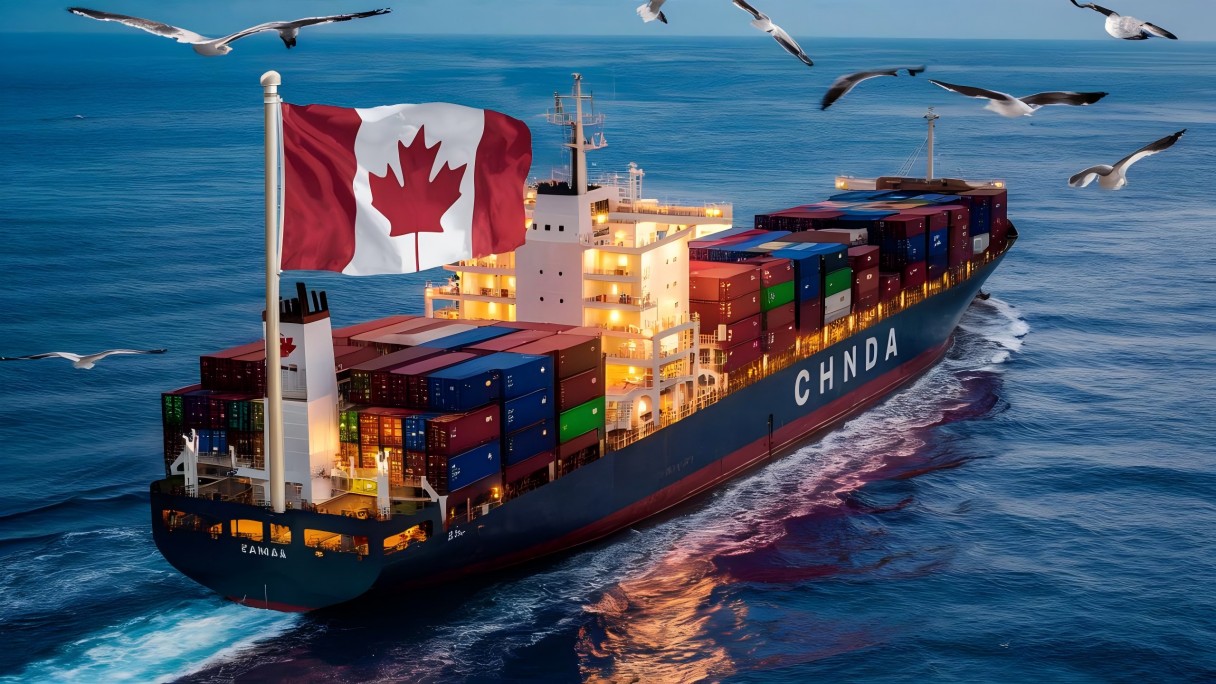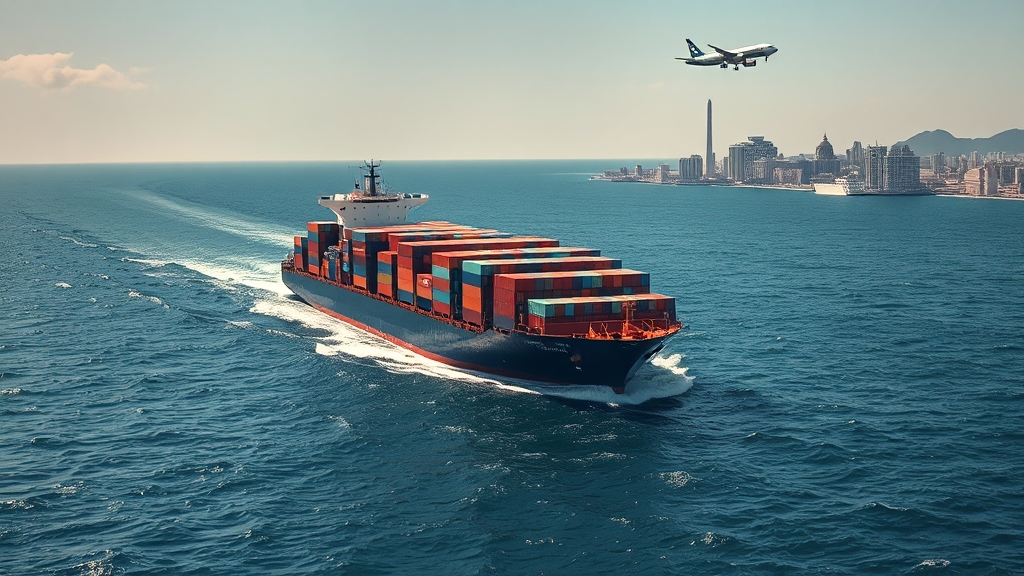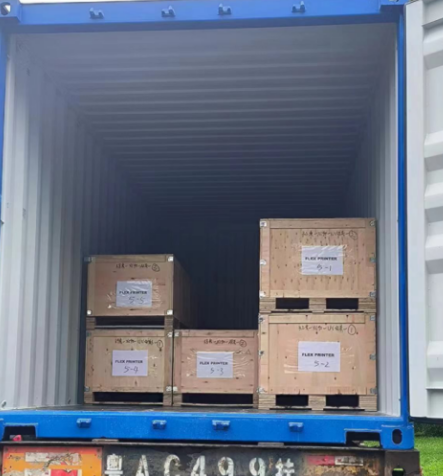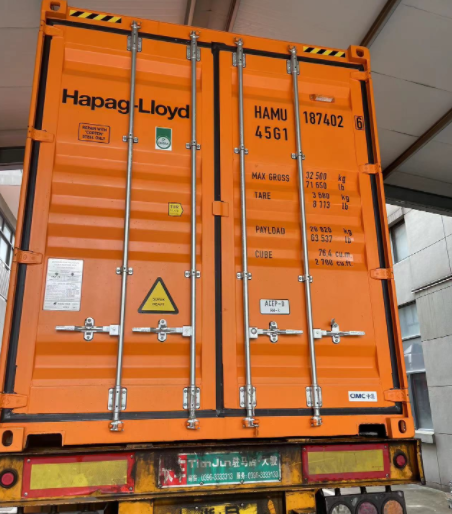
Shipping cost from China to DR Congo in October 2026 runs about $2,900-4,600 for a 20ft container and $4,100-6,500 for a 40ft or 40HQ into Matadi, $180-360 per CBM by LCL, and $7.50-10.50 per kg by air to Kinshasa. Sea transit is 32-45 days port to port, air is 6-10 days, and express lands in 5-9 days. Express is the fastest mode, a 40HQ is the cheapest per tonne, and LCL wins below roughly 10-16 CBM.
Those are the four numbers importers ask for first, and on this lane they are also the four numbers most likely to mislead. A 20ft container quoted at $3,450 on a January 2026 quotation and a 20ft container advertised at $5,803 in October 2026 are not the same product: the second number already carries Congolese duty, VAT and the clearing file. The gap between a $4,100 container and the $24,530 it costs to land is created almost entirely after the vessel sails, by a 5/10/20% duty band, the OCC’s 2% of FOB, a euro-denominated FERI and 16% VAT.
This guide prices both layers, in the currency and the order your broker will actually invoice you.
As a Shipping From China To Congo specialist working out of Shenzhen since 2008, Dantful moves FCL, LCL, air and DDP cargo into Matadi, Boma and Kinshasa every week. The rates below are the October 2026 market, the customs section follows the entities that actually clear cargo today (DGDA, OGEFREM, OCC), and every figure carries a month and a source label so you can judge its vintage before you budget against it.
Table of Contents
How Much Does Shipping from China to DR Congo Cost in 2026?
The single most useful thing to know about this lane is that published prices span $2,550 to $7,091 for the same 20ft container to the same port. That is not a market anomaly. It is three different products with the same name.
| Scope | What the number actually buys | 20ft | 40ft / 40HQ | LCL per CBM | Basis |
|---|---|---|---|---|---|
| Port-to-port ocean | Carrier freight + origin charges, cargo stops at Matadi | $2,900-4,600 | $4,100-6,500 | $180-360 | October 2026 consensus |
| Cleared at Matadi | The above + duty, VAT, OCC, FERI, terminal handling | +38-45% of CIF | +38-45% of CIF | +duty/VAT share | Worked example in the customs section |
| DDP, delivered Kinshasa | Everything, duty paid, to your door | $5,800-7,100 | $7,600-9,300 | $639-705 | Published all-in brackets, October 2026 |
Read the table down, not across. The $2,550 figure at the bottom of the market (DocShipper, 2026) is ocean freight with origin charges; the $5,803 figure at the top (SINO, “updated October 2026”) is a duty-paid door delivery, which is the only way $5,803 for a 20ft and $705.26 per CBM reconcile with each other. Both are honest numbers. Only one of them is a budget.
What the market did during 2026
DR Congo did not reprice like the trans-Pacific or the Middle East loops. It moved in a narrow band, driven by surcharges and space rather than spot spikes:
| Period | 20ft to Matadi | 40ft to Matadi | Evidence |
|---|---|---|---|
| January 2026 | — | $4,065 | Goodhope quotation log, Nansha/Dalian loading |
| March 2026 | — | $6,030 | Same log, Tianjin/Dalian loading |
| July 2026 | $3,300-4,200 | $5,200-6,500 (40HQ) | Speed Line, July 2026 table |
| October 2026 | $2,900-4,600 | $4,100-6,500 | Consensus of five sources, this article |
Two things stand out. First, the March 2026 peak of $6,030 for a 40ft came without any congestion event at Matadi — it was carrier pricing on a thin loop where three alliances share the West Africa rotation and equipment is repositioned on demand. Second, space stopped being the constraint: the same forwarder logged 44 offers to DR Congo during 2026 where equipment or space was available while the carrier quoted the rate on request. When carriers quote on request rather than publish, the number you get depends on the day you ask, which is exactly why a quote on this lane should carry a validity date of two to three weeks and no more.
One country, two Congos, two customs territories
Before any number matters, confirm which Congo you are shipping to. The Democratic Republic of the Congo (capital Kinshasa, gateway Matadi) and the Republic of the Congo (capital Brazzaville, gateway Pointe-Noire) face each other across the same river and share nothing administratively: different customs authority, different tracking document, different duty schedule. A FERI issued for one is not valid for the other, and a container re-routed across the river arrives after the free time has already started counting.
If your consignee is in Brazzaville or Pointe-Noire, the door to door shipping from China to Republic of the Congo guide is the right page. Everything below is DR Congo — Kinshasa, Matadi, Boma, Lubumbashi, Kolwezi, Goma.
For scale on the other African lanes that share this rate structure, the container shipping costs from china to Africa overview is the comparison point.
What Is Included in a China to DR Congo Shipping Quote?
A quote on this lane has four families of charge, and the reason two forwarders can differ by $1,500 on the same container is usually not the ocean freight. It is which of the four they put in the number.
The four components, and how they sum to the headline
| Component | 20ft | 40ft / 40HQ | What it covers |
|---|---|---|---|
| Ocean freight | $2,500-3,900 | $3,600-5,600 | Carrier space from a Chinese loading port to Matadi |
| Surcharges (BAF / PSS / ISPS) | $200-400 | $250-500 | Fuel, peak season, terminal security; reset by carrier notice |
| Origin charges | $180-270 | $220-350 | Export declaration, terminal handling at origin, documentation |
| Documentation | $20-30 | $30-50 | Bill of lading, manifest, amendment cover |
| Port-to-port total | $2,900-4,600 | $4,100-6,500 | Cargo stops at Matadi |
Those four lines sum exactly to the headline ranges, which is the test to apply to any quote you receive: ask for the four lines separately and add them yourself. A quote that arrives as one number cannot be audited, and on this lane the destination side is where the variance hides.
The charges that sit outside the freight
None of these are unusual and none of them are concealed — they are the standard cost chain of importing into a country whose customs system runs in French on a single window only a registered local party can file through. A professional forwarder lists them line by line in the quote rather than at the counter.
| Charge | Typical level | What it is and how to plan for it |
|---|---|---|
| Destination terminal handling (DTHC) | Quoted per container at booking | Charged by the Matadi terminal operator, not the carrier. Ask for it in writing before you compare two freight numbers. |
| FERI (OGEFREM) | €60 per 20ft, €110 per 40ft, €4 per CBM for LCL | The electronic import information form. Priced in euros, so budget the euro rate as well as the fee. |
| ECTN | Carrier-set, typically $100-200 | A second electronic cargo tracking note. Its data must match the FERI exactly. |
| OCC inspection and fee | 2% of FOB value | Covers verification of conformity and the pre-shipment inspection. On a $12,000 FOB container that is $240. |
| Import duty | 5%, 10% or 20% of CIF | Set by HS code. See the band table in the customs section. |
| VAT (TVA) | 16% of CIF + duty + charges | The largest single line on most files. |
| Broker / clearing agency fee | $150-400 per file | Filed through SEGUCE in French by a licensed broker. |
| Inland haulage Matadi-Kinshasa | From $800 per container, quoted case by case | Road is the default; rail is not yet a scheduling option. |
| Demurrage / storage | $10-20 per day per container after free time | Carrier and terminal clocks start at discharge. Free time is negotiable and generous at Matadi, thin at Kinshasa. |
The practical rule: the freight quote should state, in writing, that Matadi terminal handling, FERI, ECTN, OCC, duty and VAT are outside the number. Any forwarder who cannot produce that sentence is quoting you a number you will meet again at the port.
Sea Freight Rates from China to DR Congo: 20ft & 40ft by Port
FCL into DR Congo means one of two Atlantic terminals. Matadi carries the overwhelming majority of containerised imports: it sits roughly 150 km up the Congo River, works two berths of 175 metres each at the Matadi Gateway Terminal (MGT, operated by ICTSI) with an annual capacity around 175,000 TEU, and is the only terminal in the country with mobile harbour cranes able to work gearless vessels. Boma, downstream, is the second option and serves the same hinterland with a small premium.
| Loading port (China) | To Matadi, 20ft | To Matadi, 40ft / 40HQ | To Boma, 20ft | To Boma, 40ft / 40HQ |
|---|---|---|---|---|
| Shanghai | $2,900-4,450 | $4,100-6,300 | $2,980-4,600 | $4,180-6,450 |
| Ningbo | $2,950-4,400 | $4,150-6,250 | $3,030-4,550 | $4,230-6,400 |
| Shenzhen / Yantian | $3,000-4,550 | $4,200-6,400 | $3,080-4,700 | $4,280-6,550 |
| Xiamen | $3,100-4,550 | $4,350-6,450 | $3,180-4,700 | $4,430-6,600 |
| Qingdao | $3,150-4,600 | $4,400-6,500 | $3,230-4,750 | $4,480-6,650 |
October 2026, port-to-port, excluding destination handling, duty and VAT. Boma carries a feeder or berth premium of roughly $80-150 per container; the difference is not worth chasing unless your consignee is closer to Boma than to Matadi.
Why the port choice matters less than the draft
Matadi’s controlling depth is about 8 metres, which caps the size of vessel that can come up the river and forces larger tonnage to transship at Pointe-Noire or Durban. That single physical fact drives the transit time on this lane more than distance does: a direct call saves one to two weeks over a transshipment routing, and a direct call depends on whether the carrier can put a small enough ship on the rotation that week. It is also why the Congo River dredging programme — studies to take the channel from 26 to 33 feet, and a terminal-side plan for 12.5 metres to admit Panamax tonnage — matters commercially to importers far more than any new terminal announcement.
The one announcement that does change routing is Banana. DP World holds a 30-year concession on the deep-water port at the river mouth: a 600-metre quay, 18-metre draft, around 450,000 TEU of annual capacity, with phase one now reported for early 2027. Until it opens, and until the 143 km rail link from Banana to Matadi exists, there is no container service at Banana worth quoting. Treat any 2026 rate sheet that offers “Banana” as a gateway with suspicion — the terminal is under construction, and the road from Banana to Kinshasa still runs via Matadi through country that cannot carry containers.
If your cargo is going east, do not quote Matadi
Lubumbashi, Kolwezi, Goma and Bukavu are served through Dar es Salaam, Mombasa, Durban or Beira and overland via Kasumbalesa, in 45-65 days. Quoting Matadi for a Katanga consignee is not a cheap quote, it is half a route: the container arrives 2,000 km from the delivery address and the inland leg costs more than the ocean leg did. Dantful publishes the ocean-side detail for the whole continent in the Sea Freight from China to Africa guide, and the Matadi-specific operational detail — berth windows, terminal handling, documents — in the Sea Freight From China to Democratic Republic of the Congo page.
LCL Shipping Cost per CBM to Matadi and the FCL Break-Even
LCL into Matadi is not a scaled-down version of FCL. Groupage is charged per revenue tonne — one CBM or 1,000 kg, whichever is greater — plus a fixed documentation and CFS charge at both ends, and the destination charges are applied per shipment rather than per container. That structure is what makes the per-CBM rate fall as volume rises and what makes LCL stop making sense earlier than most importers expect.
| Volume band | LCL rate per CBM | What drives it | Typical cargo |
|---|---|---|---|
| 1-5 CBM | $300-360 | Fixed CFS and documentation charges spread over few cubic metres | First orders, samples, market stock |
| 6-14 CBM | $220-300 | Consolidation economics improve, fixed charges amortise | Replenishment for one SKU family |
| 15+ CBM | $180-260 | Competing directly with a 20ft container | Full pallet programmes |
These are all-in to Matadi CFS: ocean freight, origin consolidation and destination deconsolidation, excluding duty, VAT, OCC and the inland leg.
The break-even is lower than the European textbook
On Europe or North America, LCL usually stops paying at 12-15 CBM. Here the destination side of an LCL shipment is expensive enough that the crossover arrives sooner. At a representative $280 per CBM:
| Volume | LCL cost | 20ft container | 40ft container | Cheapest option |
|---|---|---|---|---|
| 8 CBM | $2,240 | $2,900-4,600 | $4,100-6,500 | LCL |
| 12 CBM | $3,360 | $2,900-4,600 | $4,100-6,500 | LCL at the low end, 20ft at the high end |
| 16 CBM | $4,480 | $2,900-4,600 | $4,100-6,500 | 20ft |
| 20 CBM | $5,600 | $2,900-4,600 | $4,100-6,500 | 20ft |
| 24 CBM | $6,720 | $2,900-4,600 | $4,100-6,500 | 20ft or 40ft, depending on weight |
| 28 CBM | $7,840 | $2,900-4,600 | $4,100-6,500 | 40ft |
The break-even sits at 10-16 CBM for a 20ft and 15-23 CBM for a 40ft, depending on where in the freight range your quote lands. Two adjustments push it lower in practice: the FCL column above excludes Matadi terminal handling, which LCL rates already absorb, and DRC assesses several charges per shipment rather than per container, so a single LCL file carries a disproportionate share of the fixed cost.
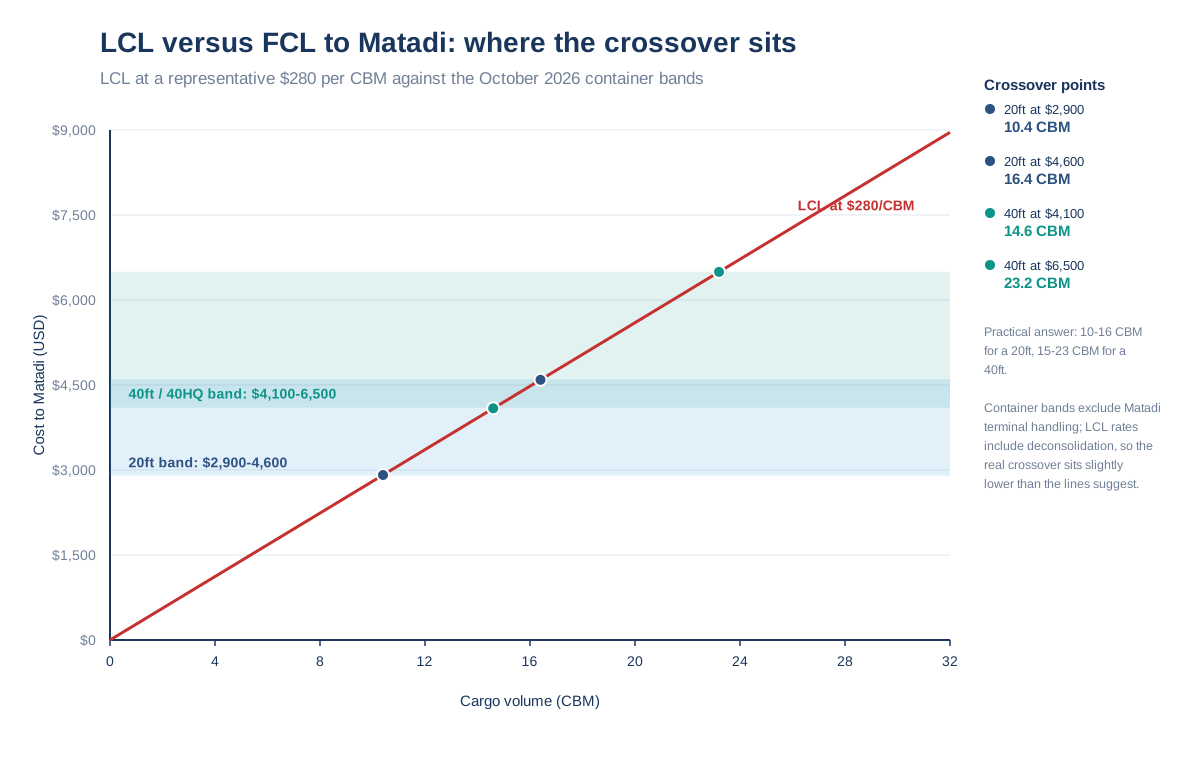
Above 20 CBM, the comparison is no longer LCL against FCL. It is a 20ft against a 40HQ, and on this lane the 40HQ wins on cost per cubic metre from about 28 CBM because a 40ft carries roughly twice the volume for well under twice the freight.
The mechanics of groupage — chargeable weight, W/M, CFS cut-offs — are set out in what is lcl and fcl in shipping, and the decision framework for small cargo in LCL vs FCL Shipping: How to Choose the Right Option for Small Cargo.
Air Freight and Express Rates from China to Kinshasa and Lubumbashi
Air is a genuine option on this lane, not a rounding error: Matadi’s draft limit means sea freight enters the country through a river port with a long inland tail, while air lands at the destination city. Kinshasa N’djili (FIH) takes the bulk of it; Lubumbashi Luano (FBM) serves the copper belt.
| Route | Transit | Rate per kg (100 kg+) | Notes |
|---|---|---|---|
| Shanghai (PVG) to Kinshasa (FIH) | 6-10 days | $7.50-10.50 | Most capacity, most reliable connection |
| Guangzhou (CAN) to Kinshasa (FIH) | 6-10 days | $7.50-10.00 | Best for Pearl River Delta suppliers |
| Hong Kong (HKG) to Kinshasa (FIH) | 7-11 days | $8.50-10.50 | Used when mainland space tightens |
| Guangzhou (CAN) to Lubumbashi (FBM) | 7-10 days | $8.20-10.20 | Mining spares, project cargo |
| Express courier, door to door | 5-9 days | $13.50-17.00 | Up to about 50 kg per piece |
October 2026, airport-to-airport for the air rows, door-to-door for express, excluding duty and VAT.
Two things decide the number more than the airline does. The first is chargeable weight: air bills the greater of gross weight and volumetric weight at L×W×H in centimetres divided by 6,000, which is 167 kg per cubic metre. A carton of plastic housewares weighing 45 kg but measuring 1.2 CBM bills as 200 kg — more than four times its actual weight. The second is density. Above roughly 150 kg per cubic metre air economics hold up against sea; below about 100 kg per cubic metre the volumetric divisor turns a light shipment into an expensive one and LCL or express is usually the better answer.
Express differs from air in more than price. It clears under the courier’s own broker and bond, which on a market where a foreign company cannot file through SEGUCE is worth paying for: 5-9 days door to door, duty and VAT collected at delivery, no clearing file to assemble. For samples, spare parts and a first test order, it is often the most predictable option per shipment even at $13.50-17.00 per kg.
Door-to-Door and DDP Shipping to DR Congo: What the All-In Price Covers
DDP is not a premium product on this lane. It is the standard way in, because three barriers sit in front of a foreign buyer who tries to clear cargo alone: only a DRC-registered party with a valid NIF can file through SEGUCE; the declaration, the invoice and the packing list must all be in French; and the FERI must be validated by OGEFREM before the vessel arrives, which means the file has to be finished in China, not at the port.
| DDP scope | 20ft | 40ft / 40HQ | LCL per CBM | Air per kg |
|---|---|---|---|---|
| Door to Kinshasa, duty paid | $5,800-7,100 | $7,600-9,300 | $639-705 | $13-20 |
| Door to Lubumbashi | Quoted by corridor | Quoted by corridor | $780-900 | $15-22 |
| Delivery time from China | 45-65 days | 45-65 days | 50-70 days | 10-16 days |
October 2026. LCL and container figures reflect the published all-in brackets from three independent sources that agree within 10% ($639, $674 and $705 per CBM); air DDP is derived from freight plus the import tax and delivery maths shown in the customs section, not from a market quotation.
The eight steps, and where the money goes
- Pickup at your supplier anywhere in China and consolidation at the export warehouse.
- Export declaration and, where the value triggers it, the pre-shipment inspection by the appointed inspector — before loading.
- FERI applied for and validated, ECTN issued, both carrying identical cargo data before the vessel departs.
- Ocean carriage to Matadi, usually with one transshipment.
- Declaration through SEGUCE in French, with the inspection certificate attached.
- OCC verification for regulated categories, running alongside customs rather than after it.
- Duty, VAT and parafiscal levies paid; release from the terminal.
- Inland haulage to Kinshasa or onward, then delivery.
Steps 3 and 8 are where budgets break. A FERI that is corrected after the vessel sails creates a penalty and a second validation; an inland leg booked after discharge is priced by whoever is standing at the gate.
The Matadi-Kinshasa leg is a logistics operation, not a formality
The distance is about 366 km on National Road 1 and the transit is 5-10 days in practice, not the 8 hours the map suggests. Three constraints decide the cost:
- Weight. Carriers cap inland movement at 28 tonnes gross per container, for both 20ft and 40ft. Overweight cargo has to be split or re-packed before it leaves the terminal.
- Rail is not yet an option. The Matadi-Kinshasa line reopened in September 2025 after a five-year stoppage, and in October 2026 ONATRA received 42 new wagons — 30 container flats and 12 boxcars, each flat rated for one 40ft or two 20ft up to 57 tonnes. The wagons were not in service at the time of writing: track works are incomplete and no commissioning date has been published. Plan road.
- Road condition and season. The corridor floods and degrades in the November-May rainy season, and truck availability tightens when it does. A road leg that costs from $800 per container in a dry month can double in a wet one.
Anyone quoting you a single flat “inland to Kinshasa” figure for the year is quoting an average they will not honour in February.
Dantful’s door to door shipping from China to Democratic Republic of the Congo service runs this chain under one bill of lading, with the FERI and the clearing file prepared in China rather than at Matadi. If you need the Incoterms comparison first — where risk passes, who pays the duty — the DDP explainer sets it out against EXW, FOB and CIF.
DR Congo Import Duty, 16% VAT, FERI and the OCC Inspection
DGDA (Direction Générale des Douanes et Accises) administers the tariff through 27 offices covering more than 95% of transaction volume, with pre-clearance through SEGUCE and declarations running on SYDONIA. Rates are ad valorem on CIF value — Brussels Definition of Value, so freight and insurance are inside the base, not on top of it.
The duty band, and the load it actually creates
DRC applies a three-band structure, with some lines extending to 30%, plus an excise layer on specific categories.
| Band | What sits in it | Duty on CIF | Duty + 16% VAT, as % of CIF |
|---|---|---|---|
| 5% | Equipment goods, raw materials, chemicals, agricultural and veterinary supplies | 5% | 21.8% |
| 10% | Staple foods, industrial inputs, spare parts, fuel, hospital supplies | 10% | 27.6% |
| 20% | Clothing, footwear, furniture, cosmetics, cigarettes, finished consumer goods | 20% | 39.2% |
| 30% | Highest finished-goods lines | 30% | 50.8% |
| Excise 5-80% | Alcohol, tobacco, fuel, cosmetics, vehicles | Added before VAT | Category-specific |
The right-hand column is the number that belongs in your budget. Duty is not the cost of importing into DR Congo; duty plus VAT is, and because VAT is charged on CIF plus duty, a 20% line produces a 39.2% load rather than 36%. On a $16,600 CIF container that is a $6,500 difference between what the duty line looks like and what the file costs.
FERI, ECTN and OCC: the three documents that gate the container
| Document | Issued by | Cost | Deadline and consequence |
|---|---|---|---|
| FERI (Fiche Électronique de Renseignement à l’Importation) | OGEFREM, through an authorised agent at the loading port | €60 per 20ft, €110 per 40ft, €4 per CBM for general cargo and LCL, plus €50 issuance | Must be validated before the vessel’s arrival. Without it the cargo cannot be cleared, and late application carries a penalty. |
| ECTN (Electronic Cargo Tracking Note) | Carrier-appointed agent | Carrier-set, typically $100-200 | Filed before departure. Data must match the FERI line for line; a mismatch is the single most reported reason containers sit at Matadi. |
| Certificate of inspection (BIVAC, on behalf of OCC) | Bureau Veritas at the port of export | OCC charges 2% of FOB, of which 0.75% funds the inspection | Required above about $2,500 in value, performed after packing and before loading. The certificate fixes CIF, and DGDA cannot revalue after it is validated. |
| Import licence | Commercial bank, for controlled categories | Bank charge | Some product categories only; confirm before ordering. |
Add the Commission d’Intervention, levied at 1.8% of gross freight (1% for a short list of commodities including rice, chicken and grey cement). It is billed to the carrier, so it arrives inside the freight number rather than as a separate invoice — which is one more reason a freight rate without a scope statement cannot be compared to another.
Two operational points worth more than the paperwork list. First, everything goes in French: invoice descriptions, packing list, declaration. Translating in China costs days; translating at Matadi costs weeks. Second, the FERI and ECTN must reflect the final shipping documents. A FERI built from a proforma invoice and a bill of lading issued three weeks later with a different quantity is a detention.
A worked example: the 40HQ that lands at $24,530
Take a 40HQ of finished household goods for Kinshasa — the 20% band, which is where most consumer imports land.
| Line | Amount | Basis |
|---|---|---|
| FOB value, China | $12,000 | Supplier invoice |
| Ocean freight to Matadi | $5,200 | October 2026, 40ft range |
| Cargo insurance | $120 | About 0.7% of FOB |
| CIF value | $17,320 | Duty and VAT base |
| Import duty 20% | $3,464 | 20% of CIF |
| OCC fee 2% of FOB | $240 | Pre-shipment inspection and conformity |
| FERI, 40ft | $123 | €110 at EUR/USD 1.1146 |
| VAT base | $21,147 | CIF + duty + OCC + FERI |
| VAT 16% | $3,383 | 16% of the VAT base |
| Duty, VAT and documents | $7,210 | 41.6% of CIF, 60.1% of FOB |
| Cleared at Matadi | $24,530 | About CDF 56.75 million at 2,313.53 |
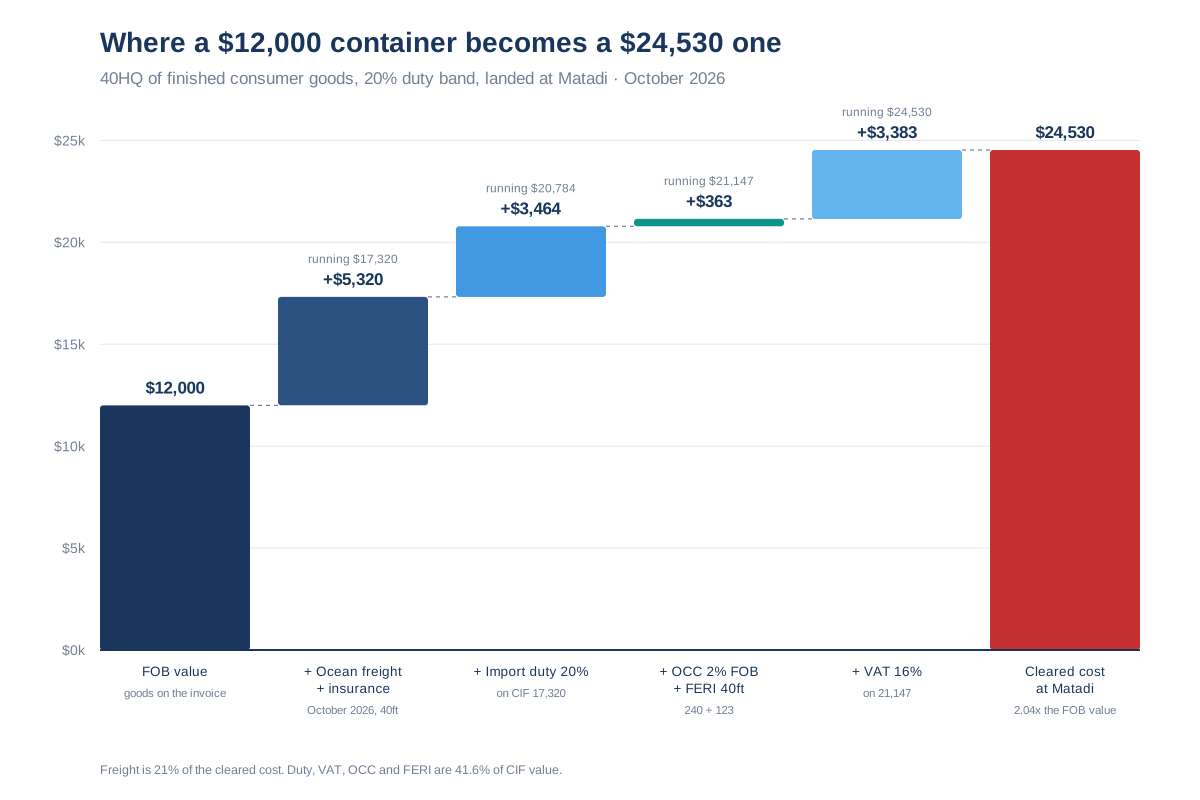
Three conclusions follow from that table. Freight is 21% of the cleared cost, not the majority of it. The tax layer is 41.6% of CIF, and it is not negotiable down by choosing a cheaper carrier — only by correct HS classification and by taking the VAT as recoverable if you are registered and accounting for it. And the figure the market advertises as “DDP 40ft from $7,600” is consistent with this arithmetic only for cargo of lower value or lower duty band than the example; a $40,000 CIF electronics container lands far above it.
If you are not VAT-registered in DR Congo, the 16% is simply a cost. If you are, it is recoverable and the effective burden halves — which is a strong argument for holding a local entity before you scale volume, and a reason the importer-of-record question belongs in the first conversation with your forwarder, not the last.
How Long Does Shipping from China to DR Congo Take?
| Mode | Route | Transit | What adds time |
|---|---|---|---|
| Sea FCL | South China to Matadi | 25-45 days port to port | Transshipment adds 7-14 days |
| Sea FCL | North China to Matadi | +3-7 days on the above | Feeder connection to the main rotation |
| Sea LCL | China to Matadi | 40-52 days | Consolidation before departure, deconsolidation after arrival |
| Sea, door to door | China to Kinshasa | 45-65 days | Plus clearance and the 5-10 day inland leg |
| Sea via east Africa | China to Lubumbashi | 45-65 days | Dar es Salaam or Mombasa, then Kasumbalesa |
| Air | China to Kinshasa FIH | 6-10 days | Space on the rotation, not distance |
| Express | Door to door | 5-9 days | Customs release under the courier’s bond |
| Clearance | Matadi | 3-10 days typical | A clean file clears in a week; a contested one takes weeks |
The wide sea range is real and it is structural. Matadi’s draft limit forces transshipment for anything larger than a feeder, and every transshipment point is a chance to miss a connection. Direct calls are the difference between 25 and 45 days, and which one you get depends on the carrier’s rotation that week — not on your booking class.
Free time and demurrage: the numbers behind a container sitting at Matadi
Free time on this lane is more generous than on most African ports, and less generous than most importers assume once the inland leg starts.
| Carrier / scope | Free time | After free time |
|---|---|---|
| CMA CGM, import Matadi / Boma / Banana | 32 calendar days | $10/day 20ft, $20/day 40ft days 33-46; $20 / $40 from day 47 |
| CMA CGM, import Kinshasa (through bill of lading, carrier haulage) | 15 calendar days | $20/day 20ft, $40/day 40ft from day 16 |
| Maersk, dry containers | Contractual | $10/day 20ft, $20/day 40ft for days 1-14 after free time; $20 / $40 from day 15 |
| Terminal storage (MCTC schedule, January 2026) | 4 days from discharge | Charged per day, per container, by storage period |
| Typical negotiated free time at Matadi | 7-14 days | Progressive tariffs apply |
Effective 2 April 2026, CMA CGM’s Matadi tariff gives 32 free days; the same carrier’s Kinshasa through-bill tariff gives 15. That gap is the single most expensive line item nobody quotes: a container moved under a through bill of lading to Kinshasa has half the free time of one discharged at Matadi and trucked separately, and the inland leg alone can consume it. Note also that terminal storage free time (4 days on the MCTC schedule) is far shorter than carrier free time, and storage is settled with the terminal, not the carrier — two clocks, two invoices.
When to ship: the 2027 calendar
| Window | Effect on this lane | What to do |
|---|---|---|
| January to mid-February | Chinese New Year 6 February 2027 factories close, space tightens before it | Book by the first week of January; cargo for March shelves must load in January |
| Mid-February to March | Ramadan begins around 8 February 2027, overlapping CNY for the first time in years | Expect slower supplier response in China and slower consular and bank processing in Kinshasa |
| March to May | Calmest window; space negotiable, inland roads still passable | Best period to move project cargo and heavy LCL |
| June to October | Rainy season from November, but mid-year is when Matadi terminal congestion builds; Q4 peak pulls forward | Book 4-6 weeks ahead, confirm free time in writing |
| November to December | Rainy season: river levels rise (good for barges), RN1 deteriorates (bad for trucks); Kinshasa festive demand peaks | Add 5-10 days to the inland leg and budget detention |
For the neighbouring corridors that share this seasonal rhythm — Dar es Salaam, Mombasa, Beira — the Africa shipping hub carries the region-level timings.
How to Choose a Reliable Freight Forwarder from China to DR Congo?
This lane puts three jobs inside one quote: an ocean leg into a river port with a draft limit, a clearing file that must be finished in China in French before the vessel sails, and an inland leg whose cost swings with the weather. A forwarder who is good at one of those and silent on the other two will cost you more than the difference in freight rates.
Four checks are worth more than any comparison table:
- Ask who files the FERI and the ECTN, and when. The right answer names OGEFREM, names the agent at the loading port, and commits to validation before the vessel’s arrival. The wrong answer is “our agent handles it” without a deadline.
- Ask who the importer of record is and whether the NIF is valid. Only a DRC-registered party can file through SEGUCE in practice. If you have no local entity, the forwarder must name the broker, the entity and the NIF status before you book.
- Ask for the quote split into origin, freight and destination, with Matadi terminal handling and the inland leg as separate lines. A single number cannot be compared, and it is the destination lines that differ by 40% between forwarders on this lane.
- Ask who pays demurrage if clearance runs late, and what free time they have secured. On a through bill of lading to Kinshasa you have 15 free days, not 32. Get the number written down.
Dantful has moved cargo out of China since 2008 under Class-A freight forwarding registration, NVOCC and FMC membership, with direct carrier contracts that keep the ocean leg priced against the actual rotation rather than a broker’s markup. The operation runs 50 operations staff and a 50-plus customer service team with 24/7 tracking, daily status updates and photographs at each handover, and the Kinshasa clearing file — FERI, ECTN, OCC, French documentation — is prepared in Shenzhen before the container is loaded, not at Matadi. As a freight forwarder in shenzhen china working this corridor weekly, the check we would want you to apply to us is the same one above: ask for the four answers in writing.
If you are still comparing providers, how to choose the right freight forwarder covers the contract and liability questions that matter more than the rate.
Frequently Asked Questions About Shipping to DR Congo
How much does it cost to ship a 20ft container from China to DR Congo?
Port-to-port to Matadi, $2,900-4,600 in October 2026, including origin charges and surcharges but excluding Matadi terminal handling, duty and VAT. Duty-paid door delivery to Kinshasa runs $5,800-7,100 for the same container.
Is LCL or FCL cheaper for Kinshasa?
LCL wins below roughly 10-16 CBM for a 20ft comparison and 15-23 CBM for a 40ft, at a representative $280 per CBM. Above 20 CBM the decision is between container sizes rather than between modes, and a 40HQ becomes the cheapest unit per cubic metre from about 28 CBM.
What is the cheapest way to ship from China to DR Congo?
Per tonne, a 40HQ filled past 28 CBM on a direct Matadi call. Per shipment under 5 CBM, LCL. Per kilogram for urgent cargo under 50 kg, express at $13.50-17.00 per kg beats air once you count the clearing file you do not have to assemble.
Do I need both a FERI and an ECTN?
Yes for sea freight. The FERI is issued by OGEFREM and priced at €60 per 20ft, €110 per 40ft or €4 per CBM for LCL plus €50 issuance; the ECTN is issued through the carrier’s agent. They must carry identical data, and both must be in place before the vessel arrives and departs respectively.
How much is import duty and VAT in DR Congo?
Duty is 5%, 10% or 20% of CIF by HS code, with some lines at 30% and excise of 5-80% on alcohol, tobacco, fuel, cosmetics and vehicles. VAT is 16% of CIF plus duty plus import charges. Combined, that is 21.8% to 50.8% of CIF depending on the band.
How long does sea freight take from China to Matadi?
25-45 days port to port from South China, plus 3-7 days if you load in North China, plus 3-10 days of clearance, plus 5-10 days for the Matadi-Kinshasa inland leg. Door to door to Kinshasa is normally 45-65 days.
Can I ship door to door to Lubumbashi?
Yes, but not through Matadi. Katanga is served via Dar es Salaam, Mombasa, Durban or Beira and overland through Kasumbalesa in 45-65 days. Air to Lubumbashi Luano (FBM) runs $8.20-10.20 per kg.
What documents does DGDA require?
Commercial invoice in French, packing list, bill of lading or air waybill, FERI, ECTN, certificate of inspection above about $2,500, certificate of origin, import licence for controlled categories, and a valid NIF for the importer of record. Descriptions, values and quantities must match across every document.
Is it safe to ship to DR Congo?
The Atlantic corridor — Matadi, Kinshasa, Kongo Central — is routine commercial traffic. Security conditions in the eastern provinces affect road legs to Goma, Bukavu and parts of the Katanga approach, so ask your forwarder for the current position on that leg before committing to a delivery date, and insure the cargo rather than assuming the carrier’s liability covers it.
Should I ship to DR Congo or the Republic of the Congo?
DR Congo (capital Kinshasa) clears through Matadi with DGDA and OGEFREM. The Republic of the Congo (capital Brazzaville) clears through Pointe-Noire with its own administration. The documents are not transferable between the two, and a re-routed container arrives after free time has started.

Young Chiu is a seasoned logistics expert with over 15 years of experience in international freight forwarding and supply chain management. As CEO of Dantful International Logistics, Young is dedicated to providing valuable insights and practical advice to businesses navigating the complexities of global shipping.