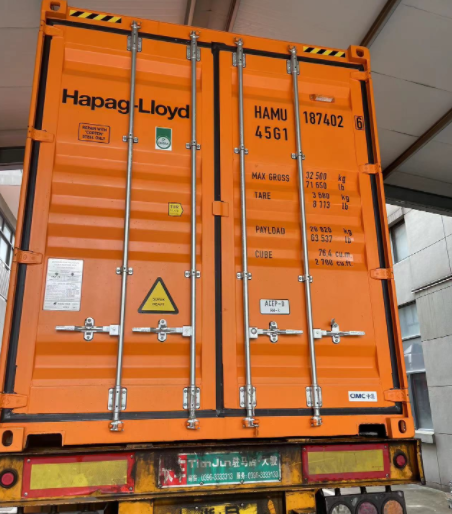
Container shipping costs from China to Panama are the one number every importer wants before booking, and it is also the number most published guides get wrong this year — not because they invent figures, but because they never date them. A 20ft box that was quoted at $2,400 in June 2026 re-priced above $4,000 by the end of October, after two carriers filed a $1,000-per-container increase and the South America index fell 21% in a fortnight. Both numbers are real. Only one of them is bookable today.
This guide is written for Shipping From China to Panama importers who move full containers: it covers what a 20ft, 40ft and 40HQ actually costs this week, why two forwarders can quote the same box at $3,600 and $9,000 without either lying, where the FCL-to-LCL break-even sits now that freight has re-priced, and what Panama’s duty, ITBMS and the Colón Free Zone add before the container leaves the terminal.
Table of Contents
How Much Does Container Shipping from China to Panama Cost in November 2026?
For the week of 2 November 2026, port-to-port ocean freight for a full container from a Chinese base port to Balboa or Colón runs $3,800–4,800 for a 20GP, $5,200–6,400 for a 40GP, $5,400–6,600 for a 40HQ and $7,800–10,500 for a 40ft reefer. LCL is $95–140 per CBM. These are ocean-freight figures including the standard surcharge package, before terminal handling at destination, customs and delivery.
The table below is the one thing this page adds that most shipping rates from china to Panama summaries do not: two columns, so you can see which quote in your inbox is simply older than the market.
| Container | Baseline, Jul–Sep 2026 | Spot, week of 2 Nov 2026 | Change | Typical cargo |
|---|---|---|---|---|
| 20GP | $2,700–3,500 | $3,800–4,800 | +$1,100 | Machinery, tiles, hardware, dense cargo |
| 40GP | $3,600–4,500 | $5,200–6,400 | +$1,600 | Furniture, appliances, general merchandise |
| 40HQ | $3,700–4,700 | $5,400–6,600 | +$1,700 | Bulky light cargo, cartons, e-commerce restock |
| 40ft reefer | $6,200–8,500 | $7,800–10,500 | +$1,600 | Food, chemicals, pharma, temperature-sensitive goods |
| LCL | $85–125/CBM | $95–140/CBM | +$10–15/CBM | Under 15 CBM, test orders, multi-supplier cargo |
Three dated facts sit behind the right-hand column, and they are worth knowing because they explain why the number moved:
- Hapag-Lloyd and CMA CGM both filed a US$1,000-per-container increase from 15 October 2026 on the Far East to Central America, the Caribbean (including Panama), Mexico West and both South American coasts — dry, reefer and out-of-gauge.
- SCFI’s Shanghai to South America base-port rate printed $4,371 per TEU on 30 October 2026, after $5,053 a week earlier — a 13.5% single-week drop that followed an 8.61% drop the week before. The index gives us a dated anchor for what the trade actually pays, not what a blog remembered.
- Drewry’s World Container Index was $4,434 per FEU on 1 October 2026, with Shanghai–Los Angeles at $7,835 and Shanghai–New York at $10,428. Panama lanes sit between the Latin American and transpacific levels, which is exactly where the $3,800–6,600 range above lands.
What that means in practice: the lane peaked in the third quarter, the general rate increase is still in the numbers, and the last two index readings point down. If your quote is dated before mid-October, it is low by roughly $1,000–1,700 per container — and if it is dated this week, ask how long it holds. In a falling market, good quotes are valid for seven days, not thirty.
Why two forwarders quote the same 40ft container at $3,600 and $9,000
Neither quote is necessarily dishonest; they describe different amounts of work. This scope ladder is the single most useful table on this page when you are comparing offers:
| Scope of the quote | 40HQ, Shenzhen → Panama | What is included | Who arranges the rest |
|---|---|---|---|
| Ocean freight only (index basis) | $5,400–6,600 | Sea freight, BAF/CAF, origin THC, BL | You pay destination THC, drayage, duty, ITBMS |
| Port-to-port, all-in | $6,300–7,900 | Above + destination THC, docs, ISPS | You clear customs and truck it |
| Delivered to Panama City warehouse | $6,900–8,700 | Above + drayage, brokerage, delivery | You pay duty and ITBMS on arrival |
| DDP all-in with taxes paid | $6,900–8,700 + duty and ITBMS on your CIF value | Above + duty and ITBMS | Nobody — this is a landed price |
Forwarder tables that publish $7,600–9,400 per container are quoting the bottom two rows on higher-value cargo, while index-based pages publish the top row. When you compare, ask one question: does this number include destination handling and delivery, and are duties in it? That single sentence resolves most of the confusion around Panama container costs. For a mode-by-mode comparison that also covers air and parcel, our all-mode cost guide breaks the same lane down by channel.
20ft vs 40ft vs 40HQ: Which Container Costs Least per CBM to Panama?
Panama importers usually ask for a 20ft because the headline rate looks friendlier, then discover the 40HQ is cheaper per cubic metre by a wide margin. The reason is simple: the fixed part of the bill — documentation, terminal charges, drayage, customs brokerage — barely changes with container size, while usable volume more than doubles.
| Container | Internal volume | Practical load | Spot ocean freight | Cost per CBM (full load) | Best for |
|---|---|---|---|---|---|
| 20GP | 33.2 CBM | 27–29 CBM | $3,800–4,800 | $131–178 | Dense cargo: tiles, machinery, tools, hardware |
| 40GP | 67.7 CBM | 56–58 CBM | $5,200–6,400 | $90–114 | Heavy palletised goods that cube out normally |
| 40HQ | 76.4 CBM | 64–66 CBM | $5,400–6,600 | $82–103 | Cartons, furniture, bulky light cargo |
| 40ft reefer | 67.7 CBM | 52–55 CBM (airflow gap) | $7,800–10,500 | $142–202 | Chilled or frozen cargo, pharma |
| 20ft open top / flat rack | 33.2 CBM footprint | Height, width or weight over limit | Quote per case | — | Machinery, vehicles, oversize units |
Two rules follow from the numbers. First, a 40HQ carries about 2.3× the volume of a 20GP for roughly 1.4× the freight, so a 40HQ becomes the cheaper unit once you are filling more than about 35–40 CBM. Below that, a 20GP or LCL is usually the better buy. Second, a 20GP only makes sense when the cargo is dense — anything over about 900 kg per CBM, where you hit the 28-tonne road limit before you run out of space. Tiles, ceramics, steel fittings and bagged materials are 20GP cargo. Furniture, cartons and plastic goods are 40HQ cargo.
Reefers deserve their own note because this lane moves a steady volume of temperature-controlled cargo: a 40RH carries less cargo than a dry 40ft (the airflow gap costs 5–8 CBM), the plug-in and power charges are billed separately, and reefer equipment is scarce on this lane in the fourth quarter. Book reefer space 4–6 weeks ahead, not two.
FCL Rates by Port Pair: 5 Chinese Ports × Balboa, Colón and Manzanillo
Panama is not one destination port, and the choice inside Panama changes both the rate and the inland leg. On the Pacific side sits Balboa, 90 minutes from Panama City and the natural gateway for domestic distribution. On the Atlantic side sit Colón Container Terminal, Cristóbal and Manzanillo International Terminal (MIT), wrapped around the Colón Free Zone. A container booked to the wrong coast pays for a 60–80 km cross-isthmus transfer it did not need.
| Origin port | 20GP to Balboa | 40HQ to Colón / MIT | Transit to Balboa | Transit to Colón |
|---|---|---|---|---|
| Shenzhen (Shekou / Yantian) | $3,800–4,600 | $5,400–6,500 | 23–29 days | 26–32 days |
| Shanghai | $3,900–4,700 | $5,500–6,600 | 24–30 days | 27–33 days |
| Ningbo-Zhoushan | $4,000–4,800 | $5,600–6,700 | 25–31 days | 28–34 days |
| Guangzhou (Nansha) | $3,900–4,700 | $5,500–6,600 | 24–30 days | 27–33 days |
| Qingdao | $4,100–4,900 | $5,700–6,800 | 27–33 days | 30–36 days |
Shenzhen and Shanghai carry the most weekly capacity and the tightest transit, which is why South China factories shipping through Shekou or Yantian usually get the best rate-to-time combination on this lane. Qingdao is the right origin only when the cargo actually starts in Shandong; moving goods south to save $200 in freight rarely pays for the trucking. For a port-level walk-through of the South China side, see shipping from Shenzhen to Panama and the wider sea freight from China to Panama guide.
Balboa or Colón: how port choice changes cost and transit
| Factor | Balboa (Pacific) | Colón, Cristóbal, MIT (Atlantic) |
|---|---|---|
| Serves | Panama City, interior, David, Chiriquí | Colón Free Zone, Caribbean, re-export |
| Canal transit needed | No — direct Pacific call | Yes on most Asia services, or transshipment |
| Drayage to Panama City | $180–350 | $450–750 (cross-isthmus) |
| Drayage to Colón Free Zone | $450–750 | $80–180 |
| Transit from China | 23–31 days | 26–36 days |
| Best for | Local importers and retailers | Free-zone traders and regional distribution |
The canal touches container costs on this lane in a narrower way than most articles suggest: cargo discharged at Balboa has finished its sea leg and never enters the locks. Only Atlantic-side routings — and any cargo continuing to the US East Coast or the Caribbean — transit. The Panama Canal Authority’s Advisory A-36-2026 of 28 September 2026 set the Neopanamax maximum draft at 14.94 m (49.0 ft) and lifted daily slots to 33 (23 Panamax + 10 Neopanamax), easing the water-saving restrictions in place since the El Niño rainfall deficit. That improves schedule reliability and how heavily a transiting ship can load; it does not change a Balboa-bound booking. Carrier canal surcharges on this corridor (Hapag-Lloyd US$130 per TEU, MSC US$100 per TEU) are filed on Asia–US trades, so if your cargo is Panamanian, confirm in writing whether any canal component is in your quote.
What Do Panama Destination Charges Add to a Container?
Destination charges are a normal part of the cost chain, and every professional forwarder should be able to list them before you book. The table below shows what each line is, why it exists, and how to plan for it.
| Charge | Typical amount (40ft) | What It Is & How to Plan |
|---|---|---|
| Terminal handling (THC) | $180–350 | Charged by the terminal for unloading and stacking. Fixed per container; confirm which terminal, since Balboa and MIT price differently. |
| Documentation / BL release | $50–100 | Carrier paperwork to release the bill of lading. Budget it as a constant. |
| ISPS / security fee | $15–40 | Port security levy passed through by the terminal. Non-negotiable, tiny. |
| Drayage (port → door) | $180–350 Panama City; $450–750 cross-isthmus | Trucking from the terminal. The single line where port choice pays or costs you; decide the port before you book, not after. |
| Customs brokerage | $180–400 per declaration | The licensed broker who files your DUCA declaration. Ask for the fee per shipment, not per container. |
| Cargo insurance | 0.3–0.5% of CIF | Cover from warehouse to warehouse. On a $24,000 CIF container that is $72–120 — the cheapest line on the bill and the one importers most often skip. |
| Free time and storage | 5–7 free days, then $50–120/day | Terminals in Panama give short free time. Plan clearance to start before the vessel berths; the clock is the most expensive thing in this table. |
| CFZ entry handling | $50–150 | Only for cargo entering the Colón Free Zone: gate processing and zone paperwork. Budget one working day. |
A realistic 40HQ Balboa to Panama City landing adds $700–1,400 on top of ocean freight. If your forwarder’s quote stops at the port gate, that number is still coming — it is simply not on their page.
LCL Rates from China to Panama and Where the FCL Break-Even Sits Now
LCL from China to Panama is quoted at $95–140 per CBM this month, on a minimum of 1 CBM, with a typical all-in door-to-door level of $120–185 per CBM once destination CFS handling, documentation and delivery are counted. Transit runs 30–42 days against 23–31 for FCL, because your cargo waits for consolidation at origin and again for de-consolidation at destination.
The break-even is where this lane gets interesting, and where most published tables are out of date. The “13–15 CBM” figure that appears on almost every competitor page was calculated when a 20GP could be booked for $2,000. At today’s rates the arithmetic says something different:
| Cargo volume | LCL at $150/CBM all-in | FCL 20GP at $5,000 all-in | FCL 40HQ at $6,900 all-in | Cheaper option |
|---|---|---|---|---|
| 8 CBM | $1,200 | $5,000 | $6,900 | LCL |
| 15 CBM | $2,250 | $5,000 | $6,900 | LCL |
| 22 CBM | $3,300 | $5,000 | $6,900 | LCL |
| 30 CBM | $4,500 | $5,000 | $6,900 | LCL (close) |
| 33 CBM | $4,950 | $5,000 | $6,900 | Level — 20GP is now full |
| 46 CBM | $6,900 | — | $6,900 | Tie — 40HQ takes over |
| 55 CBM | $8,250 | — | $6,900 | FCL 40HQ |
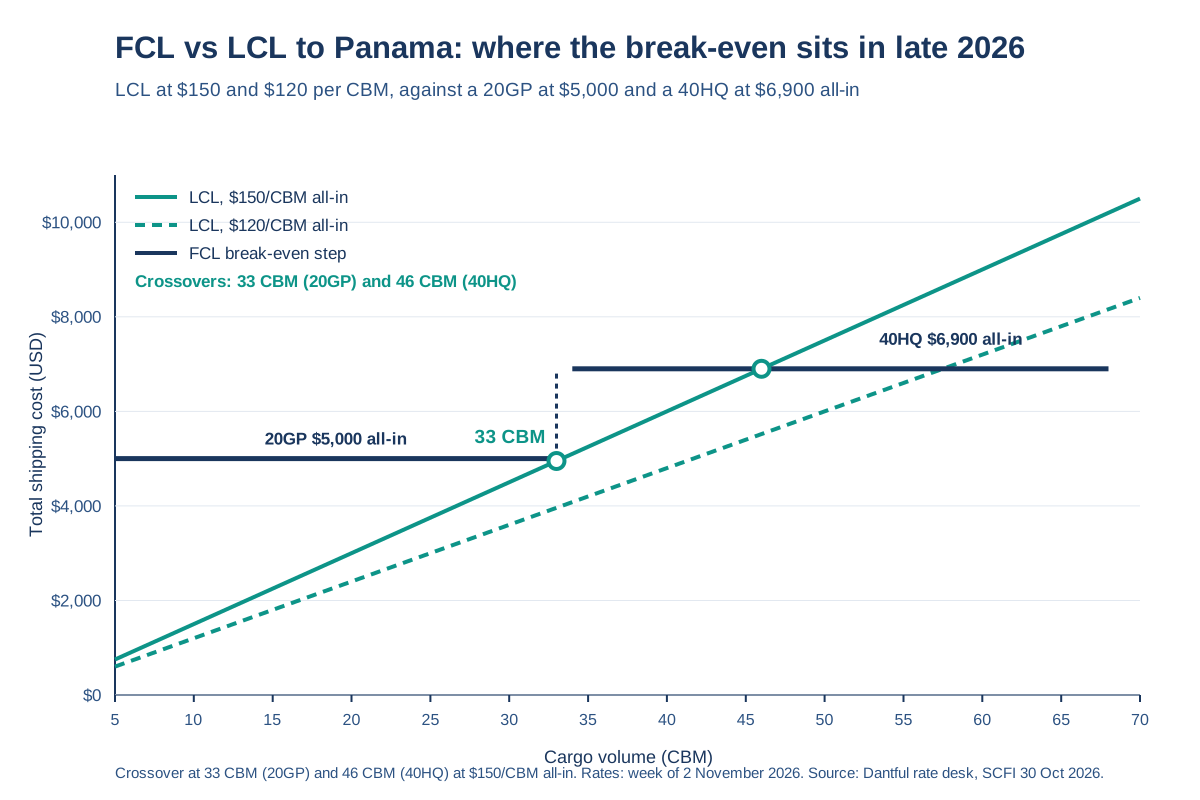
So at $150 per CBM all-in, a 20ft only beats LCL when it is essentially full, and a 40HQ takes over at about 46 CBM. Push the LCL rate to $120 and the crossovers move to 42 CBM and 58 CBM respectively. The practical instruction is not “switch to FCL at 15 CBM” any more — it is price both at 22 CBM and again at 30 CBM, and remember what LCL costs you in ways the quote does not show: 7–10 extra days, more handling per carton, and consolidation damage risk on breakable cargo.
Three volume bands hold up well on this lane:
- Under 10 CBM — LCL, without much debate. Consolidation protects your cash flow.
- 10–30 CBM — genuinely a comparison. Run both, and include destination CFS charges before deciding.
- Over 35 CBM — FCL. A 40HQ leaves 20–30 CBM of room, which is often the cheapest way to plan a second SKU batch.
If you are choosing between the two for mixed small cargo, our guide to LCL vs FCL for small cargo walks through the decision in the same arithmetic.
Panama Import Duty, ITBMS and the Colón Free Zone on a Container
Panama charges two taxes on an import, and both are calculated on the CIF value — goods, insurance and freight — declared to the Autoridad Nacional de Aduanas (ANA). There is no free trade agreement between Panama and China, so Chinese-origin goods pay the general tariff with no preference; the only relief is the WTO Information Technology Agreement, which keeps a share of electronics at zero regardless of origin.
| Cost element | Rate | Base | Notes |
|---|---|---|---|
| Import duty (arancel) | 0–15% | CIF value | Capped at 15% for most goods, agricultural exceptions apply; average bound rate roughly 12% |
| ITBMS (Panama’s VAT) | 7% general; 10% alcohol and hospitality; 15% tobacco | CIF + duty | Medicines, staple foods and certain baby products are exempt |
| ISC (selective excise) | Product-specific | CIF + duty | Applies to liquor, tobacco and a short list of others |
| Vehicles | ~15% up to $15,000 CIF, ~30% above | CIF value | Pure electric vehicles at 0% until 2030 |
| Customs service and brokerage | $180–400 per declaration | Per shipment | Filed by a licensed corredor de aduanas |
Typical duty bands by cargo type, as a planning guide only — the binding rate is the tariff line in ANA’s Arancel Oficial:
| Cargo | Typical duty band | Duty + ITBMS on CIF |
|---|---|---|
| Electronics, IT equipment (ITA lines) | 0–5% | 7–12% |
| Machinery, tools, hardware | 0–5% | 7–12% |
| Furniture, home goods | 10–15% | 18–23% |
| Apparel, footwear, textiles | 10–15% | 18–23% |
| Toys, sporting goods | 10–15% | 18–23% |
| Auto parts, accessories | 5–10% | 12–18% |
A 40HQ of furniture, landed in Panama City
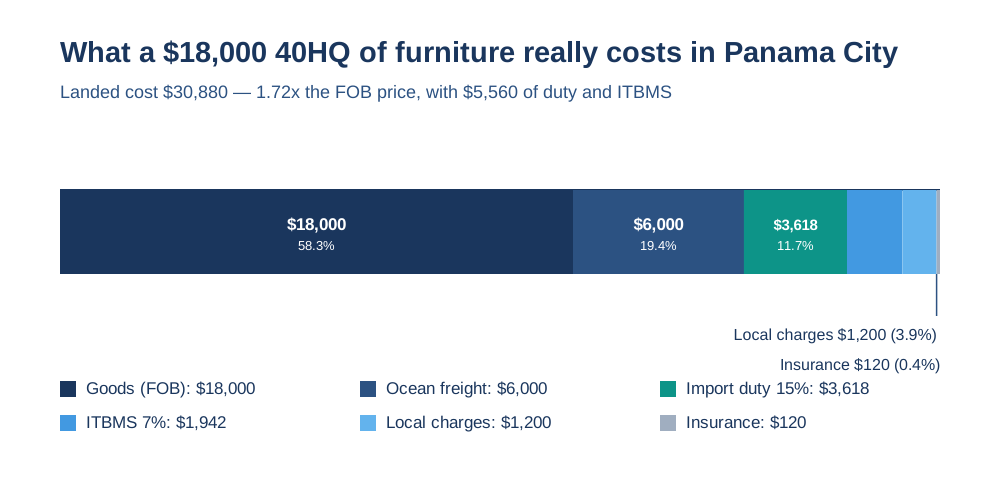
Take a 40HQ of flat-pack furniture from a Foshan supplier: FOB $18,000, ocean freight $6,000, insurance $120. The declared CIF is $24,120. Duty at 15% is $3,618, which puts the ITBMS base at $27,738 and the ITBMS at $1,942. Brokerage $350 and terminal-plus-drayage $850 complete the bill.
| Line | Amount | Share of landed cost |
|---|---|---|
| Goods (FOB) | $18,000 | 58.3% |
| Ocean freight | $6,000 | 19.4% |
| Insurance | $120 | 0.4% |
| Import duty (15%) | $3,618 | 11.7% |
| ITBMS (7%) | $1,942 | 6.3% |
| Brokerage, THC, drayage | $1,200 | 3.9% |
| Total landed cost | $30,880 | 100% |
That is 1.72× the FOB price, with $5,560 — 23% of CIF — going to duty and ITBMS before the container moves. Note the sequencing: duty is paid before release, so you need the cash at arrival even if your customer pays you in 60 days.
The Colón Free Zone changes the calculation, not the paperwork
Goods entering the Zona Libre de Colón for storage, repacking or re-export are exempt from import duty and ITBMS. That exemption is the reason a large share of Chinese consumer goods destined for Colombia, Costa Rica, the Dominican Republic and the wider Caribbean clears through Colón rather than through the destination country directly: you can hold inventory, break bulk and re-invoice without paying Panamanian tax first.
Three conditions decide whether the exemption actually applies:
- The goods must leave the zone. If any part of the shipment is later admitted into Panama’s national customs territory, duty and ITBMS apply at that moment, on the value at entry.
- The declaration must be right. The zone’s efficiency comes from paperwork accuracy: HS code, weights and invoice values must match, or the container sits while it is corrected. In zone cargo, an HS discrepancy costs days, not hours.
- Your broker must handle zone entries. A broker who files national-territory DUCA declarations is not automatically set up for zone movements. Ask before booking.
Clearance itself is filed electronically through ANA’s DUCA declaration on the SIGA platform, by a licensed broker — individual importers cannot self-file. No general import licence is needed: a company with an aviso de operación can import freely, with product-specific permits (sanitary, phytosanitary, DGNTI standards) layered on top for food, pharma and regulated goods. Unlike several markets in the region, Panama does not run a general pre-shipment inspection scheme, which removes one cost line and one delay that Nigeria, Angola or Saudi Arabia importers will recognise.
How Long Does a Container Take from China to Panama?
Transit depends on the coast. Pacific-side Balboa is a direct call from Asia and is the faster option; Atlantic-side Colón and MIT usually add the canal transit on top.
| Route | Service type | Transit time | Frequency |
|---|---|---|---|
| Shenzhen → Balboa | Direct | 23–29 days | Weekly |
| Shanghai → Balboa | Direct | 24–30 days | Weekly |
| Ningbo → Balboa | Direct | 25–31 days | Weekly |
| Guangzhou → Colón | Via canal or transshipment | 27–33 days | Weekly to fortnightly |
| Qingdao → Colón | Via canal or transshipment | 30–36 days | Weekly |
| Shenzhen → Balboa + drayage to David | Direct + 6–8 h truck | 25–31 days | Weekly |
Add 3–5 days if your booking is rolled to the next sailing — a real risk in a falling market, when carriers blank sailings and consolidate loads. For a full breakdown by origin, season and mode, see how long is freight from China to Panama.
When should you book to avoid the expensive weeks?
| Period | Market condition | What to do |
|---|---|---|
| August–October | Peak season; rates 20–40% above the annual floor | Book 4–6 weeks ahead; accept that space, not price, is the constraint |
| 1–7 October | Golden Week factory closures, blank sailings | Avoid quoting during the holiday; confirm the sailing after it |
| Mid-November | Christmas cargo window closes; spot rates soften | Best window to negotiate — quotes valid 7 days are normal |
| Late November 2026 | Carriers’ return to Suez adds effective capacity | Expect further downward pressure; do not lock a long contract at peak levels |
| January 2027 | Pre-Chinese New Year rush | Book by early January; equipment and space tighten fast |
| 6 February 2027 | Chinese New Year | Factories close 2–4 weeks; cargo for March delivery must sail before it |
| May–November | Panama rainy season | Inland trucking to David and interior provinces slows; add 1–2 days |
The single most expensive habit on this lane is booking in the third week of September because a customer needs stock in November. Between the peak surcharge and the space premium, that decision costs more than the duty on a mid-value container.
EXW, FOB, CIF or DDP: Which Incoterm Fits a Panama Container?
| Incoterm | Who books freight | Export clearance | Import clearance and duty | Your total spend | Effort | Best for |
|---|---|---|---|---|---|---|
| EXW | You | You | You | Lowest on paper, highest in practice | Very high | Buyers with a China-based agent already |
| FOB | You | Supplier | You | Freight + destination + duty | High | Importers with a Panama broker and a forwarder |
| CIF | Supplier | Supplier | You | Freight bundled into the goods price | Medium | First shipments, simple cargo |
| DDP | Forwarder | Forwarder | Forwarder (through a Panamanian IOR) | One all-in number | Low | New importers, e-commerce, door delivery |
One Panama-specific warning on DDP: the importer of record must be a party authorised to declare in Panama, so a “DDP from China” arrangement is only workable when a Panamanian registered importer or broker stands behind it — a Chinese factory cannot be your importer of record. Ask who is named on the DUCA before you accept a DDP price; if the answer is vague, the arrangement is not DDP, it is FOB with extra steps. See what DDP actually covers and our door-to-door shipping from China to Panama service for how the model works end to end.
For most established importers on this lane, FOB with a forwarder you appointed gives the best cost control: you see the ocean rate, the destination charges and the duty separately, and you own the booking. CIF is convenient, but it bundles freight into the supplier’s price, which makes the rate invisible just when it is falling fastest — and it is falling right now.
How to Choose a Freight Forwarder for Container Shipping from China to Panama?
This lane has three jobs bundled into one booking: the ocean leg with a carrier that actually serves both Panama coasts, the destination leg where port choice decides your drayage, and the customs filing that decides whether a free-zone container clears in a day or a week. A forwarder who is strong on one and thin on the others will cost you more than the rate difference.
Four checks that only matter on this lane:
- Ask for the scope in writing, line by line. Ocean, destination THC, drayage to your exact address (Panama City, David, or a CFZ warehouse), brokerage and duty. If the quote is one number, ask which of those it excludes.
- Ask which terminal and which coast. Balboa for local distribution, Colón or MIT for free-zone cargo. A forwarder who books without asking where your warehouse is has not looked at your inland cost.
- Ask for quote validity and the GRI date. In a market that fell 21% in two weeks, a 30-day quote protects the forwarder, not you. Seven days is the honest answer.
- Ask how they handle CFZ entries. Zone declarations, HS accuracy and who files them. This is where shipments to Colón quietly lose a week.
Dantful has shipped out of Shenzhen since 2008 as a Class-A licensed forwarder with NVOCC, FMC and Jctrans membership, holds direct contracts with the carriers serving both Panama coasts, and covers the full chain — pickup, export declaration, ocean, destination clearance and delivery — with daily tracking updates and photos at each handover, backed by 50 operations staff and a 50-plus customer service team. You can read more about the company here, compare our freight forwarder service from China to Panama with a shipping agent arrangement if you already work with a broker in Panama City, and use how to choose the right freight forwarder as an independent checklist.
Frequently Asked Questions
How much does it cost to ship a 20ft container from China to Panama?
Between $3,800 and $4,800 for ocean freight in the week of 2 November 2026, port-to-port including standard surcharges. Add $700–1,400 for destination terminal handling, drayage and brokerage, then duty and ITBMS on the CIF value.
How much does a 40ft container cost from China to Panama?
$5,200–6,400 for a 40GP and $5,400–6,600 for a 40HQ at current spot levels, roughly $1,600–1,700 more than the July–September 2026 baseline of $3,600–4,700, following the $1,000-per-container increases filed from 15 October.
Is it cheaper to ship LCL or FCL to Panama?
At today’s rates, LCL at $95–140 per CBM stays competitive up to roughly 28–33 CBM once destination charges are counted, so a 20ft only wins when it is nearly full. A 40HQ becomes the cheaper option above about 46 CBM. Price both at 22 and 30 CBM before deciding.
How long does a container take from China to Panama?
23–31 days to Balboa on a direct Pacific service, and 26–36 days to Colón or Manzanillo when the routing includes the canal transit or a transshipment. Add 3–5 days for a rolled booking and 1–2 days for inland delivery in the rainy season.
What taxes do I pay on a container imported into Panama?
Import duty of 0–15% of the CIF value (agricultural exceptions aside), then ITBMS at 7% on the CIF value plus duty. Alcohol and tobacco carry higher ITBMS and a selective excise. On a $24,120 CIF container of furniture at 15% duty, the two together come to $5,560.
Do I pay duty if the container goes to the Colón Free Zone?
Not at entry, provided the goods are stored, repacked or re-exported within the zone. Duty and ITBMS fall due if any part of the shipment is later admitted into Panama’s national customs territory, calculated on the value at that point.
Should I ship to Balboa or Colón?
Balboa if the cargo stays in Panama — it is a direct Pacific call with no canal transit and cheaper drayage to Panama City. Colón, Cristóbal or MIT if the cargo enters the Colón Free Zone or is re-exported to the Caribbean and South America.
Does the Panama Canal drought affect container costs to Panama?
Only for routings that transit the locks. The Canal Authority eased restrictions on 28 September 2026 under Advisory A-36-2026, restoring 14.94 m (49.0 ft) Neopanamax draft and 33 daily slots, which helps schedule reliability. Cargo discharged at Balboa never transits, so canal surcharges filed on Asia–US trades do not normally apply to Panamanian imports.

Young Chiu is a seasoned logistics expert with over 15 years of experience in international freight forwarding and supply chain management. As CEO of Dantful International Logistics, Young is dedicated to providing valuable insights and practical advice to businesses navigating the complexities of global shipping.